

Someone in Dallas may arrive at treatment exhausted, ashamed, and unsure whether group therapy will make recovery easier or expose private pain to strangers. A person may be entering detox for alcohol, opioids, fentanyl, heroin, cocaine, methamphetamine, or prescription medications while also coping with depression, anxiety, bipolar disorder, or trauma. The thought of sitting in a circle and speaking openly can feel harder than making the first call.
That fear deserves respect, not dismissal. Group therapy benefits come from a structured clinical environment, not from putting people in a room and hoping conversation solves everything. The facilitator, treatment plan, peer feedback, individual therapy, and medication-assisted treatment, or MAT, all matter. The sections below explain what a first group may feel like, what the research supports, where group work has limits, and how it can fit into addiction treatment in Dallas and the surrounding Dallas-Fort Worth area.
Table of Contents
- Walking Into Your First Group Session
- What Group Therapy Actually Looks Like
- What the Research Says About Outcomes
- Common Group Formats in Detox and Rehab
- How Group Therapy Fits With MAT and Individual Therapy
- Who Benefits Most and the Honest Limitations
- Taking the Next Step in Dallas-Fort Worth
- Questions Families Ask and a Final Word
Walking Into Your First Group Session
On the second day of detox, a patient may still be dealing with poor sleep, physical discomfort, irritability, or anxiety. A staff member mentions the afternoon recovery group, and the patient pauses at the doorway. The questions come quickly: What if someone asks for details? What if the room judges them? What if emotion takes over?
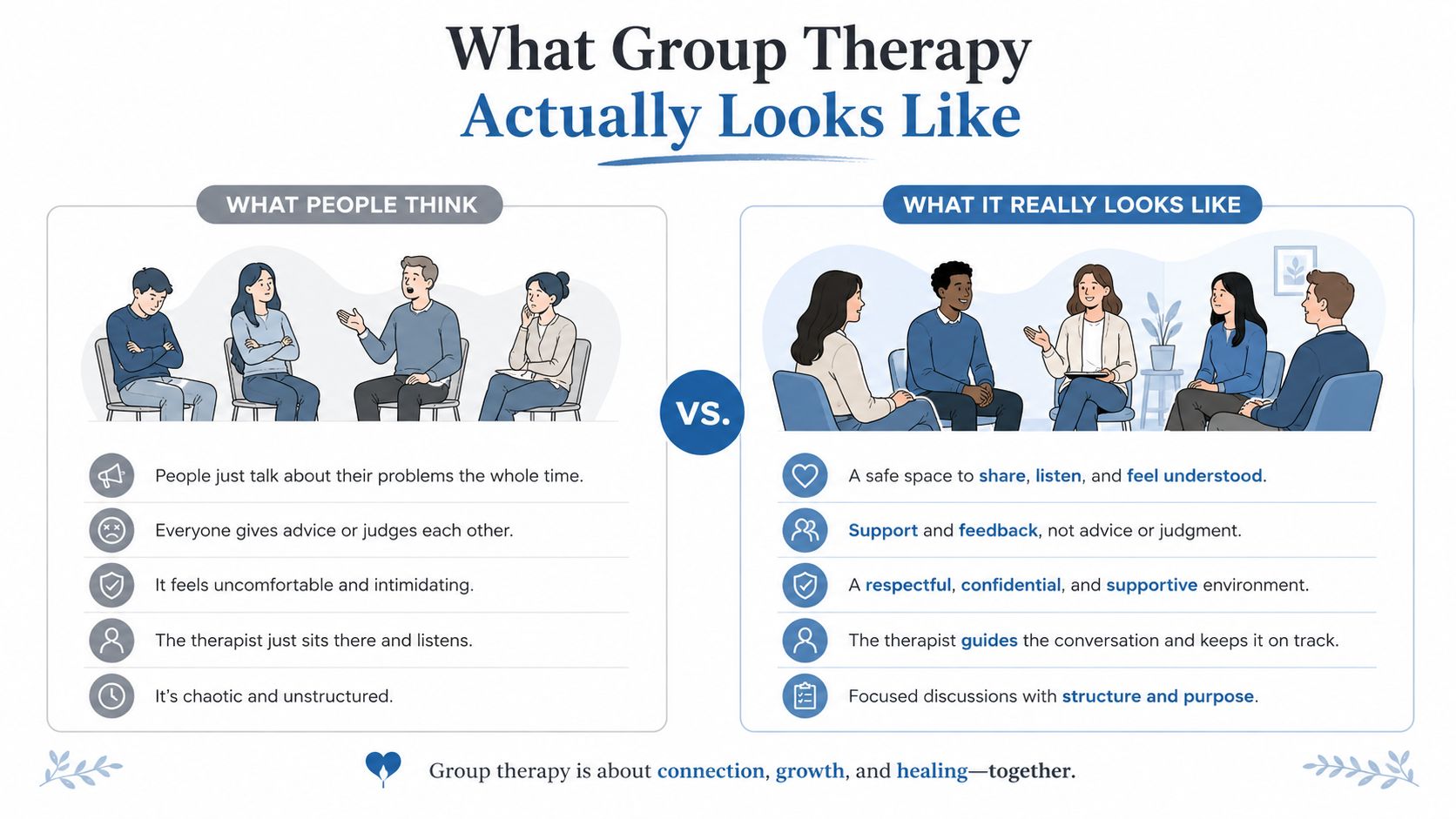
The room usually looks less intimidating than expected. Chairs are arranged in a circle rather than in rows. A clinician sits with the group, often with a worksheet, topic outline, or skills exercise ready. Before discussion begins, the facilitator reviews a printed ground-rules sheet that covers respect, privacy, listening, and the right to pass. A participant can often say, “Pass,” when a question feels too personal or when the person isn't ready to speak.
Early fears are common and specific:
- Saying too much: Participants don't need to give a complete life history during an opening check-in.
- Being judged: The facilitator redirects criticism, interruptions, or advice that crosses a boundary.
- Breaking down: Tears aren't treated as failure. The clinician can slow the pace, offer grounding, and decide whether additional support is needed.
- Not knowing what to say: A structured prompt gives each person a manageable way to participate.
A skilled facilitator protects the group with time limits and predictable turns. The opening may ask each patient to name a feeling, a craving, or one recovery goal. The discussion then moves to a defined topic, such as identifying triggers or practicing a response to an urge. The session closes with a brief share about what each person is taking away.
Practical rule: A first group doesn't require dramatic disclosure. Safe participation can begin with listening, answering one short question, and noticing how the room responds.
Group therapy has a long history in modern psychotherapy. Joseph Pratt began what is widely described as the first group psychotherapy work in 1905 with patients who had tuberculosis in Boston, and group treatment expanded during World War II as understaffed military hospitals in the United States and England treated large numbers of psychiatric casualties. The community mental health movement accelerated adoption by the early 1960s, helping group therapy become a standard treatment format. The historical development of group psychotherapy is summarized by PubMed.
The practical questions are straightforward. What happens during a typical session? How does group work differ from individual therapy? Which outcomes have researchers measured, and how does a group fit alongside MAT and private clinical care?
What Group Therapy Actually Looks Like
A typical addiction treatment group is a facilitated, time-limited, goal-directed session. A closed cohort may include 6 to 12 patients, meeting two to five times weekly with one or two trained facilitators. Sessions commonly last 60 to 90 minutes, although schedules vary by level of care and clinical need.
A session may follow this sequence:
- Opening check-in: Each participant briefly identifies a current mood, craving, challenge, or recovery goal.
- Topic or skill module: The clinician teaches a defined concept, such as urge surfing, thought checking, communication, or relapse planning.
- Practice or processing: Members apply the skill to a realistic situation, discuss barriers, or reflect on a recent experience.
- Closing share: Each participant names a takeaway, next step, or support need.
This structure helps patients distinguish therapy from an unplanned discussion. Group treatment isn't a rap session, a debate, or a requirement to reveal every private experience. The facilitator keeps the conversation connected to treatment goals and watches for safety concerns.
Group and individual therapy serve different purposes
| Area | Group therapy | Individual therapy |
|---|---|---|
| Participants | Several patients and a clinician | One patient and a clinician |
| Main focus | Skills, practice, feedback, and shared recovery work | Personal formulation, private history, and individualized goals |
| Interaction | Peer responses create opportunities to listen and respond | The patient receives sustained individual attention |
| Efficiency | One clinician can support several patients within a shared format | Care is concentrated on one person |
| Social learning | Patients practice boundaries and communication with others | The patient can explore material without a peer audience |
Neither format automatically replaces the other. A patient may learn a coping skill in group, examine its personal meaning in individual therapy, and practice it again when another group member describes a trigger. For emotion regulation skills that often appear in addiction and dual-diagnosis care, a resource on DBT for emotion regulation can provide additional plain-language context.
Group sessions also expose patients to ordinary interpersonal moments, such as disagreement, silence, feedback, or the urge to withdraw. That exposure can be useful when a person is rebuilding sober relationships, but the clinician should keep it contained and purposeful. Patients looking for concrete activities can review relapse prevention activities for groups as examples of how structured practice can support recovery planning.
What the Research Says About Outcomes
The strongest evidence doesn't support a promise that every patient will respond the same way. It supports a narrower and more useful conclusion: group therapy can produce clinically meaningful benefits across several conditions, especially when the group has a clear method, trained facilitation, and a defined treatment goal.
A broad NIH and NCBI summary reports that group therapy is as effective as individual psychotherapy across diagnoses, which may make it more cost-effective and easier to extend to underserved populations. In a depression meta-analysis, 45 of 48 studies concluded that group psychotherapy was effective, while 43 of 46 studies with adequate data found a significant reduction in depression. Compared with no treatment, the pooled post-treatment effect size was 1.026, and it remained strong at follow-up at 1.178. The NCBI clinical summary reviews these findings.
Substance use outcomes require more careful interpretation. A 2019 systematic review and meta-analysis of 33 randomized-controlled trials found small but significant abstinence effects for group therapy compared with no treatment, individual therapy, and other treatments. The same evidence indicates that effects on substance-use frequency and substance-use disorder symptoms weren't statistically significant, so group therapy may be most useful as an adjunct that reinforces abstinence behavior and retention rather than as a stand-alone solution. The PubMed record describes the substance use disorder meta-analysis.
| Study or source | Population | Group modality | Key outcome | Effect size |
|---|---|---|---|---|
| Depression meta-analysis summarized by NCBI | Adults with depression | Group psychotherapy | Significant symptom reduction in most studies with adequate data | 1.026 post-treatment and 1.178 at follow-up, compared with no treatment |
| 2019 systematic review and meta-analysis | Adults with substance use disorders | Group treatment across randomized trials | Small abstinence gains; no statistically significant effect on use frequency or symptoms | Small effects on abstinence |
| Anxiety disorders meta-analysis | Adults with anxiety disorders | Group psychotherapy | Large advantage over no-treatment controls and smaller advantage over nonspecific treatments | g = 0.92, 95% CI 0.81–1.03 versus no treatment; g = 0.29, 95% CI 0.10–0.48 versus nonspecific treatments |
| Mood disorders meta-analysis | People with depression or bipolar disorder | Group psychotherapy | Better outcomes than waitlist and treatment as usual; depression outcomes comparable to medication | Quantitative effect not stated in the verified summary |
For anxiety disorders, the evidence is stronger than a general claim that group work is “helpful.” A meta-analysis found a large reduction versus no-treatment controls, with g = 0.92, and a smaller but significant advantage over treatments containing common nonspecific factors, with g = 0.29. A separate mood-disorder meta-analysis found group therapy superior to waitlist and treatment as usual for depression and bipolar disorder, with depression outcomes comparable to medication. The anxiety and mood disorder findings are indexed by PubMed.
Group therapy is strongest when it gives patients something specific to practice, while individual care and medical treatment address needs the group can't safely hold.
Alcohol relapse-prevention groups may also outperform standard outpatient follow-up in some settings. One PubMed-indexed study reported a significant 12-month difference in abstinence and relapse rates, with chi-square = 7.95 and p = 0.019. The study's findings are available through PubMed. Another controlled field trial found no significant difference between group and individual cognitive-behavioral treatment on alcohol or drug outcomes, while social support from friends favored the group format; follow-up was 74%. The controlled trial is indexed by PubMed.
Common Group Formats in Detox and Rehab
Patients often encounter several group formats during detox, residential treatment, and step-down care. Each one answers a different clinical need. A patient who is too physically unstable for deep processing may benefit from short psychoeducation, while someone preparing to return to work or family life may need rehearsal, feedback, and a detailed relapse-prevention plan.
| Format | Primary purpose | Typical size / length | Facilitator | Member activities | Best stage of care |
|---|---|---|---|---|---|
| Cognitive-behavioral skills | Identify thoughts, emotions, and actions that reinforce substance use | Small to medium group, scheduled clinical session | Licensed therapist or trained clinician | Complete thought records, challenge high-risk beliefs, rehearse coping responses | Early residential care and step-down IOP |
| Psychoeducation | Explain withdrawal, cravings, the reward system, and recovery planning | Education-focused group, usually within the program schedule | Clinician, nurse, or qualified educator | Ask questions, review handouts, connect information to symptoms | Acute detox stabilization and early residential care |
| Relapse prevention | Recognize triggers and create responses before a high-risk event | Structured group with a defined worksheet or plan | Addiction counselor or therapist | Map triggers, identify supports, practice refusal and exit plans | Early residential care through IOP |
| Process-oriented interpersonal work | Explore current emotions and relationship patterns | Clinically managed group, length set by program | Licensed therapist | Share a current challenge, listen, receive feedback, practice boundaries | Residential care when medically and emotionally stable |
| Family or multi-family work | Improve communication and reduce patterns that undermine recovery | Family group with participating relatives | Family therapist or qualified clinician | Set boundaries, learn supportive language, plan aftercare roles | Residential care and discharge planning |
| Twelve-Step Facilitation | Connect recovery principles with ongoing peer support | Meeting-style format within the treatment schedule | Trained facilitator or counselor | Discuss recovery readings, identify support needs, plan meeting participation | Residential care and continuing care |
| Dual-diagnosis track | Treat substance use alongside mood, anxiety, trauma, or other mental health symptoms | Integrated groups adjusted to patient stability | Clinician trained in co-occurring disorders | Practice coping skills while tracking psychiatric symptoms and cravings | Across levels of care, with adjustments during detox |
Programs may sequence these groups so the week moves from stabilization to education, practice, processing, and discharge preparation. A patient might start with brief check-ins and information during acute detox, then add CBT and relapse prevention as concentration improves. Family work and community-support planning often become more prominent before residential discharge or an IOP transition.
Language access also affects participation. Patients and families considering language-accessible recovery support should ask whether the program can explain rules, medication plans, group expectations, and discharge instructions in a language the patient understands. A patient can't make full use of peer learning if the format itself creates a communication barrier.
How Group Therapy Fits With MAT and Individual Therapy
Group therapy, individual therapy, and MAT work best as one coordinated treatment plan, not as competing services. Group gives patients repeated opportunities to practice coping skills and receive accountability. Individual therapy provides privacy for trauma, grief, family conflict, or a personalized understanding of why substance use developed. MAT can stabilize symptoms related to certain substance use disorders so the patient has a better chance to engage in both forms of therapy.
A Dallas-area dual-diagnosis program might organize a week around several layers of care:
- Medical contact: A patient attends MAT check-ins, reports symptoms or cravings, and receives medication monitoring when clinically appropriate.
- Group practice: CBT, relapse prevention, and process groups address skills, behavior patterns, and interpersonal reactions.
- Private clinical work: An individual session focuses on trauma, depression, anxiety, bipolar symptoms, or another issue that requires sustained attention.
- Psychiatry follow-up: The treatment team reviews psychiatric symptoms, medication response, sleep, safety, and coordination with the broader plan.
- Recovery connection: Evening peer-support meetings help the patient practice ongoing community involvement.
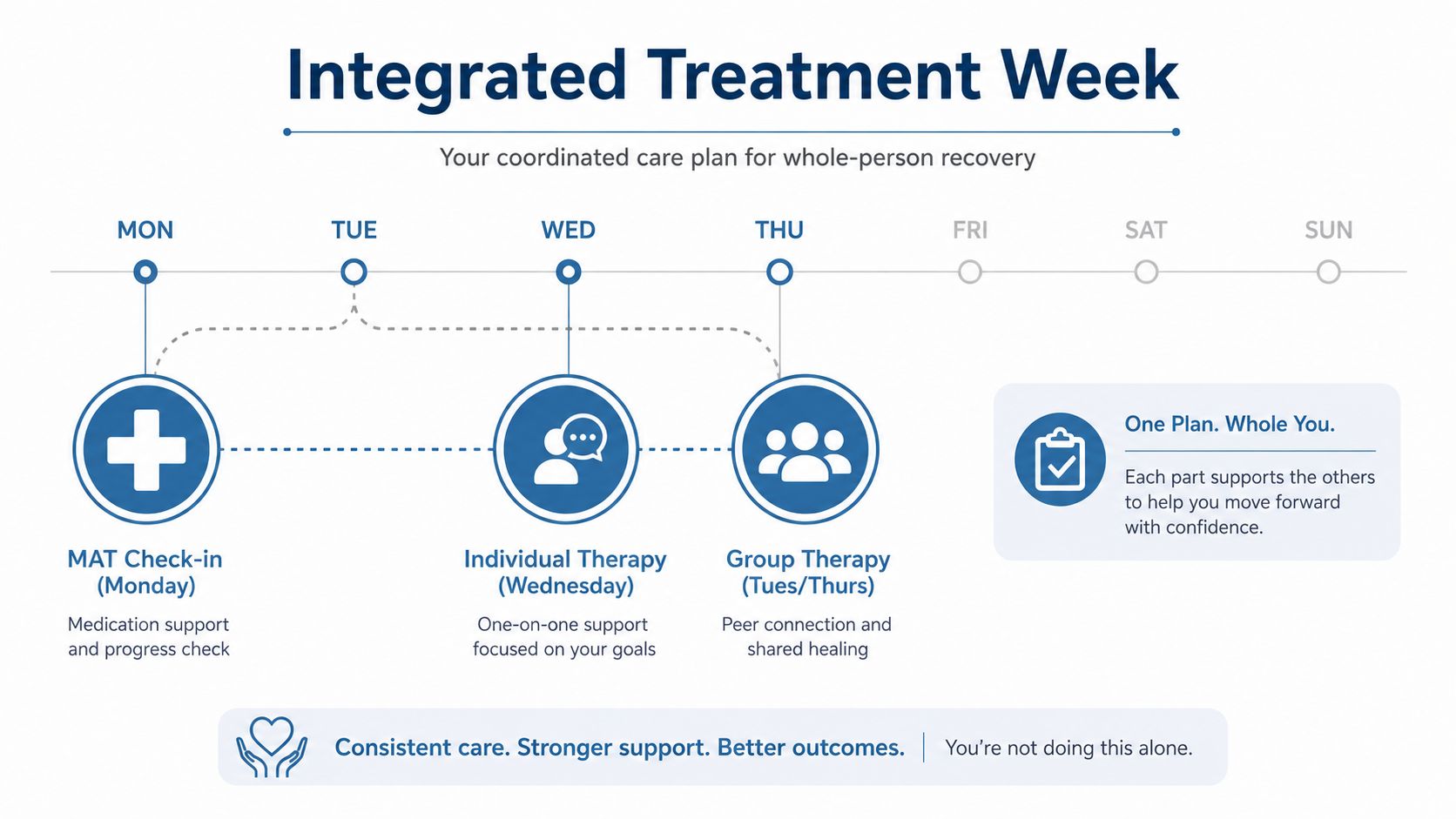
The combination matters because each layer solves a different problem. A patient may learn to challenge an all-or-nothing thought in CBT group, discuss the personal origin of that belief in individual therapy, and use MAT support to remain medically stable enough to practice the skill. A standard substance-use track may concentrate on cravings, triggers, and abstinence planning, while a dual-diagnosis track adds mood monitoring, trauma-informed pacing, psychiatric follow-up, and safety planning.
For a plain-language explanation of how medication can be incorporated into a broader recovery plan, patients and families can review what medication-assisted treatment involves. The appropriate medication, if any, depends on the substance involved, medical history, current symptoms, and the prescribing clinician's assessment.
Who Benefits Most and the Honest Limitations
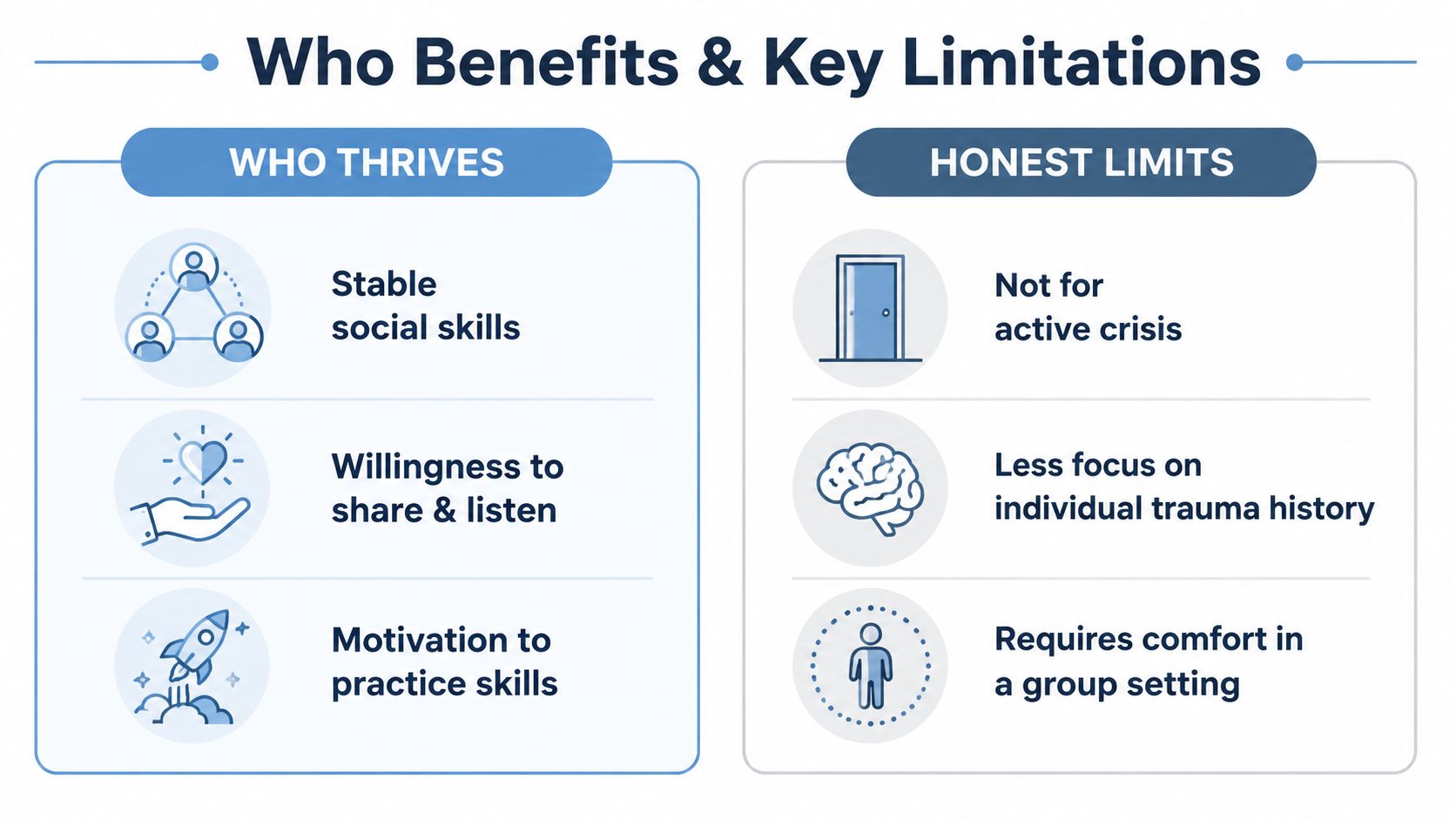
Group therapy isn't automatically right for every patient at every point in recovery. People who tend to gain the most often have enough stability to listen, tolerate ordinary disagreement, and practice skills between sessions. They don't need to be outgoing. A quiet patient can benefit by observing carefully, speaking briefly, and gradually testing new communication habits.
Strong fits often include people who are:
- Rebuilding sober networks: Peer contact can challenge isolation and offer examples of recovery behavior.
- Managing mood or anxiety symptoms: Structured interaction can support coping practice alongside psychiatric care.
- Ready to rehearse change: Patients who try a skill outside group can return with useful questions and real feedback.
- Able to respect boundaries: Listening, avoiding interruptions, and protecting privacy help create safety for everyone.
The limits are just as important. Group therapy isn't a substitute for individual trauma processing, especially when a patient needs privacy and a slower pace. Severe paranoia or active psychosis can undermine group safety and may require stabilization before participation. A poor facilitator can amplify shame, allow one person to dominate, or overlook harmful interactions. Personality clashes happen, too.
A patient who finds group unhelpful shouldn't have to choose between enduring it and leaving treatment. The person can request a different cohort, ask for a brief one-to-one debrief with a clinician, or bring the concern to the treatment team. The facilitator may need to adjust the topic, seating, participation expectations, or level of care.
Research on cohesion helps explain why the facilitator and group climate matter. A meta-analysis of 55 studies found a statistically significant weighted correlation of r = .26 between group cohesion and treatment outcome, described by the authors as a moderate effect size of d = .56. The cohesion meta-analysis is indexed by PubMed. Connection isn't a substitute for clinical skill, but a respectful group can make practice and accountability more meaningful.
Taking the Next Step in Dallas-Fort Worth
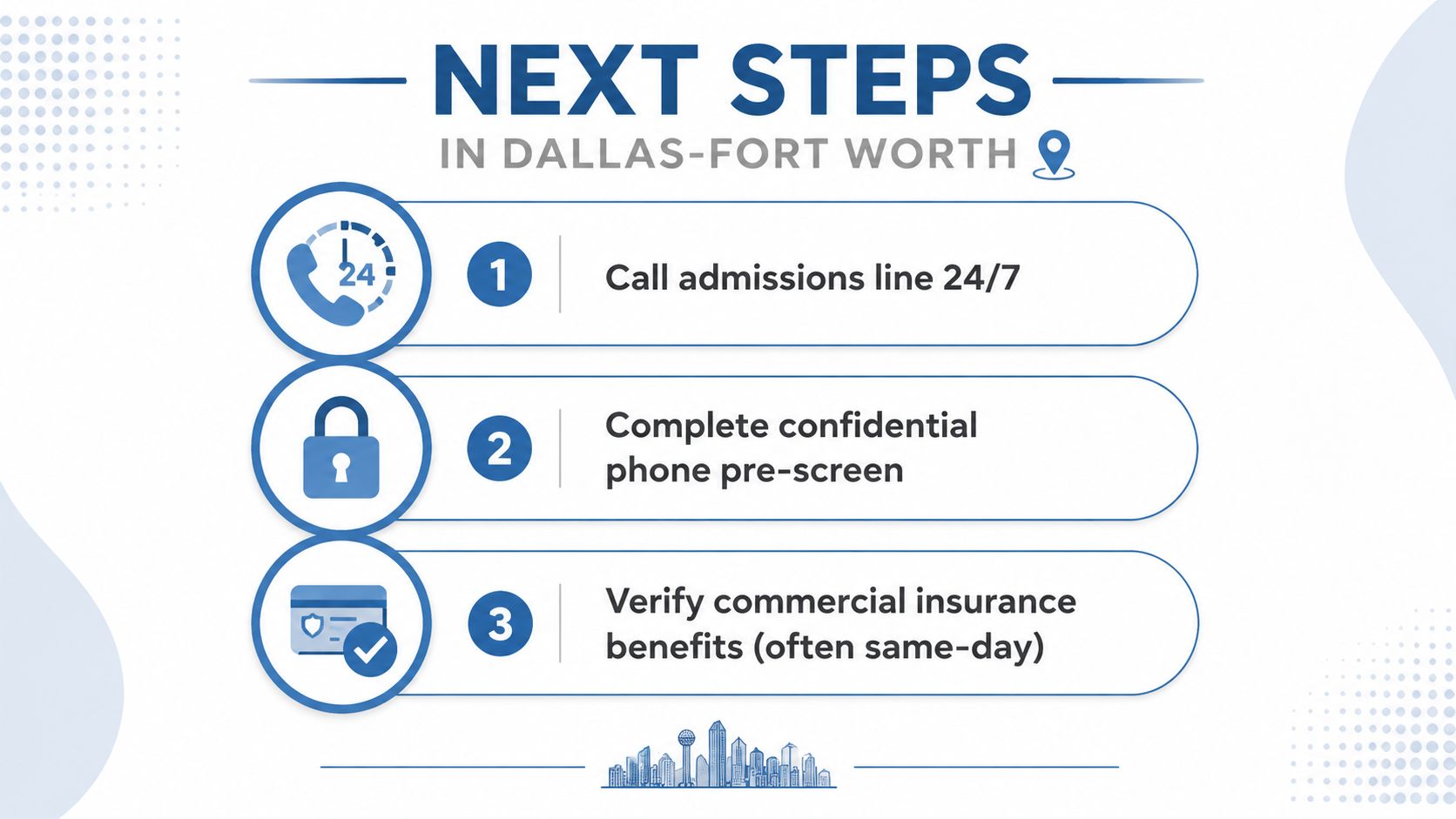
Seeking treatment can feel complicated when someone is already in withdrawal or a family is trying to act quickly. A clear admissions process reduces avoidable friction. Dallas-Fort Worth residents can begin by calling a Tru Dallas Detox admissions line 24/7, completing a confidential phone pre-screen, and asking the admissions team to coordinate medically supervised detox admission into a Dallas residential program when that level of care is appropriate.
Insurance questions should be answered before admission whenever possible. A family member or patient can ask the admissions team to verify:
- Network status: Whether the facility and relevant clinicians are in network.
- Level-of-care benefits: Whether coverage applies to residential treatment, IOP, or both.
- MAT coverage: Whether medication visits and prescribed treatment are included.
- Dual-diagnosis coverage: Whether co-occurring mental health services are covered.
- Financial responsibility: The deductible and estimated out-of-pocket amount.
- Authorization rules: Whether prior authorization or continued-stay review is required.
Commercial PPO plans such as BCBS, Aetna, Cigna, and United may be checked during the verification process, with typical same-day verification when the necessary insurance information is available. Coverage still depends on the specific plan, clinical criteria, authorization, and benefits, so a verification result shouldn't be treated as a guarantee of payment.
Planning for arrival
Patients may need transportation help from neighborhoods across Dallas, Fort Worth, Irving, Arlington, Plano, Frisco, Garland, Richardson, or nearby communities. The admissions team can explain available transportation options, arrival timing, required identification, medication information, and what belongings are permitted.
Families should ask what to bring, what to leave at home, how medications are reviewed, and when visitation begins. Tru Dallas Detox & Recovery Center offers medically supervised detox, residential care, help finding outpatient options, MAT, individual therapy, group counseling, dual-diagnosis services, and aftercare planning from its Euless facility. The most useful first call is the one that answers the immediate safety, clinical, transportation, and insurance questions without requiring a patient to solve everything alone.
Questions Families Ask and a Final Word
Is group therapy confidential? The clinician should explain privacy expectations before participation begins. Group members are expected to protect one another's stories, but no program can guarantee what another participant may say outside the room. A responsible facilitator reviews this limit directly instead of promising absolute confidentiality.
How is a loved one with depression or PTSD protected? The treatment team should screen for psychiatric symptoms, assess safety, and decide whether the patient is stable enough for a particular group. A dual-diagnosis program can adjust topics, pacing, participation expectations, and individual support while coordinating psychiatric care. Private trauma material doesn't have to be processed in front of peers.
What happens if someone relapses during treatment? The clinical team should respond with assessment rather than humiliation. Staff may evaluate intoxication, withdrawal risk, medication needs, access to substances, safety concerns, and whether the current level of care remains appropriate. The group may discuss recovery impact in a way that protects the person's privacy and avoids turning the event into a public punishment.
How can family members participate? Multi-family groups can teach relatives how to communicate supportively, set boundaries, recognize warning signs, and prepare for discharge. Families can also ask for guidance on how to help a family member with addiction while respecting the patient's clinical privacy.
A clinician evaluating a program should look beyond the presence of group sessions on a schedule. The important questions concern integration: Is group therapy coordinated with individual treatment? Can the program address depression, anxiety, bipolar disorder, or trauma? Is MAT available when clinically indicated? Does the discharge plan connect the patient with continuing therapy, sober support, medication follow-up, and relapse-prevention resources?
Group therapy can offer connection, practice, feedback, and accountability. It works best when a trained team places those benefits inside a personalized plan rather than presenting group work as a complete treatment by itself.
Tru Dallas Detox & Recovery Center offers medically supervised detox, residential treatment, help finding outpatient options, MAT, individual therapy, group counseling, dual-diagnosis care, and continuing recovery planning for Dallas-Fort Worth adults. Families and patients can visit Tru Dallas Detox & Recovery Center to request confidential guidance, verify insurance benefits, and discuss the safest next step.
