
The hardest part of detox often isn't the first day. It's the quiet moment when the discharge date gets real, the room feels less protected, and a family starts wondering what happens when the schedule stops and ordinary life starts again. In Dallas, that question matters just as much as the treatment itself, because recovery has to survive traffic, work stress, neighborhood triggers, family pressure, and the ordinary routines that used to lead straight back to use.
That's where alumni programs come in. In recovery, they work like a bridge after the clinical bridge has already done its job. Detox helps steady the body. Alumni support helps steady the person who has to live the next month, the next season, and the next hard conversation without the structure of around-the-clock care.
Table of Contents
- What Alumni Programs Mean in Recovery
- Why Aftercare Continuity Matters More Than Detox Alone
- Core Services a Strong Recovery Alumni Program Offers
- Real Scenarios From Alumni Engagement
- Measurable Outcomes That Show Alumni Programs Work
- How Tru Dallas Supports Alumni in the Dallas-Fort-Worth Area
- Common Misconceptions About Recovery Alumni Programs
- How to Join and What to Expect Next
What Alumni Programs Mean in Recovery
When treatment ends, families often expect relief to feel immediate. Instead, the first days after discharge can feel like standing at the edge of a pool after weeks of being held up by rails, schedules, and daily clinical contact. Recovery alumni programs exist to keep support from dropping off at that exact moment.
They are not the same as university alumni groups or corporate alumni communities. Those models connect former members for networking, pride, or career value. Recovery alumni programs do something more protective. They keep people tied to people who understand relapse risk, early recovery stress, and the need for structured support after detox or residential care.
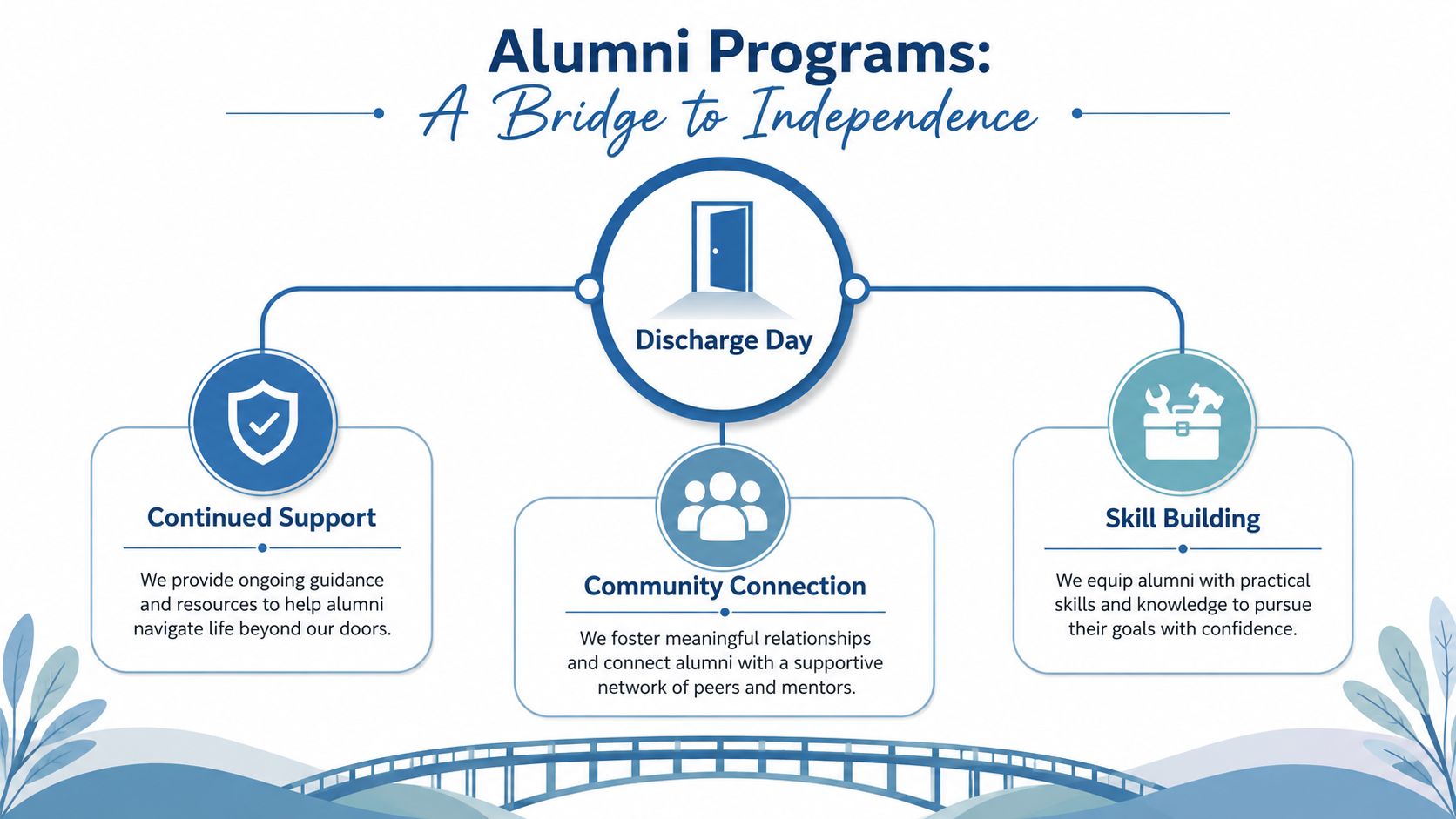
A safety net that stays in place
A good way to think about an alumni program is a safety net woven by people who have already walked the same road. The net is not there to keep someone dependent forever. It's there to catch the wobble that often happens when treatment structure fades and real-life pressure returns.
Practical rule: if a program only helps while someone is inside the building, it's not a continuation of care. It's just a finish line.
That is why recovery alumni programs are usually built around ongoing contact, peer encouragement, and practical guidance. They serve people after discharge, but they also help families, because loved ones often need a clear place to turn once the clinical team steps back.
For families in Dallas, that matters in a very ordinary way. Someone may leave a Dallas detox center with strong intentions, then face a weekend in Oak Cliff, a work dinner in Uptown, or a stressful commute home through North Dallas. Alumni support helps keep the recovery plan active in those real settings. The structure matters because life does not pause after treatment.
A useful local starting point for many people is the aftercare overview at Tru Dallas Detox's aftercare page, which shows how discharge planning can stay connected to care instead of becoming a handoff with no follow-up.
Why Aftercare Continuity Matters More Than Detox Alone
Detox clears the body and helps a person get medically stable. It does not teach someone how to handle a tense text from a family member, a lonely Friday night, or the first holiday where alcohol is everywhere. That gap is exactly where aftercare continuity becomes protective.
A recovery plan that stops at detox is like teaching someone to float, then sending them into open water without a rope. The body may be stable, but the nervous system, habits, and triggers are still active. Alumni engagement keeps people from feeling like they have been dropped from a supervised setting into daily life with no buffer.
Structure replaces the missing rails
In early recovery, routine matters because it gives shape to uncertain days. Alumni programs help replace the rails that inpatient care provided with check-ins, mentor contact, and a predictable reason to stay honest. That matters for people moving back through Dallas neighborhoods where daily stressors don't slow down for recovery.
The emotional side matters too. Shame grows in isolation. So does rationalizing a return to use. When someone has a place to report a bad day before it becomes a bad decision, the recovery process gets more breathable.
Recovery is rarely lost in one dramatic moment. It usually frays when no one is watching and the person feels alone with it.
Families often notice the difference first. A person who stays connected tends to talk more openly, ask for help earlier, and use the plan instead of improvising in a crisis. That does not make the road easy. It makes the road visible.
Alumni continuity also helps people move from “I completed treatment” to “I'm still practicing recovery.” That shift sounds small, but it changes expectations. Completion is a moment. Maintenance is a skill. Alumni programs help build the skill.
Core Services a Strong Recovery Alumni Program Offers
A strong alumni program is built from ordinary, repeatable supports, not one big event. That matters because recovery tends to get tested on ordinary days, not only on special occasions. The best programs make participation feel practical, not ceremonial.
What participation can look like week to week
Some people need a quick phone check-in after a hard work week. Others need a peer mentor to talk through a wedding, a business trip, or a family conflict. A strong program gives room for both without turning support into a hassle.
- Regular meetups: These give people a place to reconnect, share what's changed, and remember they're not the only ones managing recovery in the world.
- Peer mentoring pairings: A newer alum can talk with someone who has already handled the same early-recovery stress, which makes advice feel grounded rather than abstract.
- Relapse-prevention planning sessions: These help people rehearse what to do before risk shows up, not after.
- Sober living referrals: For someone who needs more stability after discharge, this can be the difference between a shaky transition and a safer one.
- Ongoing group therapy or recovery groups: These keep the person anchored to accountability and honest conversation.
- Family education events: Loved ones often need a translation layer for what recovery really requires.
- Milestone celebrations: Small wins matter because they remind people that progress is real even when it feels slow.
The point is not to add busywork. The point is to give people different doors into support. A parent may need one kind of support in the morning, while a young professional may need another after work. Good alumni programming meets those realities without forcing every person into the same lane.
| Alumni Service | What It Replaces After Discharge |
|---|---|
| Regular meetups | The daily contact that inpatient care once provided |
| Peer mentoring | The immediate guidance that a clinical team used to supply |
| Relapse-prevention planning | Guessing what to do when cravings or stress hit |
| Sober living referrals | Trying to stabilize at home before the person is ready |
| Family education | Confusion, mixed messages, and unintended enabling |
For readers comparing recovery supports, a useful companion resource is this relapse-prevention guide, which fits naturally with the planning side of alumni care.
A simple example helps. A Saturday morning hike at White Rock Lake can be more than exercise. It can be a low-pressure way for an alum to reconnect without the intensity of a formal session. A virtual check-in during a high-stress work week can serve the same purpose without requiring a long drive or a perfect schedule.
Real Scenarios From Alumni Engagement
The value of alumni support gets clearer when the situations stop being abstract. Recovery rarely collapses because someone forgot the theory. It wobbles when a real day gets complicated.
A work trip with alcohol everywhere
A young professional in Dallas gets invited to a business trip where drinks are part of the evening agenda. The trip sounds manageable until the room service menu, the social pressure, and the late-night loneliness start stacking up. A peer mentor helps that person plan specific exits, scripts, and check-ins before the trip begins.
The takeaway is simple. Preparation beats improvisation when the environment is risky.
A parent carrying family stress
A parent in early recovery may be trying to show up for children, manage bills, and keep the household calm while still feeling emotionally raw. Family members can care and still not know how to respond in a way that lowers stress. Alumni group sessions give that parent a sounding board, and the room usually understands the difference between advice and real support.
Here, the most useful part is often the permission to be honest without having to protect everyone else's feelings. That kind of honesty is hard to get at home.
A relapse that doesn't become a disappearance
Someone slips, feels ashamed, and wants to hide. That hiding instinct is dangerous because isolation can turn a lapse into a longer return to use. An alum who already has contacts in place can reach back into the program instead of disappearing.
For people in that situation, the fastest path back is not perfection. It's contact.
If the goal is to find a recovery rhythm that includes community, the local listing for NA meetings in Dallas can help people see how outside support and alumni follow-up can work together without replacing one another.

Measurable Outcomes That Show Alumni Programs Work
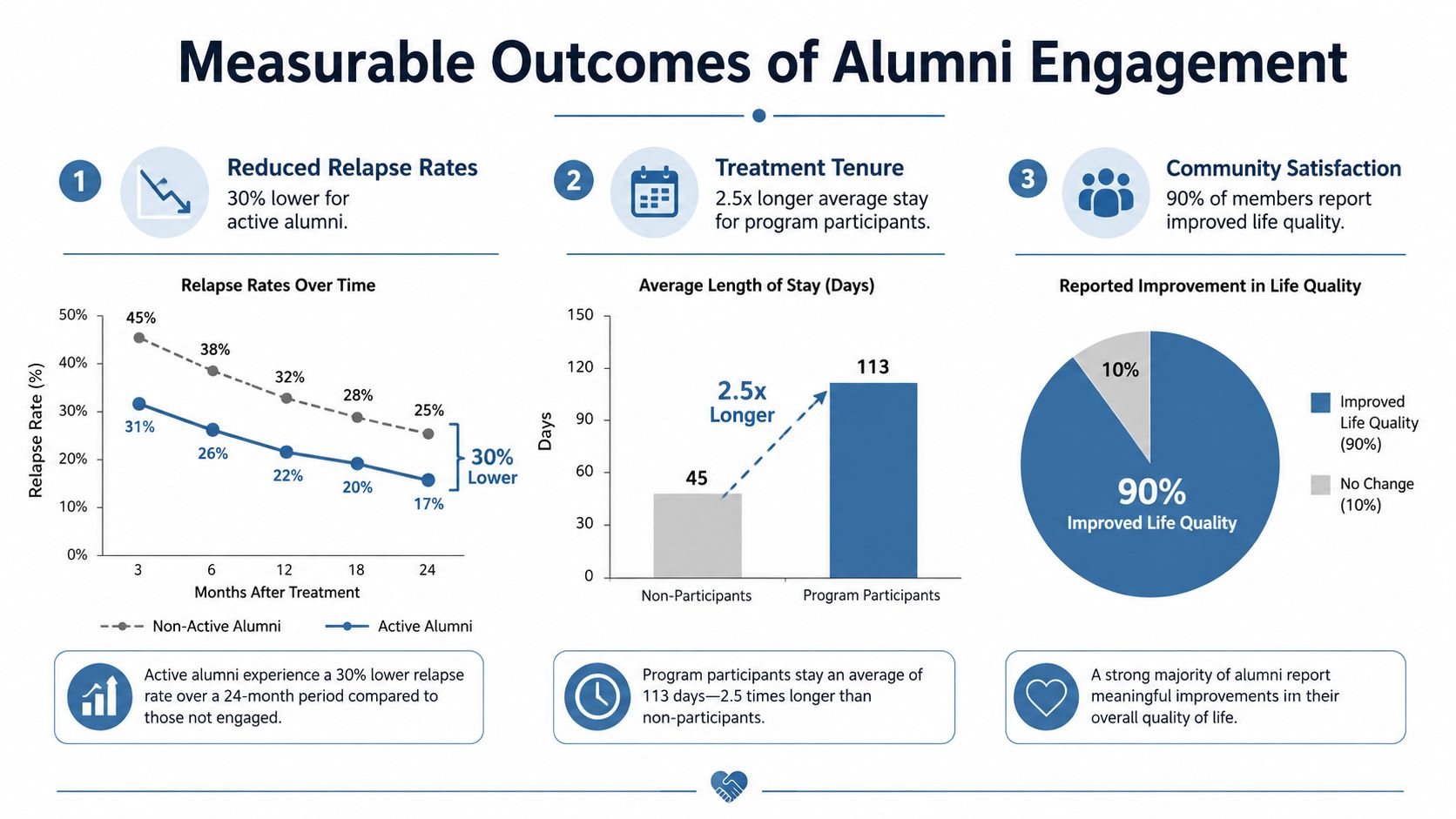
Families trust outcomes more than promises, and recovery programs should expect that. Alumni participation is not magic, and it's not a guarantee, but it does give people a more stable path to follow when life gets uneven.
What programs should be able to explain
A responsible program should be able to talk plainly about how it tracks progress. That might include follow-up contact, continued participation, and whether the person stays connected after discharge. It should also be honest about limits, because self-reported progress can miss the messy parts of real recovery.
The broader business and workforce world has already moved toward alumni communities because they can support measurable value, not just goodwill. For example, a research summary reports that 98% of Fortune 500 companies have some form of alumni program, and it ties engaged alumni communities to business outcomes such as a 2.8x increase in revenue per employee, a 4.5x increase in product innovation, and a 6x increase in employer attractiveness. It also notes that alumni contribute to 44% of net new business, boomerang hires show a 44% higher retention rate over three years, and 73% of alumni are willing to engage in contract work. Enterprise Alumni's research summary frames alumni communities as a real organizational asset, not a side benefit.
That same logic applies in recovery, even though the outcomes are different. If people stay engaged, they are more likely to keep using support, stay visible to the care team, and get help before a small issue grows larger.
The best question for a program isn't whether people liked it. It's whether it stayed useful after the first burst of enthusiasm faded.
Families can ask direct questions during an admissions call. How does the program know if alumni are still engaged? What follow-up happens after discharge? Are there clear pathways back to care if someone starts to struggle again? Those questions are fair, and good programs should answer them without defensiveness.
The most honest answer is often the simplest. Consistent connection usually helps more than silence, and a weak program should not pretend otherwise.
How Tru Dallas Supports Alumni in the Dallas-Fort-Worth Area
For people in the Dallas-Fort Worth area, continuity matters most when it is reachable. A support plan that looks good on paper but is hard to use on a Tuesday night won't carry much weight. Tru Dallas Detox & Recovery Center structures alumni care around that reality, using its Euless facility as a base for people who live and work across the metroplex.
What the local pathway can include
The local alumni path can include regular meetups, peer mentoring pairings, ongoing group sessions, sober living referrals across the area, and relapse-prevention planning that starts before discharge. For someone with co-occurring depression, anxiety, or bipolar disorder, coordinated support matters because recovery shouldn't split mental health from substance use care.
A practical example helps. A person leaving treatment may need one plan for housing, another for weekend support, and another for return-to-work stress. If those pieces are handled separately, the person spends recovery coordinating recovery. If they're handled together, the person gets to focus on healing.
Insurance questions can also stall aftercare, so the team assists with verification for most PPO plans. That removes one of the most common friction points families face when they're already tired, worried, and trying to make a good decision quickly.
Tru Dallas Detox & Recovery Center also connects alumni support to discharge planning instead of treating it like an optional add-on. That means the recovery conversation continues after detox and residential treatment, which is especially important for working adults balancing responsibilities in Dallas, Irving, Arlington, and nearby communities.
When a family is deciding what to do next, the most useful question is not whether support exists in theory. It's whether the next step will still feel manageable after discharge. That is where local alumni structure matters most.
Common Misconceptions About Recovery Alumni Programs
One common myth is that alumni programs are just social extras. They're not. In recovery, they function more like a maintenance plan, especially when early warning signs can be subtle and easy to dismiss.
Another misconception is that asking for alumni support means a person is weak. In practice, it usually means the person understands how hard early recovery can be and doesn't want to pretend otherwise. That's not weakness. That's good judgment.
Four myths that keep people away
- “It's only for people who can't manage on their own.” Strong alumni support is about staying connected, not proving dependency.
- “It's the same as a generic support meeting.” Recovery alumni care is usually tied to the discharge plan and the clinical team.
- “Joining means staying tied to treatment forever.” In reality, the point is to create a bridge, not a leash.
- “If treatment worked, no follow-up should be needed.” Recovery usually needs practice, not just intention.
A third myth says alumni programs are no different from a general peer group. The difference is coordination. Alumni support can be built around the person's actual treatment history, current risks, and next steps, which makes it more specific than a one-size-fits-all meeting.

How to Join and What to Expect Next
The first step is simple. Reach out while discharge planning is still fresh, and have insurance details, treatment history, and current support needs ready. That makes it easier to map the right follow-up plan without losing momentum.
The first 30 days usually focus on settling in, staying in contact, and identifying risk points early. By 60 days, the person should have a steadier routine for check-ins and recovery support. By 90 days, the goal is a rhythm that feels sustainable instead of forced.
Families usually ask the same questions, and they deserve direct answers.
- Does it cost extra? That depends on the program structure and coverage details.
- Is participation required? It often isn't, but it can be strongly encouraged as part of aftercare.
- Is confidentiality protected? It should be, and that should be explained clearly before enrollment.
- How soon should someone join? The best time is usually before discharge, so the plan is ready when the person leaves.
For Dallas-area families who want a more stable transition after detox, the safest move is to start the conversation early and keep it specific. Ask what aftercare looks like, how alumni support stays connected, and what happens if the person struggles again. Then make the next call while the plan is still clear.
Tru Dallas Detox & Recovery Center supports people who need more than a discharge date, it offers detox, coordinated aftercare, and alumni follow-up that fits real life in Dallas-Fort Worth. If a loved one is leaving treatment soon, or if aftercare has already started to feel fragile, visit Tru Dallas Detox & Recovery Center to verify insurance and take the next step toward steady, connected recovery.
