
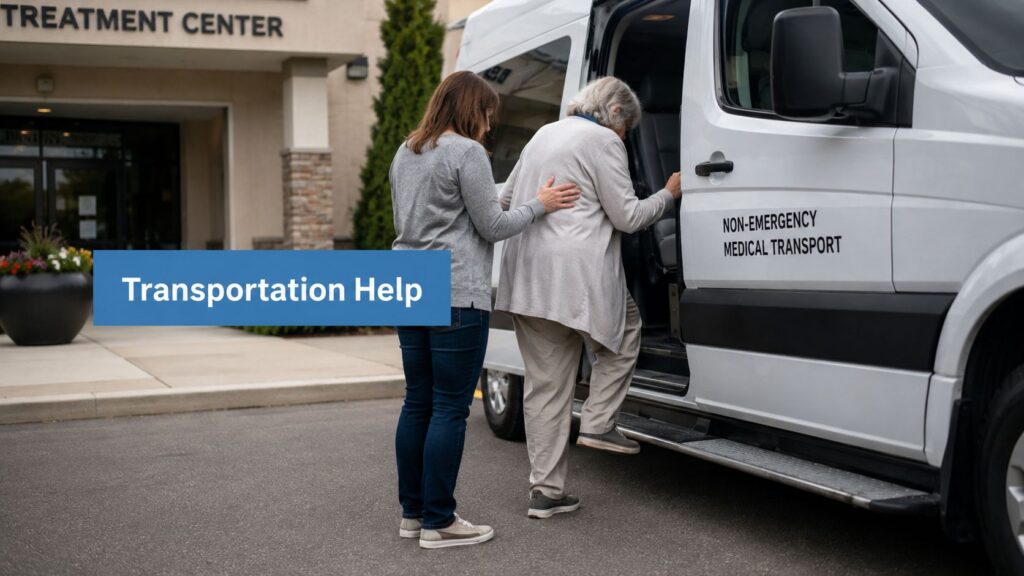
A family in Dallas can spend hours trying to get a loved one to treatment, only to discover that the ride doesn't accept the insurance, can't accommodate withdrawal symptoms, or won't arrive when the admission team expects the patient. That delay can turn a determined decision into another missed opportunity. Transportation help isn't just about finding a vehicle. It's about finding a safe, dependable way to reach treatment on time.
For families seeking a Dallas detox center, the right choice depends on medical needs, insurance, mobility, urgency, and whether the patient can safely travel without clinical supervision. The options include non-emergency medical transportation, ambulance services, rideshare arrangements, family drivers, accessible public transportation, and pickups coordinated by the treatment facility.
Table of Contents
- Why Getting to Treatment Is Harder Than It Should Be
- Comparing Your Transportation Options to a Dallas Detox Center
- Checking Insurance Coverage and Eligibility for Transport Benefits
- How Tru Dallas Detox Simplifies Your Transportation
- Safety and Medication Considerations During Transport
- Your Transport Day Checklist and Next Steps
Why Getting to Treatment Is Harder Than It Should Be
A parent may have a treatment bed available, a spouse may be ready to leave, and an admissions coordinator may be waiting in Euless. Still, the family has to answer difficult questions quickly. Can the patient sit safely in a regular vehicle? Will a driver wait if the admission process takes longer than expected? Can prescribed medication travel with the patient? What happens if withdrawal symptoms intensify on the way from Dallas, Irving, Plano, Richardson, or another part of the metroplex?
These concerns aren't exaggerated. About 12% of people with disabilities reported difficulty getting needed transportation, compared with 3% of people without disabilities. CDC data from 2022 found that 14.4% of adults with disabilities lacked reliable transportation for daily living during the previous 12 months, compared with 4.9% of adults without disabilities. The disparity was higher among working-age adults, according to the Bureau of Transportation Statistics analysis of transportation access.

The ride has to match the person
A healthy adult traveling to an appointment may manage a standard vehicle. Someone experiencing alcohol or opioid withdrawal may need a calmer setting, direct supervision, or medical transport. A person with mobility limitations may need a lift, securement equipment, or door-to-door assistance rather than a curbside drop-off.
The main categories of transportation help around Dallas include:
- Non-emergency medical transportation: A scheduled vehicle for patients who need assistance but aren't experiencing an emergency.
- Ambulance transportation: Appropriate when symptoms require medical monitoring or immediate care during transit.
- Family or friend transport: Often the fastest option when the patient is stable and a trusted adult can drive.
- Rideshare arrangements: Potentially useful for stable patients who can enter, ride, and exit without hands-on support.
- Accessible public transportation: A possible fit for eligible riders who can safely manage the route and timing.
- Facility-coordinated pickup: A practical option when the treatment provider can verify coverage and arrange the trip.
Practical rule: A ride that exists isn't automatically a ride that works. The vehicle, driver, timing, accessibility, and patient condition all have to fit.
Families shouldn't wait until the admission day to solve every detail. The safest move is to tell the treatment center what the patient is experiencing, what medications are involved, whether mobility assistance is needed, and where the pickup will occur. That information lets the admissions team steer the family toward a workable option instead of leaving them to guess.
Comparing Your Transportation Options to a Dallas Detox Center
The cheapest option isn't always the most useful. A patient who misses an intake because a vehicle arrives late may face another round of calls, uncertainty, and emotional resistance. A national longitudinal study of 3,175 outpatient drug treatment clients across 44 programs found that car, van, or contracted rides were associated with improved retention beyond clinically meaningful thresholds, while vouchers or public-transit payment weren't, as documented in the PubMed study on transportation modality and treatment retention.
The comparison below focuses on practical fit. Actual prices and availability vary by provider, plan, distance, and medical condition, so families should verify the details before booking.
| Transport Type | Estimated Cost | Booking Lead Time | Withdrawal-Safe | Companion Allowed | Reliability |
|---|---|---|---|---|---|
| Non-emergency medical transportation | Insurance-dependent or privately arranged | Often advance scheduling | Suitable for stable patients who need assistance | Often, but confirm first | Good when authorized and confirmed |
| Ambulance | Insurance-dependent or privately arranged | Immediate for emergencies, scheduled when appropriate | Best for patients needing medical monitoring | Usually limited, confirm with dispatch | High for urgent medical needs |
| Rideshare | Passenger-paid or program-supported | Often short notice | Only for stable patients without acute symptoms | Depends on vehicle and policy | Variable |
| Family or friend driver | Fuel and vehicle costs | Immediate if available | Suitable only when the patient is stable | Yes | Depends on driver and traffic |
| DART Paratransit | Eligibility and fare rules apply | Certification and advance scheduling may apply | Appropriate for eligible riders who can travel safely | Confirm when booking | Reliable after eligibility and reservation |
| Facility-arranged pickup | Insurance or facility arrangement | Depends on admissions coordination | Can be matched to the patient's condition | Confirm with the facility | Often strong when scheduled directly |
What each option handles well
NEMT works best for planned admissions. It can provide a more appropriate setting than a standard car, particularly for patients who need help entering or exiting the vehicle. Insurance authorization can take time, so a family should ask about pickup windows, return-trip rules, companion riders, and cancellation procedures.
An ambulance is a medical decision, not a convenience upgrade. Severe symptoms, a seizure, serious dehydration, loss of consciousness, or acute psychiatric danger require emergency evaluation rather than a routine ride to detox. Emergency services should be contacted when immediate medical care is needed.
Family transport can be effective for a stable patient. The driver should know the destination, carry a phone, and avoid transporting someone who is confused, fainting, severely agitated, or medically unstable. The patient shouldn't drive independently to treatment during withdrawal or intoxication.
DART Paratransit may help eligible riders who can't use fixed-route buses or trains. DART describes its paratransit service as origin-to-destination, door-to-door transportation for qualified people with disabilities across member cities, including Dallas, Irving, Plano, Richardson, and DFW International Airport. Certification requires a formal application, written physician verification, document submission, and an in-person eligibility assessment. Families can review DART Paratransit Services before relying on it for a time-sensitive admission.
For larger family groups or a planned private transfer, a Dallas group transit provider may be worth reviewing, particularly when a standard passenger vehicle won't fit everyone comfortably. Dallas group transit from Max's Luxury Rides can help families assess a group-vehicle option, but the treatment center should still confirm whether the arrangement is appropriate for the patient's condition.
Checking Insurance Coverage and Eligibility for Transport Benefits
Transportation benefits can be difficult to identify because insurers use different terms, approval rules, and scheduling systems. A plan may cover medical transportation in one situation but require prior authorization, a qualifying diagnosis, an approved destination, or a participating transportation provider in another.
Families should start with the insurance card and the treatment center's admissions team. Tru Dallas Detox & Recovery Center assists with insurance verification for most PPO plans, and the team can help determine whether transportation benefits are part of the admission plan. For broader coverage questions, families can also review whether insurance covers detox in Texas.
Ask the insurer precise questions
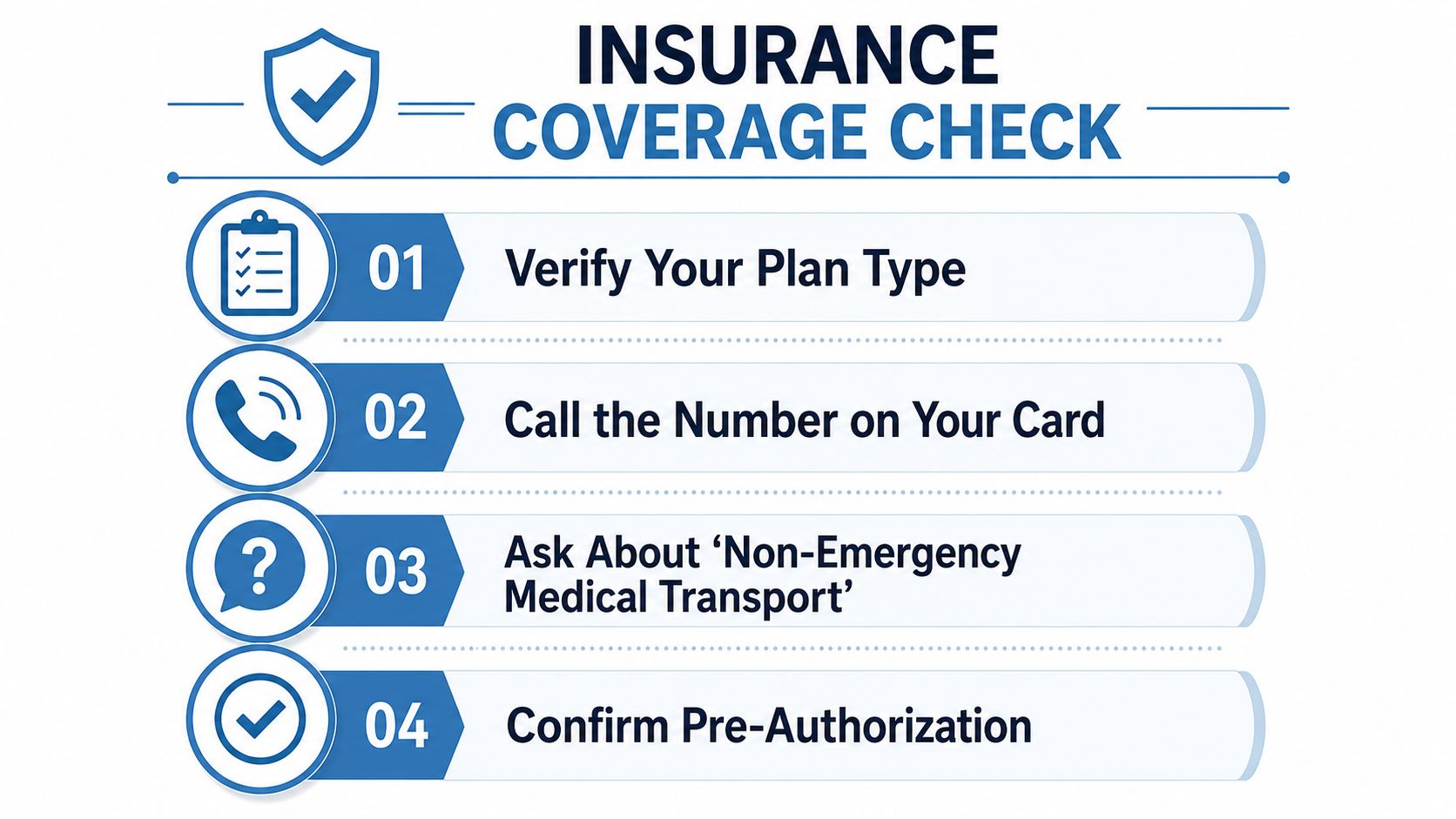
A vague request such as “Does the plan cover a ride?” often produces an incomplete answer. The caller should use the phrase non-emergency medical transportation and ask the representative to explain the benefit for an admission to addiction treatment.
The call should establish:
- Whether transportation is covered: Ask if the plan covers travel to a medically supervised detox or rehabilitation facility.
- Whether authorization is required: Ask if the insurer or transportation administrator must approve the trip before booking.
- What the benefit includes: Confirm whether the ride is one-way or round-trip, whether door-to-door assistance is available, and whether a companion may ride.
- What documentation is needed: Ask whether the facility must submit an admission confirmation, medical necessity statement, physician documentation, or another form.
- Who schedules the vehicle: Some plans require the member to call a transportation broker, while others allow the facility to coordinate the ride.
A useful script keeps the conversation focused:
“A family member needs transportation to a Dallas-Fort Worth addiction treatment admission. Does the plan include non-emergency medical transportation, is prior authorization required, and what information must the facility provide?”
The caller should write down the representative's name, reference number, approved destination, pickup instructions, and cancellation policy. Coverage isn't the same as availability. A benefit may exist, yet no vehicle may be available for the requested time or location.
Use local reduced-fare options carefully
DART's Reduced Fare GoPass Tap Card provides a 50% discount off the public fare for qualifying veterans, seniors, people with disabilities, youth, students, and income-qualified riders, including people enrolled in Medicaid, SNAP, CHIP, TANF, and WIC, according to DART's reduced fare information. This can reduce travel costs for eligible Dallas-area riders, but a reduced fare doesn't solve every clinical or timing issue.
A patient in active withdrawal may need direct supervision rather than a discounted public trip. The transportation decision should account for safety first, then cost.
How Tru Dallas Detox Simplifies Your Transportation
Transportation is easiest when the admissions team treats it as part of intake instead of leaving the family to coordinate every detail alone. Tru Dallas Detox & Recovery Center can assist with insurance verification, pickup logistics, and local transportation planning, helping families move from the first call to arrival at the Euless facility with fewer gaps.
The process usually starts with a confidential conversation about the patient's substance use, current symptoms, medical history, insurance, location, and immediate safety. The team needs to know whether the patient is intoxicated, experiencing withdrawal, taking prescribed medication, using mobility equipment, or traveling with a companion. Those details determine whether a private pickup, family driver, NEMT vehicle, or emergency response is appropriate.

One team can manage the moving pieces
Tru Dallas serves patients from across the Dallas-Fort Worth metroplex, including Dallas, Irving, Plano, Richardson, Euless, and surrounding communities. The admissions team can help coordinate private pickups at DFW or Love Field and assist with local transportation to the facility when arrangements are available.
Families should provide:
- Pickup location: Include the exact address, apartment access instructions, gate code, and a safe meeting point.
- Patient condition: Describe withdrawal symptoms, confusion, mobility limitations, or psychiatric concerns plainly.
- Insurance details: Have the member identification information available for benefit verification.
- Travel needs: Report medication requirements, mobility aids, luggage, and whether a companion will ride.
- Timing constraints: Share the preferred arrival window and any existing authorization or reservation details.
The team can also explain what happens after arrival, including clinical intake, medically supervised detox, therapy planning, medication-assisted treatment when appropriate, and continuing care. Families seeking a prompt response can use the 24/7 rehab admissions hotline to begin the conversation.
The practical advantage is coordination. A family doesn't have to describe the same situation repeatedly to an insurer, a transportation dispatcher, and a treatment facility without knowing whether the information was passed along. The admissions team can connect the transportation plan to the clinical intake plan, while recognizing that emergency symptoms require emergency medical care.
Safety and Medication Considerations During Transport
A standard rideshare or family vehicle may be reasonable for a patient who is alert, medically stable, calm, and able to enter and exit independently. It isn't the right setting for someone having a seizure, showing signs of severe dehydration, losing consciousness, experiencing acute psychiatric danger, or becoming medically unstable. In those situations, emergency medical services should be contacted.
Withdrawal can change during the trip. A patient who seemed stable at pickup may develop vomiting, tremors, confusion, agitation, severe anxiety, or other symptoms on the road. The driver or companion should know the destination, keep a phone available, and contact the treatment facility or emergency services if the patient's condition worsens.
A review of 18 studies identified lack of public transit, no driver's license, long travel distance, and high transit costs as recurring transportation barriers, and concluded that transportation assistance generally improves engagement and continuation in substance-use treatment, according to the review of transportation assistance in substance-use treatment. The same evidence also supports tracking ride use, missed appointments, and retention rather than assuming that offering a ride automatically solves access.
Medication handling deserves a clear plan
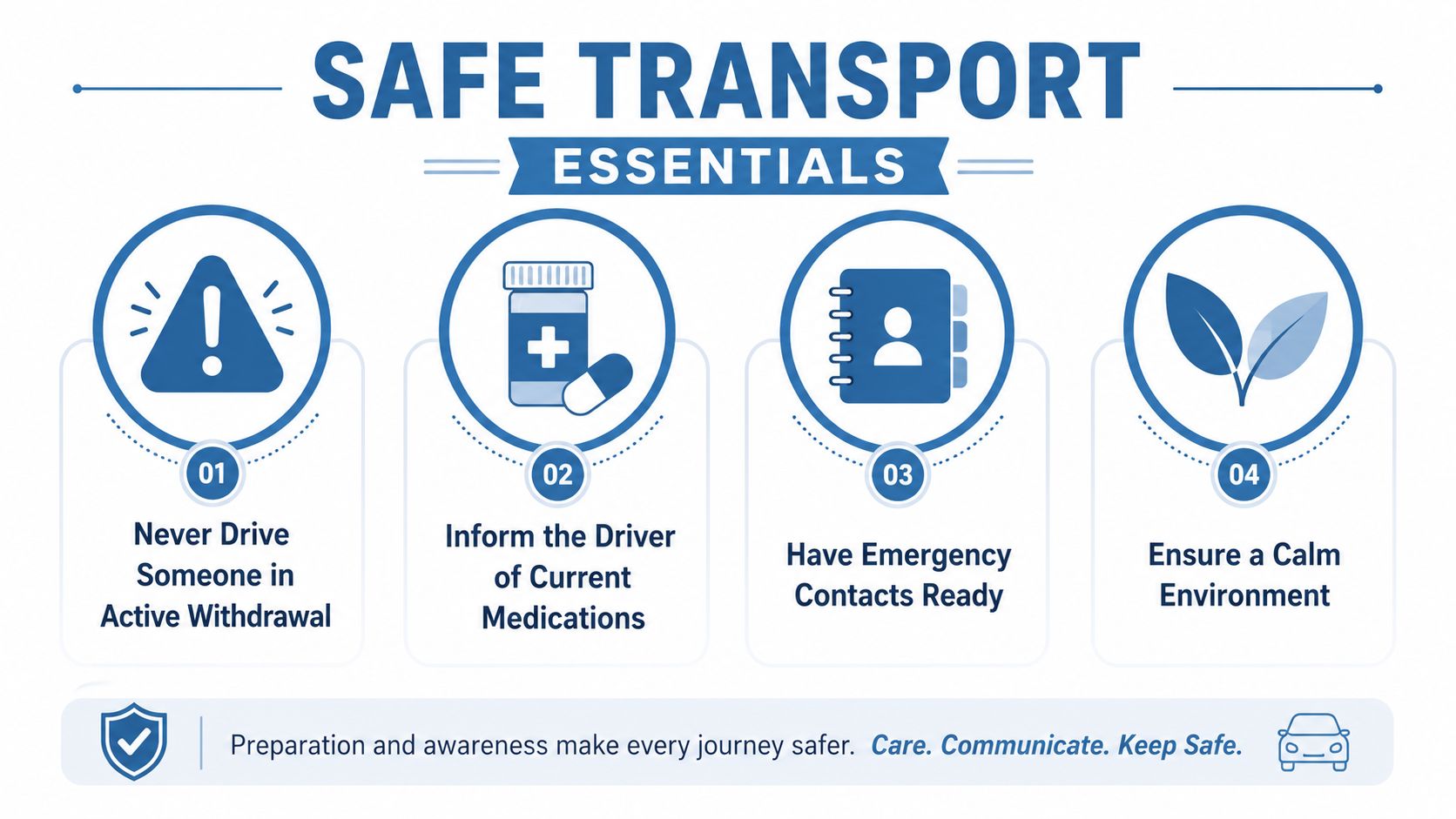
Medication should stay in its original labeled container whenever possible. The patient or companion should carry a current medication list and tell the admissions team about prescribed medications, recent doses, allergies, and medication-assisted treatment such as buprenorphine or methadone.
Families can read about the role of medication-assisted treatment before admission, but transportation staff shouldn't change, administer, or withhold medication unless a qualified clinician directs them to do so. The patient should never place loose pills in an unmarked bag or leave medication unattended in a vehicle.
Before departure, the responsible adult should:
- Confirm the route: Share the destination and estimated arrival with a trusted contact.
- Describe the patient accurately: Tell the driver or dispatcher about mobility needs and symptoms that could affect the trip.
- Create a calm environment: Limit crowding, arguments, loud music, and unnecessary stops.
- Keep emergency contacts ready: Include the treatment center, a family contact, and emergency services.
- Plan for escalation: Pull over safely and call for help if the patient becomes unresponsive, has a seizure, or presents an immediate danger.
Transportation safety depends on accurate information. Hiding withdrawal symptoms to secure a faster ride can place the patient, driver, and family at risk.
Your Transport Day Checklist and Next Steps
The day of admission should follow a simple sequence. Organization won't eliminate every delay, but it gives the family a clear response when a vehicle is late, a phone goes unanswered, or the patient becomes anxious.
The day before pickup
Confirm the pickup time, vehicle type, driver contact process, facility address, and expected arrival window. The family should also ask who to call if the ride is delayed or canceled. A patient should avoid packing valuables and should prepare comfortable clothing, identification, an insurance card, a medication list, prescribed medications in original bottles, and essential contact information.
At pickup
The companion or responsible adult should verify the vehicle before departure and make sure the patient has the treatment center's phone number. The driver should receive accurate destination information, while the family keeps a trusted contact informed of the route and arrival.
If a scheduled ride doesn't appear, the family should call the transportation dispatcher and the treatment center immediately. The admissions team may be able to identify another safe option, but a medically unstable patient shouldn't be placed in a routine vehicle to preserve the appointment.
Backup support in Dallas County
My Ride Dallas offers door-through-door non-emergency transportation for medical appointments in Dallas County. The service centers on (972) 855-8084, and client advocates are available at no additional cost for riders who need assistance during medical trips, as described in the My Ride Dallas transportation guide. Families should confirm whether the service fits an addiction treatment admission and whether scheduling requirements apply.
After arrival at Tru Dallas, the patient can begin the intake process and receive guidance about detox, therapy, medication-assisted treatment, co-occurring mental health needs, and continuing care. The family can help by ensuring that insurance information, medications, and relevant medical details arrive with the patient.
Tru Dallas Detox & Recovery Center helps adults and families coordinate insurance verification, admission logistics, and transportation planning to its Euless facility for addiction treatment. Visit Tru Dallas Detox & Recovery Center to request help, verify coverage, and take the next step toward a safe arrival at treatment.
