
Some people in Dallas wake up already bargaining with themselves. They swear tonight will be different. They’ll stop at two drinks, skip the liquor store on the way home, or make it through dinner without pouring another glass. By late evening, the same cycle is back. Cravings rise, shame follows, and the next morning starts with fear, exhaustion, and the thought that maybe nothing will work.
That’s often the point when medication assisted treatment for alcohol starts to matter. Not because it replaces therapy or motivation, but because it gives the brain and body enough support to make change possible. For many people in Dallas-Fort Worth, the biggest barrier isn’t a lack of desire to quit. It’s that cravings, withdrawal symptoms, and repeated relapse keep overpowering good intentions.
A medical approach can interrupt that pattern. It can reduce the pull to drink, make early recovery safer, and create enough stability for counseling, family repair, and long-term planning to finally take hold.
Table of Contents
- A New Path to Recovery from Alcohol Addiction in Dallas
- What Is Medication Assisted Treatment for Alcohol Use Disorder
- Key Medications Used in MAT for Alcohol Recovery
- Who Is a Good Candidate for Alcohol MAT in Dallas
- How MAT Fits Into a Complete Recovery Plan at Tru Dallas
- Starting Your Journey with MAT at Tru Dallas Detox
- Common Questions About MAT for Alcohol Recovery
A New Path to Recovery from Alcohol Addiction in Dallas
In North Dallas, Oak Lawn, Plano, Irving, and across the wider DFW area, the story often sounds the same. Someone keeps functioning just well enough to hide how bad things have become. They make it to work, answer texts, and show up for family events, but alcohol is taking over their schedule, their mood, and their health.

For many, the turning point isn’t dramatic. It’s quieter than that. It’s the realization that willpower alone hasn’t been enough. It’s another failed promise to stop. It’s a spouse who’s losing trust, a parent who’s worried, or a person sitting alone in a car outside a Dallas detox center wondering if treatment can work for them this time.
Medication assisted treatment for alcohol offers a different path. It treats alcohol use disorder as a medical condition, not a moral failure. That shift matters. When care is built around safety, brain chemistry, and practical recovery planning, people often feel relief before they feel confidence.
Why hope returns when treatment gets practical
The most helpful change is often simple. Instead of asking a person to fight cravings at full strength, treatment reduces the intensity of those cravings and supports the brain during early recovery. That doesn’t solve everything. It does make everything else more workable.
Recovery usually starts moving when the body is safer, the mind is clearer, and the next step feels manageable.
A good treatment plan also accounts for real life in Dallas-Fort Worth. Some patients need medical detox first. Some are still drinking and don’t know how to stop safely. Some have anxiety, depression, or trauma mixed into the alcohol problem. Medication can be part of the answer, but only when it’s used thoughtfully and matched to the person in front of the clinical team.
What people often get wrong about alcohol treatment
Many families still assume that medication means weakness or dependency. That misunderstanding keeps people stuck. Medication for alcohol use disorder isn’t a shortcut. It’s a clinical tool that can make relapse less likely and treatment engagement more realistic.
In a city as busy and spread out as Dallas, many people delay care until the problem is severe. That’s one reason a local, structured treatment path matters. With the right support, recovery doesn’t have to begin with another promise to white-knuckle it alone. It can begin with a plan.
What Is Medication Assisted Treatment for Alcohol Use Disorder
Medication assisted treatment for alcohol is the use of FDA-approved medication together with counseling and behavioral treatment to help someone recover from alcohol use disorder. It isn’t about replacing one addiction with another. It’s about using medicine in a controlled, therapeutic way to reduce the brain and body disruptions that keep alcohol use going.
A simple comparison helps. No one tells a person with high blood pressure to prove commitment by refusing medication. The goal is to stabilize the condition so healthier habits can work. Alcohol use disorder deserves the same medical common sense.
How MAT helps the brain recover
Alcohol changes signaling in the brain over time. That’s part of why a person can feel driven to drink even when they desperately want to stop. Different medications address different parts of that process.
According to a clinical overview from the University of Colorado Anschutz Medical Campus, FDA-approved medications for alcohol use disorder act on distinct neurobiological pathways. Naltrexone blocks mu-opioid receptors to reduce alcohol-related dopamine release and cravings. Acamprosate helps restore the glutamate and GABA balance disrupted by chronic drinking. Disulfiram creates a severe aversive reaction if alcohol is consumed.
That means medication can help in different ways depending on the problem:
- Cravings are constant: A medication may reduce the urge and reward response.
- Early abstinence feels shaky: A medication may help the brain settle after withdrawal.
- A person needs a strong external deterrent: A medication may make drinking feel too risky or unpleasant.
What MAT is not
MAT isn’t sedation. It isn’t punishment. It also isn’t a stand-alone cure.
People sometimes come in expecting one pill to erase every urge, repair every relationship, and stop every relapse. That’s not how alcohol treatment works. Medication lowers barriers. Therapy, structure, accountability, and ongoing support do the deeper rebuilding.
Practical rule: When medication assisted treatment for alcohol works best, it clears enough mental and physical noise that a person can finally participate in recovery instead of just surviving the day.
Why stigma gets in the way
The phrase “you should be able to do this on your own” has delayed a lot of treatment. It sounds tough, but it ignores what alcohol dependence does to the body. Once tolerance, withdrawal, and compulsive use are in the picture, recovery often needs more than motivation.
That’s especially true when someone has tried to quit before and kept relapsing. Repeated failure can convince a person they’re hopeless, when, in fact, the problem is that they’ve been trying with too little medical support.
The real goal of treatment
The goal isn’t only abstinence on paper. The goal is stability. That can mean safer withdrawal, fewer binges, less chaos at home, stronger participation in therapy, and more consistent follow-through. In practice, medication gives recovery a foothold.
For people seeking addiction treatment in Dallas, that kind of support can be the difference between another short-lived attempt and a real start.
Key Medications Used in MAT for Alcohol Recovery
The three FDA-approved medications most often discussed for alcohol use disorder are naltrexone, acamprosate, and disulfiram. They all support recovery, but they do it in very different ways. Choosing well matters more than choosing quickly.
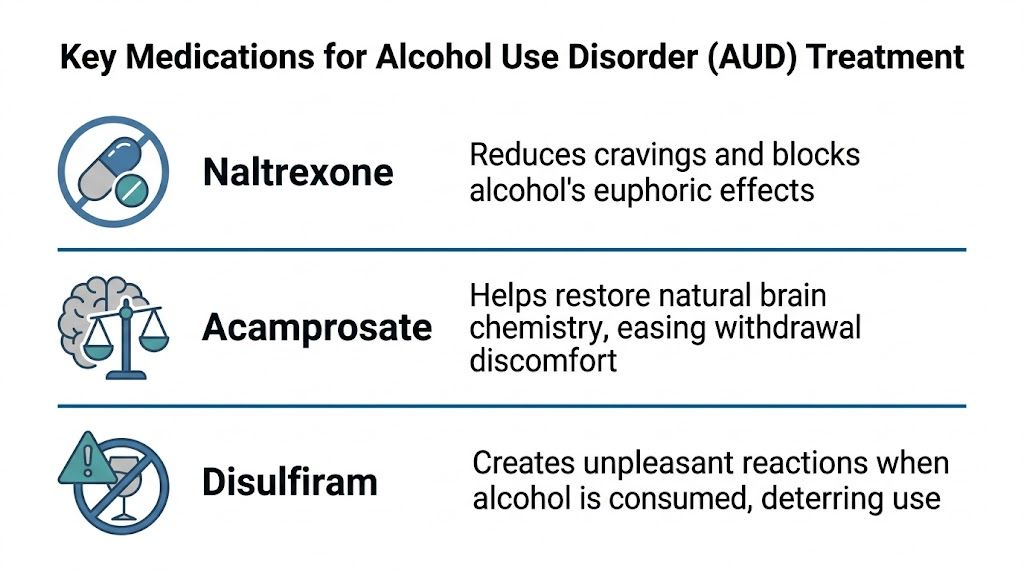
A major 2023 JAMA systematic review and meta-analysis that included 118 clinical trials and 20,976 participants found that oral naltrexone at 50 mg/day and acamprosate are first-line medications for alcohol use disorder. In that review, oral naltrexone reduced return to heavy drinking with a relative risk of 0.81, and acamprosate had a number needed to treat of 11 to prevent one person from returning to any drinking.
Naltrexone
Naltrexone is often a strong option when the central problem is craving, reward, or repeated heavy drinking after an initial effort to cut back. It works by blocking mu-opioid receptors, which reduces the dopamine-related reward response alcohol can trigger.
For some patients, that translates into a very practical effect. The first drink doesn’t produce the same reinforcement. The craving loop softens. The urge to keep going after one or two drinks may weaken.
A few important details shape whether it’s the right fit:
- How it’s given: It can be taken as an oral medication, and there is also an injectable form used on a longer dosing schedule.
- Who may benefit most: People who describe alcohol as having a strong “pull,” especially those who relapse into heavy drinking.
- Who needs caution: Anyone using opioids needs careful review before naltrexone is considered.
People researching options often want a focused explanation of how this medication works day to day. This overview of naltrexone for alcohol cravings can help frame that conversation with a treatment team.
Acamprosate
Acamprosate is usually better understood as a stabilizing medication than a blocking medication. It doesn’t punish drinking. It doesn’t blunt alcohol’s reward in the same way naltrexone does. Instead, it supports the brain during the post-withdrawal period by helping restore the glutamate-GABA balance that chronic drinking disrupts.
That makes it especially relevant for people who’ve already stopped drinking and want help maintaining abstinence. Some patients describe the early sober period as raw, restless, or emotionally jagged. Acamprosate is often considered when that unsettled feeling threatens to pull them back to alcohol.
Key considerations include:
- Best fit: People who’ve completed withdrawal and want support staying alcohol-free.
- Administration: It’s typically taken on a regular daily schedule.
- Caution area: Renal impairment can limit use, so medical screening matters.
Acamprosate tends to work best for people who are aiming for abstinence, not a casual reduction in drinking. The medication doesn’t create motivation on its own, but it can support the brain while motivation is being turned into daily action.
Disulfiram
Disulfiram is the most behaviorally direct of the three. It interferes with alcohol metabolism, causing an aversive reaction if a person drinks. In plain terms, it creates a strong deterrent.
This medication can be useful, but it requires honesty, planning, and usually a high level of structure. If someone is ambivalent about quitting, has frequent impulsive drinking, or doesn’t have support around medication adherence, disulfiram often isn’t the easiest place to start.
It may fit better when:
- Accountability is strong: A spouse, family member, or program structure helps supervise use.
- The goal is immediate abstinence: The patient wants a clear consequence attached to drinking.
- The person understands the risk: Drinking on disulfiram can cause a serious unpleasant reaction.
Some medications reduce the drive to drink. Disulfiram works differently. It raises the cost of drinking so sharply that the person has time to choose something else.
How the options compare
Not every patient in a Dallas alcohol rehab setting needs the same tool. One person needs craving relief. Another needs post-detox stabilization. Another needs a strict external deterrent because repeated impulsive drinking keeps breaking through.
| Medication | How It Works | Primary Goal | Administration |
|---|---|---|---|
| Naltrexone | Blocks mu-opioid receptors and reduces alcohol-related reward and cravings | Reduce heavy drinking and craving-driven relapse | Oral or injectable |
| Acamprosate | Helps restore glutamate-GABA balance disrupted by chronic drinking | Support abstinence after withdrawal | Oral |
| Disulfiram | Causes an aversive reaction if alcohol is consumed | Deter drinking through behavioral consequence | Oral |
What works and what doesn’t
What works is matching the medication to the patient’s pattern. What doesn’t work is treating medication like a generic add-on. A person who’s still drinking daily may need a different starting strategy than someone who has just finished detox. A person with poor adherence may struggle with a medication that depends on consistent daily decisions.
Some programs also consider non-FDA-approved options when first-line medications aren’t a fit. Clinical guidance from the same University of Colorado overview notes that topiramate may be considered in some cases as a second-line option. That kind of decision belongs in careful medical hands, especially when patients have co-occurring psychiatric symptoms or a complicated treatment history.
Who Is a Good Candidate for Alcohol MAT in Dallas
The short answer is that many adults with moderate to severe alcohol use disorder are reasonable candidates for medication support, especially when cravings, relapse, or withdrawal keep derailing recovery. The better answer is more personal. Candidacy depends on drinking pattern, medical history, mental health symptoms, and what has or hasn’t worked before.
In Dallas, a lot of people reach treatment after several unsuccessful attempts to stop on their own. That history matters. It doesn’t prove failure. It often suggests that the person may need more than meetings, promises, or short bursts of motivation.
Signs MAT may be worth discussing
Medication deserves a serious look when alcohol has become repetitive, compulsive, or medically risky. Some of the clearest signs include the following:
- Cravings keep taking over: The person can stop briefly, but the urge to drink keeps returning and feels hard to control.
- Relapse happens after short periods of sobriety: They make progress, then slide back once stress, boredom, conflict, or social triggers return.
- Withdrawal symptoms make quitting harder: Shaking, anxiety, sweating, insomnia, or fear of stopping may be part of the pattern.
- Mental health symptoms are in the mix: Depression, anxiety, trauma symptoms, or mood instability can make alcohol harder to leave behind.
A dual diagnosis deserves special attention. When alcohol is tangled up with psychiatric symptoms, the treatment plan needs to reduce crisis risk while improving engagement. Medication can help create that stability when it’s used as part of integrated care.
When a professional assessment matters most
Self-diagnosis has limits. A person may think they only need motivation when they require detox. Another may assume medication isn’t appropriate because they’re still drinking, when a clinician could identify a safe path to begin treatment.
The right question usually isn’t “Do medications work in general?” It’s “Which option fits this person’s drinking pattern, medical status, and recovery goals right now?”
That’s why a confidential assessment matters. It sorts out withdrawal risk, other substance use, current psychiatric concerns, medication contraindications, and whether the immediate goal is abstinence, reduced heavy drinking, or safe transition into structured treatment.
For many families in Dallas-Fort Worth, that assessment is also the first calm conversation they’ve had about alcohol in a long time. Clarity alone can be therapeutic. Once the picture is clearer, the next step becomes less frightening.
How MAT Fits Into a Complete Recovery Plan at Tru Dallas
A patient finishes alcohol detox feeling clearer, steadier, and hopeful. Then real life starts pressing in again. Poor sleep, family tension, cravings on the drive home, and untreated anxiety can pull recovery off course fast if treatment ends at detox.
Medication assisted treatment works best when it is built into a connected care plan. For people across Dallas, Fort Worth, Arlington, Euless, Grapevine, and nearby communities, that means each stage should support the next stage, with no guessing about what comes after withdrawal, how medications are monitored, or where therapy fits.

Medication has a specific job. It can reduce cravings, lower the reward response to alcohol, or support abstinence after detox. Therapy has a different job. It helps patients work through the stress, grief, trauma, relationship strain, and daily routines that kept alcohol in place.
Both matter.
Detox sets the foundation for MAT
If withdrawal risk is high, safety comes first. A person who has been drinking heavily for a long time may need monitoring before any longer-term medication plan is started, especially if there is a history of tremors, seizures, severe anxiety, or repeated relapse after trying to stop alone.
Patients and families often feel less overwhelmed once they understand the medically supervised alcohol detox process. It clarifies what clinicians watch for, how symptoms are managed, and why detox is often the safest entry point into treatment.
Timing matters here. Some alcohol-use-disorder medications are started after withdrawal has settled. Others may be considered later, once the medical team has a clear picture of liver function, opioid use, psychiatric symptoms, and the patient’s immediate goals. That decision should be made by clinicians, not improvised at home.
MAT helps patients stay engaged in treatment
Once the body is more stable, patients can usually participate in treatment with much better focus. Sessions are more productive when a person is not fighting constant urges to drink or spending every hour trying to white-knuckle through cravings.
This is especially true in dual diagnosis care. Anxiety, depression, trauma symptoms, and alcohol use often feed each other. Medication can lower the noise enough for therapy to start working in a practical way.
At Tru Dallas Detox & Recovery Center, MAT can be integrated with detox, psychiatric review, individual therapy, group counseling, and discharge planning as part of one coordinated treatment process. That matters because recovery often breaks down during handoffs. A patient does better when the plan is clear, medications are monitored, and the next level of care is arranged before motivation fades.
Medication does not replace recovery work. It gives people enough stability to do recovery work consistently.
Some families also benefit from seeing how structured accountability supports behavior change over time. For a legal-system example, the Michigan Adult Drug Treatment Court Program shows how treatment expectations, monitoring, and follow-through can reinforce long-term progress.
Aftercare is where gains are protected
Early progress can be misleading. Many patients feel better within days or weeks, then assume they no longer need support. In practice, this is often the stage when old triggers return and confidence starts to outrun preparation.
A stronger aftercare plan usually includes:
- Medication follow-up: Prescribers assess benefit, side effects, adherence, and whether the medication still fits current goals.
- Ongoing therapy: Individual and group sessions help patients build coping skills and address the issues alcohol was masking.
- Relapse prevention planning: Patients identify triggers, warning signs, high-risk situations, and who to call before a lapse turns into a full return to drinking.
- Family involvement when appropriate: Loved ones learn how to support recovery without slipping into panic, rescuing, or control battles.
- Local continuity of care: Patients in the Dallas-Fort Worth area need a plan that fits where they live, work, and return home.
That is how MAT fits into a full recovery plan. It is not a stand-alone fix. It is one part of a careful, personalized approach that starts with safety, continues with real clinical work, and gives patients in Dallas-Fort Worth a better chance of staying well after treatment ends.
Starting Your Journey with MAT at Tru Dallas Detox
Getting help usually feels hardest before the first call. People imagine judgment, pressure, or a complicated intake process. In reality, the first step is often a straightforward conversation about safety, drinking history, and what kind of help is needed right now.
For adults looking for addiction treatment in Dallas or nearby communities like Euless, Arlington, Grapevine, Bedford, and Fort Worth, the process becomes more manageable when it’s broken into small decisions instead of one overwhelming leap.
What the first call usually covers
The first contact is usually about sorting out urgency and fit. If alcohol use has been heavy or daily, the immediate question is whether detox may be necessary before medication planning begins. If someone is already abstinent, the conversation may shift toward which medication approach could support recovery and what level of care makes sense next.
A typical intake discussion may cover:
- Current alcohol use: How much, how often, and whether stopping has caused withdrawal symptoms before.
- Other substances: Opioid use especially matters when considering medication options.
- Mental health concerns: Anxiety, depression, trauma symptoms, and mood shifts help shape the treatment plan.
- Insurance and logistics: Staff can often help verify benefits and explain practical next steps.
People often wait because they think they need to have everything figured out before reaching out. They don’t. The purpose of the call is to start organizing a safe plan.
Why Dallas-Fort Worth families trust Tru Dallas Detox
Families usually aren’t looking for a sales pitch. They’re looking for signs that treatment will be competent, respectful, and individualized. Trust grows when a center takes both the alcohol use and the mental health picture seriously.
What tends to matter most includes:
- Personalized clinical planning: Medication, detox, therapy, and aftercare should match the person, not a generic template.
- Dual diagnosis capability: Alcohol use often overlaps with anxiety, depression, or bipolar symptoms that need concurrent attention.
- A comfortable environment: Privacy and structure can lower resistance and help patients stay engaged.
- Continuity of care: The handoff from detox to rehab or outpatient support shouldn’t feel disconnected.
These details sound simple, but they often determine whether someone follows through. When care is coordinated and expectations are clear, families usually feel less panic and more direction.
What to do next
The next step doesn’t need to be dramatic. It needs to be timely. If someone is drinking in a way that feels out of control, blacking out, waking up shaky, or repeatedly trying and failing to stop, waiting rarely makes the decision easier.
Help is most effective when it starts before the next crisis, not after it.
A confidential call can answer basic questions, review whether medical detox is needed, and begin insurance verification. From there, the clinical team can recommend whether medication assisted treatment for alcohol belongs in the immediate plan and what setting offers the safest start.
For many people in Dallas-Fort Worth, that first conversation is the moment the problem stops feeling impossible. It becomes something that can be treated.
Common Questions About MAT for Alcohol Recovery
Questions about medication are usually practical. People want to know how long treatment lasts, whether medication can begin before full sobriety, what side effects to expect, and whether insurance can help cover care. Those are the right questions.

How long does someone stay on medication
There isn’t one universal timeline. Some people use medication for a shorter, high-risk period in early recovery. Others benefit from a longer course because cravings, relapse history, or psychiatric complexity make continued support useful.
The key point is that medication duration should be reviewed clinically, not decided by frustration or impatience. Stopping too early can leave a person exposed at the exact moment life stress starts picking back up.
Can MAT start while someone is still drinking
Sometimes yes, but not every medication works the same way. This is one of the most important practical distinctions in alcohol treatment.
A treatment overview on medication initiation for active drinkers notes that oral naltrexone can sometimes be started without a waiting period if opioids aren’t involved, while acamprosate and disulfiram require a period of abstinence, creating a pre-treatment window that often needs skilled clinical support.
That matters because many people seek help while they’re still actively drinking. If the plan requires abstinence before medication can begin, the team has to help manage that gap safely and realistically. In some cases, detox is the right bridge. In others, a different medication strategy may be considered first.
What about side effects and safety
Every medication has trade-offs. Some patients tolerate a medication well and feel clear improvement. Others need a dosage change, closer monitoring, or a different option. Safety depends on careful screening for liver issues, kidney concerns, heart conditions, opioid use, and psychiatric symptoms, depending on the medication being considered.
Withdrawal treatment and long-term alcohol medication also aren’t the same thing. If someone is searching for information on early withdrawal management, this guide on the best medication for alcohol withdrawal can help clarify the difference between detox support and maintenance treatment for alcohol use disorder.
The safest medication plan is the one built around the person’s full medical picture, not just their drinking pattern.
Will insurance cover treatment
Coverage depends on the plan, the level of care, and medical necessity. Many patients have benefits for some combination of detox, residential care, outpatient treatment, psychiatric services, and medication management. The easiest next move is usually to verify insurance directly with the treatment provider so the family knows what’s covered before admission decisions are made.
Cost concerns stop a lot of families from calling. Silence usually costs more. When alcohol use is escalating, getting accurate coverage information early can prevent delays and open options that people didn’t realize were available.
Medication assisted treatment for alcohol isn’t the whole answer, but for many people it’s the step that makes the rest of recovery possible. When treatment is timed well, medically supervised, and tied to therapy and aftercare, people often find that the cycle can be interrupted.
If alcohol has taken over daily life, Tru Dallas Detox & Recovery Center can help you take the next step with confidential guidance, insurance verification, and a clear plan for safe detox, treatment, and ongoing recovery support in the Dallas-Fort Worth area.
