
Navigating the path to lasting recovery from substance use is a journey of resilience, self-discovery, and connection. While individual commitment is crucial, the power of a supportive community cannot be overstated. Group settings provide a unique environment where shared experiences reduce isolation, foster accountability, and build a toolkit of practical skills for real-world challenges.
Effective group work transforms recovery from a solitary struggle into a collective endeavor, strengthening each individual's resolve. This article explores 10 dynamic and evidence-based relapse prevention activities for groups, offering detailed insights for facilitators and participants alike.
From cognitive restructuring to experiential role-playing, these activities are designed to equip individuals with the strategies needed to manage triggers, cope with stress, and build a fulfilling, substance-free life. Understanding these approaches is the first step toward creating a robust support system. This is a core component of the comprehensive care model we champion for individuals in the Dallas-Fort Worth area, where we integrate group therapy to ensure clients build a strong foundation for long-term sobriety. Readers will gain actionable guidance on how to implement and benefit from these powerful group exercises.
1. Cognitive Behavioral Therapy (CBT) Group Sessions
Cognitive Behavioral Therapy (CBT) group sessions are structured, evidence-based meetings that form the bedrock of many successful relapse prevention plans. This approach teaches participants to recognize the intricate link between their thoughts, feelings, and actions. By identifying and challenging distorted or negative thought patterns, individuals can develop healthier behaviors and more effective coping mechanisms.
The group format provides a supportive environment where members can share experiences and learn from one another, reducing feelings of isolation. This method is highly effective because it equips individuals with tangible skills to manage cravings and navigate high-risk situations long after treatment ends.
How to Implement CBT in a Group Setting
Implementing CBT requires a structured approach led by a trained facilitator. The goal is to make abstract psychological concepts practical and applicable to daily life.
- Thought Records: Use worksheets to help participants identify a triggering event, record their automatic negative thoughts, and then challenge those thoughts with more balanced, rational alternatives.
- Role-Playing Scenarios: Create realistic scenarios where members can practice new behaviors. For example, a group member could practice saying "no" when offered a drink at a social event, receiving constructive feedback from peers.
- Behavioral Goal Setting: Encourage members to set specific, measurable, achievable, relevant, and time-bound (SMART) goals, such as exercising for 30 minutes three times a week to manage stress. Progress is tracked and discussed in subsequent sessions.
- Psychoeducation: Dedicate time to explaining core CBT concepts, such as cognitive distortions (e.g., all-or-nothing thinking, catastrophizing), so members can better identify them in their own lives.
Key Insight: The power of CBT in a group setting lies in its combination of skill-building and peer support. As members learn to challenge their own negative thoughts, they also gain strength from witnessing others succeed in doing the same.
The connection between cognitive health and substance use is profound. Exploring how mental health and substance abuse co-occur can provide deeper context for applying CBT techniques effectively. For a closer look at this dynamic, you can read more about the link between mental health and substance use on dallasdetox.com. This understanding reinforces why CBT is a cornerstone of dual diagnosis treatment and a vital tool among relapse prevention activities for groups.
2. Peer Support and Accountability Groups
Peer Support and Accountability Groups are founded on the principle of mutual aid, where individuals with shared experiences of addiction and recovery come together to offer encouragement, practical advice, and emotional support. These groups foster a powerful sense of community and belonging, directly combating the isolation that often fuels relapse. The dynamic is one of shared responsibility, where members not only receive support but also strengthen their own recovery by helping others.

This model, famously established by programs like Alcoholics Anonymous (AA) and Narcotics Anonymous (NA), thrives on the idea that connection with others who truly understand the journey is a vital component of sustained sobriety. It provides a safe space for members to celebrate milestones, navigate challenges, and hold each other accountable to their recovery goals, making it a cornerstone of many relapse prevention activities for groups.
How to Implement Peer Support in a Group Setting
Creating an effective peer support group requires establishing a safe, structured, and empowering environment. A facilitator's role is often to guide the process rather than lead with authority, allowing the group's collective wisdom to emerge.
- Establish Clear Norms: Begin by co-creating group guidelines, including strict confidentiality, respectful communication, and a commitment to non-judgment. This builds the trust necessary for honest sharing.
- Use a Structured Sharing Format: Implement timed shares (e.g., 3-5 minutes per person) to ensure everyone has an opportunity to speak without interruption. This promotes balanced participation and focused discussion.
- Create a Buddy System: Pair members to provide support between meetings. This accountability partnership offers a direct line of help during moments of high-risk or craving, reinforcing the group's support system.
- Rotate Leadership Roles: Encourage shared ownership by rotating facilitators or chairs for each meeting. This empowers members, builds leadership skills, and prevents dependency on a single individual.
Key Insight: The strength of peer support lies in its reciprocity. The act of giving support is just as therapeutic as receiving it, reinforcing a member’s own commitment to recovery while helping another.
Understanding how to provide effective encouragement is crucial for both group members and their loved ones outside the group. For a deeper guide on this, you can learn how to support someone in recovery on dallasdetox.com. This knowledge empowers everyone involved to contribute positively to the recovery journey.
3. Relapse Prevention Skills Training (RPST) Workshops
Relapse Prevention Skills Training (RPST) workshops are intensive, focused sessions designed to equip individuals with specific, practical techniques to maintain sobriety. Unlike ongoing therapy groups, these workshops are often time-limited and curriculum-driven, concentrating on teaching participants to identify personal triggers and high-risk situations, develop concrete coping strategies, and create detailed relapse prevention plans.
The power of this model lies in its structured, educational framework. It treats relapse prevention as a skill that can be learned and practiced, empowering participants with a clear roadmap for navigating recovery challenges. This approach is highly effective because it provides tangible tools and a written plan that individuals can refer to long after the workshop concludes.
How to Implement RPST in a Group Setting
Facilitating an effective RPST workshop requires a clear curriculum and interactive elements to ensure participants can apply the concepts to their own lives. The focus is on practical skill acquisition.
- Identify High-Risk Situations: Guide participants to create a personal inventory of their unique triggers, from people and places to emotional states like stress or boredom.
- Develop Coping Responses: For each identified risk, the group brainstorms and role-plays specific coping skills. This could include mindfulness exercises, communication strategies, or planning alternative sober activities.
- Create a Relapse Prevention Plan: Provide structured worksheets for participants to build a comprehensive plan. This document should detail their triggers, coping strategies, support contacts, and steps to take if a lapse occurs.
- Interactive Case Studies: Present relevant scenarios and case studies that reflect the group's demographics. Discussing these examples helps members analyze situations without personal pressure and learn from different perspectives.
Key Insight: RPST workshops transform relapse prevention from an abstract hope into a concrete, actionable plan. The emphasis on creating a physical document gives individuals a powerful reference tool to use during moments of vulnerability.
By systematically addressing potential pitfalls, these workshops build confidence and resilience. This structured approach is a vital component of a comprehensive aftercare strategy and one of the most proactive relapse prevention activities for groups. Understanding how to build a support network is a key part of this process, reinforcing the skills learned in the workshop.
4. Mindfulness and Meditation Groups
Mindfulness and meditation groups teach participants to anchor themselves in the present moment with non-judgmental awareness. This practice helps individuals observe their thoughts, feelings, and cravings without immediately reacting to them, creating a crucial pause between urge and action. By cultivating this state of mindful awareness, members learn to manage stress, regulate difficult emotions, and reduce the power of triggers.

The group setting offers a shared space for quiet reflection and mutual encouragement, making the practice less intimidating. This approach is highly effective because it provides a practical, internal tool for navigating discomfort, empowering individuals to find peace and stability from within rather than seeking external substances. It is a cornerstone of many modern relapse prevention activities for groups.
How to Implement Mindfulness in a Group Setting
A facilitator should guide the group through various mindfulness exercises, creating a safe and supportive atmosphere for inner exploration. The focus is on direct experience rather than theoretical discussion.
- Guided Meditations: Lead sessions that focus on the breath, bodily sensations (body scans), or sounds. Start with short, 5 to 10-minute sessions to help members build their "attention muscle" gradually.
- Mindful "Urge Surfing": Teach participants to visualize their cravings as waves that rise, crest, and eventually fall. This technique helps them ride out the urge without giving in, understanding its temporary nature.
- Walking Meditation: Guide the group in a slow, deliberate walk, encouraging them to pay full attention to the sensation of their feet on the ground and the movement of their body.
- Normalize Difficulty: Reassure members that it is normal for the mind to wander or for resistance to arise. The goal is not to have a perfectly clear mind but to gently bring attention back to the present moment each time it drifts.
Key Insight: Mindfulness doesn't eliminate cravings or difficult emotions, but it fundamentally changes one's relationship to them. By learning to observe these experiences with acceptance, individuals strip them of their power and urgency, making relapse far less likely.
5. High-Risk Situation Simulation and Role-Play
High-Risk Situation Simulation and Role-Play is an interactive and experiential group activity designed to prepare individuals for real-world triggers. This method involves acting out specific scenarios that could jeopardize sobriety, allowing participants to practice and refine their coping strategies in a controlled, supportive environment.
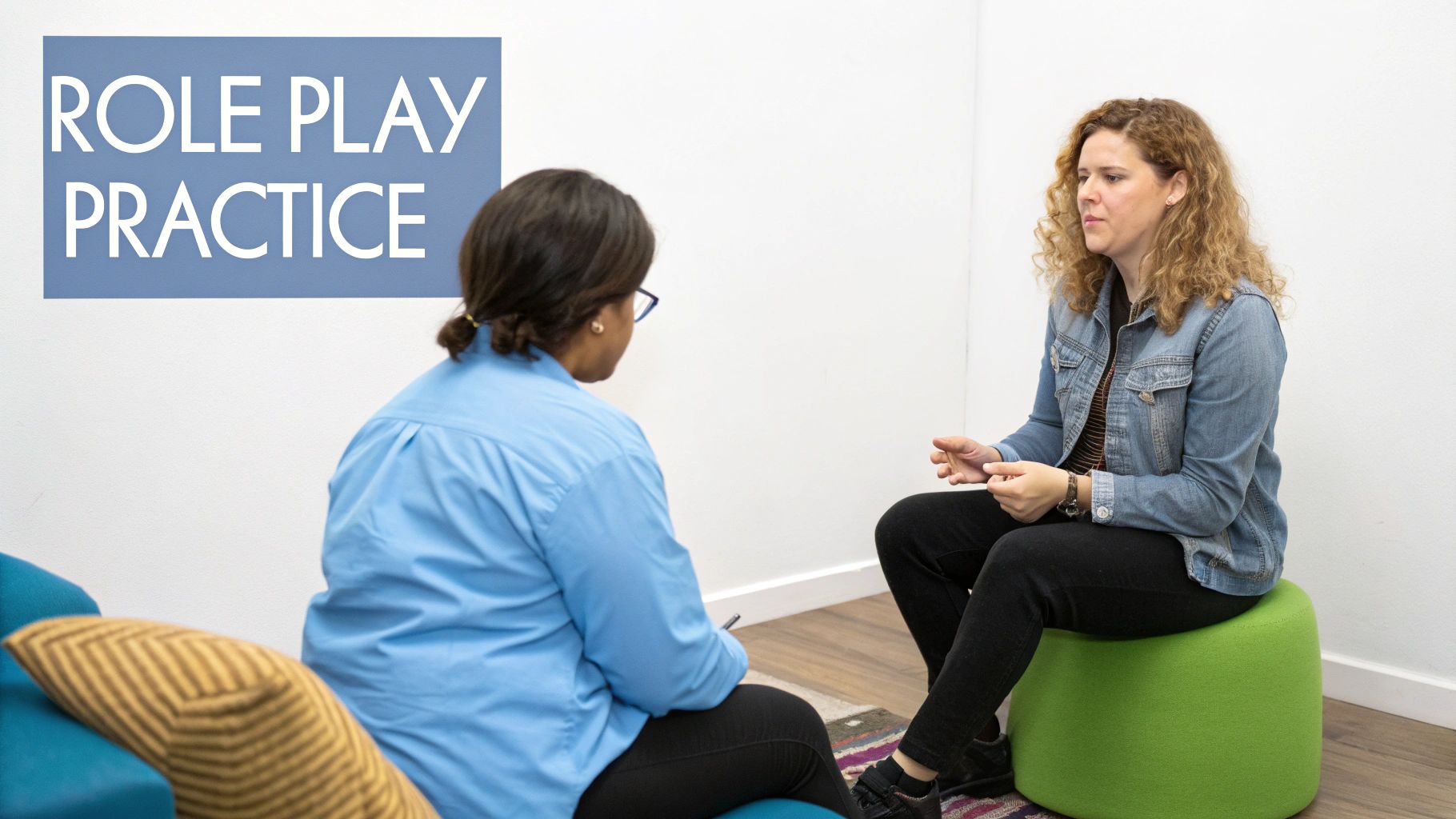
By confronting simulated challenges like social pressure or intense emotional states, members build "muscle memory" for healthy responses. This hands-on approach is highly effective because it moves relapse prevention from a theoretical concept to a practical, rehearsed skill, building confidence and reducing anxiety about future high-risk encounters.
How to Implement Role-Play in a Group Setting
Facilitating role-play requires creating a safe space where participants feel comfortable being vulnerable and making mistakes. The focus is on practice, not performance.
- Develop Realistic Scenarios: Collaborate with the group to create scenarios relevant to their lives, such as being offered a substance at a party, dealing with a stressful family conflict, or experiencing a sudden craving while alone.
- Assign Roles and Rehearse: Assign roles to different members, with one person practicing their coping skills while others might play the part of a trigger or a supportive friend. The participant rehearses using "I" statements, setting boundaries, or deploying a specific coping technique.
- Provide Constructive Feedback: After each role-play, the group and facilitator provide feedback. Focus on what the participant did well and offer gentle suggestions for alternative approaches, reinforcing positive behaviors.
- Debrief and Process: Always dedicate time after a simulation for the entire group to process the experience. Discuss the emotions that came up, the effectiveness of the strategies used, and what was learned.
Key Insight: Role-playing transforms abstract coping skills into tangible, accessible tools. By safely practicing difficult conversations and actions, individuals significantly increase their capacity to navigate real-life triggers successfully and maintain their recovery.
6. Recovery Goal-Setting and Action Planning Groups
Recovery goal-setting and action planning groups provide a structured environment where individuals collaboratively define and pursue their recovery objectives. This approach moves beyond abstract intentions, teaching participants to create specific, measurable, achievable, relevant, and time-bound (SMART) goals. The group dynamic fosters accountability and mutual support, turning individual aspirations into a shared mission.
This method is powerful because it builds self-efficacy and momentum. By breaking down the daunting prospect of lifelong sobriety into manageable steps, participants experience consistent wins, which reinforces their commitment. The group serves as both a source of encouragement and a practical resource for overcoming obstacles, making it one of the most empowering relapse prevention activities for groups.
How to Implement Goal-Setting in a Group Setting
A facilitator’s role is to guide the group in transforming broad recovery desires into concrete, actionable steps. The process should be collaborative, transparent, and focused on tangible progress.
- Create Written Goal Contracts: Have members write down their primary recovery goals and the specific actions they will take to achieve them. Signing these documents adds a layer of personal commitment and accountability.
- Break Down Large Goals: Guide participants to deconstruct a large goal, like "stay sober for a year," into smaller weekly or monthly milestones. Examples include attending three support meetings this week or practicing a new coping skill daily.
- Regular Progress Reviews: Dedicate a portion of each session to reviewing progress. Members can share successes, discuss challenges, and receive constructive feedback and encouragement from the group.
- Celebrate Achievements: Publicly acknowledge when a member reaches a milestone, no matter how small. This celebration reinforces positive behavior and motivates the entire group to keep moving forward.
Key Insight: The value of goal-setting groups lies in their ability to transform hope into a concrete plan. When members see their peers systematically achieving goals, it provides tangible proof that long-term recovery is not just possible, but achievable through deliberate action.
7. Coping Skills Workshop Series
A Coping Skills Workshop Series offers a structured, sequential approach to building the practical tools needed for long-term recovery. Instead of a single session, these workshops are designed as a curriculum, with each meeting focusing on a specific, manageable skill set. This format allows participants to learn, practice, and master techniques for managing stress, regulating emotions, handling cravings, and navigating high-risk social situations.
The series format is powerful because it builds momentum and reinforces learning over time. Members can practice a skill between sessions and report back on their experiences, creating a practical feedback loop. This focused, skill-by-skill approach makes the overwhelming task of staying sober feel more achievable and is a cornerstone of effective relapse prevention activities for groups.
How to Implement a Coping Skills Workshop Series
A successful series requires a clear curriculum and an engaging, interactive environment led by a facilitator. The goal is to move beyond theory and into real-world application.
- Dedicated Skill Modules: Structure each workshop around a single theme, such as stress management (deep breathing, mindfulness), anger management (identifying triggers, de-escalation), or social skills (setting boundaries, assertive communication).
- Provide Practical Tools: Use workbooks, handouts, and practice logs to support learning. For a stress management module, provide a worksheet for participants to track their daily stressors and the coping skills they used.
- Use Varied Teaching Methods: Combine short lectures with video demonstrations, group discussions, and role-playing. This keeps participants engaged and accommodates different learning styles.
- Connect to Relapse Prevention: Explicitly link each skill back to recovery. For example, when teaching emotion regulation, discuss how unmanaged emotions can be a powerful trigger for substance use.
Key Insight: A workshop series breaks down the complex process of recovery into digestible, actionable steps. By mastering one skill at a time, individuals build a robust toolkit and the confidence to use it when facing real-life challenges.
Building a foundation of healthy coping mechanisms is essential for navigating the pressures that can lead to relapse. Exploring a wide range of these techniques can empower individuals to find what works best for them. For a deeper dive into these vital tools, you can read more about developing coping skills for addiction on dallasdetox.com. This knowledge reinforces why a dedicated workshop series is such a valuable and empowering group activity.
8. Triggers and Craving Identification Group
Triggers and Craving Identification groups are focused sessions designed to help participants pinpoint the specific people, places, emotions, and situations that can provoke substance use cravings. These meetings systematically deconstruct the relapse process by bringing awareness to the early warning signs that precede a lapse in sobriety.
The group setting offers a powerful advantage by allowing members to share their unique triggers, which often helps others identify triggers they hadn't recognized in themselves. This shared exploration normalizes the experience of having triggers and fosters a collaborative environment for creating proactive coping strategies. It is one of the most fundamental relapse prevention activities for groups because it empowers individuals to manage their environment and internal states.
How to Implement a Triggers and Cravings Group
Facilitating this group involves moving from broad concepts to specific, personalized plans. The goal is to equip each member with a clear roadmap of their high-risk situations and what to do when they arise.
- Create Trigger Maps: Use a large whiteboard or individual worksheets where members can visually map their triggers. Categorize them into internal (e.g., stress, loneliness) and external (e.g., a specific bar, an old acquaintance) to see patterns.
- Structured Identification Worksheets: Provide worksheets that guide participants through identifying triggers related to all five senses (sight, sound, smell, taste, touch) as well as emotional and social cues.
- Develop Contingency Plans: For each major trigger identified, the group can brainstorm and document a "contingency plan." This is a step-by-step guide on what actions to take when that trigger is encountered, such as calling a sponsor or leaving the situation immediately.
- Periodic Reassessment: Emphasize that triggers can change over time. Schedule regular check-ins where members can update their trigger lists and refine their management strategies based on new life experiences.
Key Insight: Understanding a trigger is only the first step. The true power of this group exercise comes from creating and rehearsing a concrete, actionable plan for what to do the moment a trigger is identified, turning a moment of vulnerability into an opportunity for empowerment.
9. Recovery Support Network Building Group
A Recovery Support Network Building Group is a crucial component of long-term sobriety, focusing on developing and strengthening healthy social connections. These sessions guide participants in identifying supportive relationships, setting boundaries with negative influences, and building a community that champions their recovery, effectively reducing the isolation that often fuels relapse.
The group environment itself serves as a foundational support system. It provides a safe space where individuals can practice communication, share vulnerabilities, and learn how to foster connections that offer accountability and encouragement. This is one of the most vital relapse prevention activities for groups because it builds the external framework necessary to sustain internal change.
How to Implement a Support Network Group
Facilitating this group involves practical exercises aimed at mapping, building, and maintaining a robust support system. The goal is to move from theoretical support to a tangible, real-world network.
- Supportive Relationship Mapping: Ask participants to create a visual map of their current social circle, color-coding relationships as supportive, neutral, or detrimental. This exercise helps identify who to lean on and who to distance from.
- Boundary Setting Role-Play: Create scenarios where members practice setting firm but respectful boundaries with friends or family who enable substance use. For example, a member could rehearse declining an invitation to a bar.
- Community Connection Planning: Guide the group in researching and scheduling attendance at local recovery events, support meetings (like AA or NA), or sober social clubs. The goal is to integrate members into the broader recovery community.
- Peer Support Systems: Establish a group phone tree or a secure messaging group to provide immediate peer support between sessions, helping members navigate cravings or difficult moments in real-time.
Key Insight: Recovery is not a solitary journey. The strength of a person's support network is often directly proportional to their ability to maintain long-term sobriety. This group transforms the abstract concept of "support" into a concrete, actionable life skill.
Building a solid support network is essential for navigating the challenges of post-treatment life. By creating these connections, individuals develop a safety net that protects their progress and fosters continued growth. For those seeking structured support after treatment, exploring an Alumni Program can provide an immediate and powerful network of peers who understand the recovery journey.
10. Lapse vs. Relapse Education and Management Group
Lapse vs. Relapse Education and Management groups are crucial educational sessions that demystify the recovery journey. They teach participants the critical difference between a "lapse," a brief, isolated return to substance use, and a "relapse," a full-blown return to old patterns. This distinction empowers individuals to view a slip-up not as a total failure but as a learning opportunity that can be managed and overcome.
The group setting normalizes the experience of a lapse, reducing the shame and guilt that often fuel a full relapse. By providing a framework to understand and interrupt this progression, these sessions are one of the most practical relapse prevention activities for groups, offering immediate, actionable strategies to get back on track.
How to Implement a Lapse vs. Relapse Education Group
Facilitating this group requires creating a non-judgmental atmosphere where members feel safe discussing setbacks. The focus is on proactive planning and compassionate self-correction.
- Define the Terms: Clearly differentiate a lapse (a mistake) from a relapse (abandoning the recovery plan). Use analogies, like a dieter eating a piece of cake versus abandoning their diet entirely, to make the concept relatable.
- Case Study Discussions: Present anonymous case studies or real-life examples of individuals who successfully managed a lapse. Discuss what actions they took to prevent it from escalating.
- Develop a "Lapse Plan": Guide each member in creating a personalized, written action plan. This plan should outline immediate steps to take after a lapse, such as calling a sponsor, attending a meeting, or contacting a therapist.
- Challenge the Abstinence Violation Effect: Educate the group on this psychological phenomenon, where feelings of guilt and self-blame after a lapse lead to giving up entirely. Role-play self-compassionate responses to counter this effect.
Key Insight: The primary goal is to reframe a lapse from a catastrophe into a correctable event. By equipping individuals with a pre-planned response, the power of a single misstep is significantly diminished, fostering resilience and long-term commitment to recovery.
Understanding that the path to recovery is not always linear is fundamental. By providing tools to manage setbacks, these groups build confidence and reinforce the idea that recovery is a continuous process of learning and growth. To explore more about the long-term journey of recovery, you can read about the importance of aftercare planning on dallasdetox.com. This knowledge helps solidify why managing lapses effectively is a cornerstone of sustainable sobriety.
10-Point Comparison: Relapse Prevention Group Activities
| Intervention | Implementation Complexity 🔄 | Resource Requirements ⚡ | Expected Outcomes ⭐📊 | Ideal Use Cases 💡 | Key Advantages ⭐ |
|---|---|---|---|---|---|
| Cognitive Behavioral Therapy (CBT) Group Sessions | Moderate–High 🔄: structured curriculum; trained facilitator required | Moderate ⚡: therapist time, materials, weekly sessions | High ⭐⭐⭐⭐ 📊: improved coping, reduced relapse over weeks | Individuals needing structured skill-building in outpatient/group care | Evidence-based; practical tools; addresses cognitive root causes |
| Peer Support and Accountability Groups | Low 🔄: informal structure; peer-led possible | Low ⚡: minimal cost; community spaces | Moderate ⭐⭐⭐ 📊: increased engagement, reduced isolation | Ongoing mutual support, low-cost community options | Strong sense of belonging; accessible; reciprocal benefit |
| Relapse Prevention Skills Training (RPST) Workshops | Moderate 🔄: time-limited but curriculum-dense | Moderate ⚡: skilled facilitators, written plans | High ⭐⭐⭐⭐ 📊: focused skill mastery; concrete prevention plans | Discharge workshops, brief intensive training before transition | Time-efficient; concrete plans; builds self-efficacy |
| Mindfulness and Meditation Groups | Low–Moderate 🔄: facilitator-guided practice; requires consistency | Low ⚡: recordings, facilitator; minimal equipment | Moderate ⭐⭐⭐ 📊: reduced stress/cravings with regular practice | Managing stress-triggered cravings; adjunctive treatment | Accessible; non-pharmacological; improves emotion regulation |
| High-Risk Situation Simulation & Role-Play | High 🔄: intensive facilitation; safety/trauma considerations | High ⚡: skilled facilitators, time for rehearsal/debrief | High ⭐⭐⭐⭐ 📊: strong behavioral change and confidence gains | Mid/advanced recovery; preparing for real-world triggers | Experiential learning; identifies coping gaps; memorable practice |
| Recovery Goal-Setting & Action Planning Groups | Moderate 🔄: structured planning and follow-up | Low–Moderate ⚡: facilitators, tracking tools | Moderate–High ⭐⭐⭐📊: increased motivation, measurable progress | Motivated clients needing direction and accountability | Clarifies purpose; measurable steps; peer feedback |
| Coping Skills Workshop Series | Moderate 🔄: sequential topics, repeated attendance needed | Moderate ⚡: series format, materials, facilitator time | High ⭐⭐⭐⭐ 📊: broad practical toolkit when completed | Building comprehensive coping strategies across triggers | Directly applicable skills; customizable; increases self-efficacy |
| Triggers & Craving Identification Group | Low–Moderate 🔄: assessment-focused; individualized mapping | Low ⚡: worksheets, facilitator time | Moderate ⭐⭐⭐ 📊: increased self-awareness; foundation for prevention | Intake, early recovery, tailoring other interventions | Highly personalized; reveals early warning signs |
| Recovery Support Network Building Group | Moderate 🔄: trust-building and community linkage | Low–Moderate ⚡: mapping exercises, community contacts | High ⭐⭐⭐⭐ 📊: strong protective effect on relapse rates | Those with some social resources; rebuilding support networks | Strengthens social accountability; reduces isolation |
| Lapse vs Relapse Education & Management Group | Low 🔄: educational format; crisis planning | Low ⚡: facilitator, case examples, action plans | Moderate ⭐⭐⭐ 📊: reduces shame; improves quick recovery after lapse | Continuing care, aftercare, relapse-risk education | Normalizes setbacks; provides immediate damage-control steps |
Integrating Group Activities into a Lasting Recovery Plan
The journey to sustained sobriety is not a passive process but an active, ongoing practice of building skills, fostering connection, and deepening self-awareness. The diverse relapse prevention activities for groups detailed throughout this article represent a powerful and comprehensive toolkit designed to support this journey. From dissecting cognitive distortions in CBT sessions to practicing real-world refusal skills in role-playing workshops, each activity contributes a vital layer of defense against the pressures of addiction.
The true strength of these approaches lies in their synergy. An effective recovery plan, like those we facilitate for individuals and families across the Dallas–Fort Worth area, does not rely on a single method. Instead, it strategically integrates multiple modalities. A person might use the emotional regulation techniques learned in a mindfulness group to manage a craving identified in their triggers workshop, then draw strength from their peer support network to navigate the high-risk situation. This multi-faceted strategy ensures that individuals are equipped to handle challenges from every angle: cognitive, emotional, social, and behavioral.
Building a Resilient Recovery Framework
Mastering the concepts presented in these group activities is invaluable because it shifts the individual's role from being a passive victim of addiction to an empowered architect of their own recovery. Participating in these structured, supportive environments demystifies the recovery process, breaking it down into manageable skills and actionable steps. It replaces isolation with community, helplessness with competence, and fear with a well-practiced plan.
Ultimately, the goal is to internalize these strategies so they become second nature. Consistent engagement in relapse prevention activities for groups builds more than just a list of coping mechanisms; it builds a resilient mindset. It fosters a profound understanding that while challenges will arise, you possess the tools, the knowledge, and the support system necessary to face them without returning to substance use. This foundation of preparedness and connection is the very essence of a lasting, fulfilling life in recovery.
Key Takeaways
- Variety is Key: A robust relapse prevention plan incorporates multiple types of group activities, addressing cognitive, behavioral, emotional, and social needs.
- Practice Builds Confidence: Experiential activities like role-playing and skills workshops are crucial for turning knowledge into real-world capability.
- Community is a Buffer: Strong peer support networks are one of the most significant predictors of sustained recovery, reducing isolation and providing accountability.
- Self-Awareness is Foundational: Activities focused on identifying personal triggers and cravings empower individuals to anticipate and manage high-risk situations proactively.
- Lapses Are Not Failures: Understanding how to manage a brief lapse without it turning into a full relapse is a critical resilience skill that reduces shame and promotes a quick return to the recovery path.
Frequently Asked Questions (FAQ)
-
What is the ideal group size for these activities?
- For most therapeutic and skills-based groups, a size of 8-12 participants is ideal. This is small enough to ensure everyone has a chance to participate and receive individual attention, yet large enough to generate diverse perspectives and rich discussion.
-
How do I know which type of group is right for me?
- Consider your primary challenges. If you struggle with negative thought patterns, a CBT group might be best. If loneliness is a major trigger, a peer support group is essential. Many treatment programs can help guide you to the most beneficial options based on a thorough assessment.
-
Can I participate in these activities online?
- Yes, many of these group activities are now offered in virtual formats. Online CBT groups, peer support meetings (like AA/NA), and mindfulness sessions have become widely accessible, providing crucial support for those with transportation or mobility challenges.
-
Are these activities only for people newly in recovery?
- Not at all. Relapse prevention is a lifelong process. While these activities are fundamental in early recovery, they are also incredibly valuable for individuals with years of sobriety who want to strengthen their skills, reconnect with a supportive community, and address new life stressors.
-
What if I have a co-occurring mental health condition like anxiety or depression?
- It is vital to choose a group that is equipped to handle dual diagnosis. Many of these modalities, especially CBT and mindfulness groups, are specifically designed to address both substance use and mental health symptoms. Always ensure the group facilitator is trained in treating co-occurring disorders.
