

A person may finish detox or rehab feeling relieved, but the next question can feel harder than expected. Home may still carry triggers. Family may want support in place. Search results may bring up “halfway house Fort Worth TX,” yet the options under that label often mean very different things.
That confusion matters. In Fort Worth, the term can refer to sober living homes for recovery, residential reentry centers for parolees, and transitional housing tied to federal custody, and those models have different rules, eligibility paths, and funding structures according to the Texas Department of Criminal Justice halfway house information. A family looking for post-treatment housing can easily end up reading about a criminal justice placement that doesn't apply to a loved one leaving rehab.
For people sorting through legal and housing barriers after an arrest history, this overview of criminal record housing in Texas can help frame why placement options sometimes look limited. For families focused on recovery housing after treatment, it also helps to understand what sober living is and how it differs from rehab, because that's usually the more accurate search term.
The safest choice usually starts with naming the right need. Recovery housing, parole housing, and treatment are not interchangeable.
Table of Contents
- Your Next Step After Treatment What Is a Halfway House
- Halfway House vs Sober Living Home in Fort Worth
- How Sober Living Fits into Your Recovery Journey
- Navigating Sober Living Regulations in Texas
- Questions to Ask Before Choosing a Sober Living Program
- Costs Insurance and Transportation in DFW
- Start Your Recovery Journey with Confidence at Tru Dallas
Your Next Step After Treatment What Is a Halfway House
The phrase halfway house Fort Worth TX sounds simple, but it usually isn't. A son may be leaving inpatient treatment. A spouse may be trying to avoid a return to the same apartment where substance use happened. A parent may think a halfway house is the standard next step, only to discover that some places under that label aren't recovery housing at all.
That's why the first question shouldn't be, “Which halfway house is best?” The first question should be, “What kind of setting does this person need right now?”
The three needs people often mix together
In everyday searches, these categories get blended:
- Recovery housing: A sober living home for someone who has completed detox, rehab, or another treatment phase and needs a sober place to live.
- Criminal justice reentry housing: A supervised placement connected to parole, probation, or another correctional process.
- Treatment: Detox, residential rehab, outpatient care, or medication support for someone who still needs clinical services.
Each serves a different purpose. One focuses on daily sober living. Another focuses on supervision and reentry. Another provides medical or therapeutic care.
What families often expect
Many families use “halfway house” as a catch-all term for any structured housing after addiction treatment. That's understandable. The problem is that a person leaving treatment may need peer accountability and routine, not a justice-system placement. Another person may still need a higher clinical level of care before sober living is appropriate.
Practical rule: If someone still needs withdrawal support, active psychiatric stabilization, or daily clinical treatment, housing alone isn't enough.
A useful way to think about it is this. Halfway house is a broad public term. Sober living home is often the more precise recovery term for a person who's medically stable and working on long-term sobriety.
Halfway House vs Sober Living Home in Fort Worth
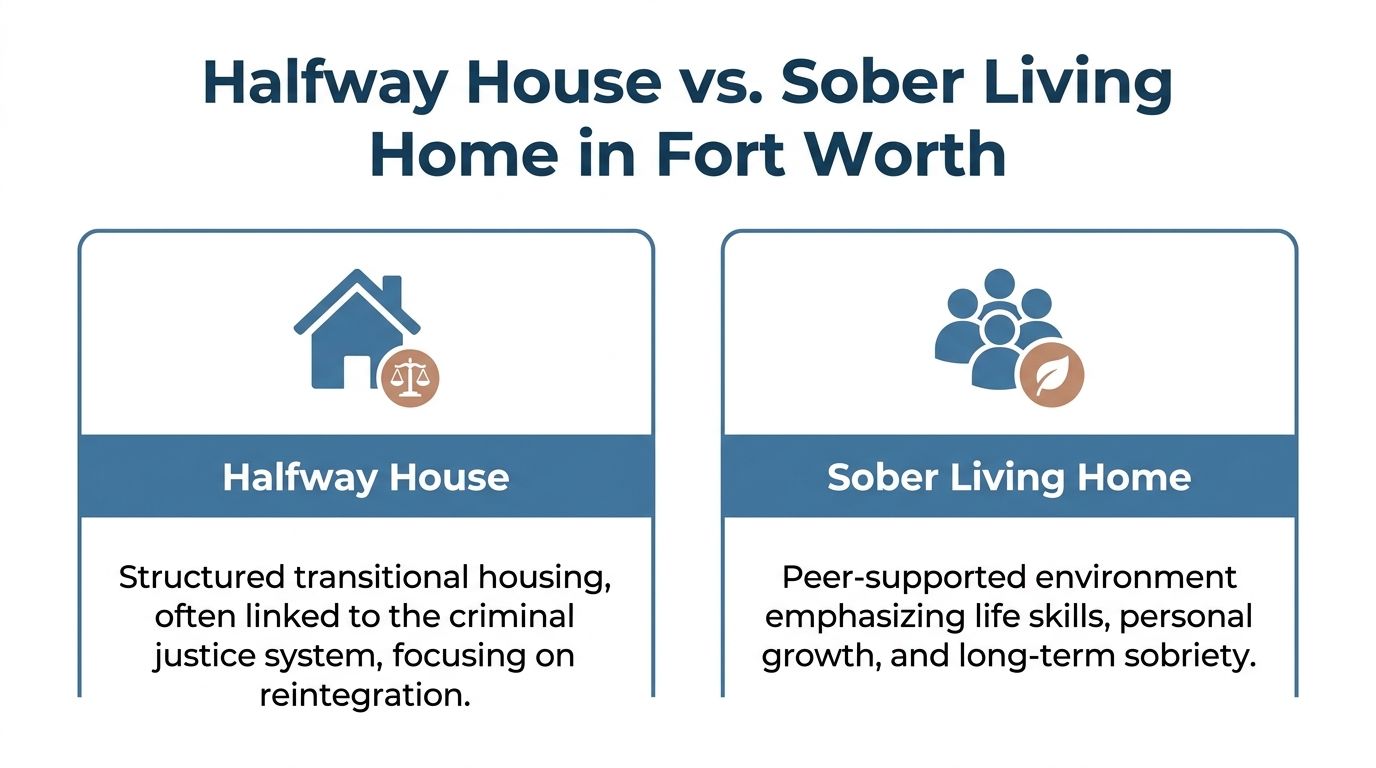
Some searchers are looking for a recovery residence and don't realize they're reading about a reentry facility. Others are dealing with a court, parole, or custody issue and assume a sober living home can substitute for an assigned placement. In Fort Worth, those paths usually don't overlap.
What a halfway house usually means in Fort Worth
A clear local example is the Fort Worth Transitional Center, described by Avalon Correctional Services as a 220-bed halfway house at 600 N. Henderson St., Fort Worth, TX 76107 that contracts with the Texas Department of Criminal Justice for 200 halfway house offenders and also reports services such as employment readiness, placement, case management, and reintegration programs on its Fort Worth Transitional Center page.
That description tells families something important. This kind of halfway house is not just shared housing with peer support. It is a formal, structured reentry setting tied to agencies and placement systems.
Residents in federally contracted residential reentry centers also face a defined supervision model. The federal court guidance for residential reentry centers explains that residents are typically in the last portion of a federal sentence, stay for a limited transition period, complete substance-abuse education and life-skills classes, and move through increasing community access under rules and monitoring on the Northern District of Texas residential reentry centers page.
What sober living means for recovery
A sober living home usually fits a different person. This is often the right option for someone leaving detox, inpatient treatment, or outpatient care who needs a stable, substance-free environment and daily accountability, but not the structure of a correctional placement.
The practical difference is simple:
- Reentry housing is usually referral-based and tied to the justice system.
- Sober living is usually chosen as part of a recovery plan.
- Treatment addresses medical, psychiatric, and therapeutic needs.
For many families searching in Tarrant County or the wider DFW area, the better phrase is often sober living Fort Worth, especially when the goal is recovery support after rehab rather than parole or federal transition housing. This overview of sober living in Fort Worth can help narrow that search.
How Sober Living Fits into Your Recovery Journey
A sober living home can be a strong next step, but it isn't the first step for everyone. The timing matters. A person who is still detoxing from alcohol, opioids, benzodiazepines, or other substances may need medical supervision first. A person with severe depression, anxiety, or another co-occurring condition may need a clinical setting before moving into recovery housing.
Sober living is not treatment
Many people misunderstand this distinction. A sober living home is housing with rules, accountability, and recovery culture. It is not a substitute for detox. It is not the same as inpatient rehab. It usually doesn't provide the level of clinical supervision found in treatment programs.
That doesn't make sober living less important. It makes it a step-down environment. The person has more independence, but still lives in a setting that supports sobriety.
Recovery often works better when support is reduced gradually, not all at once.
Where each level of care fits
The easiest way to understand the continuum is to compare the role of each level.
| Level of Care | Primary Focus | Clinical Supervision | Best For |
|---|---|---|---|
| Medical detox | Safe withdrawal and stabilization | High | People who may experience withdrawal symptoms or need close monitoring |
| Inpatient residential treatment | Intensive therapy and daily recovery structure | High | People who need a protected setting away from triggers |
| Outpatient treatment | Ongoing therapy while living at home or in supportive housing | Moderate to lower, depending on the program | People who are stable enough for more independence |
| Sober living | Safe housing, routine, accountability, peer support | Limited or non-clinical | People who are medically stable and need a structured place to practice recovery |
A common example helps. Someone completes detox and feels physically better, but still has cravings, unstable sleep, strained family relationships, and no healthy home routine. Going straight back home may be risky. Moving into sober living while attending outpatient care can create a more manageable transition.
Another person may still be missing appointments, struggling with active mental health symptoms, or unable to stay substance-free for even short periods. That person may need more treatment before sober living becomes realistic.
Families in Dallas, Fort Worth, Euless, Arlington, and nearby communities often do best when they stop asking whether sober living is “good” or “bad” in general. The better question is whether the person is ready for sober living and whether ongoing treatment will continue alongside it.
Navigating Sober Living Regulations in Texas
Families often assume sober living homes are regulated exactly like treatment centers. That usually isn't the case. Recovery housing sits in a different category, which means the burden shifts to the family and referral source to ask better questions and look for responsible operations.
What Fort Worth regulates locally
Fort Worth treats sober living homes as group residences under local zoning, with requirements around spacing, safety, and occupancy limits, according to a Fort Worth recovery housing guide that also notes Tarrant County reported 503 fatal overdoses in 2023 on its Fort Worth recovery housing guide.
That local detail matters for two reasons. First, it shows that recovery housing isn't an informal side issue. It intersects with neighborhood rules, safety expectations, and public health realities. Second, it reminds families that not every house offering “sober living” operates with the same level of seriousness.
What families should look for
Good oversight often shows up in the basics:
- Clear written rules: Residents should know curfew expectations, guest policies, meeting requirements, and consequences for rule violations.
- Safety practices: Families should ask about medication storage, emergency procedures, room setup, and how the home handles conflicts.
- Appropriate referrals: A responsible home should be willing to say when a person needs treatment first.
- Recovery culture: The house should support sobriety in daily life, not merely provide a bed.
Some homes also pursue voluntary standards or affiliations through recovery housing organizations. Even when a home isn't state-licensed like a detox or rehab facility, families can still evaluate whether it acts like a serious recovery environment or just a rental property using recovery language.
A safe home should be able to explain how it supports sobriety, not just how much rent it charges.
Questions to Ask Before Choosing a Sober Living Program
A strong sober living home usually feels organized from the first phone call. Staff or house leadership should answer direct questions without sounding evasive. If answers are vague, rushed, or inconsistent, families should pause.
Questions that reveal structure
Federal reentry programs offer one useful example of what accountability can look like. The Federal Bureau of Prisons explains that residents in that system are expected to work 40 hours per week within 15 days of arrival, pay a subsistence fee based on income, and follow monitored sign-out rules for approved activities on its residential reentry management centers page. A recovery residence doesn't need to copy that model, but quality homes usually share the same basic idea. Structure supports change.
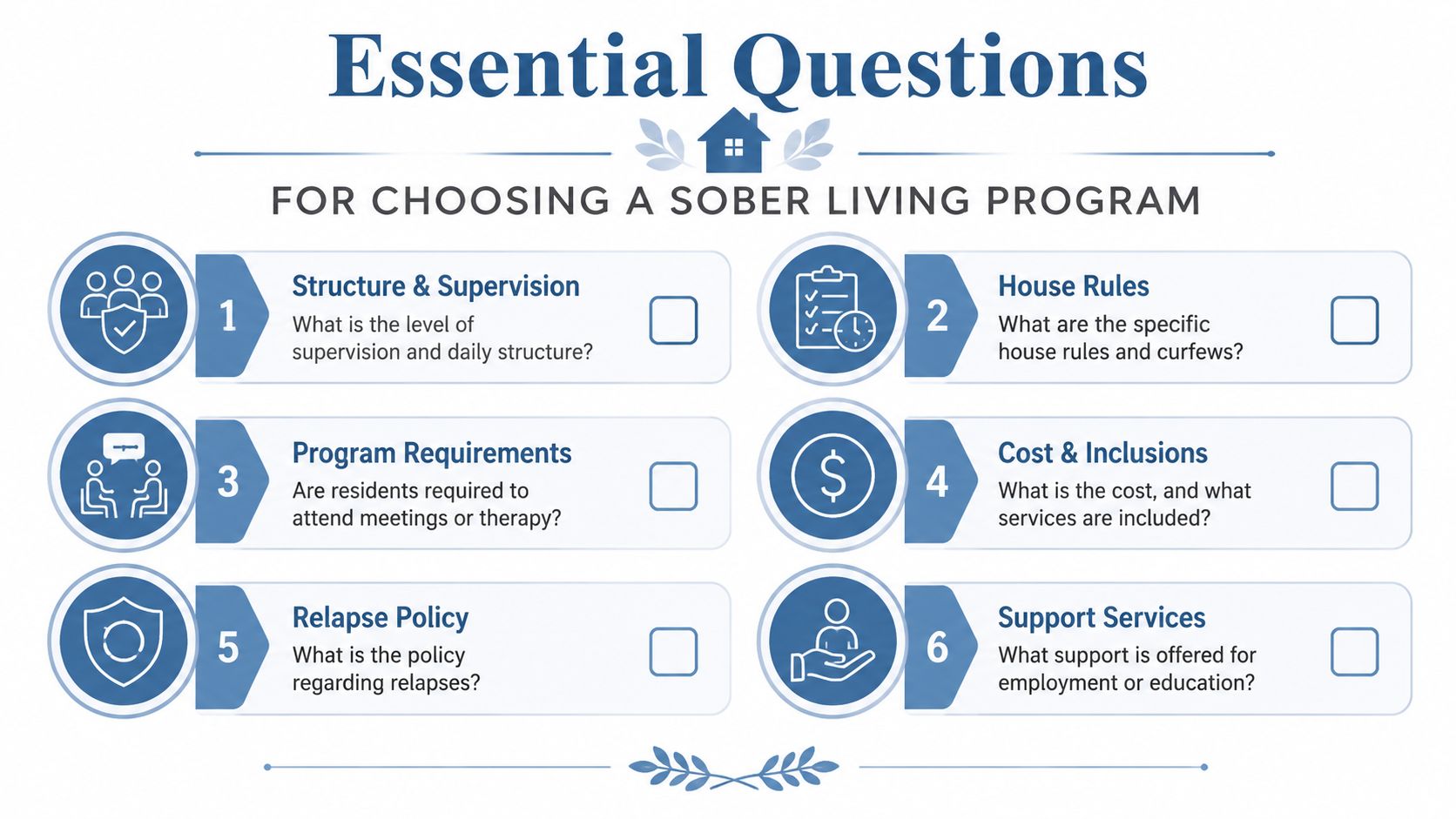
These questions help expose whether a house has that structure:
- How are days organized? A good answer might include curfews, chore expectations, meeting attendance, or regular check-ins.
- What does accountability look like? Ask how the home responds when a resident misses rules, skips obligations, or avoids recovery activities.
- Are work, school, or volunteering expected? A home doesn't need to look punitive, but residents usually do better when daily life has purpose.
- How does the house support routine? Early recovery often improves when waking, meals, transportation, and meetings follow a predictable pattern.
Questions that reveal safety and fit
Structure alone isn't enough. A house can have rules and still be the wrong fit.
Families should also ask:
- How are relapses handled? Some homes respond with immediate discharge. Others assess safety, clinical needs, and next steps. The policy should be clear.
- Is the home compatible with medication-assisted treatment? This is a major issue for people recovering from opioid or alcohol use disorders. The answer should be explicit.
- Who manages the house day to day? Families should know whether there is onsite leadership, a house manager, or another responsible contact.
- What outpatient support is expected or encouraged? A sober living home works better when treatment, therapy, psychiatry, or recovery meetings continue as needed.
One more question often gets overlooked. Ask whether the home would accept the resident if there were no family pressure and no urgency to fill a bed. Ethical homes care about fit. They don't just say yes to everyone.
The right house should feel supportive, but it should also feel boundaried. Recovery rarely grows in chaos.
Costs Insurance and Transportation in DFW
Finances can complicate an otherwise solid plan. Many families can prepare emotionally for sober living, then get stuck on the practical side. Housing costs, insurance questions, and everyday transportation can decide whether a placement works.
What to expect financially
Sober living typically differs from clinical treatment regarding payment. Detox, inpatient rehab, outpatient care, and medication management may involve insurance review depending on the plan and the service. Housing generally works more like rent and household costs.
That distinction matters because families sometimes assume a sober living home will bill insurance the way a treatment center does. Usually, it won't. For people trying to make sense of changing insurer rules and coverage language, this guide to healthcare billing policies can help clarify why housing and clinical services are often handled differently. For a more recovery-specific overview, this article on how much sober living costs and whether financial assistance options exist can help families plan the conversation.
Why location matters every day
A house may look good online and still fail a practical test. Residents need to get to work, outpatient therapy, recovery meetings, pharmacy visits, court obligations, or family appointments. If transportation is unreliable, stress rises quickly.
In DFW, that means families should ask practical questions such as:
- Is the house near work opportunities or common commuting routes?
- Can residents reach meetings and appointments without depending on one unreliable ride?
- Does the neighborhood support recovery, or does it place the resident near old triggers and contacts?
A lower-cost house farther away isn't always the better deal if it makes treatment attendance or employment harder. Recovery housing works best when the daily routine is sustainable, not just affordable on move-in day.
Start Your Recovery Journey with Confidence at Tru Dallas
Individuals searching for a halfway house in Fort Worth aren't really looking for a correctional reentry placement. They're looking for safety after treatment. They want a stable address, accountability, and a realistic chance to keep building sober days without going straight back into the same environment that supported substance use.
Clarity first, then placement
The strongest plans usually start by answering three questions in the right order:
- Is the person medically stable?
- Does the person still need clinical treatment?
- What kind of housing supports the next phase of recovery?
When those answers are rushed, families can land in the wrong setting. A person who needs detox may get sent to housing. A person who needs sober living may be confused by parole-oriented search results. A person who needs outpatient follow-up may end up with housing but no treatment plan.
A safer way to plan the next step
For people in Dallas, Fort Worth, Euless, and the surrounding area, one practical option is Tru Dallas Detox & Recovery Center, which provides medically supervised detox, inpatient or outpatient rehab, medication-assisted treatment, dual diagnosis care, and aftercare planning that can include sober living referrals when appropriate.

That kind of planning matters because sober living is only one part of recovery. The person also needs the right clinical foundation, a manageable discharge plan, support for mental health if needed, and a place to land that matches the actual stage of healing.
Families don't have to decode all of this alone. A careful assessment, honest discussion about readiness, and a housing plan tied to treatment can reduce confusion and help the next step feel possible.
When a family is trying to sort out halfway house Fort Worth TX options, the safest move is to get a confidential assessment and clear guidance before choosing housing. Tru Dallas Detox & Recovery Center can help verify treatment needs, discuss aftercare planning, and support the search for an appropriate next step in recovery.
