

In Texas, the legal alcohol limit is 0.08% BAC for most drivers age 21 and older, 0.04% BAC for commercial drivers, and a zero-tolerance rule for drivers under 21, which means any detectable alcohol can lead to a charge. That's the simple answer, but for many people in Dallas, the trouble often begins after a dinner in Uptown, a game night in Deep Ellum, or drinks with coworkers in Addison, when the drive home suddenly turns into a legal and personal crisis.
A Dallas driver might leave a restaurant feeling steady enough to make it home to Lakewood or Oak Cliff. The car starts. The road feels familiar. Then flashing lights appear in the mirror, and everything changes at once. Fear takes over quickly because the number a person searched for online is only part of what Texas law looks at.
That confusion matters. Many people want a clean rule they can trust, but DWI cases in Texas often turn on behavior, judgment, and what an officer says was observed in the moment. For someone already worried about alcohol use, the stakes can feel even heavier. The legal question becomes personal very fast, especially when work, family, health, and the future all seem at risk.
Table of Contents
- The Question on Every Dallas Driver's Mind
- Texas Blood Alcohol Concentration Limits Explained
- Why a BAC Under 0.08 Can Still Lead to a DWI Charge
- The True Cost of a DWI Conviction in Texas
- Immediate Steps to Take After a DWI Arrest in Dallas
- From a Wake-Up Call to Recovery Your Path Forward in Dallas
- Frequently Asked Questions About Texas DWI
The Question on Every Dallas Driver's Mind
A common Dallas story often has an unassuming beginning. Someone has drinks at dinner near Knox-Henderson, waits a while, drinks water, and is confident the worst is over. By the time that person heads toward North Dallas or the tollway, the thinking usually sounds the same. It's probably fine. The person doesn't feel drunk. Home is close.
That's why so many people search for what's the legal alcohol limit in Texas after a stop, an arrest, or a terrifying near miss. They want certainty. They want to know whether one number decides everything.
The answer is partly legal and partly human. Texas does set specific BAC limits, and those limits matter. But a DWI case can also involve how a person was driving, how clearly that person spoke, how well instructions were followed, and whether normal mental or physical abilities seemed affected.
Why the search usually happens in a moment of crisis
For many families in Dallas-Fort Worth, this question doesn't come up in a calm moment. It comes up late at night from a parking lot, early in the morning after release from jail, or during the first call to a spouse, parent, or employer. Shame and panic often push people toward bad decisions, including talking too much, minimizing what happened, or ignoring the role alcohol may be playing in daily life.
A DWI arrest can be both a legal emergency and a health warning at the same time.
That dual reality matters. Some readers need legal clarity right now. Others also need to ask a harder question. Was this a one-time lapse, or has alcohol already started to shape decisions in dangerous ways?
What makes Dallas drivers especially vulnerable to confusion
Dallas traffic culture can blur judgment. Long commutes, social drinking after work, and the habit of driving almost everywhere create a setting where people regularly convince themselves they're okay to drive. A person may compare the situation to others at the bar, rely on “feeling fine,” or assume that staying below the obvious limit makes the risk manageable.
Texas law is much less forgiving than that mindset suggests. Understanding the numbers is the first step. Understanding how Texas defines intoxication is what protects people from making a second mistake after the first one.
Texas Blood Alcohol Concentration Limits Explained
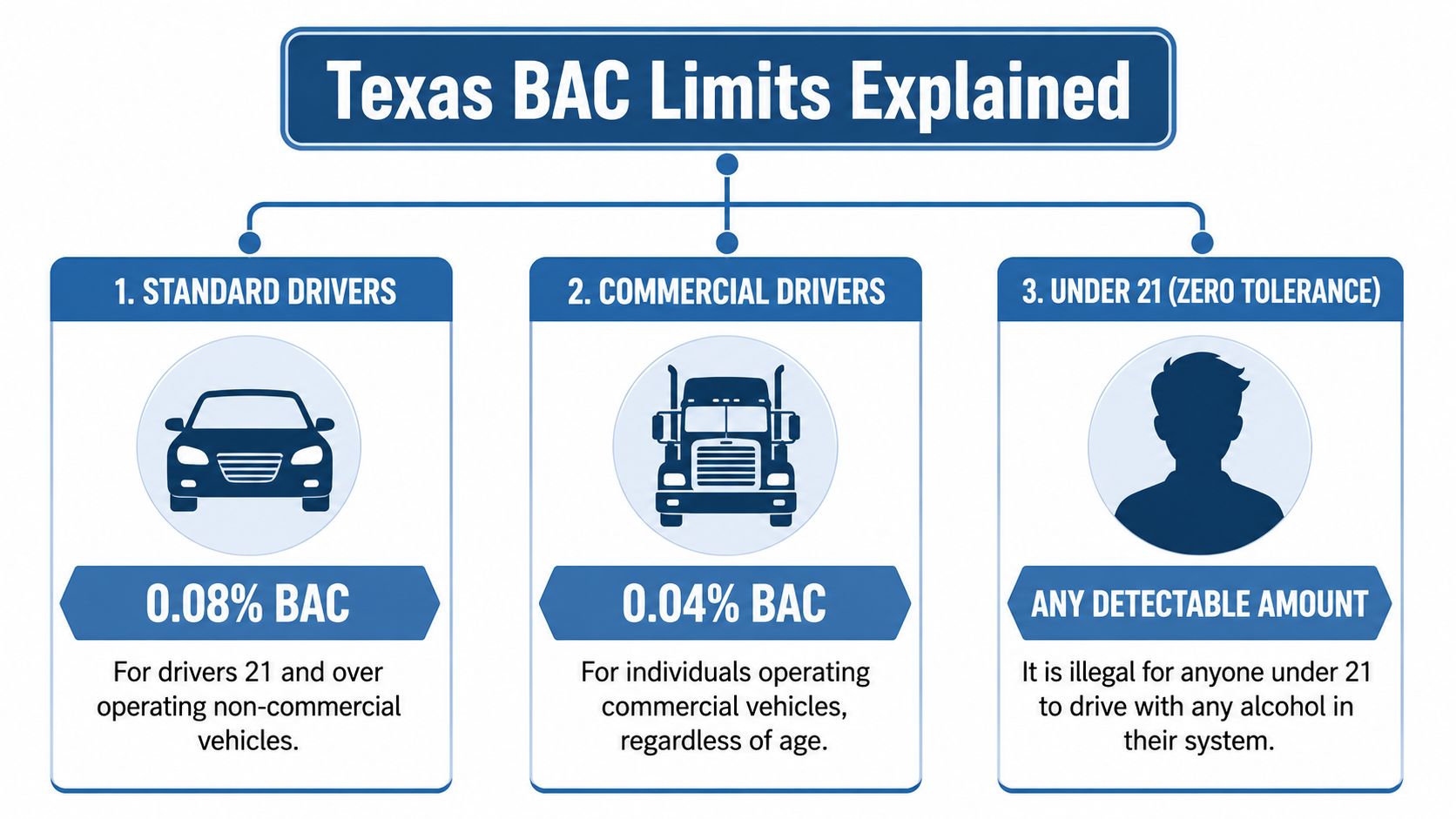
Texas uses three main BAC rules, depending on the driver. According to the Texas Department of Transportation's impaired driving guidance, the legal blood alcohol concentration is 0.08% for drivers age 21 and older operating non-commercial vehicles, 0.04% for commercial drivers, and a zero-tolerance policy applies to drivers under 21, meaning any detectable amount of alcohol can lead to a DUI charge.
For readers comparing state rules while traveling or supporting a family member with charges in multiple places, understanding Georgia's DUI laws can help show how these frameworks differ from one state to another.
How the standard adult limit works
For most adults, 0.08% BAC is the number people hear most often. Texas treats that threshold as a per se standard. In plain language, that means a driver at or above 0.08% is legally intoxicated under the statute, even if the driver insists that everything felt normal.
This point causes a lot of confusion because many people treat 0.08% like a safety line. It isn't a safety line. It's a legal threshold. A person can feel less impaired than expected and still be over it, or feel composed and still make poor decisions behind the wheel.
A simple way to read the rule is this:
| Driver category | BAC rule in Texas | What it means |
|---|---|---|
| Adult non-commercial driver | 0.08% | At or above this level, Texas law treats the driver as legally intoxicated |
| Commercial driver | 0.04% | A stricter threshold applies because of the responsibility attached to commercial driving |
| Driver under 21 | Any detectable alcohol | Zero tolerance means even a small detectable amount can trigger a DUI charge |
Who faces stricter rules
Commercial drivers face a 0.04% BAC limit. That lower standard reflects the heightened safety expectations attached to holding a commercial license. For younger drivers, the rule is even stricter. Under the zero-tolerance approach, a driver under 21 can face consequences for any detectable alcohol in the system.
Practical rule: The safest reading of Texas law is simple. If a person plans to drive, alcohol and “close enough” should never be in the same sentence.
That's why the question “what's the legal alcohol limit in Texas” should never stop at the number alone. The numbers identify the legal baseline. They don't guarantee safety, and they don't tell the whole story of how an arrest happens.
Why a BAC Under 0.08 Can Still Lead to a DWI Charge
One of the most dangerous misunderstandings in Texas is the belief that anything under 0.08% is automatically safe from arrest. It isn't. Texas law also allows a DWI charge when a person has lost the normal use of mental or physical faculties because of alcohol, drugs, or a combination of substances. According to Texas DWI guidance on alcohol limits and sub-0.08 arrests, 15-20% of DWI arrests in Texas occur with BACs below 0.08%.

The rule many drivers miss
A point of confusion for readers often arises: they hear “legal limit” and assume the law cares only about chemistry. Texas also cares about function. If an officer believes alcohol affected coordination, reaction time, speech, balance, or judgment, the case may move forward even below the familiar number.
That matters for people who think clearly in one moment and poorly in the next. It also matters when fatigue, medication, anxiety, or other substances complicate the picture.
A Dallas example makes the point. A driver leaves a bar in Lower Greenville after “just a couple” of drinks. The car drifts over a lane marker. During the stop, the driver fumbles for insurance, answers questions slowly, and struggles with roadside instructions. Even if later testing shows a BAC below 0.08%, the arrest may still rest on the officer's observation that normal faculties seemed impaired.
What that looks like during a stop
The law's focus on impairment means behavior becomes evidence. Common issues can include:
- Driving pattern concerns: Drifting, late braking, inconsistent speed, or a minor traffic violation can start the encounter.
- Physical signs: Slurred speech, red eyes, trouble standing steadily, or delayed responses can shape the officer's judgment.
- Task performance: Difficulty following directions or completing roadside exercises may be treated as signs of impairment.
For readers who are also trying to understand how alcohol shows up in testing, this guide on whether a drug test can detect alcohol helps explain part of the testing side in plain language.
Being under 0.08% doesn't mean a person is protected from a DWI arrest. It only means the case may rely more heavily on observed impairment.
That's why “I felt fine” is such a risky defense in real life. Feeling fine and driving safely aren't always the same thing. In Texas, the law leaves room for that difference.
The True Cost of a DWI Conviction in Texas
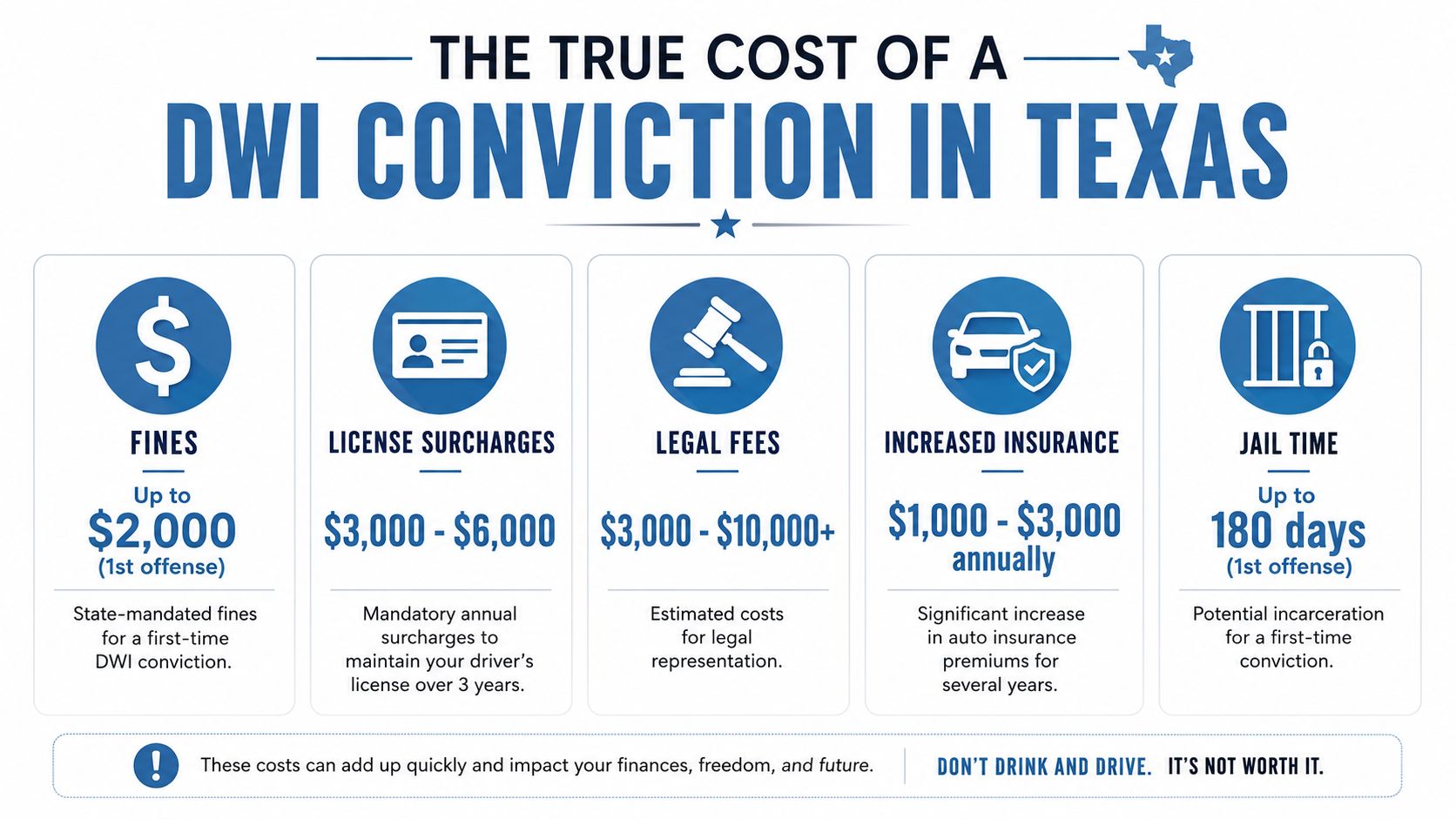
A DWI conviction in Texas can change a person's finances, schedule, reputation, and relationships all at once. According to Texas DWI penalty guidance for first offenses and high BAC cases, a first-time DWI is a Class B misdemeanor with fines up to $2,000 and up to 180 days in jail. If the BAC is 0.15% or higher, the charge rises to a Class A misdemeanor with fines up to $4,000 and up to one year in jail.
How penalties increase
The legal system treats BAC level and repeat conduct seriously. Higher alcohol concentration can bring a harsher charge, and repeated offenses can move a case into felony territory. The same verified Texas penalty summary notes that a third DWI offense can become a first-degree felony with a $10,000 fine and up to 10 years in prison through Texas BAC legal limit and penalty information.
The numbers are serious enough on their own, but they rarely capture the full disruption. Court appearances, time away from work, transportation problems, and family stress can turn one arrest into a long period of instability.
A reader in Dallas may also be facing practical problems that don't wait for the case to end:
- Work risk: Missing shifts, losing trust with supervisors, or struggling to commute without a license.
- Parenting pressure: School drop-offs, custody schedules, and household routines can unravel quickly.
- Emotional fallout: Shame, secrecy, and conflict at home can deepen alcohol use instead of stopping it.
The damage outside the courtroom
The courtroom penalty is only one layer. The private cost can be worse. A person may stop attending family events, avoid calls, or start drinking in more isolated ways after the arrest. That pattern is especially dangerous because legal fear often pushes the underlying alcohol problem underground.
For some people, the arrest exposes a problem that loved ones had already noticed. For others, it is the first moment anyone says out loud that alcohol may be controlling more than just a night out.
A DWI conviction doesn't just punish a bad decision. It can expose a pattern that needs treatment before the next crisis arrives.
The most useful way to look at the cost is broad. There is the legal cost. There is the financial cost. Then there is the personal cost of doing nothing after a warning that could have been fatal.
Immediate Steps to Take After a DWI Arrest in Dallas
The hours after a DWI arrest are chaotic. A person may be scared, embarrassed, angry, or desperate to explain everything away. The fastest way to regain control is to stop reacting emotionally and start making careful decisions.
What to do in the first hours
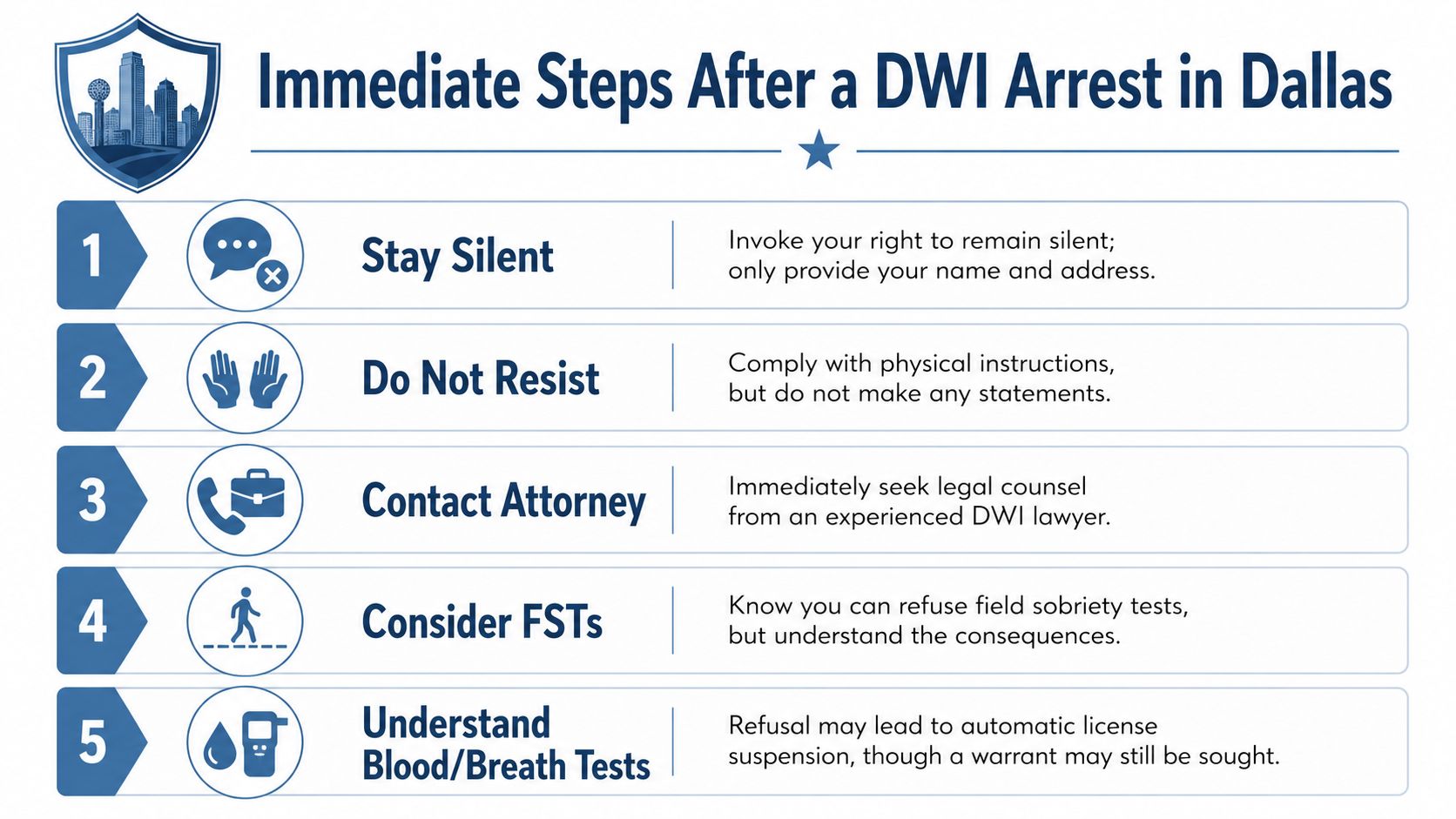
The first priority is simple. Stay respectful and protect legal rights at the same time. A person can comply physically without offering extra explanations, guesses, or apologies that may later be used against that person.
A calm response usually looks like this:
- Provide basic identifying information. Name and address are routine. Volunteering a long explanation usually isn't helpful.
- Don't argue on the roadside. The place to challenge evidence is through counsel, not during the stop.
- Avoid self-damaging statements. Comments like “I only had a few” or “I thought I was okay” may sound harmless but can become part of the case.
For readers reviewing defense issues after an arrest, these Humble TX Lawyers DWI insights offer a useful overview of how charges may be challenged.
How to regain control quickly
After release, a person should focus on three tracks at once. Legal, practical, and personal.
- Legal: Contact a qualified Dallas-area DWI attorney as soon as possible.
- Practical: Find out where the vehicle is, keep records, and organize paperwork immediately.
- Personal: Take an honest look at what led to the arrest. If alcohol use has been escalating, this isn't the moment to minimize it.
Some people are surprised to learn that court involvement and treatment can overlap in important ways. This explanation of rehab and court-mandated treatment helps clarify how treatment can fit into the larger legal picture.
Critical point: The best immediate step after a DWI arrest is not damage control through excuses. It's damage control through calm, documented, informed action.
A short checklist can help a family member support someone after an arrest:
| First-day priority | Why it matters |
|---|---|
| Get legal guidance | Early advice can protect rights and prevent avoidable mistakes |
| Gather documents | Court papers, towing information, and release details are easy to lose in a panic |
| Stabilize transportation | Work and family obligations don't pause while the case moves forward |
| Assess alcohol use honestly | The arrest may be signaling a deeper problem that needs treatment |
The person who acts early usually has more options than the person who freezes, hides, or waits for the next hearing.
From a Wake-Up Call to Recovery Your Path Forward in Dallas
A DWI arrest often feels like a collapse. In some cases, it becomes the first honest turning point a person has had in years. The legal crisis forces a question that family members may have been afraid to ask directly. Is alcohol causing more harm than anyone wanted to admit?

When the legal crisis points to a health problem
Not every DWI arrest means a person has alcohol use disorder. But every DWI arrest deserves a serious review of alcohol's role in decision-making, stress, sleep, work, and relationships. If drinking has become a coping strategy, the risk usually grows in private before it becomes visible in public.
Warning signs can include patterns like these:
- Using alcohol to come down after stress
- Hiding the amount consumed from loved ones
- Driving after drinking because it has “worked out before”
- Needing alcohol to sleep, relax, or get through social situations
When those patterns are present, legal help alone won't solve the underlying danger. Medical and therapeutic support may be the safer next step.
What real support can look like in Dallas
For Dallas-area families, meaningful help usually starts with structure. That can mean medically supervised detox when stopping alcohol suddenly may be physically risky. It can also mean therapy, dual diagnosis care for co-occurring mental health symptoms, and a realistic plan for what happens after the immediate crisis settles.
Readers exploring treatment options often benefit from learning how medically supervised alcohol detox works before making a decision. Understanding the process reduces fear and helps families act sooner.
A strong local treatment option should offer more than a bed and a promise. It should provide clinical monitoring, individualized planning, support for mental health needs, and a path that continues after detox. In the Dallas-Fort Worth area, that combination matters because many people need care that fits work obligations, family involvement, and the emotional shock of a recent arrest.
Recovery often starts when a person stops asking how to get past the charge and starts asking how to stop repeating the pattern.
In these circumstances, timely action matters most. The same event that threatens a license, a job, or trust at home can also become the moment that keeps something worse from happening later. For many people in Dallas, the path forward is not about pretending the arrest was only bad luck. It's about using the warning for what it is.
Frequently Asked Questions About Texas DWI
What happens if someone refuses a breath or blood test
Refusing chemical testing can create serious consequences of its own. Texas uses implied consent principles, which means driving on Texas roads comes with legal obligations around testing after a lawful arrest request. Refusal can lead to license-related consequences, and officers may still seek a warrant for a blood draw depending on the circumstances. A person in this position should get legal advice quickly.
Can a DWI come off a record
Sometimes, but not automatically. Whether a DWI can be removed from a record or sealed depends on the case outcome, prior history, and other legal details. Some people assume every arrest can be erased with time. That assumption can lead to costly mistakes, especially when employment or licensing issues are involved. A qualified Texas attorney should review the exact case facts.
Can a DWI affect work and professional licenses
Yes. A DWI can affect job applications, employer trust, driving-related work duties, and some professional licensing reviews. In Dallas, the practical impact may be immediate for anyone who commutes long distances, drives for work, supervises others, or holds a position that depends on background checks and reliability.
For families, the key point is simple. A DWI case is rarely “just a traffic matter.” It can touch nearly every part of daily life.
If the arrest also revealed an unhealthy relationship with alcohol, the smartest response is to handle both problems. Legal support protects rights. Treatment protects the future.
For anyone in Dallas-Fort Worth who's facing a DWI and questioning whether alcohol has become a bigger problem, Tru Dallas Detox & Recovery Center offers confidential help, medically supervised detox, personalized treatment planning, and support for co-occurring mental health needs. A call for guidance or insurance verification can be the first steady step out of panic and toward real recovery.
