
The moment usually doesn't feel dramatic. It feels confusing.
A person in Dallas stops using meth after a binge and expects to “sleep it off,” but the crash turns into something harder to control. They can't think clearly. They sleep for long stretches, then wake up agitated, empty, and desperate to use again. A partner notices paranoia, mood swings, or a deep depression that wasn't there before. A parent sees someone who looks physically spent and emotionally unreachable.
That's often when families realize this isn't just a bad comedown. It's withdrawal.
Meth withdrawal signs can feel frightening, but they aren't random. They follow a recognizable medical pattern. That matters, because what has a pattern can be monitored, managed, and treated. For people across Dallas, Euless, Fort Worth, Irving, Arlington, and the wider DFW area, safe help is available close to home.
Table of Contents
- Recognizing the Need for Help
- Common Physical and Psychological Withdrawal Signs
- The Meth Withdrawal Timeline Day by Day
- Factors That Influence Withdrawal Severity
- When to Seek Emergency Care or Medical Detox
- How Medically Supervised Detox in Dallas Can Help
- Your Path Forward After Detox
Recognizing the Need for Help
For many people, the warning sign isn't one symptom. It's the cycle.
Someone uses meth, crashes, feels awful, and then uses again just to escape the crash. That cycle can tighten fast. The body gets exhausted, sleep becomes irregular, appetite changes, and thinking gets darker. Families in Dallas often describe the same turning point. They stop asking, “Is this just a rough few days?” and start asking, “Is this safe?”
That question matters. Meth withdrawal signs can include intense cravings, fatigue, mood changes, and psychological distress. None of that means a person has failed. It means the brain and body are reacting to the absence of a powerful stimulant.
Meth withdrawal is easier to face once it's named clearly. It's not chaos. It's a withdrawal process, and withdrawal responds best to structure.
A person may need help when they can no longer reliably care for themselves, when they're emotionally unstable, or when loved ones feel they have to watch them constantly. That can show up as sleeping for unusually long periods, becoming severely depressed, losing motivation completely, or cycling into fear and suspicion. It can also look quieter than people expect. A flat, numb, disconnected presentation can be just as serious as agitation.
Families who aren't sure whether the situation has crossed the line can review these signs that medical detox may be needed. The key is not to wait for things to become extreme before reaching out.
The shift from manageable to unsafe
A lot of people try to set home rules first. Rest. Eat. Stay hydrated. Don't use. Those steps sound reasonable, but they often break down once cravings rise or depression deepens.
Common clues that the situation has moved beyond “manageable” include:
- Loss of control: The person says they want to stop but can't tolerate even the first phase of withdrawal.
- Behavior changes: They become withdrawn, suspicious, angry, or emotionally unreachable.
- Family strain: A spouse, partner, or parent feels they can't leave the person alone safely.
- Rapid relapse: They return to meth not for euphoria, but to stop the crash.
In addiction treatment in Dallas, this is a familiar clinical picture. It's serious, but it's treatable.
Common Physical and Psychological Withdrawal Signs
A family often sees the same confusing pattern. Their loved one crashes into bed, barely eats for a while, then wakes up anxious, irritable, and fixed on using again. That mix of exhaustion, emotional pain, and craving is what makes meth withdrawal feel so hard to handle at home.
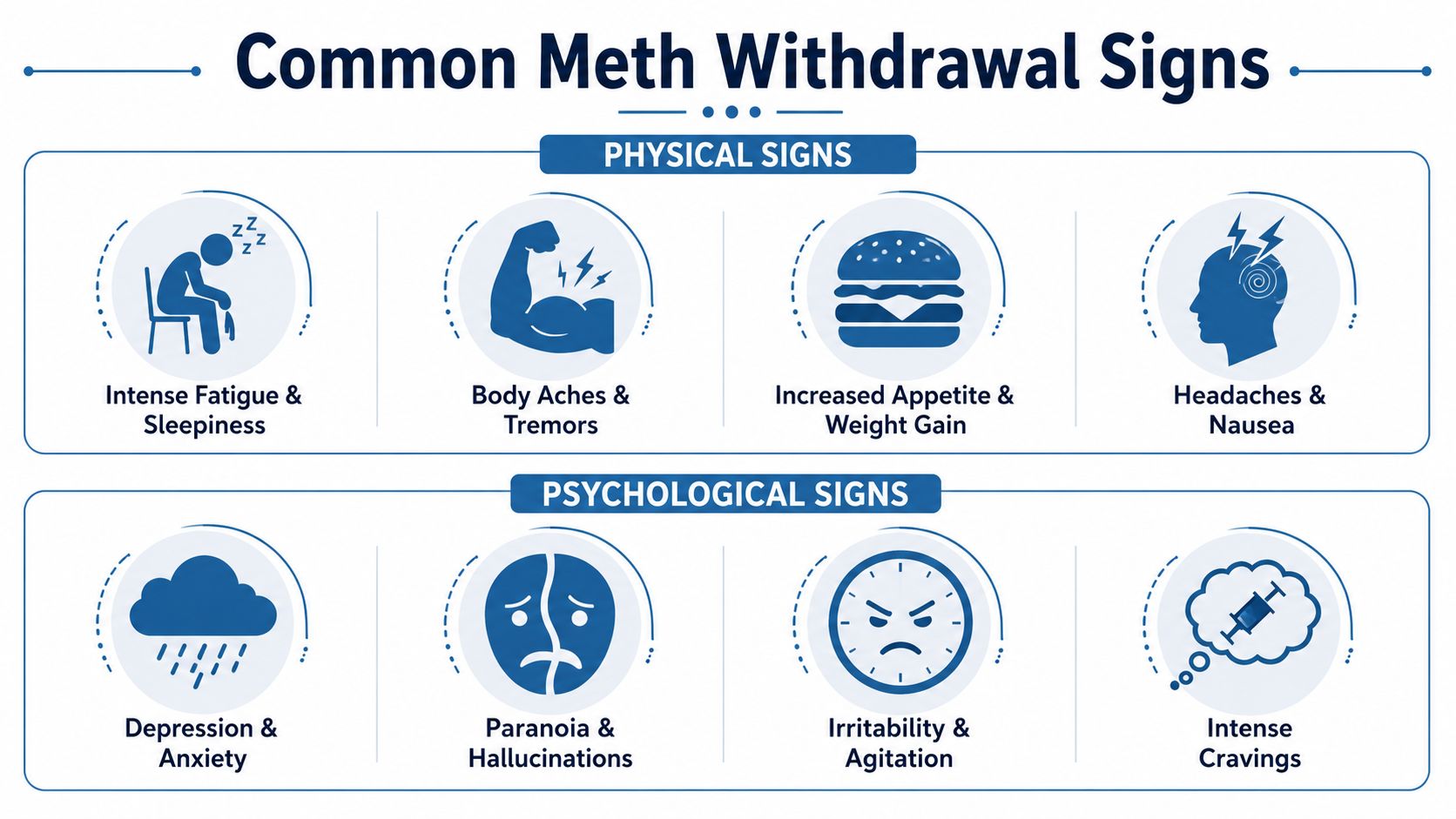
Meth withdrawal usually comes in clusters, not isolated symptoms. In practice, we see a phased process. The body slows down, mood drops, sleep shifts, and cravings surge at the same time. A clinical review found that up to 70% of abstinent methamphetamine users reported craving or “thinking about” meth at study entry, which made craving the most frequently reported symptom in that sample (clinical review of methamphetamine withdrawal). The same review described withdrawal as generally mild and well tolerated overall in that cohort, but two of 32 participants, about 6%, reported suicidal thoughts in the same sample.
Psychological and emotional signs
These are often the symptoms that push a person from “I can get through this” to “I need help now.” They affect judgment, safety, and the ability to stay away from meth long enough for the first phase to pass.
- Intense cravings: Cravings can be constant, intrusive, and hard to shut out. They are a major reason people return to meth early, especially during the first few days. Families often mistake this for lack of commitment when it is really part of the withdrawal pattern.
- Depression or emotional emptiness: Some people feel openly sad. Others feel flat, numb, hopeless, or disconnected from everyone around them.
- Anxiety and agitation: Restlessness can show up as pacing, irritability, snapping at loved ones, or being unable to settle long enough to eat or sleep.
- Paranoia: Suspicion and fear can intensify during withdrawal. A person may misread other people's motives or feel watched and unsafe.
- Low motivation: Basic tasks can feel disproportionately hard. Getting dressed, answering a text, or taking a shower may feel out of reach.
- Mood swings: Emotional state can change fast over a few hours.
- Aggression: One clinical symptom summary reported aggression in 27% of participants during meth withdrawal.
From a treatment standpoint, the trade-off is straightforward. Trying to “push through” severe mood symptoms at home may save time in the moment, but it increases the risk of relapse, unsafe behavior, and delayed care.
Physical signs
The physical side of meth withdrawal is often underestimated. People expect a stimulant crash to be mostly emotional, but the body can feel depleted, heavy, sore, and out of rhythm for days or longer.
- Profound fatigue and sleepiness: Many people feel physically drained and may sleep for long stretches during the early crash.
- Sleep disruption: Sleep can swing both ways. Some people oversleep at first, then struggle with broken sleep or poor-quality rest. In the same sample, 52% reported sleep problems.
- Headaches: Head pain is common during the early phase. In that same sample, 63% experienced headaches.
- Appetite changes: Hunger can return hard after long periods of poor intake while using. In the same sample, 36% had appetite issues.
- Body aches and physical discomfort: The body often feels slowed down and worn out.
- Eye irritation and low energy: Red or itchy eyes and severe low energy can appear alongside the broader crash.
Those symptoms tend to overlap rather than arrive neatly one by one. That is why a person may sleep all day, wake up angry, complain of a headache, eat heavily, then become intensely preoccupied with using again by evening. Families who want a clearer sense of how these phases unfold can review this methamphetamine recovery timeline.
Sleep is one area where supportive care helps, but only up to a point. Basic routines, reduced stimulation, hydration, and these tips for better sleep may improve sleep hygiene, but they do not treat the full withdrawal picture. If symptoms are intense, if the person becomes unreachable or unsafe, or if relapse seems likely, professional detox in Dallas is the safer option.
The Meth Withdrawal Timeline Day by Day
At 2 a.m., families often ask the same question. “Is this still withdrawal, or is something getting dangerously worse?” A clear timeline helps because meth withdrawal usually follows a phased pattern, even though the exact pace varies from person to person.
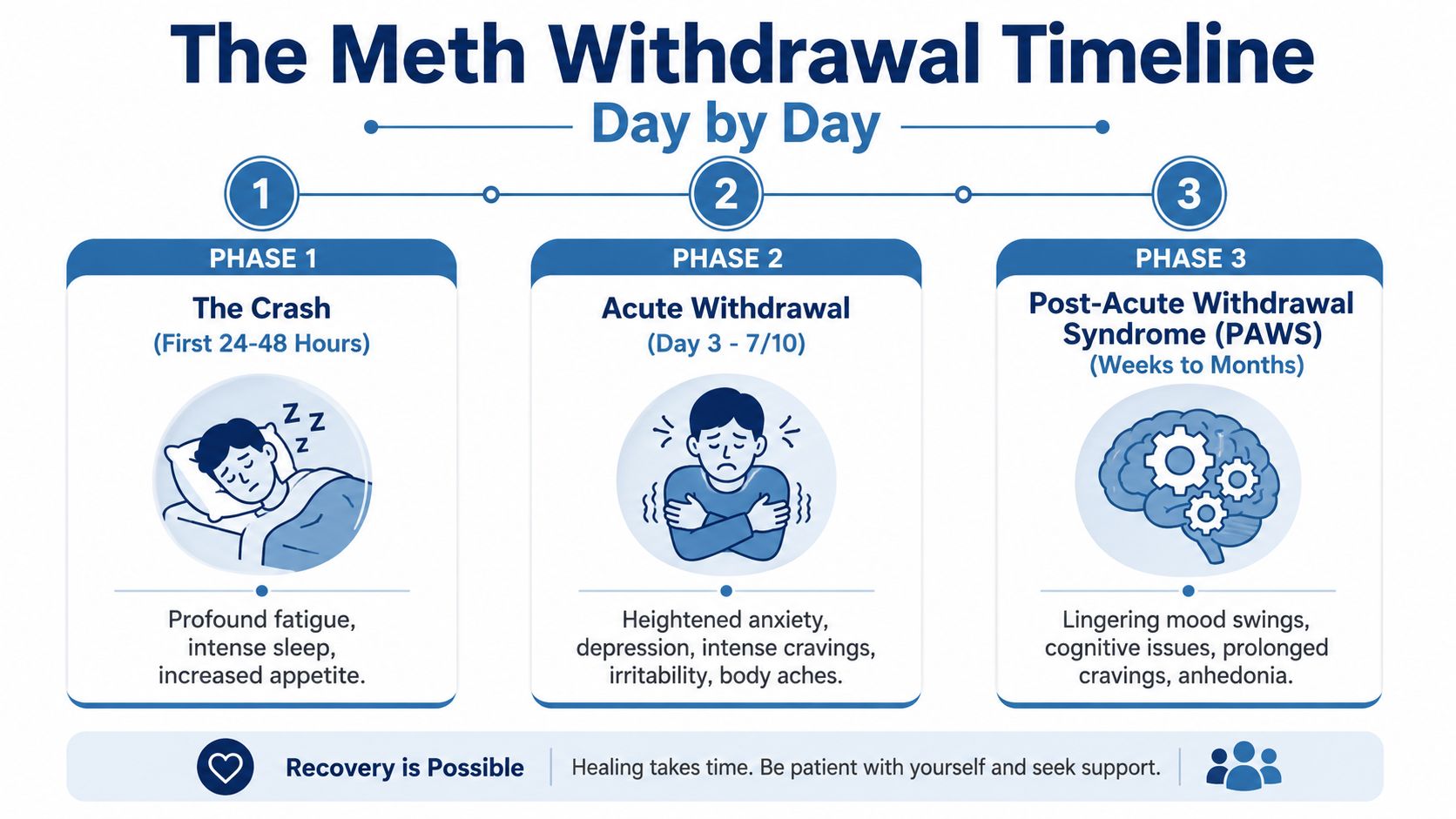
The helpful way to view this process is not as one long, shapeless crash, but as a series of stages that can be managed with the right support. For a broader overview of how recovery unfolds after the first detox period, see this methamphetamine recovery timeline.
The first 24 to 72 hours
The first phase is usually the crash. Acute symptoms can begin within 24 hours of the last use, and the initial phase often lasts roughly 24 to 48 hours, according to this overview of early meth withdrawal symptoms.
In practice, this is the period when a person may seem shut down, very exhausted, emotionally flat, or hard to engage. Some people sleep for long stretches. Others are agitated, anxious, or restless even while feeling drained.
A separate review describes this early crash as often peaking between Days 1 and 3 and notes that some people experience 12 to 20 hours of sleep per day during this phase, based on this dopamine-focused withdrawal explanation.
That swing can confuse families. Heavy sleep does not always mean the person is stabilizing. Agitation does not always mean they are “through the worst of it.” Both can happen in the same phase.
Days 3 to 5
After the initial crash, many people become more awake but not more steady. This is often the point when cravings hit harder, mood becomes less predictable, and impulse control is weaker.
One widely used clinical summary notes a crash lasting 24 to 72 hours, followed by intense cravings during days 3 to 5, with sub-acute withdrawal continuing through weeks 2 to 3 and post-acute withdrawal symptoms sometimes persisting for months, as described earlier in the article.
That middle window matters because relapse risk is often high when energy starts to return before judgment and emotional regulation recover. A person may say they feel “fine enough” to leave, use again, or reject help. Families should not mistake improved alertness for full stability.
| Phase | Typical experience |
|---|---|
| Crash | Heavy sleep, exhaustion, slowed thinking, emotional blunting |
| Early withdrawal | Strong cravings, irritability, anxiety, depression, poor judgment |
| Sub-acute recovery | Sleep disruption, low motivation, mood swings, concentration problems |
| Longer-tail symptoms | Intermittent cravings, low mood, uneven sleep, reduced drive |
The rest of the first two weeks
Another health summary reports that acute withdrawal often peaks between days 2 and 3, with most symptoms resolving within 7 to 14 days, though some low-level symptoms may last up to 2 weeks, based on this health summary of meth withdrawal duration.
That does not mean every symptom disappears on a set schedule. It means the most intense physical and emotional disruption often settles during that window, while sleep, motivation, concentration, and mood may take longer to normalize.
This is one of the main trade-offs families face. Waiting it out at home may sound simpler, but the person is often dealing with cravings, depression, poor judgment, and exhaustion at the same time. In a supervised detox setting in Dallas, staff can track safety, respond to severe distress, and help the person stay engaged long enough to get through the phase that most often pulls people back to meth.
Factors That Influence Withdrawal Severity
Two people can stop meth on the same day and have very different withdrawal experiences. That difference usually comes down to history, health, and context.
Why one person crashes harder than another
Several factors can make meth withdrawal signs more severe or harder to manage:
- Longer or heavier use: The more entrenched the pattern, the more disruptive the stop can feel.
- Sleep deprivation before stopping: Many people enter withdrawal already physically depleted.
- Poor nutrition and dehydration: The body has less reserve to recover.
- Other substances involved: Alcohol, sedatives, opioids, or other drugs can complicate the picture.
- Mental health conditions: Depression, anxiety, trauma-related symptoms, or bipolar disorder can all intensify distress.
- Limited support at home: Even mild symptoms become riskier when no one is present to notice changes.
A person with severe depression before withdrawal may not just feel “down” during detox. The withdrawal process can amplify hopelessness, numbness, and loss of drive. Someone with underlying anxiety may become far more agitated once meth is removed. Someone with a history of paranoia may become harder to reassure.
The question isn't whether another person got through withdrawal at home. The question is whether this person can do it safely.
Why assessment matters
A proper assessment doesn't label someone. It identifies the risks that change the care plan.
Clinicians usually need to know:
- What the meth use looked like: how often, how recently, and whether there were binges.
- What else is in the picture: other substances, prescription medications, or untreated psychiatric symptoms.
- What the home setting is like: safe and supportive, or chaotic and relapse-prone.
- What has happened before: prior detox attempts, prior relapse, prior self-harm thoughts, or prior psychotic symptoms.
This is why one-size-fits-all advice fails. A person in Dallas with severe cravings and untreated depression needs a different level of support than someone with milder symptoms and strong family supervision.
When to Seek Emergency Care or Medical Detox
A common Dallas call goes like this: someone has finally stopped using meth, slept for hours, then wakes up profoundly depressed, suspicious, or desperate to use again. Families often hope rest will fix it. Sometimes it does not, and waiting at home becomes the risk.
Red flags that need immediate action
Meth withdrawal is often survivable, but it is not always safe to manage without help. The danger usually comes from severe depression, psychosis, poor judgment, relapse pressure, and medical problems that can show up at the same time.
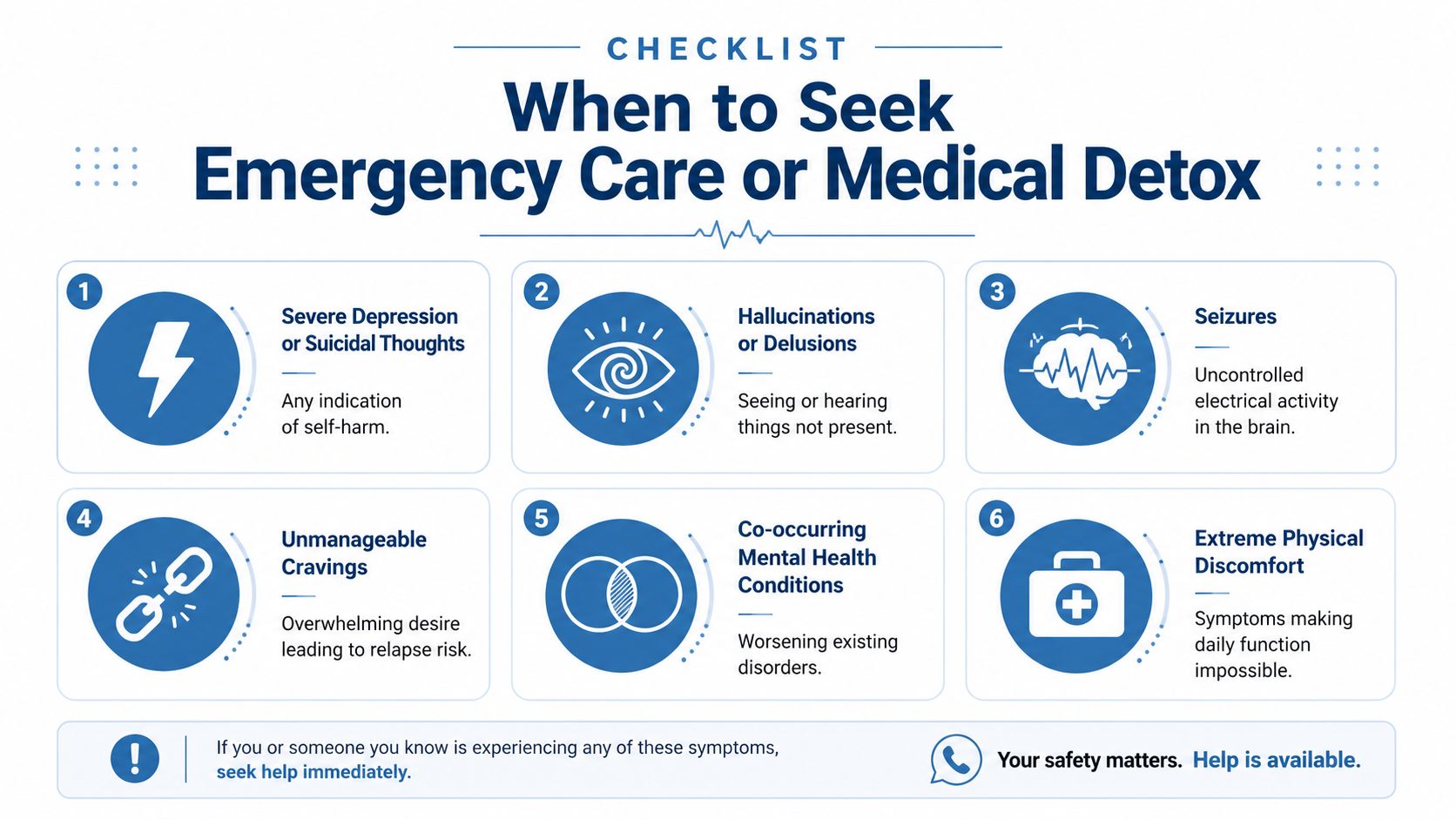
Seek emergency care or an urgent detox evaluation if you notice any of these signs:
- Suicidal thoughts or self-harm risk: Any statement about wanting to die, disappear, or hurt oneself needs immediate attention.
- Hallucinations or delusions: Seeing, hearing, or firmly believing things that are not real can turn into unsafe behavior fast.
- Severe paranoia: If the person feels watched, hunted, or threatened and cannot be reassured, do not try to handle it alone.
- Chest pain or serious physical distress: Meth use can strain the heart and blood vessels. Withdrawal can overlap with dangerous medical complications.
- Extreme inability to function: The person cannot eat, drink, sleep, or manage basic self-care.
- Unmanageable cravings with immediate relapse risk: If constant supervision is the only thing keeping the person from using, home is not a stable setting.
As noted earlier, the crash phase can bring severe depression and suicidal thinking, especially when untreated mental illness or medical problems are already in the picture.
Why detoxing alone can go wrong
Families are often told that stimulant withdrawal is "not as dangerous" as withdrawal from alcohol or benzodiazepines. That comparison misses the point. A person does not need seizures to be in real danger.
What I watch for clinically is whether the person can stay safe, accept support, and get through the next 24 to 72 hours without spiraling into self-harm, psychosis, or immediate relapse. If the answer is unclear, professional detox is the safer choice. For families who want to understand the setting before making that decision, this guide explains what to expect from medically supervised detox in Dallas.
A simple guide helps:
| Situation | Safer response |
|---|---|
| Mild discomfort, stable mood, reliable supervision | Prompt professional screening |
| Strong cravings, agitation, worsening depression | Medical detox evaluation |
| Psychosis, suicidality, chest pain, severe instability | Emergency care now |
This is a phased process, not a test of willpower. The right level of help depends on what phase the person is in, how severe symptoms are, and whether the home setting can realistically keep them safe. For many Dallas and Fort Worth families, medical detox is the clearest path out of chaos and into recovery.
How Medically Supervised Detox in Dallas Can Help
Detox works best when it replaces chaos with monitoring, comfort, and structure.

A person entering a Dallas detox center for meth withdrawal isn't expected to “tough it out.” The setting is built to reduce risk during the period when judgment, mood, and relapse pressure are least reliable. For a fuller picture of the process, this guide on what to expect from medically supervised detox in Dallas helps families understand the first steps.
What happens in a Dallas detox center
In a professional detox setting, care usually starts with a clinical assessment. Staff evaluate current symptoms, mental health status, recent substance use, medical concerns, and immediate safety issues.
Support typically includes:
- 24/7 monitoring: Someone is tracking changes instead of hoping they settle on their own.
- Comfort-focused care: Rest, hydration, nutrition, and symptom relief matter because exhausted people relapse faster.
- Mental health observation: Depression, paranoia, and emotional instability are taken seriously from the start.
- Private, low-stimulation space: This helps when the person is overwhelmed, suspicious, or unable to regulate stress well.
- Discharge planning early in the process: The next step is considered before detox ends.
What professional care does better than going alone
Home detox usually fails for practical reasons, not moral ones. The person in withdrawal can't be both the patient and the decision-maker when cravings spike. Families also burn out fast. They may not know whether a behavior is expected, escalating, or dangerous.
Professional detox changes the trade-offs:
- Less guesswork: Symptoms are interpreted by clinicians, not frightened loved ones.
- Less access to impulsive relapse: Structure matters most when cravings hit hardest.
- Better handoff into treatment: Detox alone often becomes a revolving door. Linked follow-up care improves the chance of staying engaged.
- More dignity: People stabilize in a setting designed for care, not conflict.
A safe detox environment doesn't just manage symptoms. It protects the person from making permanent decisions during a temporary neurochemical crash.
For the DFW community, that kind of support can be the difference between another relapse cycle and a real beginning.
Your Path Forward After Detox
The first goal is getting through withdrawal safely. The next goal is staying well long enough for the brain and body to recover more fully.

Why detox is the beginning, not the finish line
Detox can stabilize the crash, but it doesn't erase the longer tail of recovery. According to this review of stimulant withdrawal and ongoing symptoms, acute symptoms often resolve within 7 to 14 days, yet dopamine depletion can cause anhedonia, or loss of pleasure, for months. The same source notes that 53% of people who inject drugs experience withdrawal symptoms weekly, highlighting the need for long-term care beyond the acute phase.
That explains a problem families often misread. Once the person is eating, sleeping a bit better, and no longer in immediate crisis, everyone wants life to snap back quickly. Instead, the person may still feel flat, joyless, foggy, or vulnerable to cravings. That isn't laziness. It isn't a lack of commitment. It's part of recovery.
Another review describes the post-acute period as one where protracted anhedonia and dysphoria can persist for months, making that later stage the period of highest relapse risk rather than the initial crash in this discussion of post-acute meth withdrawal.
Building a recovery plan in Dallas
The strongest recovery plans don't stop at detox. They keep support in place while motivation, mood, and thinking are still rebuilding.
Useful next steps often include:
- Residential or inpatient treatment: Best when the home setting is unstable or relapse risk is high.
- Outpatient care: A good fit when the person is medically stable and has reliable support.
- Dual diagnosis treatment: Important when depression, anxiety, trauma symptoms, or bipolar disorder are part of the picture.
- Therapy and relapse planning: Cravings often return before confidence does.
- Family involvement: Loved ones need structure too, not just reassurance.
In addiction treatment in Dallas, lasting recovery usually comes from continuity. Detox addresses the immediate crisis. Ongoing treatment addresses the reasons relapse keeps happening.
A person doesn't have to be completely ready for every future step today. They only have to take the first safe one.
If meth withdrawal signs are putting someone at risk, Tru Dallas Detox & Recovery Center offers confidential help for people and families across Dallas, Euless, Fort Worth, and the DFW area. The program includes medically supervised detox, support for co-occurring mental health concerns, and clear next-step planning after stabilization. Call now, ask questions, or verify insurance. Getting help quickly can make this process safer, calmer, and far more manageable.
