

Trauma-informed therapy shifts the question from "What's wrong with you" to "What happened to you" and focuses on creating safety, choice, and collaboration for healing. It helps people whose past experiences shape current substance use, mood, and relationships, providing a path to recovery right here in Dallas.
Table of Contents
- Understanding the Key Concepts of Trauma Informed Therapy
- How Trauma-Informed Care Became Mainstream Practice
- Core Principles That Guide Trauma Informed Treatment in Dallas
- Evidence-Based Modalities Used Within a Trauma-Informed Framework
- Key Differences Between Standard Therapy and Trauma Informed Care
- What to Expect When Reaching Out for Trauma Informed Care in Dallas
- Frequently Asked Questions About Trauma-Informed Therapy in Dallas
Understanding the Key Concepts of Trauma Informed Therapy

Trauma-informed therapy is a care framework used across detox, rehab, and behavioral health treatment in Dallas, Texas. It recognizes that past events change the nervous system, shaping reactions like cravings, hypervigilance, or emotional numbing. This means that at leading Dallas treatment centers like Tru Dallas Detox, care attends to safety and stabilization before processing painful memories.
What Trauma Informed Therapy Looks Like in Practice in Dallas
- Clinicians ask about experiences and responses rather than blaming the person.
- Treatment plans include grounding skills, pacing, and informed consent for sensitive work.
- Our Dallas services integrate medical detox, medication-assisted treatment, and mental health care when needed.
Key Insight: Trauma-informed work at Tru Dallas Detox reduces re-traumatization by prioritizing trust and predictability in every interaction, making it a cornerstone of effective addiction treatment in Dallas.
Core Benefits for People With Substance Use Disorders
- Safer Detox in Dallas: Our clinical teams anticipate trauma reactions and monitor them closely, ensuring a safer withdrawal experience.
- Improved Engagement: Patients feel respected and understood, which is crucial for staying committed to recovery.
- Better Outcomes: Dual diagnosis needs are treated together, not separately, leading to more sustainable healing.
For example, a person in Dallas who used substances to quiet panic will first learn stabilization tools in therapy at Tru Dallas Detox before exploring the traumatic memory that triggered the panic. This staged approach prevents overwhelming the nervous system and supports steady progress.
How This Approach Differs From Standard Therapy
Standard therapy often targets symptoms alone. Trauma-informed therapy adds a lens that examines the survival strategies people learned over time. Practically, that shows up as longer intake conversations, routine trauma screening, and safety plans before processing begins—all standard practice at our Dallas facility.
Numbered steps our clinicians follow when trauma is present:
- Create physical and emotional safety
- Teach grounding and coping skills
- Stabilize before trauma processing
How to Find Trauma Informed Providers in Dallas
Look for programs that explicitly state trauma-informed policies, offer dual diagnosis care, and provide medical detox. At Tru Dallas Detox, we build our intake and treatment planning around this lens. We support insurance verification for many PPO plans to make accessing care easier for the Dallas community. To delve deeper into the fundamental definition and purpose of this approach, consider exploring this related resource: find trauma informed care.
If you or a family member in Dallas are considering care, reaching out for a confidential assessment with Tru Dallas Detox is a strong next step toward safety and recovery.
How Trauma-Informed Care Became Mainstream Practice
The story really starts with clinicians working with Vietnam veterans and survivors of violence—people who carried lasting changes in memory, sleep, and stress responses long after the danger had passed. These practitioners began asking a different kind of question: not "What's wrong with you?" but "What happened to you?" That shift moved trauma out of the shadows and into the clinical spotlight, reframing it as something that reshapes the nervous system itself.
And here's why that matters for addiction treatment in Dallas and beyond: once you understand trauma, you start seeing substance use as a coping strategy rather than a moral failing. That single reframe changes everything about how we approach recovery at Tru Dallas Detox.
Then came the Adverse Childhood Experiences study, which connected early adversity to later disease and substance use in ways nobody had mapped before. The research made it painfully clear that trauma doesn't just affect mental health—it rewires physical health over decades. Communities like DFW felt that reality acutely, and the demand for quality, compassionate services grew accordingly.
Key Insight: When systems acknowledge trauma, care becomes safer and more effective for people with substance use disorders. This is the guiding philosophy at our Dallas treatment center.
By the 2000s, SAMHSA was actively promoting trauma-informed care as a set of guiding principles. The push encouraged clinics, hospitals, and detox centers to adopt practices that reduce re-traumatization and actually support recovery. However, early implementation was uneven. This created a gap where some programs might use the term "trauma-informed" without having the practices to back it up.
That gap pushed leading providers in the Dallas–Fort Worth area, like Tru Dallas Detox, to emphasize measurable, high-quality practices, not just buzzwords.
Historical Changes That Shaped Our Clinical Practice
- Longer intakes and routine trauma screening became standard, helping our clinicians identify needs early.
- Safety plans and grounding skills are taught first, giving our patients tools to manage overwhelm.
- Medical detox and mental health care are fully integrated for those with co-occurring conditions.
Over time, clinicians figured out something important: being trauma-informed isn't the same as delivering trauma-focused therapy. Think of it this way—trauma-informed care is the framework that makes every interaction safer, from the front desk to the treatment room. Trauma-focused treatments like CBT or EMDR are the specific tools that directly process traumatic memories. Tru Dallas Detox combines both approaches because that's what actually produces better outcomes for our patients.
Practical Takeaway: Effective care blends trauma-informed policies with evidence-based therapies and medical supports. That is the standard of care at Tru Dallas Detox.
Tru Dallas Detox follows this combined approach at our Euless facility by pairing medically supervised detox, dual diagnosis assessment, and trauma-focused therapies. This means Dallas residents get both the safety framework and the specific treatments that address traumatic memories and substance use. If you're ready to take the next step, calling us to verify your insurance and request a confidential assessment is a practical move toward getting the care you deserve.
Core Principles That Guide Trauma Informed Treatment in Dallas

Trauma informed therapy isn't just a clinical approach—it's a complete shift in how care gets delivered at Tru Dallas Detox. Every interaction, from that first phone call all the way through discharge, is shaped by a set of principles designed to keep people safe and respected.
The environment at our Dallas-area facility is designed to be calm and predictable, lowering anxiety before any clinical work begins.
"Instead of asking what's wrong, our clinicians ask what happened and how it still affects daily life."
That single reframe changes everything. It centers your lived experience and replaces judgment with genuine curiosity.
Safety
In our Dallas detox setting, safety is both physical and emotional. Both are our top priority.
Physical safety shows up as 24/7 clinical monitoring during withdrawal and private rooms where people can stabilize. Emotional safety means our staff explains each step, understands that fear shrinks when people know what to expect, and responds with patience.
- Quiet spaces for regulation
- Staff who recognize trauma reactions during withdrawal
- Emergency protocols explained in plain language
Trustworthiness And Transparency
Trust is built through consistent, honest communication.
At Tru Dallas Detox, our clinicians walk you through medications, care plans, and what to expect so you are always an informed partner in your own treatment. We believe you should never feel kept in the dark about your own care.
- Written consent for any sensitive procedures—no exceptions
- Routine check-ins to adjust care based on your preferences
- Transparent billing and insurance verification for most PPO plans
Peer Support And Collaboration
There's something powerful about talking to someone who's been through it.
Our group sessions and peer support create that connection. People feel understood in a way that clinical expertise alone can't replicate, improving both engagement and outcomes at our Dallas center.
- Peer-led discussions that normalize setbacks instead of shaming them
- Collaborative care planning where your input shapes the direction of treatment
Empowerment, Voice And Choice
Trauma often strips away a person's sense of control. Giving choices back—real ones—helps rebuild what was lost.
This shows up in practical ways at Tru Dallas Detox: you have options about the pace of therapy, family involvement, and the level of care that makes sense for you. These choices remind you that you have agency again.
- Patients set their own goals and pace for trauma work
- Family sessions happen only when the patient invites it and feels safe doing so
Cultural, Historical And Gender Awareness
Your identity matters in treatment. Ignoring it is not an option.
Our clinicians practice cultural humility, adapting their approach to honor each person's background, gender, and lived experience. This flexibility makes treatment effective and respectful for everyone we serve in the diverse Dallas community.
- Ongoing staff training on cultural humility
- Materials and approaches adapted for different sensitivities
What This Looks Like During Treatment at Tru Dallas Detox
Putting these principles into practice changes the entire experience of care.
- Intake includes routine trauma screening and assessments that don't rush the process.
- Stabilization skills come first—you learn to manage distress before processing traumatic memories.
- Our dual diagnosis care addresses depression, anxiety, or bipolar disorder alongside substance use.
Checklist when calling a DFW treatment center:
- Do they explain withdrawal monitoring and safety measures clearly?
- Is informed consent for trauma work described upfront?
- Are peer supports and family options actually available?
- Do they accept your PPO plan or help verify insurance before you commit?
If you're looking for trauma informed care in Dallas, Tru Dallas Detox builds these principles into every step of the process. Call us today. We can help verify your insurance and walk you through what comes next.
Evidence-Based Modalities Used Within a Trauma-Informed Framework
Cognitive Behavioral Therapy (CBT) takes a practical, hands-on approach to changing the thought patterns that keep painful memories looping. At Tru Dallas Detox, our clinicians teach this slowly, layering in grounding skills first so patients feel stable before they ever touch the hard material.
Eye Movement Desensitization and Reprocessing (EMDR) helps the brain reprocess distressing memories that got stuck. In our trauma-informed setting, EMDR only comes into play after a person has reached stabilization and given clear, informed consent.
Prolonged Exposure and Cognitive Processing Therapy target avoidance and the unhelpful beliefs that take root after trauma. Pacing matters enormously here—the nervous system needs room to integrate change without getting flooded. Our compassionate therapists guide this process with care.
Somatic approaches focus on the body, where trauma often lives. Our clinicians teach breathing exercises, movement practices, and grounding tools that our patients can use in moments of craving or panic.
Mindfulness interventions build present-moment awareness and dial down reactive patterns. These skills become a foundation for relapse prevention by improving emotional regulation.
How Tru Dallas Integrates These Modalities
As the leading trauma-informed treatment center in Dallas, Tru Dallas Detox provides a comprehensive, integrated approach.
- We begin with medically supervised detox and round-the-clock monitoring.
- We offer inpatient and outpatient levels of care based on your unique needs.
- Our programs include medication-assisted treatment (MAT) for alcohol, opioids, fentanyl, heroin, and prescription medications.
- We blend individual trauma therapy, group counseling, family sessions, and MAT into coordinated weekly plans.
Key Insight: The trauma-informed lens shapes how care is delivered at Tru Dallas Detox—through pacing, choice, and consent—rather than replacing the therapy itself.
A Typical Week of Treatment at Our Dallas Facility
A coordinated week at Tru Dallas might look something like this:
- Two individual trauma therapy sessions focused on stabilization
- Three group counseling sessions building coping skills and peer support
- MAT appointments or medication management check-ins as needed
- One family session (optional) to rebuild communication
Dual Diagnosis and Why It Matters in Dallas
Up to 75% of people with a substance use disorder report a trauma history. That number alone explains why integrated dual diagnosis care isn't optional—it's essential for recovery in Dallas. Treating PTSD symptoms alongside addiction lowers relapse risk. At Tru Dallas, our care plans address mood disorders, anxiety, and other co-occurring conditions together with substance use treatment.
Practical Tips for Families
- Ask how a program sequences stabilization before trauma work begins, and whether they verify insurance for most PPO plans.
- Make sure staff explain consent and choices clearly before any trauma processing starts.
- Confirm MAT availability if opioid or alcohol dependence is present.
If you need help in Dallas or nearby neighborhoods like Oak Cliff, Euless, or Fort Worth, call Tru Dallas Detox to verify insurance and request a confidential assessment. We are here to help.
Key Differences Between Standard Therapy and Trauma Informed Care
Trauma informed care flips the script on a fundamental question. Instead of asking "What is wrong with you," clinicians at Tru Dallas Detox start with "What happened to you." That single shift ripples through everything—your intake experience, treatment goals, and the pace of therapy.
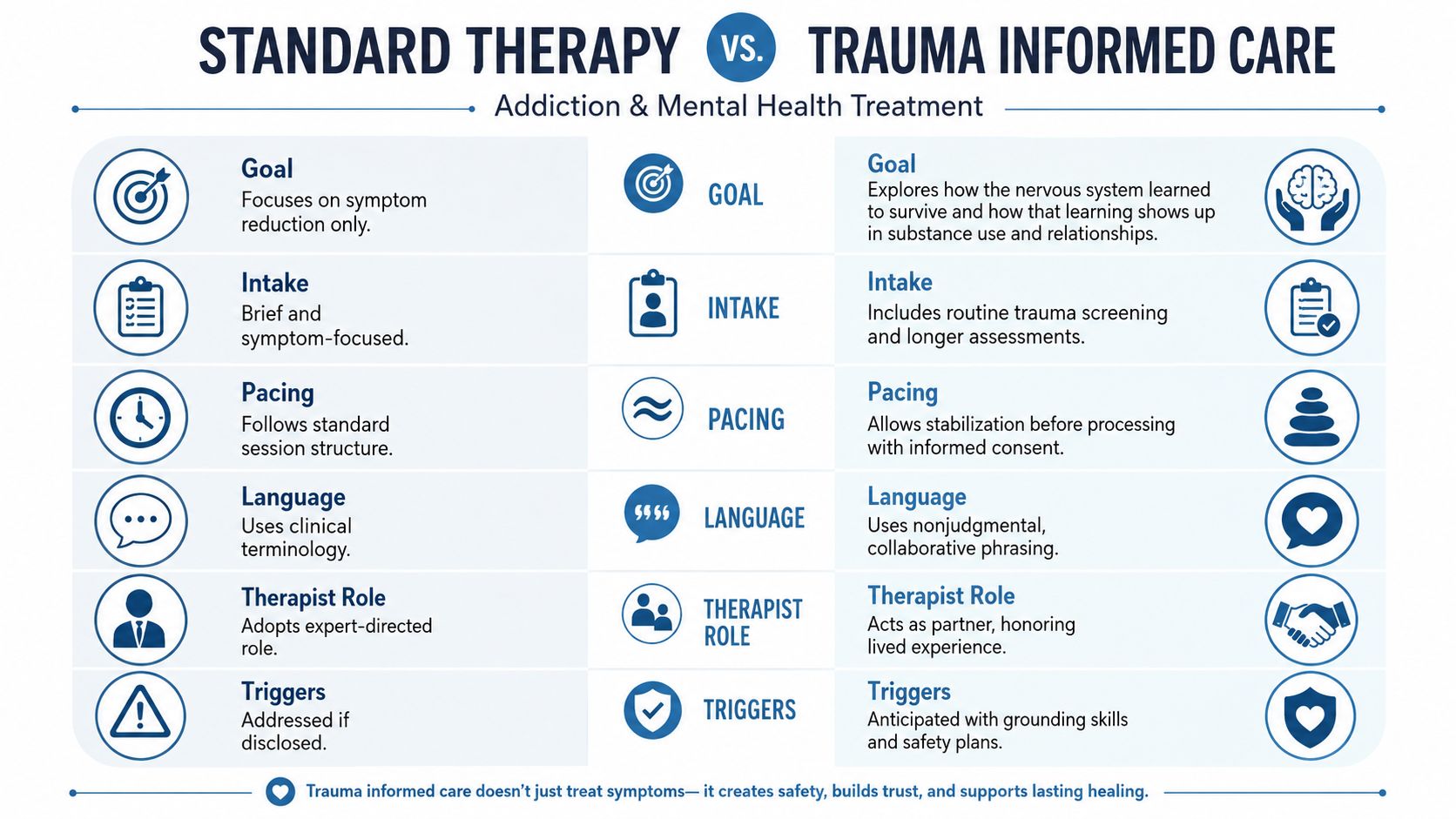
The chart above breaks down six practical differences you would notice during intake, stabilization, and integration with detox and medication-assisted treatment. These are the things that shape your day-to-day experience in a quality Dallas program.
Here is the core distinction: Trauma informed care looks at how your nervous system learned to survive. Standard therapy often zeroes in on symptom reduction without explicitly addressing those underlying survival patterns. That is why leading trauma informed programs in Dallas invest more time in safety and stabilization first—and why people tend to stay engaged longer.
What You Might Notice When Arriving At Our Dallas Program
- Longer, compassionate intakes that include routine trauma screening.
- Early instruction in grounding and coping skills.
- Clear communication about pacing, options, and shared decision making to rebuild trust.
Key Insight: Programs that anticipate trauma reactions and teach grounding early, like Tru Dallas Detox, see higher retention and better recovery outcomes.
Practical Operational Differences
1. Intake Process
- Standard therapy: Brief symptom checklist.
- Trauma informed care: Extended assessment with routine trauma screening and safety planning.
2. Therapist Role
- Standard therapy: Expert-directed problem solving.
- Trauma informed care: Collaborative partner who honors your lived experience and choice.
3. Trigger Management
- Standard therapy: Addressed if disclosed.
- Trauma informed care: Anticipated with pre-taught grounding skills and safety plans.
4. Integration With Medical Care
- Standard therapy: Separate pathways for detox or MAT.
- Trauma informed care: Coordinated with medically supervised detox, MAT, and dual diagnosis care under one roof.
Why This Matters For Addiction Recovery in Dallas
When trauma sits underneath cravings, treating only the surface symptoms often leads to relapse. Trauma informed care at Tru Dallas Detox reduces re-traumatization and supports sustained engagement, which is critical for long-term recovery.
For families in Dallas, Euless, Fort Worth, and nearby DFW areas, these distinctions mean better support during withdrawal and early recovery. You know what to look for, and you know what to ask about when choosing a treatment center.
How Tru Dallas Puts This Into Practice
- Longer intakes and routine trauma screening guide our individualized plans.
- Stabilization comes before processing, with written consent and clear pacing options.
- Our discharge planning includes sober living referrals and ongoing mental health supports to reduce relapse risk.
Read also: Learn more about how mental health treatment integrates trauma informed principles in our guide on Mental Health Treatment at Tru Dallas
If you have tried programs before and left early, a trauma informed approach that builds safety first may be the answer. Contact Tru Dallas Detox to verify your insurance and request a confidential assessment.
What to Expect When Reaching Out for Trauma Informed Care in Dallas

Making that first call is often the hardest part. At Tru Dallas Detox, we've built our entire intake process around reducing anxiety and protecting your privacy from the moment you reach out for help in the Dallas area.
Your initial confidential call is about listening. Our compassionate staff will help verify your insurance coverage for most PPO plans and walk you through your options without any pressure.
After that first conversation, you'll complete a clinical assessment. This gathers your medical history, substance use patterns, and includes trauma screening to build a complete picture. If detox is necessary, that assessment flows naturally into a medical evaluation to determine the safest next steps.
What Happens Next at Tru Dallas Detox
- Medical Detox Evaluation: We provide 24/7 clinical monitoring if withdrawal is expected, keeping you safe during the highest-risk window.
- Personalized Care Planning: Your plan may include medically supervised detox, inpatient rehab, outpatient programming, or medication-assisted treatment (MAT).
- Dual Diagnosis Assessment: We ensure conditions like depression or anxiety get treated alongside substance use.
What our staff will say to reassure you:
"We understand that you might feel uncertain. We respect that, and we will move at a pace that feels safe for you."
A typical day during inpatient care at our Dallas-area facility balances structure with genuine restoration.
- Morning nursing check and medication management
- Individual therapy focused on stabilization and practical coping skills
- Group counseling on grounding techniques, relapse prevention, and peer connection
- Family sessions scheduled only when you feel ready
- Restorative amenities and private rooms to minimize environmental triggers
If you're worried about affording treatment, our staff handles billing transparently. We verify benefits, explain costs upfront, and review financial options without judgment.
Practical steps you can take before calling:
- Grab your insurance card and a brief medication list.
- Note your recent substance use and any prior detox experiences.
- Write down questions about MAT, length of stay, and family involvement.
How Tru Dallas Supports Dallas Area Families
Tru Dallas Detox weaves trauma informed principles into every step—from that first confidential call through discharge planning. For a deeper look at outpatient options, check out our guide on Trauma Focused Intensive Outpatient Programs.
Ready to take the next step? Call Tru Dallas Detox now to verify your insurance, request a confidential assessment, or arrange immediate admission. We serve the entire Dallas–Fort Worth area and are ready to help.
Frequently Asked Questions About Trauma-Informed Therapy in Dallas
Do I need a PTSD diagnosis to benefit from trauma-informed therapy in Dallas?
Not at all. Trauma-informed care at Tru Dallas Detox is built for anyone whose past experiences are affecting their daily life. The goal is to move beyond labels and focus on healing patterns of anxiety, cravings, or sleep problems. This approach can help you build stabilization skills right away, regardless of a formal diagnosis.
How long does trauma-informed therapy usually take?
It varies. Your history and co-occurring conditions play a role. Rather than counting weeks, we focus on functional gains—sleeping better, fewer cravings, stronger relationships. A stabilizing detox stay may be just a few days, while deeper processing can unfold over months. At Tru Dallas Detox, your treatment plan is tailored to you.
Will I have to relive painful memories in detail?
Only if and when you decide you are ready. Your safety and consent are our priority. Our clinicians teach grounding tools first, ensuring any processing happens only when you feel prepared. We may spend several sessions building coping skills before ever introducing therapies like EMDR or CBT.
Can family members join treatment at your Dallas center?
Yes, and it often strengthens recovery. Our family sessions focus on building healthy communication and boundaries, and they only happen when you, the patient, invite them to participate.
Where do I start in Dallas?
Pick up the phone and call Tru Dallas Detox for a confidential assessment. Have your insurance card handy and ask us about our trauma screening, 24/7 medical monitoring for detox, and integrated dual diagnosis care. Located in Euless, we serve the entire Dallas-Fort Worth metroplex and can verify most PPO plans to get you started on the path to recovery.
For help, contact Tru Dallas Detox & Recovery Center at dallasdetox.com
