

A lot of Dallas families reach the same breaking point at the same time. A loved one finishes detox, the discharge folder lands on the kitchen table, and suddenly everyone is trying to answer the same urgent question, where do they go next without sending them home too soon?
That's where searches for halfway houses Texas get messy fast. In Texas, halfway house usually means parole or corrections reentry housing, not the kind of recovery housing many families need after detox or rehab, and that distinction changes everything about who qualifies, who pays, and what rules apply. The wrong term sends people chasing the wrong doors.
For families in Dallas, the core task is simpler than the internet makes it look. First decide whether the person is leaving incarceration, leaving treatment, or needs a structured bridge into sober living. Those are three different situations, and they do not point to the same housing option.
Table of Contents
- What Families in Dallas Need to Know First
- The Three Housing Models People Mix Up
- How Texas Regulates Each Housing Type
- Who Qualifies and How Intake Actually Works
- Costs, Insurance, and Who Actually Pays
- What Daily Life Looks Like During a Stay
- How to Vet a Dallas–Fort Worth Option Before Committing
- Taking the Next Step With Tru Dallas Detox
What Families in Dallas Need to Know First
A family in Dallas usually starts this search at the worst possible moment. Someone is leaving detox, someone else is still scared to go home, and nobody wants to make a bad placement call under pressure. That panic is real, but it also leads to the biggest mistake, using the phrase halfway house when the actual need is recovery housing.
Texas does not treat those terms as interchangeable. Texas-focused guidance says halfway houses in Texas only serve former inmates transitioning from incarceration to parole, while sober living homes are separate recovery residences that are usually privately paid and not government-sponsored. That means the question is not “What halfway house is best?” It's “What kind of transition is happening right now?”
Practical rule: If the person is leaving jail or prison, start with corrections-linked housing. If the person is leaving detox or rehab, start with sober living or recovery housing.
That distinction matters in real life because the wrong housing model can create a bad fit on day one. A parole-linked setting is built around supervision, rules, and reentry compliance. A sober living home is built around recovery support, structure, and drug- and alcohol-free living.
Dallas families also benefit from understanding how often the search terms get mixed together. A spouse may say halfway house when they really mean structured recovery home. A parent may think any supervised residence will do. Those assumptions waste time, and time is usually the one thing a discharge planner and a worried family don't have.
For anyone sorting legal obligations at the same time, find a Dallas child support attorney can be a useful resource when housing, custody, or release conditions are colliding. The key point is simple, though. Halfway house is a legal and corrections term in Texas, not a generic label for every place where someone in recovery can live.
The Three Housing Models People Mix Up
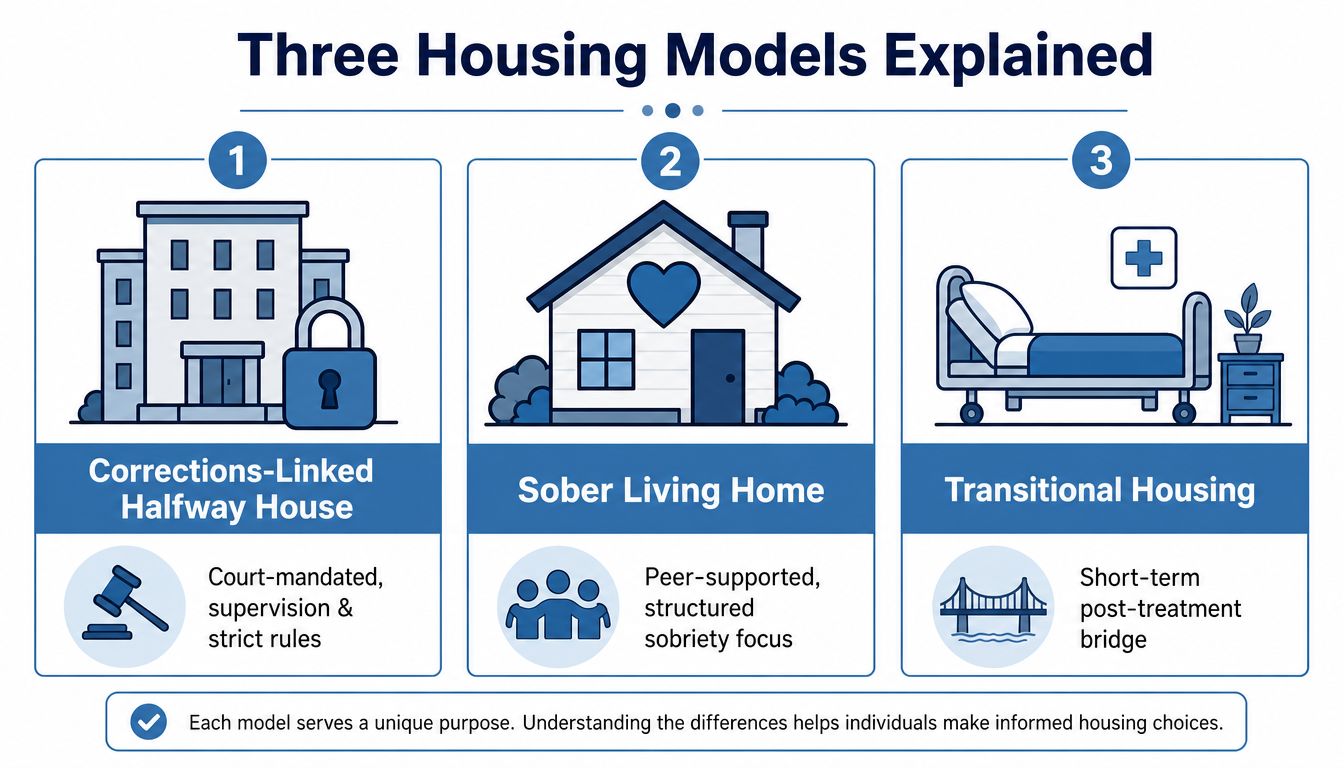
The cleanest way to stop making bad comparisons is to separate the housing options into three buckets. They sound similar, but they solve different problems and answer to different systems.
Corrections-Linked Halfway Houses
These are the residential reentry centers and community residential facilities tied to the parole or prison-to-community process. Texas statute defines halfway houses as transitional housing for parolees, and federal residential reentry centers place people during the last portion of a sentence with structured programming and gradual community access. The federal model includes at least 8 hours of substance-abuse education and 12 hours of life-skills classes as described here.
The typical resident is someone leaving incarceration under supervision. The payer is usually a government system, not the resident. The rules are strict because the point is reentry compliance, not open-ended recovery support.
Sober Living Homes
These are peer-supported, drug- and alcohol-free residences for people in recovery. Texas-focused guidance says they are separate from halfway houses and are usually privately paid rather than state-sponsored. They're not for someone who needs a parole placement. They're for someone who needs structure after treatment, usually with house rules, sobriety expectations, and shared accountability.
Dallas families should think of these as recovery-focused homes, not correctional housing. The right fit is usually someone stable enough to live with peers, follow rules, and keep building recovery outside a hospital or detox setting.
Treatment-Linked Recovery Housing
This is the bridge people often overlook. It may be attached to an outpatient or clinical program and can sometimes work with insurance when the housing is part of a broader treatment plan. The facility is still not the same thing as detox or rehab, but it can sit close to care.
A sober living home can be a good step-down after treatment, but it is not a substitute for medical detox or active clinical care.
For readers trying to tell the difference between sober living and rehab housing, the practical breakdown is explained in this Dallas guide on sober living and rehab. If the person is leaving treatment and still needs real support, this third bucket is often the one worth screening first.
How Texas Regulates Each Housing Type
Texas regulation makes more sense once the categories are separated. The state does not use one single licensing lane for every recovery residence, and that creates confusion for families who expect a simple license lookup.
What Texas does and doesn't license
Texas recovery-housing research confirms that halfway houses are defined as transitional housing for parolees, while recovery residences are separate peer-supported, drug- and alcohol-free settings. That means the regulatory framework, referral pathway, and payer model differ by category as outlined in the Texas recovery-housing study.
For Dallas families, the practical takeaway is blunt. The absence of a statewide license for a sober living home is not automatically a red flag, but it does mean the family has to ask better questions. A legitimate home can still be unlicensed in the clinical sense while operating with clear house rules, screening, and accountability.
Why local rules still matter in Dallas
Dallas and other major cities can layer on their own boarding-house, group-home, occupancy, or fire-safety requirements. That patchwork is easy to misread because a house can be perfectly real, active, and structured without fitting the public's usual idea of a regulated “facility.” The burden shifts from relying on a state label to checking the operator's policies and the city's practical rules.
That's also why families should not confuse a corrections-linked residence with a recovery home. One sits under the state parole system and, in federal settings, a structured step-down model. The other serves voluntary residents who need a sober environment and peer support.
The simplest rule is this. If the person is under parole supervision, verify the correctional placement pathway. If the person is leaving treatment, verify the home's rules, screening process, and whether any clinical services are properly licensed. If those details aren't clear on the first call, keep looking.
Who Qualifies and How Intake Actually Works
Intake looks different depending on whether the person is coming out of the justice system or coming out of treatment. Families waste time when they expect one process to cover both.
If the placement is corrections-linked
For federal residential reentry centers, placement is usually limited to the last 10% of a sentence, capped at six months per the federal residential reentry center guidance. That means the person usually doesn't shop independently the way a private consumer would. The system, case manager, or parole process drives placement.
The resident then follows mandatory programming and gains gradual community access while completing the step-down process. That structure is the point. It is meant to reduce custody intensity while the person rebuilds work, treatment, and family connections.
If the placement is post-treatment
A person leaving detox, inpatient rehab, or outpatient care has more choice, but the home still screens carefully. Admissions staff usually want to know whether the person can follow house rules, stay sober, and pay for the stay. Families should have the basics ready before calling, because a good intake call moves faster when the paperwork is organized.
Bring these items together before the first call:
- Identification: A current ID helps the staff confirm who is being considered for placement.
- Clinical summary: A recent discharge summary or treatment note gives the home a picture of current needs.
- Medication list: This matters if the person is managing withdrawal aftercare or mental health treatment.
- Insurance details: If the home offers any treatment-linked services, the staff needs the plan information early.
- Provider contact: Having the treatment team's number speeds coordination and discharge planning.
Useful standard: If the admissions person cannot explain who qualifies, who screens, and what paperwork is needed, that is not a solid home. That is a stall.
For context on the correctional intake side, federal reentry centers build in at least 8 hours of substance-abuse education and 12 hours of life-skills classes during the placement period as described by the federal court resource. For treatment-linked homes, the timeline depends more on the family's response time, the person's readiness, and whether insurance or self-pay can be confirmed quickly.
Costs, Insurance, and Who Actually Pays
The money question is where a lot of families get caught off guard. Housing can be free, private pay, or partially linked to insurance depending on the model, and those differences should be clarified before a deposit changes hands.
The three payer paths
Corrections-linked halfway houses are generally funded by government systems, so the resident usually doesn't pay direct rent in the way a private consumer would. Sober living homes are typically private pay and often not covered by insurance. Treatment-linked recovery housing sits in the middle, because the housing itself may not be covered, but parts of the care around it sometimes are.
Dallas families should ask the admissions coordinator to separate housing from clinical services. If outpatient therapy, medication management, or case management is part of the setup, the insurance question is different from the housing question. The home may accept a plan for treatment services while the room itself remains private pay.
What to verify before paying anything
The smartest move is to get every cost in writing before move-in. Ask whether the monthly rate includes utilities, food, transportation, and testing. Ask what happens if the person leaves early, gets discharged, or needs a higher level of care.
A solid admissions conversation should also include insurance verification. For families comparing recovery housing and treatment-linked support, this insurance guide for sober living homes in Texas helps frame the right questions before any commitment.
| Typical Funding by Housing Model | Typical Payer | Insurance Coverage | What to Confirm |
|---|---|---|---|
| Corrections-linked halfway house | Government or parole system | Not the usual consumer model | Placement authority, supervision rules, release conditions |
| Sober living home | Resident or family | Usually not for housing itself | Monthly rate, house rules, testing policy, included services |
| Treatment-linked recovery housing | Resident, family, or treatment program | May apply to clinical services | What's housing, what's treatment, and what the plan covers |
If a home won't separate the rent from the therapy, the family should pause. Confusion at the start usually becomes a billing problem later.
For Dallas decision-makers, the goal is not to find the cheapest option. It's to find the option whose funding structure matches the person's actual needs. A private-pay sober home can be the right answer after detox, while a corrections-linked placement may be the only valid answer for parole. Those are not interchangeable, and treating them like they are creates avoidable chaos.
What Daily Life Looks Like During a Stay
Daily life in a structured home is not mysterious, but it does ask for a lot. Families usually picture a bed and a rule sheet. Residents experience a schedule, supervision, and a lot less freedom than they had before.
The daily rhythm
A typical weekday starts early, then moves into check-ins, work, treatment, or house responsibilities. Curfews matter. Drug screening can be random. Chores are part of the expectation, not a punishment. Phone access and visitor privileges often start limited and improve only after the resident proves consistency.
That structure can feel annoying to a resident who wants independence. It can also feel reassuring to a family that has watched chaos for too long. Both reactions are normal.
The emotional part is real. People get bored. They get frustrated. They dislike living with strangers. They also often say the same thing once they settle in, the structure helps more than they expected.
What gets earned over time
Privileges usually expand because behavior stays stable. Weekend passes, later curfews, and overnight visitation are often earned rather than given on day one. That slow increase in trust is part of what makes the model work.
The house culture matters just as much as the rules. A person who needs quiet and predictability may struggle in a loud, highly social setting. Someone who needs active peer contact may do poorly in a very isolated house. The right fit is not just about sobriety, it's about whether the environment matches the person's level of stability.
If a family can tour the home or speak with someone currently living there, that's worth doing. The written rules matter, but the atmosphere matters too. A room can be sober and still be a bad fit.
How to Vet a Dallas–Fort Worth Option Before Committing
The best vetting calls are direct. Families do not need a sales pitch. They need answers.
Questions that separate real operators from sloppy ones
A strong first call should cover the basics quickly:
- House rules: Ask for a written copy before anyone pays.
- Screening process: Find out how they handle sobriety checks and background questions.
- Staffing: Ask who is on site, when, and what supervision looks like.
- Relapse response: Clarify what happens after a positive drug test.
- Outside coordination: Confirm whether they communicate with treatment providers.
- Crises: Ask how medical or mental-health emergencies are handled.
- Discharge planning: Find out whether planning starts immediately or only at the end.
- Visitors and family contact: Ask what is allowed and when.
- Transportation: Determine whether they help with appointments or work access.
- Grievance process: See whether residents can raise concerns without retaliation.
How to cross-check legitimacy
Use public directories to see whether the home shows up where it should. Texas guidance notes that there are only 17 properties listed by SAMHSA/FindTreatment.gov as sober homes, halfway houses, and/or transitional housing, which suggests supply is limited and careful vetting matters more as reported by 211 Texas. That doesn't mean a good home must appear on every list, but it does mean a family should not rely on vibes alone.
For families dealing with release coordination or detention-related placement questions, find your loved one at ICE Dallas can be a helpful starting point when the housing problem is tied to custody status rather than treatment discharge. That's a very different search from sober living, and the distinction matters.
A few red flags should end the call immediately. No written house rules, no clear grievance process, no transparent fee structure, and pressure to pay on the spot are all bad signs. A serious operator doesn't need to rush a family into a decision.
For families comparing recovery residences in particular, this Dallas guide to sober living homes in Texas can help frame the right follow-up questions after the first screening call. The goal is not to be polite, it's to be accurate.
Taking the Next Step With Tru Dallas Detox
The hardest part of this decision is usually the handoff. Detox ends, the person is no longer safe to stay the same place, and the family needs a next step that doesn't fall apart in three days. That's where continuity matters more than the label on the door.
Tru Dallas Detox & Recovery Center, based in nearby Euless and serving the Dallas–Fort Worth area, helps connect medically supervised detox to rehab, aftercare, and sober living referrals that fit the person's situation. A confidential call can include insurance verification for most PPO plans, a clinical assessment, and a direct conversation about what kind of housing makes sense after discharge.
If the person needs structure after detox, the safer move is to plan the transition before leaving care. Call for a confidential assessment, verify insurance, and get clear guidance on the housing path that matches the recovery plan.
A CTA for Tru Dallas Detox & Recovery Center.
