

A lot of people in Dallas reach the point where recovery starts to feel confusing instead of hopeful. They may want to stop using, may mean every promise they make, and may still find themselves repeating the same cycle. Families feel it too. They watch someone they love try hard, relapse, feel ashamed, and then start over exhausted.
That's where structure matters. In addiction treatment in Dallas, one of the most practical tools for early recovery is contingency management. It doesn't ask a person to rely on willpower alone. It creates a clear system that rewards real progress, helps people stay engaged, and turns small wins into momentum.
Table of Contents
- What Is Contingency Management in Addiction Treatment
- How Positive Reinforcement Rewires the Brain for Sobriety
- How CM Programs Work in a Real-World Setting
- Evaluating the Effectiveness of Contingency Management
- Why CM Is Stronger When Paired with Other Therapies
- What to Expect from Contingency Management at Tru Dallas Detox
- Common Questions About Contingency Management
What Is Contingency Management in Addiction Treatment
A common recovery pattern looks like this. Someone leaves detox or starts outpatient care with real determination. For a few days or weeks, motivation is high. Then stress hits, cravings return, routines break down, and the brain starts chasing quick relief again.
Contingency management gives that vulnerable early stage more support. It's a behavioral treatment that uses immediate rewards for verified recovery behaviors, such as negative drug screens, attending treatment, or taking medication as prescribed, according to this overview of contingency management. The basic idea is simple. Healthy actions get reinforced quickly and consistently.
Why this approach feels different
Many people expect addiction treatment to focus only on consequences. CM flips that pattern. Instead of waiting for a setback and reacting to it, the treatment team actively notices and rewards progress.
That matters because early recovery is often uneven. A person may want sobriety and still struggle to feel motivated every day. CM helps bridge that gap with structure.
Clinical reality: Recovery behaviors become easier to repeat when they lead to something immediate, visible, and positive.
What recovery behaviors can include
CM isn't limited to one goal. Depending on the treatment plan, the program may reinforce:
- Negative toxicology results
- Consistent therapy attendance
- Medication adherence
- Participation in recovery tasks
- On-time arrival and follow-through
In practical terms, that can make addiction treatment in Dallas feel less abstract. Instead of hearing “just stay sober,” the person gets a clear roadmap. Do the next healthy action. Get recognized for it. Repeat.
CM also fits within a broader continuum of care. For readers trying to understand where different levels of treatment fit, this guide to understanding ASAM Level 1 treatment can help clarify how structured outpatient support is often matched to clinical need.
What is contingency management, then? It's primarily a way to make recovery more tangible. It rewards action, not intention alone, and that can be a powerful shift for people who've spent a long time feeling stuck.
How Positive Reinforcement Rewires the Brain for Sobriety
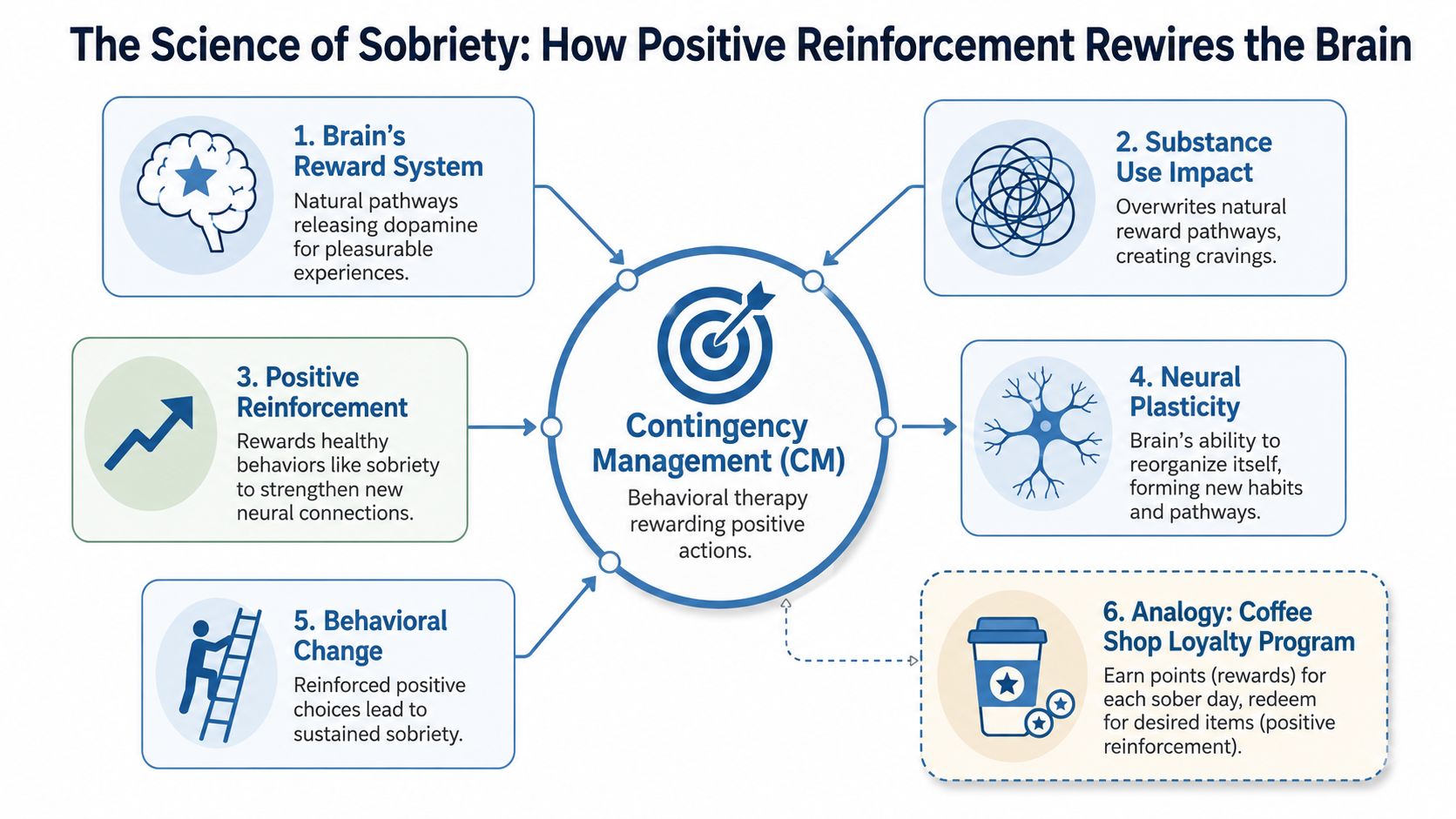
A useful way to understand CM is to think about a loyalty program. When someone buys coffee and gets a stamp toward a free drink, the reward strengthens the habit of returning. The brain starts linking the behavior with a positive outcome.
That same principle applies in recovery, but with much higher stakes. Substance use trains the brain to expect fast relief or reward from a drug or alcohol. CM helps create a competing pattern by reinforcing sober behaviors right away.
Why timing matters so much
The reward has to be close to the behavior. If a person attends treatment, provides a negative test, or follows through on a recovery goal, delayed recognition loses power. Immediate reinforcement helps the brain connect the action and the benefit.
That doesn't mean the reward has to be large. It means it has to be predictable, timely, and tied to something specific.
A well-designed CM plan usually follows this pattern:
- Choose a target behavior. The goal has to be measurable, such as attendance or a verified negative screen.
- Verify the behavior objectively. The person knows what counts and how progress is tracked.
- Deliver reinforcement quickly. Fast feedback helps lock in the connection.
- Repeat often enough to build momentum. Recovery strengthens through repetition.
Why this isn't bribery
Some families worry that rewarding sober behavior sends the wrong message. In practice, CM is a clinical strategy, not a shortcut. Addiction has already trained the brain to value immediate rewards tied to substance use. CM helps treatment compete on the same timeline.
Healthy choices often need to feel rewarding before they start to feel natural.
That's one reason this method can be especially useful early on, when cravings are strong and internal motivation may still be fragile. The reward doesn't replace therapy, insight, or accountability. It supports them.
What changes over time
At first, the external incentive helps a person show up and follow through. Over time, other benefits start to matter more:
- More stability at home
- Less chaos and crisis
- Better attendance in counseling
- Growing confidence from meeting goals
- More trust from family and treatment providers
Those changes matter because the brain can learn new routines. Repeated sober actions build familiarity. Familiarity lowers friction. What felt forced at the start can become part of a daily pattern.
For many people in the Dallas-Fort Worth area, that shift is the beginning of real hope. Recovery stops feeling like endless deprivation and starts feeling like progress that can be seen, measured, and repeated.
How CM Programs Work in a Real-World Setting
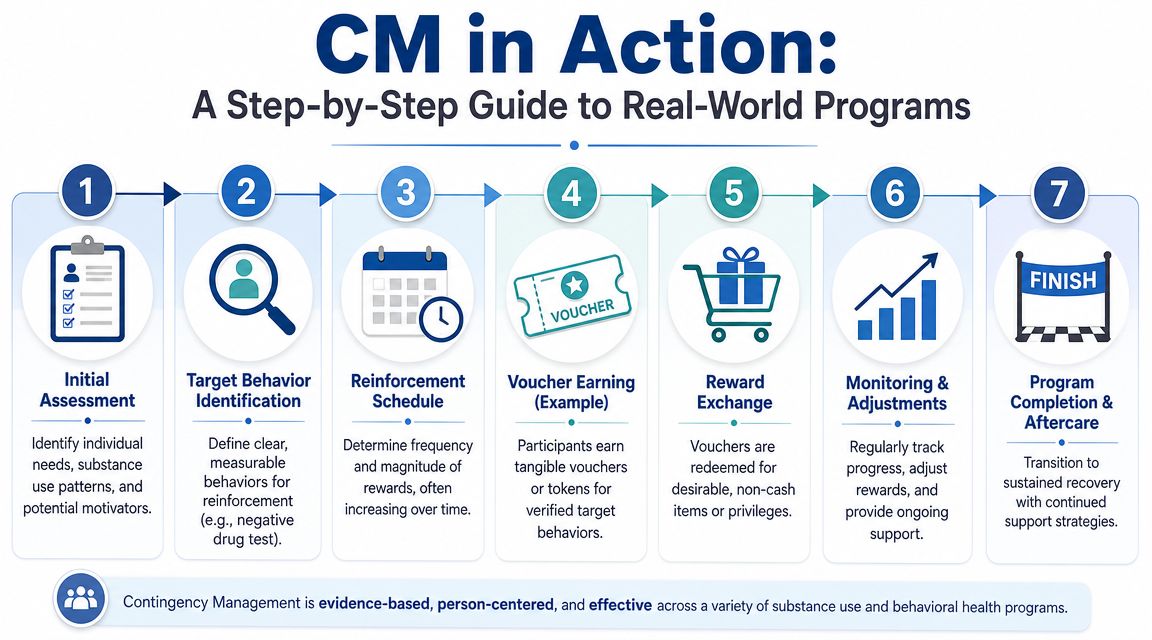
People often hear the term contingency management and still wonder what happens day to day. In a real program, the process is direct. A treatment team identifies a target behavior, explains how it will be measured, and gives a reward when that behavior is verified.
What a participant usually sees
The structure has to be transparent. People do better when they know exactly what earns reinforcement and what doesn't.
A typical CM program includes these parts:
Clear target behaviors
The program might reward negative drug tests, treatment attendance, medication adherence, or another concrete recovery task.Objective verification
Progress isn't based on guesswork. The behavior is verified through attendance records, testing, or another consistent method.Immediate reinforcement
Once the behavior is verified, the reward is delivered as quickly as possible.A set schedule
The participant knows how often the behavior is checked and what the reinforcement pattern looks like.A reset or adjustment process
If the target behavior isn't met, the program responds in a predictable way rather than with shame or chaos.
Two common reward models
Programs usually use non-cash incentives in a structured format. Two common examples are voucher systems and prize-based systems.
| Model | How it works | Why it helps |
|---|---|---|
| Voucher-based | The person earns points or vouchers for verified progress | It creates a steady link between effort and reward |
| Prize-based | The person earns chances to draw for prizes after meeting goals | It adds anticipation and keeps participation engaging |
Neither model works well if the rules are vague. CM succeeds when expectations are concrete and consistent.
Practical rule: The reward system should never feel random. People need to know what action leads to what outcome.
What doesn't work
CM loses strength when programs make a few common mistakes:
- Delayed rewards that arrive long after the behavior
- Unclear standards that leave participants guessing
- Infrequent monitoring that weakens accountability
- Changing rules midstream that make the system feel unfair
That's why CM is usually part of a broader treatment setting with regular contact. In practice, behavioral approaches often work best when they're paired with therapies that help people challenge thought patterns and build coping skills. A helpful example is this overview of cognitive behavioral therapy for alcohol addiction, which shows how behavior change and thinking change can reinforce each other.
What the day-to-day experience feels like
For the participant, a good CM program usually feels steady rather than dramatic. The person attends sessions, completes agreed-on recovery tasks, receives immediate feedback, and sees progress accumulate over time.
That can reduce one of the hardest parts of early sobriety. It gives people a reason to keep going on the days when motivation alone isn't enough.
Evaluating the Effectiveness of Contingency Management
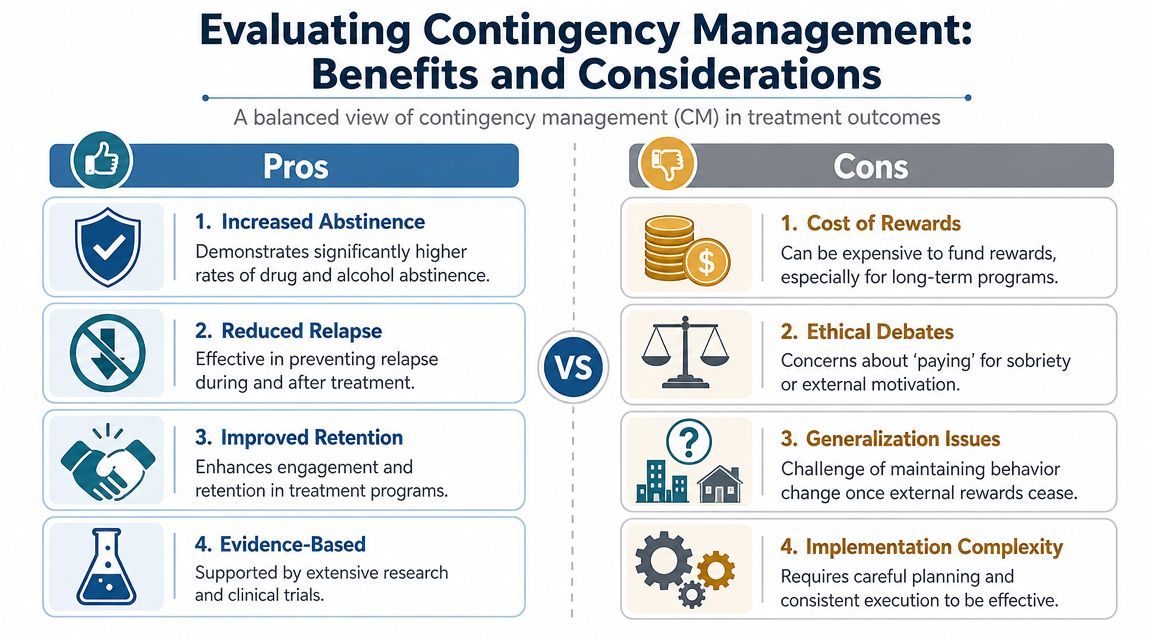
Contingency management has strong research behind it, especially when the program is designed carefully and delivered consistently. A 2021 meta-analysis of 74 clinical trials with over 10,000 adults found that CM improved opioid and other substance abstinence, treatment attendance, and medication adherence. Another review reported that participants in CM programs were 22% more likely to remain abstinent at follow-up.
That matters because good addiction treatment doesn't only aim for short-term abstinence. It also needs to help people stay engaged long enough to benefit from the rest of care.
What the evidence supports most clearly
The strongest case for CM is practical. It helps people do the behaviors that treatment depends on.
That includes areas such as:
- Showing up consistently
- Following medication plans
- Reducing substance use
- Staying involved in recovery long enough to gain traction
When a person attends more sessions and follows through more often, the rest of treatment has a better chance to work.
The criticism families often raise
The most common objection is simple. Are treatment programs just paying people to stay sober?
The better way to frame it is this. CM uses structured incentives to help people build early momentum while the deeper work of recovery is taking hold. It's not a replacement for insight, accountability, or therapy. It's a support for behavior change during a period when relapse risk is often high.
A reward can open the door. Long-term recovery still depends on what a person builds once they're inside treatment.
Real trade-offs to consider
CM isn't magic, and it isn't enough by itself. There are real limitations.
| Consideration | What it means in practice |
|---|---|
| Program design matters | Poorly structured incentives can weaken trust and reduce effectiveness |
| External motivation has limits | A person still needs coping skills, support, and relapse prevention planning |
| Staff consistency is essential | The method depends on reliable monitoring and follow-through |
Those trade-offs don't make CM weaker. They clarify where it fits. It works best as one tool inside a full treatment plan, especially for people who need help staying engaged through the difficult early phase of recovery.
For Dallas families asking whether this method is worth considering, the honest answer is yes when it's implemented well and paired with the right level of care.
Why CM Is Stronger When Paired with Other Therapies
Contingency management works best as part of a team. It helps people get through the front door of change, but other therapies help them stay there and grow.
A federal policy review notes that contingency management can target more than abstinence, including treatment attendance and medication adherence, and that it is especially supported for stimulant use disorder, where structured incentives can help in an area with limited medication options, as outlined in this HHS discussion of contingency management for substance use disorders.
Where it fits with medication and counseling
For some people, the first hurdle isn't understanding recovery. It's sticking with the plan long enough for the plan to help. CM can reinforce attendance, medication follow-through, and regular participation in therapy.
That makes it a strong companion to approaches such as medication-assisted treatment, where consistency often matters as much as motivation. When someone keeps appointments and stays engaged, treatment becomes more stable and more useful.
Why dual diagnosis care matters
Many people in addiction treatment in Dallas aren't only dealing with substance use. They may also be living with anxiety, depression, trauma, or another mental health condition. If the substance use remains chaotic, it's harder to do meaningful work in therapy.
CM can help create enough structure for that deeper work to happen. A person who starts attending reliably and reducing use may become more able to participate in counseling, practice emotional regulation, and follow through outside sessions.
Trauma care is a good example. Families who are trying to understand how trauma treatment supports recovery may find it useful to read about trauma counselling in Kelowna, because it shows how unresolved trauma can shape behavior long after the original events have passed.
Recovery tends to strengthen when behavioral stability and emotional healing happen together.
That's why CM usually has the most value when it's connected to therapy, psychiatric support when needed, family involvement, and a realistic aftercare plan. On its own, it can increase follow-through. In combination with the right clinical care, it can help people build a more durable recovery foundation.
What to Expect from Contingency Management at Tru Dallas Detox
At Tru Dallas Detox & Recovery Center, contingency management can be folded into a broader treatment plan rather than used as a stand-alone tactic. That matters for people in Dallas-Fort Worth who need more than a short burst of motivation. They need detox support when appropriate, a clear clinical plan, and steady follow-through after the first crisis passes.
How the experience is usually structured
The process starts with assessment. The clinical team identifies what behaviors need reinforcement most. For one person, that may be treatment attendance. For another, it may be medication adherence, abstinence goals, or consistent participation after detox.
The plan should feel personalized, not generic. A person with stimulant use issues may need one type of structure. Someone with alcohol dependence and co-occurring anxiety may need another.
Common elements often include:
- Defined goals that are realistic and measurable
- Frequent check-ins so progress doesn't get lost between sessions
- Recognition of effort instead of only attention to mistakes
- Integration with counseling so behavior change connects with deeper therapeutic work
What families often notice
A supportive CM approach can change the tone of treatment. Instead of every conversation revolving around what went wrong, there's room to reinforce what's going right.
That doesn't mean expectations are lowered. It means progress becomes easier to see and repeat. Many families also respond well to behavioral approaches that complement communication-based methods like motivational interviewing for substance abuse, where change talk and practical follow-through can support each other.
For someone searching for a Dallas detox center or rehab option in the DFW area, the most important next step is an honest clinical conversation. A good assessment can clarify whether CM fits the person's needs, what level of care is appropriate, and how treatment can support both immediate safety and longer-term recovery.
Common Questions About Contingency Management
Is contingency management only for stimulant addiction
No. It can be used for different substance use disorders and for different recovery behaviors. In practice, it may be especially useful when a person needs help with attendance, medication follow-through, or early stability.
Does it only work while rewards are happening
The rewards are meant to help establish behavior patterns, not replace recovery. Long-term success usually depends on what else is built around CM, including therapy, relapse prevention planning, and support at home.
Is this the same as getting paid to stay sober
Not really. A clinical CM program uses structured, non-cash reinforcement to support verified behaviors tied to treatment goals. The focus is on building consistency and strengthening participation in care.
Will insurance cover treatment that includes CM
Coverage depends on the plan and the level of care being recommended. Many people in the Dallas-Fort Worth area start by verifying PPO benefits and asking what detox, residential treatment, outpatient care, and behavioral therapies may be covered.
Who's a good candidate
A good candidate is someone who needs more structure around follow-through in early recovery. That may include people who've struggled with repeated relapse, poor attendance, or difficulty staying engaged after detox.
What should a family ask when calling
A family can ask:
- How recovery behaviors are measured
- What kinds of incentives are used
- How CM fits with counseling and aftercare
- Whether dual diagnosis needs are addressed
- How insurance verification works
If someone in Dallas, Euless, or the surrounding DFW area is looking for clear answers about detox, rehab, or whether contingency management fits a loved one's needs, Tru Dallas Detox & Recovery Center can help with a confidential conversation, treatment guidance, and insurance verification for eligible plans.
