

It often feels like you're alone when facing alcohol addiction, but with the right approach, recovery is absolutely within reach. Cognitive behavioral therapy for alcohol addiction is one of the most effective, research-backed methods out there. It’s a practical therapy that gives you the power to change the specific thoughts and behaviors that keep you stuck in the cycle of drinking.
This isn't about endlessly digging into your past. It’s about building real-world skills for a better present and future.
Key Takeaways
- Skills-Based Approach: CBT focuses on teaching you practical skills to identify, challenge, and change the negative thought patterns that fuel alcohol addiction.
- Present-Focused: Unlike other therapies, CBT deals with your current challenges, providing immediate tools to manage cravings and triggers.
- Breaks the Cycle: The therapy works by interrupting the automatic link between your thoughts (e.g., "I need a drink to relax"), feelings (anxiety), and actions (drinking).
- Evidence-Backed: Extensive research confirms that CBT provides significant, measurable benefits for individuals with alcohol use disorder, improving their chances of long-term sobriety.
- Empowerment: The ultimate goal is to equip you with lifelong skills to become your own therapist, confidently managing life's challenges without alcohol.
Your Path to Recovery Starts Here
Living with alcohol use disorder (AUD) can feel like you're on a hamster wheel. A trigger—maybe it's stress from work, a social gathering, or just a tough emotion—sets off an automatic thought. That thought sparks an intense craving, and before you know it, you're drinking again.
Cognitive behavioral therapy, or CBT, is specifically designed to get you off that wheel. It's built on a simple but profound idea: your thoughts, feelings, and actions are all connected.
Think of it like learning to read the instruction manual for your own mind. CBT doesn’t just tell you to “stop drinking.” It shows you how by helping you spot the unhelpful thinking patterns—the "faulty code"—that leads to drinking. For example, the thought, "I need a drink to relax after a hard day," isn't treated as a fact. Instead, it's viewed as a habit of thinking that can be challenged and changed.
Building a Foundation for Sobriety
Instead of relying on sheer willpower, which often fails us when we're stressed, CBT gives you a mental toolkit for building a solid foundation for sobriety. It's a hands-on, goal-oriented approach, and its effectiveness is backed by decades of research.
In fact, study after study has confirmed that CBT works. Pooled results from clinical trials have shown it to be a reliable treatment that delivers consistent benefits over no treatment at all. One major meta-analysis found that people undergoing CBT were 15% to 26% more likely to have better outcomes than those who didn't. You can dig into some of that research yourself through the National Institutes of Health.
This evidence highlights something crucial: CBT gives you a structured roadmap for recovery. You and your therapist become a team, working together to hit measurable goals and develop coping skills that will serve you for the rest of your life. The real goal is to become your own therapist—someone who can confidently handle life’s ups and downs without turning to alcohol.
CBT empowers you to move from being a passenger in your addiction to the driver of your recovery. It's about taking back control, one thought and one action at a time.
This journey isn’t about trying to erase your past. It’s about actively building a new future. By learning to understand and reshape your internal world, you start creating healthier neural pathways that make sobriety feel more natural and sustainable over the long haul.
How CBT Reshapes Your Relationship with Alcohol
Cognitive Behavioral Therapy, or CBT, works by getting to the root of the automatic link between a trigger and the urge to drink. Over time, addiction forges a very strong mental shortcut: feel stress, grab a drink. CBT is all about intentionally carving out a new, healthier pathway in your brain.
This whole process starts with understanding something called the cognitive triangle. It’s a core CBT concept showing how your thoughts, feelings, and actions are all tied together. A negative thought like, “I can’t handle this pressure,” triggers a difficult feeling (like anxiety), which then pushes you toward a specific behavior (drinking to numb that feeling). It's a vicious cycle that can feel impossible to break on your own.
Deconstructing the Addiction Cycle
You can think of your brain's automatic response to stress as faulty code in a computer program. A certain input (a trigger) always gives you the same problematic output (drinking). CBT is like debugging that code. It helps you find the specific lines of faulty programming—those automatic, negative thoughts—that keep the system crashing.
You learn to hit pause and actually look at these thoughts instead of just accepting them as true. For example, the thought "I need a drink to be social" isn't a command from on high. It's a learned belief, and like any belief, it can be questioned, challenged, and ultimately, rewritten.
This diagram breaks down how CBT connects your actions, your thoughts, and the evidence you need to dismantle old habits.
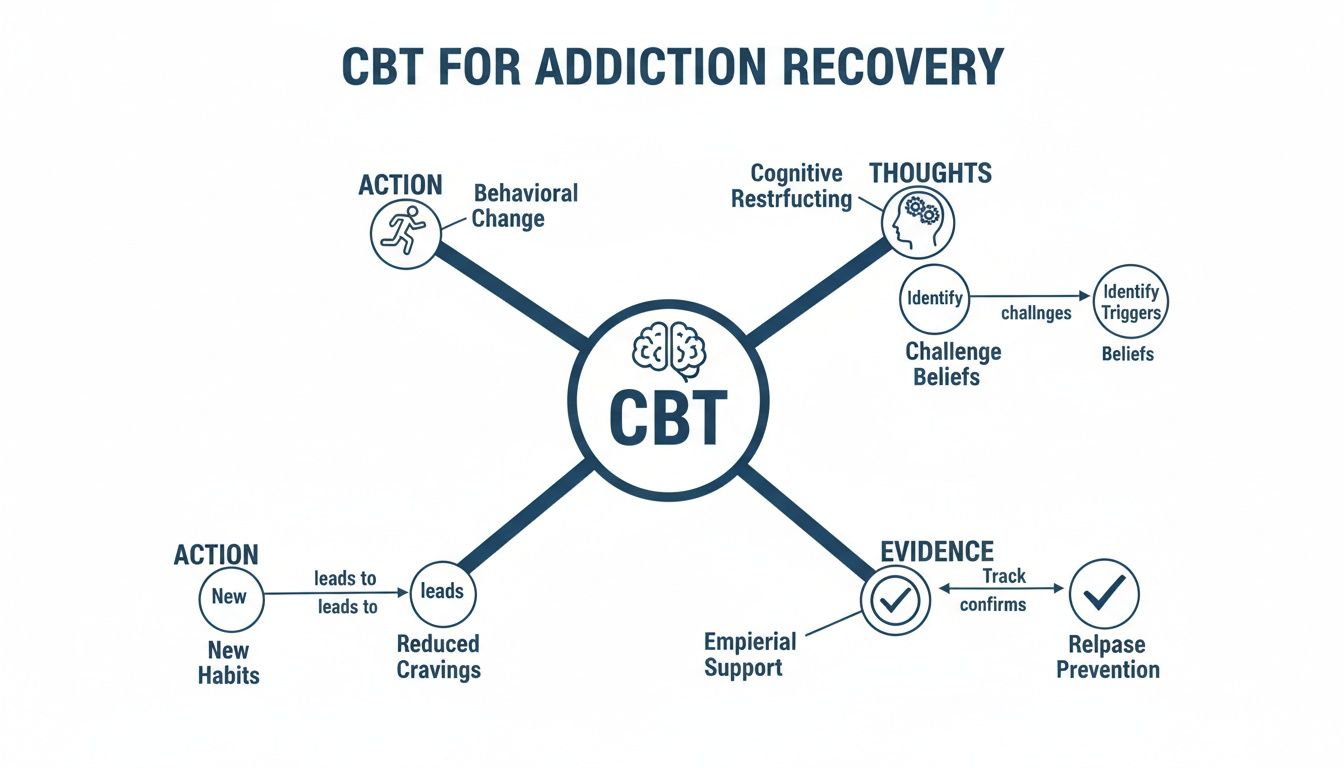
As you can see, recovery isn't just about white-knuckling it and stopping an action. It’s about systematically changing the thoughts that fuel the action and then finding real-world proof to support new, healthier behaviors.
Moving From Automatic Reaction to Mindful Response
The goal here is to shift from being reactive to being mindful and in control. CBT gives you the tools to create a critical moment of pause between the trigger and your response. In that small gap, you find the power to choose a different direction.
"The core principle of CBT is that by changing distorted thinking, you can change how you feel and what you do. It’s about learning to become an active participant in your own mind, rather than a passive observer of your impulses."
This shift is practical and based on skills you can actually learn. You'll dig into the function of your drinking. What job is it doing for you? Is it a temporary fix for boredom, social anxiety, or overwhelming stress? Once you figure out its purpose, you can start developing healthier, more effective ways to meet those same needs without alcohol.
The table below really illustrates this transformation, comparing the old, automatic cycle with the new, conscious one you build in therapy.
The Addiction Cycle vs The CBT Recovery Cycle
| Stage | The Addiction Cycle (Automatic Reaction) | The CBT Recovery Cycle (Learned Response) |
|---|---|---|
| Trigger | Experiencing a high-stress meeting at work. | Experiencing a high-stress meeting at work. |
| Thought | "This is unbearable. I need a drink to calm down." | "This is stressful, but I have ways to handle it." |
| Feeling | Overwhelming anxiety and an intense craving. | Manageable stress and a sense of capability. |
| Behavior | Stopping at the bar on the way home. | Going for a run or calling a supportive friend instead. |
| Consequence | Temporary relief followed by guilt and worsening anxiety. | Reduced stress, increased self-respect, and reinforced sobriety. |
Notice how the trigger is exactly the same, but your internal and external responses are completely different. This new cycle doesn't just appear overnight; it’s built by practicing, day in and day out. With every conscious choice you make, you strengthen that new neural pathway, making the sober response feel more and more natural over time. You are actively rewriting the script that has governed your relationship with alcohol.
Key Takeaways
- The Cognitive Triangle: CBT is built on the powerful idea that your thoughts, feelings, and actions are all interconnected and influence one another.
- Challenge Negative Thoughts: The therapy teaches you to identify and challenge the automatic, negative thoughts that drive your urge to drink.
- Create a Pause: A primary goal is to create a "pause" between a trigger and your reaction, empowering you to choose a healthier response.
- Find Alternatives: By understanding the function of your drinking (e.g., coping with stress), you can develop effective, non-alcoholic strategies that meet the same need.
- Rewire Your Brain: Consistent practice of these new skills builds healthier neural pathways, making sobriety feel less like a struggle and more natural over time.
Practical CBT Skills You Will Learn
Knowing the theory behind CBT is a great start, but the real change happens when you start putting it into practice. This isn't about sitting around discussing abstract concepts; it's an active, hands-on therapy that gives you specific, real-world tools to manage alcohol use disorder. These are the skills you’ll use every day to break old habits and build a solid foundation for sobriety.
Think of it as becoming an apprentice of your own mind. Your therapist will guide you as you learn to be a detective, a planner, and a problem-solver—all in the service of your recovery.
Let's dig into some of the core skills you'll get to master.
Unpacking Your Triggers with Functional Analysis
You can't change a behavior until you understand it from the inside out. That’s where Functional Analysis comes in. It's a core CBT skill where you and your therapist basically become investigators, mapping out the "who, what, when, where, and why" behind your drinking.
This isn't about judgment—it's about gathering facts. You’ll learn to see the exact sequence of events that leads to drinking and what happens afterward.
- Antecedents: What happens right before the urge to drink shows up? It could be something external, like driving past a certain bar, or something internal, like a sudden wave of loneliness.
- Behavior: This is the act of drinking itself. How much, how fast, and where?
- Consequences: What are the immediate payoffs (a temporary feeling of relief) and the long-term fallout (guilt, relationship problems, health issues)?
By laying it all out on the table, drinking stops feeling like a random, chaotic event and starts looking like a predictable pattern. Seeing that pattern clearly is the first crucial step toward breaking it.
Rewriting the Script with Cognitive Restructuring
One of the most powerful tools in cognitive behavioral therapy for alcohol addiction is Cognitive Restructuring. This is where you learn to catch, challenge, and change the automatic negative thoughts that drive the desire to drink. These thoughts often feel like undeniable truths, but they're usually just old, unhelpful beliefs running on autopilot.
A classic example might be the thought: "I've had a horrible day, I deserve a drink."
Cognitive restructuring teaches you to put that thought on trial. Instead of just accepting it, you learn to cross-examine it: "Is alcohol really a reward, or is it just a short-term escape with a long-term price? What’s a healthier way I could actually reward myself for surviving this day?"
You get good at replacing those distorted thoughts with more balanced and realistic ones. This skill slowly dismantles the mental scaffolding that addiction builds, taking away its power one thought at a time. It’s all about creating a new inner voice that supports your recovery instead of undermining it.
Building Your Arsenal of Coping Skills
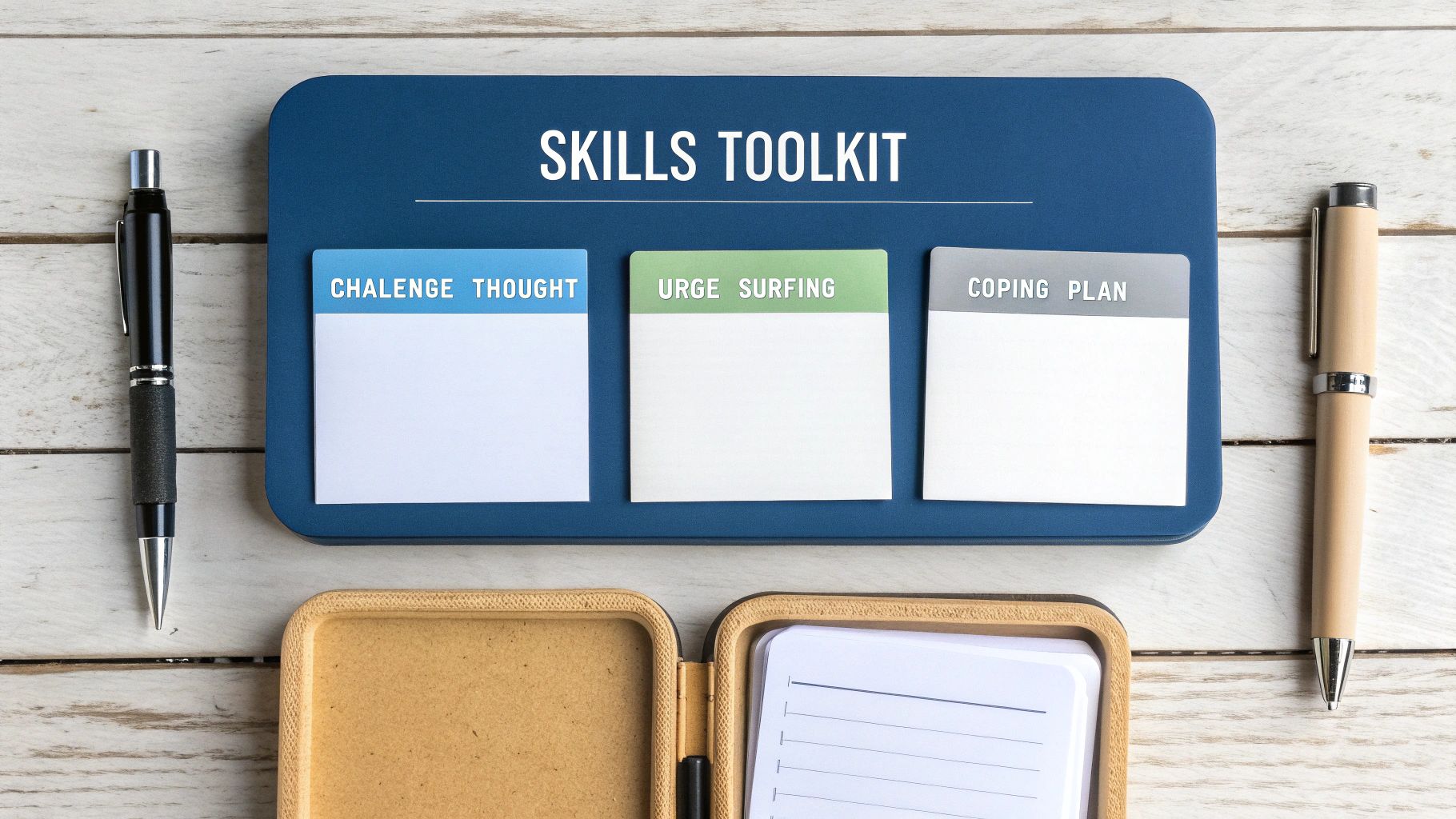
Let's be honest: willpower alone usually isn't enough to stare down a powerful craving or navigate a high-risk situation. That's why a huge piece of CBT is building a diverse toolkit of practical coping skills. This is your go-to arsenal for handling the tough moments that are an inevitable part of life.
These aren't just ideas; they are active techniques you'll practice until they feel like second nature.
- Urge Surfing: Instead of fighting a craving head-on, you learn to "surf" it. It’s a mindfulness technique where you observe the craving as a temporary wave of sensation—it will rise, peak, and eventually pass on its own. It teaches you that cravings are just suggestions, not commands.
- Stress Management: Stress is a massive trigger for so many people. You'll develop healthy ways to manage it, like deep breathing, muscle relaxation exercises, or finding hobbies that genuinely help you unwind.
- Problem-Solving Skills: You'll also learn how to break down big, overwhelming problems into smaller, more manageable steps. This builds confidence and stops you from feeling so defeated that drinking seems like the only way out.
Developing these abilities is essential for lasting sobriety. You can find even more strategies in our guide on effective coping skills for addiction. Every new skill you master is another line of defense against relapse, giving you far more options than just reaching for a drink when life gets tough.
Key Takeaways
- Functional Analysis: You'll learn to become a detective of your own behavior, mapping out the specific triggers and consequences of your drinking.
- Cognitive Restructuring: This core skill teaches you to catch, challenge, and replace the automatic negative thoughts that fuel your addiction.
- Coping Skills Development: You will build a practical toolkit of techniques like urge surfing and stress management to handle difficult situations without alcohol.
- Problem-Solving: CBT helps you develop structured ways to tackle life's problems, reducing the feelings of overwhelm that can lead to drinking.
- Active Practice: These are not just theoretical concepts; they are hands-on skills you will actively practice and refine with your therapist.
What a Typical CBT Session Looks Like
The idea of therapy can be nerve-wracking, especially when you're facing something as personal as alcohol use disorder. It’s easy to imagine a stuffy room and a lot of vague questions. But a cognitive behavioral therapy for alcohol addiction session is anything but mysterious. Think of it less like a traditional therapy cliché and more like a coaching session for your recovery.
These sessions are built on collaboration. It’s a partnership where you and your therapist work as a team to tackle challenges head-on. The entire process is structured, goal-oriented, and practical—designed to give you tangible skills, not just to talk about problems. You’re in the driver's seat.

The Opening Check-In and Agenda Setting
Every session kicks off with a quick check-in. Your therapist will want to know how your week went—what were the wins? What were the tough spots? This isn't just small talk; it's a real-time pulse check that helps guide the session based on what’s actually happening in your life.
Right after that, you’ll set the agenda together. This is a critical step because it ensures the session focuses on what’s most important to you. Maybe you're anxious about an upcoming wedding, struggling with a specific craving, or noticing a negative thought that keeps popping up. By setting the agenda jointly, you make sure every minute is productive.
Reviewing and Building on Your Skills
A good chunk of the session is spent looking at how you applied your new skills out in the real world. CBT is all about action, so the "homework" you do between sessions is where the magic really happens. This isn't about getting a grade—it's about road-testing your recovery tools.
You’ll talk through what worked and what didn't. For example, if you tried to "urge surf" through a craving but it felt overwhelming, you and your therapist can dissect what happened and tweak your approach. This constant cycle of practice, review, and refinement is how these new sober habits start to feel like second nature. Our guide on CBT in addiction treatment dives deeper into how this consistency creates lasting change.
Learning and Rehearsing New Techniques
The heart of the session is dedicated to learning something new. Your therapist might introduce a new way to challenge a self-defeating belief or walk you through a strategy for politely turning down a drink. The focus is always on practical, real-world application.
One of the most powerful parts of CBT is something called behavioral rehearsal, which is basically just role-playing. You might practice what to say when a friend offers you a beer. By acting it out in a safe space, you build the confidence and muscle memory to handle the situation smoothly when it happens for real.
This kind of rehearsal prepares you for high-risk situations, so your new skills are ready to go when you need them most.
Before you leave, you’ll wrap up by creating a simple, concrete action plan for the coming week. You won't walk away with vague advice, but with specific, manageable goals to work on. This structure keeps you moving forward, feeling empowered and fully supported every step of the way.
Key Takeaways
- Collaborative Structure: CBT sessions are not passive lectures; you and your therapist actively work together to set the agenda and goals for each meeting.
- Real-World Focus: Sessions begin by checking in on your actual experiences from the past week, making the therapy relevant and practical.
- Practice and Refine: A major focus is on reviewing how you used your skills, celebrating successes, and troubleshooting any challenges you faced.
- Active Learning: You will learn and rehearse new coping strategies in a safe environment, such as role-playing how to navigate social pressure.
- Action-Oriented: You will always leave a session with a clear, concrete plan for what to work on in the week ahead, ensuring continuous progress.
Why CBT Is a Key Part of Comprehensive Treatment
Getting sober is about more than just putting down the drink. Anyone who’s been there knows that’s just the first step. True, lasting recovery means getting to the heart of why you drink, and that’s where the real work begins. This is exactly why cognitive behavioral therapy for alcohol addiction isn't just an add-on; it's an essential piece of a complete, effective treatment plan.
Think of it like building a house. Medical detox is like clearing the land and pouring a solid concrete foundation. It’s absolutely critical for getting through the physical side of withdrawal safely. But a foundation alone won't protect you from the elements. CBT is the framework of the house—it gives you the structure, the skills, and the mental resilience to actually live on that foundation for good.
Without tackling the thoughts and habits that led to drinking, that foundation is always at risk of cracking.
Bridging Medical and Mental Health
CBT creates a vital bridge, connecting the medical side of recovery with the psychological healing that needs to happen. It picks up where detox leaves off, diving into the "why" behind the addiction. While detox frees your body, CBT helps retrain your brain.
When you put them together, you get a powerful, one-two punch that addresses addiction from every angle.
- Detox deals with the physical. It breaks the body's cycle of dependency and cravings.
- CBT deals with the psychological. It breaks the mind's automatic response to triggers.
This comprehensive approach makes sure you're not just physically sober, but mentally equipped to stay that way.
How CBT Supports Medication-Assisted Treatment
CBT is particularly powerful when it’s paired with Medication-Assisted Treatment (MAT). Medications used in MAT are incredibly helpful for tamping down cravings and making alcohol less appealing, but they don't teach you how to handle life when a trigger pops up.
That’s where CBT shines. As you learn to restructure your thoughts and develop new coping skills, you build the mental muscle to navigate tough emotions and high-risk situations. This makes the medication far more effective because you’re not just white-knuckling it and relying on a pill to do all the work. You become an active participant in your recovery, changing your entire mindset. You can get a deeper look into this by exploring our guide on what Medication-Assisted Treatment is.
Combining medical support with the psychological skills from CBT creates a robust recovery plan. You're not just treating symptoms; you're building a new way of living that addresses both your body and your mind.
Ultimately, weaving CBT into a broader treatment plan gives you the best of both worlds. You get the medical care you need to get stable and the psychological tools required to protect your sobriety for the long haul.
Key Takeaways
- Addresses Root Causes: CBT is a core part of a full treatment plan, digging into the psychological roots of addiction that detox alone cannot address.
- Complements Detox: It works hand-in-hand with medical detox, providing the mental skills needed to maintain sobriety after your body has stabilized.
- Enhances MAT: CBT significantly strengthens Medication-Assisted Treatment (MAT) by teaching you how to manage the triggers that medications don't resolve.
- Holistic Approach: This integrated method treats the whole person—both mind and body—leading to a more durable and long-lasting recovery.
- Reduces Relapse Risk: By combining medical support with psychological skills, you build the strongest possible defense against relapse.
Digital CBT and the Future of Accessible Care
Let's be honest: getting help for a drinking problem has never been easy. Finding the time for appointments, dealing with the cost, or just overcoming the stigma can feel like huge roadblocks. But technology is changing all of that, putting the proven, powerful techniques of cognitive behavioral therapy for alcohol addiction right on your phone or computer.
This isn't about replacing human connection; it's about making support more immediate and accessible. Think of it as having a set of recovery tools in your pocket. Whether it's a structured online program or a mobile app, these resources offer privacy and the chance to work on coping skills the very moment you need them—like when a late-night craving hits or a stressful day at work makes you want to reach for a drink.
And this isn't some watered-down, "therapy-lite" experience. The research shows these digital tools can be incredibly effective.
The Power of On-Demand Support
Digital CBT platforms guide you through structured lessons and interactive exercises, giving you immediate feedback to help you build healthier habits. This constant, on-demand access means you're reinforcing new skills in real-time, right where life actually happens. For many, the privacy and convenience are what finally makes it possible to take that first brave step toward recovery.
The evidence backing this up is compelling. A randomized trial for a web-based program called CBT4CBT found that participants using the digital tool increased their percentage of days abstinent by more than 50% over an eight-month period. In fact, while actively in treatment, they had even better abstinence outcomes than those in standard outpatient care. You can dig into the full study from Yale Medicine here.
Digital CBT democratizes recovery, moving essential mental health tools from the therapist’s office into the palm of your hand, making support both immediate and discreet.
This modern approach fits perfectly alongside traditional therapy. For some, it might be the main form of treatment. For others, it's a powerful way to stay engaged and practice new skills between in-person sessions. By knocking down the old barriers to entry, digital CBT is opening the door to recovery for more people than ever before.
Key Takeaways
- Accessibility and Privacy: Digital CBT platforms offer convenient, private access to therapy tools directly on your phone or computer.
- On-Demand Support: These resources provide immediate help for managing real-life challenges, like cravings or negative thoughts, whenever and wherever they occur.
- Proven Effectiveness: Solid research demonstrates that digital CBT can be highly effective, sometimes leading to even better outcomes than traditional care alone.
- Overcomes Barriers: This approach helps overcome common hurdles to treatment, such as scheduling conflicts, cost, and the fear of stigma.
- Flexible Use: Digital tools can be used as a primary form of therapy or as a supplement to strengthen the work you're doing with an in-person therapist.
Frequently Asked Questions
When you're starting the journey to recovery, it's natural to have a lot of questions. Let's walk through some of the most common ones we hear about using cognitive behavioral therapy for alcohol addiction to give you a clearer picture of the road ahead.
How Long Does CBT for Alcohol Addiction Usually Take?
One of the best things about CBT is that it’s not meant to be a lifelong commitment to therapy. It's a focused, goal-oriented process designed to give you a specific set of skills. While everyone's path is different, a typical round of CBT usually lands somewhere in the 12-20 session range. The whole idea is to be efficient and equip you with the tools you need to manage your own recovery for the long haul.
Is CBT Effective if I Have Relapsed Before?
Absolutely. In fact, CBT is incredibly well-suited for people who have struggled with relapse. We don't see relapse as a sign of failure; we see it as a chance to learn something vital. A slip-up gives us real-world data about your most powerful triggers and shows us exactly which coping skills need a tune-up. This approach lets you turn past stumbles into the foundation for a more solid, lasting sobriety.
Can My Family Be Involved in My CBT Treatment?
Yes, and in most cases, it is strongly encouraged. Addiction impacts the entire family, and having a supportive home environment can be a game-changer. CBT principles can be extended into family therapy to improve communication, establish healthy boundaries, and help your loved ones become a truly supportive part of your recovery team.
Do I Have to Believe in the Therapy for It to Work?
No, you don't. Think of CBT less like a philosophy you have to adopt and more like physical therapy for your mind. You don't have to "believe" in the exercises for them to strengthen a muscle—you just have to do the work. CBT's power comes from consistently practicing the skills. As you start to see real, positive changes in your life from your actions, any initial skepticism usually fades on its own.
What if I also struggle with anxiety or depression?
CBT is an excellent choice for co-occurring disorders. The same skills you learn to manage alcohol cravings—like identifying and challenging negative thought patterns—are also highly effective for treating anxiety and depression. Your therapist can create an integrated plan that addresses both your addiction and your mental health simultaneously, as they are often deeply connected.
