
When you're struggling with addiction, it often feels like you're fighting your own brain. And in a way, you are. Years of substance use can carve deep pathways, creating automatic links between certain thoughts, feelings, and the urge to use. Cognitive Behavioral Therapy (CBT) is a hands-on approach designed to help you rewire those connections.
It’s not just about talking; it's about doing. CBT gives you practical skills to identify and change the destructive thought patterns and behaviors that keep the cycle of addiction going. You learn real, tangible coping strategies to manage cravings and handle high-risk situations, building a solid foundation for a new way of life.
Key Takeaways
- Cognitive Behavioral Therapy (CBT) provides practical skills to change destructive thought patterns that fuel addiction.
- It focuses on rewiring the brain's automatic responses to triggers, creating healthier habits.
- CBT is an active, "doing" therapy, not just a passive "talking" therapy.
- The goal is to equip individuals with tangible coping strategies for long-term recovery.
- It addresses the connection between thoughts, feelings, and actions to break the cycle of addiction.
How CBT Rewires the Brain for Sobriety
Imagine your brain's ingrained habits are like a well-worn path in a forest. A trigger—say, seeing a bar you used to frequent—sends you down that path automatically. The thought pops up: "A drink would take the edge off." This leads to a feeling of craving, which then leads to the old action of walking into the bar.
CBT is like a guide who helps you forge a new path. It doesn't just block the old one; it helps you build a better, healthier route that, with practice, becomes your new go-to.
Finding the Glitches in Your Thinking
The first step in CBT for addiction is becoming a detective of your own mind. You learn to spot those automatic, negative thoughts that have been running the show for so long.
Instead of just accepting "I need a drink to relax," you're taught to pause and question it. Is that really true? What happens after the initial relief? What are the actual consequences? This simple act of awareness is powerful. It helps you see that cravings aren't mysterious forces; they are predictable responses to specific triggers you can learn to manage.
CBT provides a practical, structured framework for recovery. It moves beyond simply talking about problems and equips you with the tools to actively solve them, helping you become your own recovery expert.
Building New, Healthier Responses
Once you can see the faulty patterns, you can start to change them. This is the "behavioral" part of CBT. You'll work on developing a toolkit of new, healthier ways to respond to stress, boredom, or social anxiety.
Instead of turning to a substance, your new automatic response might become:
- Stepping outside for a five-minute walk to clear your head.
- Sending a quick text to a friend or sponsor.
- Putting on a playlist that always lifts your mood.
These aren't just one-off tricks. They are skills you rehearse until they become second nature. Over time, you're literally forging those new neural pathways in your brain.
Beyond its clinical effectiveness, CBT in addiction is also recognized for its financial sense. Economic studies have shown it's a highly cost-effective treatment. In the UK, for example, CBT is a top-recommended therapy for depression (which often goes hand-in-hand with addiction) partly because it provides lasting results, making it a smart, sustainable investment in long-term health. You can read more about the economic viability of CBT on CrownCounseling.com.
By consistently using these strategies, you strengthen your brain's ability to choose the new, healthy path, making it easier to navigate triggers and maintain your sobriety for good.
How CBT Actually Works
At its core, Cognitive Behavioral Therapy is built on a straightforward but profound idea: the cognitive triangle. This is just a simple way of showing how our thoughts, feelings, and actions are all tied together. Imagine them as three points of a triangle—if you move one point, the other two have to move with it.
In the grip of addiction, this connection is what creates a vicious cycle. A fleeting thought can set off a powerful emotional reaction, which then drives the behavior of using. The first real step to breaking free is seeing this cycle for what it is.
The Power of the Cognitive Triangle
The cognitive triangle isn't some abstract concept; it's a practical map of what’s happening inside your head. It reveals that an external event, like a tough day at work, isn't what directly forces you to act. The real trigger is the thought you have about that tough day.
Let’s walk through a common example:
- Thought: "I can't take this stress. A drink is the only thing that will help me relax."
- Feeling: That single thought can instantly bring on feelings of anxiety and being overwhelmed, topped off with an intense craving.
- Action: The feeling gets so strong that reaching for a drink feels less like a choice and more like a necessary escape.
This loop can become so automatic that you're not even aware of the thought that kicked it all off. CBT helps you press pause on that process. You learn to spot the initial thought, question it, and consciously choose a different response. You can see a detailed breakdown of how this applies to alcohol in our guide on Cognitive Behavioral Therapy and alcoholism.
Breaking the Cycle With Proven Techniques
CBT is more than just identifying these patterns; it gives you a practical toolkit to actively rewire them. A therapist works with you to master specific, evidence-based techniques that help you build healthier, more constructive responses to stress and cravings.
Let's look at some of the most important tools in the CBT toolkit. The table below breaks down a few key techniques, what they're for, and how they look in a real-world recovery setting.
| Technique | Purpose in Addiction Treatment | Practical Example |
|---|---|---|
| Cognitive Restructuring | To identify, challenge, and reframe the automatic negative thoughts that drive substance use. | Your thought is: "I've relapsed before, so I'll never succeed." You work with a therapist to challenge this by looking at the evidence: "I've also had weeks of sobriety. A slip doesn't erase that progress. What can I learn from it?" |
| Behavioral Activation | To overcome apathy and low motivation by scheduling and engaging in positive, sober activities. | Instead of waiting to "feel like it," you schedule a 20-minute walk after work every day. This action itself helps create positive feelings and provides an alternative to old routines. |
| Skills Training | To learn and practice practical skills for managing triggers and high-risk situations. | You role-play with your therapist how to politely turn down a drink at a social event or how to handle a stressful phone call with a family member without resorting to substance use. |
| Exposure and Response Prevention | To gradually face triggers in a controlled way to reduce their power and the anxiety they cause. | You might start by simply driving past a liquor store without stopping, then progressing to going into a grocery store with a liquor section without buying anything, all while using coping skills. |
By consistently applying these techniques, you're not just fighting urges—you're fundamentally changing the thought patterns that create them in the first place.
This infographic gives a great visual of how CBT helps swap out addictive thoughts for sober actions.
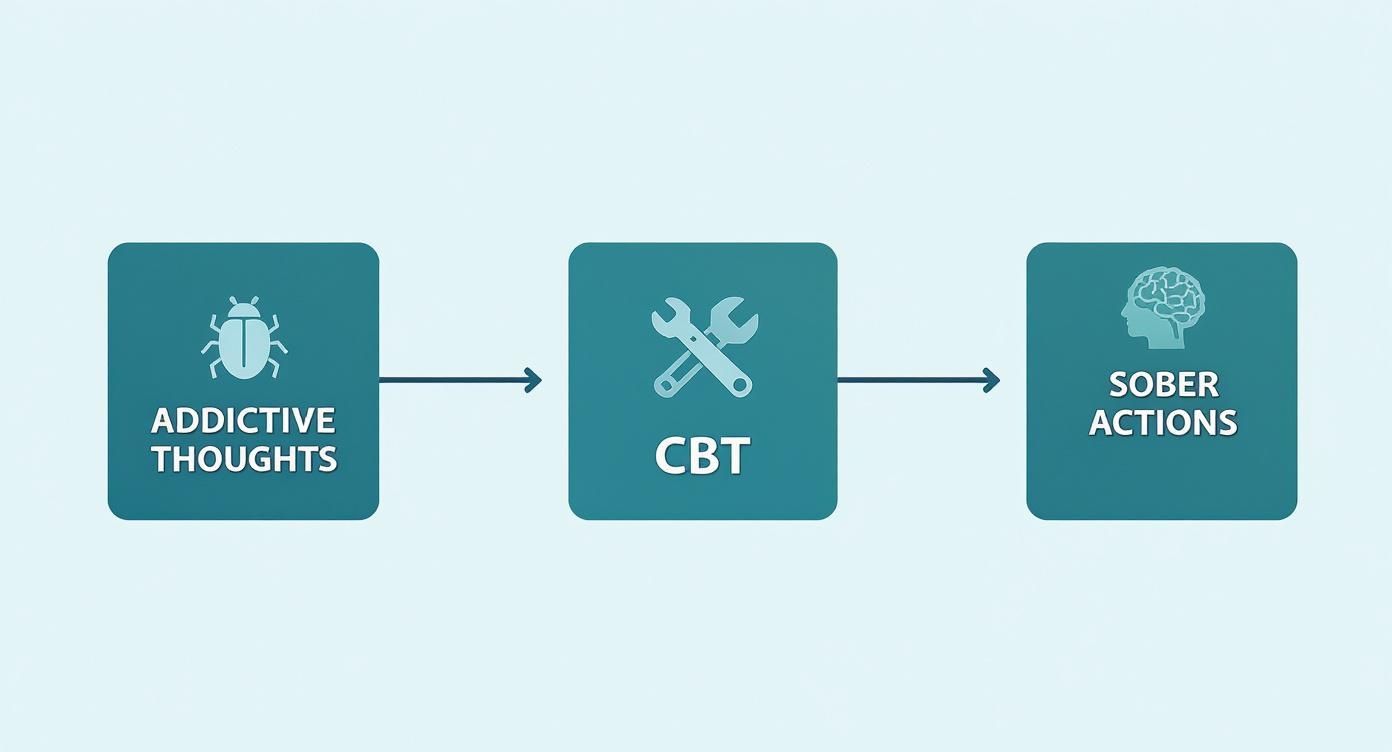
As you can see, CBT acts as the critical bridge that intercepts those destructive thought patterns and empowers your brain to choose healthier behaviors instead.
“The goal of CBT is to teach you that while you cannot control every aspect of the world around you, you can take control of how you interpret and deal with things in your environment.”
This really gets to the heart of it. CBT is incredibly empowering. It shifts your focus away from the external triggers you can’t always control and puts it squarely on your internal responses—which you absolutely can. By mastering these skills, you stop being a passenger to your addiction and get back in the driver's seat of your own recovery. With practice, these new ways of thinking and acting become second nature.
Putting CBT into Practice with Real Scenarios
Theory is great, but seeing how Cognitive Behavioral Therapy actually works in the real world is where it all clicks. The real strength of CBT in addiction treatment is that it isn’t a rigid, one-size-fits-all script. Instead, it’s a flexible framework that a therapist can shape to fit your specific substance use, personal history, and unique triggers.
Think of it like learning to play an instrument. First, you learn the basic chords and scales—those are the core concepts of CBT. But to really make music, you have to apply those fundamentals to different songs and styles. Let's look at a few "songs" to see how CBT helps people build real-world skills for a life in recovery.
Tackling Alcohol Use Disorder with Functional Analysis
Let's start with a common scenario. Meet Sarah. Every night, like clockwork, she’d pour a glass of wine at 6 PM to decompress from her high-stress job. That single glass usually turned into a bottle, and the habit was starting to damage her health and her relationships.
A CBT therapist would start with something called functional analysis. It’s basically about becoming a detective of your own behavior.
Together, they'd map out the entire sequence:
- Trigger: The clock hits 6 PM after a draining day.
- Automatic Thought: "I need this. It's the only thing that will shut my brain off."
- Feeling: A heavy mix of anxiety, exhaustion, and the promise of relief.
- Behavior: Pouring and drinking the wine.
- Consequence (Short-Term): A fleeting sense of calm and numbness.
- Consequence (Long-Term): Waking up feeling guilty, sleeping poorly, and facing even more anxiety the next day.
Laying it all out like this helps you see the pattern for what it is. The "reward" was just a short-term loan with a high interest rate. With this new clarity, Sarah and her therapist worked on a new 6 PM routine: a 20-minute walk listening to a podcast, followed by a hot cup of herbal tea. This new plan still addressed the trigger (stress), but it replaced the negative cycle with a positive, healthy one.
Overcoming Opioid and Stimulant Cravings
For substances like opioids or stimulants, the cravings can feel overwhelmingly physical and intense. CBT gives you the tools to handle that intensity without giving in.
Imagine Alex, who is in early recovery from an opioid addiction. He's watching a movie, and a scene involving drug use flashes on the screen. Instantly, a powerful craving hits him. But his CBT training kicks in, and he uses a technique called "urge surfing."
Instead of panicking or trying to fight the urge, he simply acknowledges it. He reminds himself that cravings are just like waves in the ocean—they build, they peak, and then they always, always crash. Research shows that most cravings crest within 15-30 minutes. He uses mindfulness to notice the physical sensations without judging them, then uses a distraction technique like calling his sponsor or starting a small project. He’s learned that he can successfully ride it out.
By reframing a craving as a temporary and manageable event rather than an unbearable command, CBT empowers you to reclaim control. You learn that you are not at the mercy of your urges; you have the tools to withstand them.
Addressing Co-Occurring Anxiety and Depression
Addiction rarely shows up alone. It often brings friends, like anxiety and depression. When this happens, it’s called a dual diagnosis, and CBT is exceptionally good at helping because the same tools apply. The thought patterns that fuel addiction are often the same ones that fuel anxiety and depression.
Let's take someone with social anxiety who also has a stimulant addiction. They might have an automatic thought that says, "If I don't use, I'll be boring and awkward, and no one will want to talk to me." CBT helps them put that thought on trial:
- Examine the Evidence: "Where's the proof that I'll be awkward? Can I remember a time I had a decent conversation while sober?"
- Consider the Alternatives: "Maybe if I'm not high, I'll actually listen better. Maybe I'll make a more genuine connection with someone."
- Decatastrophize: "What's the absolute worst thing that happens if one conversation is a little slow? Is it really the end of the world?"
This process systematically pulls the plug on the power of that anxious thought, which in turn reduces the "need" for the substance. By treating both the addiction and the co-occurring disorder at the same time, CBT gives you a much more stable foundation for wellness. We cover more of these strategies in our guide to developing coping skills for addiction.
Key Takeaways
- CBT is incredibly adaptable, whether you're dealing with alcohol, opioids, or another substance.
- Tools like functional analysis help you pinpoint the exact chain of events that leads to use so you can break it.
- Skills like "urge surfing" give you practical, in-the-moment ways to manage intense cravings.
- CBT is a powerhouse for dual diagnosis because it gets to the root of the negative thinking that drives both addiction and other mental health challenges.
- With practice, these techniques become second nature—reliable coping skills for a sustainable, long-term recovery.
How CBT Fits Into a Modern Treatment Plan
Cognitive Behavioral Therapy isn't some isolated technique used in a vacuum. It’s a core component woven through every single stage of a modern, effective addiction recovery plan. Think of it as the strategic playbook that makes all the other moving parts of treatment work together seamlessly. Rather than being a standalone fix, CBT in addiction treatment is designed to work hand-in-hand with other crucial services, creating a safety net that supports the whole person.
This integration is everything. Recovery is a complex journey, not a simple A-to-B path. The mental and emotional skills you build with CBT provide the solid foundation needed for medical treatments and other therapies to stick for the long haul.
A Collaborative Approach to Healing
Good treatment programs understand that addiction doesn’t just affect one part of your life—it touches everything from your physical health to your closest relationships. That's why CBT is delivered in a few different ways, with each format designed to tackle a different piece of the recovery puzzle.
- Individual Therapy: This is where the real deep work happens. You'll work one-on-one with a therapist in a private, focused setting to unpack your personal triggers, build foundational CBT skills, and map out a relapse prevention strategy that’s truly yours.
- Group Therapy: In a group, you get to put your new CBT skills to the test in a safe, supportive social setting. It’s incredibly powerful for breaking through the isolation that addiction creates and lets you learn from others who genuinely get what you're going through.
- Family or Couples Therapy: Addiction puts an immense strain on relationships. Bringing CBT into family or couples sessions helps repair broken lines of communication, rebuild trust, and teach loved ones how they can support you without accidentally enabling old, destructive patterns.
This multi-faceted approach builds resilience from all sides. It creates a powerful network of support that reinforces the very skills you’re learning, making them second nature when you need them most.
The Perfect Partner for Medical Treatments
CBT provides the "why" and "how" that are so critical to the "what" of medical interventions. For most people, the first step is medical detox, which is all about safely managing the purely physical symptoms of withdrawal. While detox gets your body stabilized, CBT goes to work on your mind.
In the same way, Medication-Assisted Treatment (MAT) is a game-changer for managing cravings and rebalancing brain chemistry, especially for opioid and alcohol use disorders. But MAT is always most effective when it’s paired with behavioral therapy.
CBT helps you understand and manage the thoughts and behaviors that trigger cravings in the first place. It gives you the power to make conscious, healthy choices while the medication creates the physical stability you need to do that work.
This combination is what makes recovery stick. The medication gives you a window of opportunity—a period where your brain isn't screaming for a substance—so you can fully show up for therapy and build the psychological toolkit for lifelong sobriety. The link between mental health and substance abuse is undeniable, and treating both at the same time is the gold standard for care that actually works.
The Rise of Digital CBT
Technology is making high-quality therapy more accessible than ever before. Telehealth and specialized digital platforms now bring CBT directly to people who might have been held back by things like transportation, tough work schedules, or the stigma of seeking help. This flexibility is a huge deal.
And it’s not just a convenient option; it’s highly effective. Digital therapeutic CBT has shown some incredible results. One study, for instance, found that a digital CBT program for people with alcohol use disorder resulted in a 73.3% abstinence rate during the program's final weeks—a rate significantly higher than the group receiving standard therapy. These aren't small differences. They show just how adaptable CBT is and how technology can help us get it to more people who need it.
This integrated model—blending individual, group, and digital therapy with essential medical services—creates a robust and personalized path to recovery.
Key Takeaways
- CBT is a central part of modern addiction treatment, not just an add-on.
- It's delivered in multiple formats—individual, group, and family—to offer well-rounded support.
- CBT works in tandem with medical detox and Medication-Assisted Treatment (MAT), tackling the psychological side of addiction.
- It provides the mental skills to manage cravings and triggers while medical care stabilizes the body.
- Digital and telehealth options are making CBT easier to access and have been proven to be extremely effective.
What to Expect on Your CBT Journey
Starting therapy can feel like jumping into the deep end, but a journey with Cognitive Behavioral Therapy isn't about aimlessly treading water. It’s a structured, collaborative process that gives you a clear roadmap to recovery. Think of your therapist less as a distant guide and more as a co-pilot; you're the one in the driver's seat, and you're an essential part of your own healing.
The entire process is built on a real partnership. You won't just be talking about your problems—you'll be actively working on solutions together. Each session is like a focused workshop for your mind, designed to build practical skills.

What a Typical Session Looks Like
While every session is built around you and your needs, most follow a predictable and productive rhythm. This consistency is a good thing—it helps you know what to expect and allows both you and your therapist to track your progress week after week.
A typical CBT session for addiction usually flows like this:
- Check-in and Progress Review: You’ll start by touching base on your week. What went well? What was tough? This is also when you'll go over any "homework" and talk about what you learned from it.
- Setting the Agenda: Together, you'll decide what to focus on for the session. Maybe it’s a specific trigger that came up, or perhaps you want to work on a new skill for handling cravings.
- Learning and Practicing a Skill: This is the heart of the session. You might dive into identifying automatic thoughts, challenging a belief that's holding you back, or even role-playing a tough conversation or high-risk social situation.
- Planning for the Week Ahead: You'll wrap up by setting a clear, actionable goal to practice before your next meeting. This is crucial for making sure the work you do in therapy sticks in your day-to-day life.
The Role of Practice and Homework
One of the most powerful parts of CBT in addiction is what happens between your appointments. "Homework" isn't about getting a grade; it's about taking the skills you practice in the therapy room and applying them in the real world, where it counts. This is how new, healthy habits actually take root.
Practice is how new skills move from being a conscious effort to an automatic response. Each time you use a thought record or choose a coping skill over an old habit, you are strengthening the new neural pathways that support your sobriety.
Common homework assignments might involve using a thought record to catch and reframe negative thinking patterns, intentionally scheduling positive activities to combat boredom, or practicing mindfulness exercises to "ride out" an urge instead of acting on it. Your active participation is what makes CBT so effective.
Duration and Effectiveness of Therapy
So, how long does it take? The timeline for CBT is always personalized, but many people see significant improvement within 12 to 16 sessions. The goal isn’t to keep you in therapy forever. It's to give you a toolbox of lifelong skills that you can use on your own, long after your sessions are done.
Cognitive Behavioral Therapy is a cornerstone of addiction treatment for a simple reason—it works. While it’s one of several evidence-based approaches, its real strength is in providing a practical, skill-building framework for change. You can learn more about how CBT compares to other behavioral therapies to see where it fits into modern treatment. The bottom line is that its structured, goal-oriented path is designed to deliver tangible, life-changing results.
Key Takeaways
- CBT sessions are structured and collaborative; you and your therapist set the agenda together.
- A typical session involves reviewing your progress, learning a new skill, and setting practical goals for the week.
- "Homework," like using thought records, is essential for applying new skills to real-life situations.
- The goal of CBT is to equip you with lifelong coping strategies, often within a 12-16 week timeframe.
- Your active participation is the most critical ingredient for achieving lasting, positive change.
Wrapping It Up: Key Insights for Your Recovery
As we wrap up, let's distill everything down to the most important points about Cognitive Behavioral Therapy. Think of these as the core principles you can lean on as you move forward—simple, powerful ideas to keep in your back pocket.
The real power of CBT in addiction is that it helps you break the cycle that keeps you feeling trapped. It's not just about talking through your problems; it’s a practical, hands-on therapy that gives you the actual tools to dismantle your addiction piece by piece.
Core Ideas to Take With You
What makes this whole process work isn't just showing up—it's your active participation. You're not a passive bystander here; you are the one in the driver's seat of your own recovery.
Here are the five biggest takeaways to remember:
-
Breaking the Cycle: At its heart, CBT shows you how to interrupt the automatic chain reaction between your thoughts, feelings, and actions. This gives you the power to step in before a trigger leads to using.
-
Real-World, Lifelong Skills: This is so much more than talk therapy. You'll learn and rehearse tangible skills for navigating cravings and handling stress—tools you can rely on for the rest of your life.
-
A Powerful Tool for Dual Diagnosis: CBT is one of the best approaches for tackling both addiction and co-occurring issues like anxiety or depression simultaneously, recognizing they are often deeply intertwined.
-
Flexible to Fit Your Life: Therapy isn't one-size-fits-all. It can be adapted to what works for you, whether that’s one-on-one sessions, a group dynamic, or even digital tools.
-
Your Effort is the Magic Ingredient: The real change happens between sessions. Your commitment to practicing these new skills in your daily life is what turns concepts from therapy into lasting, meaningful change.
Your Questions About CBT for Addiction, Answered
Deciding to start therapy is a big step, and it’s natural to have questions. Getting clear on what to expect can make the whole process feel less intimidating and a lot more empowering. Let's walk through some of the most common questions people have when considering CBT for addiction treatment.
How Long Does CBT for Addiction Take?
One of the first things people want to know is, "How long will this take?" Unlike some open-ended therapies, CBT is designed to be structured and efficient. While everyone’s journey is different, a typical round of CBT for addiction usually lands somewhere in the 12 to 16-session range.
The point isn't to keep you in therapy forever. It's to give you a powerful mental toolkit that you can carry with you for the rest of your life. You and your therapist work together to build and practice these skills so you can confidently use them on your own to protect your sobriety long after your sessions are complete.
Is CBT Effective for Every Type of Addiction?
CBT has proven to be incredibly versatile. It’s one of the most rigorously studied and effective therapies we have for substance use disorders. The evidence is solid for a whole host of addictions, including:
- Alcohol Use Disorder
- Stimulant Addiction (cocaine, methamphetamine)
- Cannabis Use Disorder
- Opioid Use Disorder (especially when combined with MAT)
But it doesn't stop there. The core ideas behind CBT are just as effective for behavioral addictions. Issues like gambling or internet addiction are driven by the same feedback loop of triggers, thoughts, and compulsive actions. CBT gives you a proven framework for taking that cycle apart, no matter what the specific behavior is.
How Is CBT Different From Just Talking About My Past?
This is a fantastic question because it gets to the heart of what makes CBT unique. Many traditional therapies focus on digging into your past to find the roots of your current struggles. That can be incredibly insightful, but CBT works differently. It’s all about the present moment and moving forward.
Instead of a deep dive into your childhood, a CBT session is focused on what’s happening in your life right now. It's a hands-on, collaborative process where you and your therapist are actively solving today’s problems and building skills for tomorrow.
The central question in CBT isn't "Why do I feel this way?" It's "What can I do right now to change the thoughts and behaviors that are causing me problems?" This shift from analysis to action is what makes CBT such a powerful engine for change in recovery.
You won't just be talking; you'll be doing. You’ll learn to spot your personal triggers, challenge unhelpful beliefs on the fly, and practice new ways of coping until they feel like second nature. It's like you're building a new, healthier operating system for your mind.
What if I Relapse While in CBT?
The fear of relapse is real and can feel overwhelming. The CBT approach to relapse is what I find most helpful for my clients: it’s not a moral failure or proof that the therapy isn't working. It's data. It’s a powerful learning opportunity that we can use to make your recovery plan even stronger.
If a slip-up happens, we'll work together to do a "functional analysis" to figure out exactly what led to it.
- What was the specific situation or trigger?
- What automatic thoughts popped into your head?
- Where was the breakdown in your coping strategy?
By deconstructing the relapse, we can pinpoint the weak spot and build a much better plan to handle that situation next time. This reframes a moment of difficulty into a valuable lesson that actually makes your recovery more resilient in the long run.
Will I Have to Do Homework?
Yes, and honestly, this is where the magic really happens. In CBT, the "homework" isn't like schoolwork; it's the bridge between what you discuss in a session and what you do in your actual life.
This real-world practice might look like:
- Keeping a thought record to catch and reframe negative thinking.
- Intentionally scheduling positive, sober activities into your week.
- Using a mindfulness exercise to ride out a craving instead of acting on it.
Think of it like learning to play the guitar. You can have a great teacher, but if you never pick up the instrument between lessons, you won't get very far. Consistently applying these new skills is what carves out new pathways in your brain, making healthier choices feel more and more automatic. Your active participation is what truly makes the difference.
Frequently Asked Questions
Can CBT help if I also have anxiety or depression?
Absolutely. This is one of CBT's greatest strengths. It's a gold-standard treatment for both anxiety and depression. Since these issues so often go hand-in-hand with addiction, CBT allows you to work on the underlying thought patterns that fuel all of these challenges at once.
Do I need to be completely abstinent to start CBT?
Not at all. CBT is designed to meet you right where you are. While abstinence is often the end goal, the skills you learn are valuable at any stage. You can begin building self-awareness and learning healthier coping mechanisms even if you're still using, which can become a powerful motivator for change.
What if I don't feel comfortable in a group setting?
That's completely understandable, and it's not a problem. While group therapy can be a fantastic source of support, CBT is extremely effective in a one-on-one setting. You can work privately with a therapist to build your skills in a space that feels safe, confidential, and tailored specifically to you.
