
CBT isn't just about talking things out. Think of it more like a practical, hands-on training manual for your brain, designed to rewire the very patterns that fuel alcohol cravings. By learning to actively challenge your thoughts and behaviors, you gain the skills to navigate old triggers and build a solid foundation for sobriety.
How CBT Retrains Your Brain for Sobriety
Cognitive Behavioral Therapy approaches recovery as a set of skills you can learn, not as a simple test of willpower. The entire process works by identifying and breaking the destructive cycle where a negative thought leads to a negative feeling, which then triggers the act of drinking.
Here’s a look at the core components of CBT for alcohol use disorder:
- Identifying Triggers: The first step is to become a detective. You'll learn to pinpoint the specific situations, people, or emotions that spark your cravings.
- Challenging Thoughts: This is where you learn to question and dispute those unhelpful beliefs that pop into your head, like "I've had a hard day, I deserve this drink."
- Developing Coping Strategies: You'll build a toolkit of healthy responses to stress and cravings, like practicing deep breathing exercises or calling someone in your support network.
This approach essentially treats your brain like a muscle. Every time you practice a new coping skill instead of turning to alcohol, you're strengthening a healthier response. Over weeks of guided sessions, these new neural connections start to become your go-to reaction.
Let's say a heated argument at work typically triggers the thought, "I need a drink to calm down." Instead of automatically reaching for a bottle, CBT teaches you to pause, identify the feeling you're experiencing (like anger or frustration), and consciously choose a different, healthier action.
It can definitely feel tough at first, but those small wins—like catching a craving before it takes hold—build incredible momentum and confidence. That snowball effect is what keeps you moving forward.
Core Mechanisms of CBT Practice
At its heart, CBT relies on a technique called functional analysis to create a blueprint for change. You learn to map out your own patterns, tracing the chain of events from the initial trigger to your thoughts and, finally, to your actions.
“When we intercept a single thought, we can reroute an entire chain of reactions.” – Leading CBT Clinician
The data backs this up. A comprehensive meta-analysis of 30 randomized controlled trials found that CBT led to 15% to 26% greater improvements compared to minimal or no treatment. These improvements were measured by things like fewer drinking days and lower craving intensity. You can dive into the full research on CBT efficacy published by UCLA.
This isn't just theory. Through repeated practice using tools like role-playing exercises, thought records, and real-world homework assignments, you are literally reshaping the neural pathways in your brain. Over time, those automatic, reflexive responses to alcohol cues begin to weaken as healthier habits take their place.
Each therapy session builds on the last, empowering you to spot potential pitfalls before you fall into them. This gradual retraining process equips your brain with new default settings, turning overwhelming urges into manageable signals that it's time to use one of your new coping skills.
Key Takeaways
- CBT is Skill-Based: It teaches practical skills to manage thoughts and behaviors, rather than relying on willpower alone.
- It Breaks the Cycle: The therapy focuses on interrupting the loop of negative thoughts, feelings, and the action of drinking.
- Identify and Challenge: Core components include pinpointing personal triggers and questioning the unhelpful thoughts that lead to cravings.
- Evidence-Backed: Research shows that CBT leads to significant improvements in reducing drinking days and craving intensity.
- It Rewires Your Brain: Through consistent practice, CBT helps build new, healthier neural pathways, making sober choices more automatic.
Frequently Asked Questions
What is the main goal of CBT for alcoholism?
The main goal is to equip you with the skills to recognize and change the specific thought patterns and behaviors that lead to drinking. It's about giving you practical tools to manage cravings, cope with stress, and build a sustainable, sober life.
How is CBT different from just talking to a friend?
While talking to a friend is supportive, CBT is a structured, evidence-based therapy led by a trained professional. It uses specific techniques like functional analysis and cognitive restructuring to systematically address the root causes of addictive behavior, providing a clear roadmap for change that friendship, while valuable, can't offer.
Understanding the Thought-Feeling-Action Cycle
At the very heart of cognitive behavioral therapy for alcoholism is a simple but profound concept: the Cognitive Triangle. It's the idea that our thoughts, feelings, and actions aren't isolated events. Instead, they’re locked in a constant, interconnected cycle where each one directly influences the others.
Think about it like this: you've had a brutal day at work. That feeling of being stressed and overwhelmed kicks things off. This feeling can trigger a thought that feels almost automatic: "I really need a drink to relax." That single thought then points you directly toward an action, like stopping at the store on your way home.
CBT isn't about judging that action. It's about shining a light on this sequence that often runs on autopilot. The first step is just to see the cycle for what it is.
How the Cycle Reinforces Drinking
Once you have that drink (the action), it might offer a moment of relief from the stress (the feeling). This temporary fix reinforces the original thought—"See? A drink was exactly what I needed." And just like that, you’ve created a powerful feedback loop.
Every time this cycle completes, it carves that neural pathway a little deeper. The link between stress, thinking about alcohol, and the act of drinking becomes stronger and faster. After a while, it can feel less like a choice and more like an uncontrollable reflex. This infographic shows just how easily this pattern can take hold.
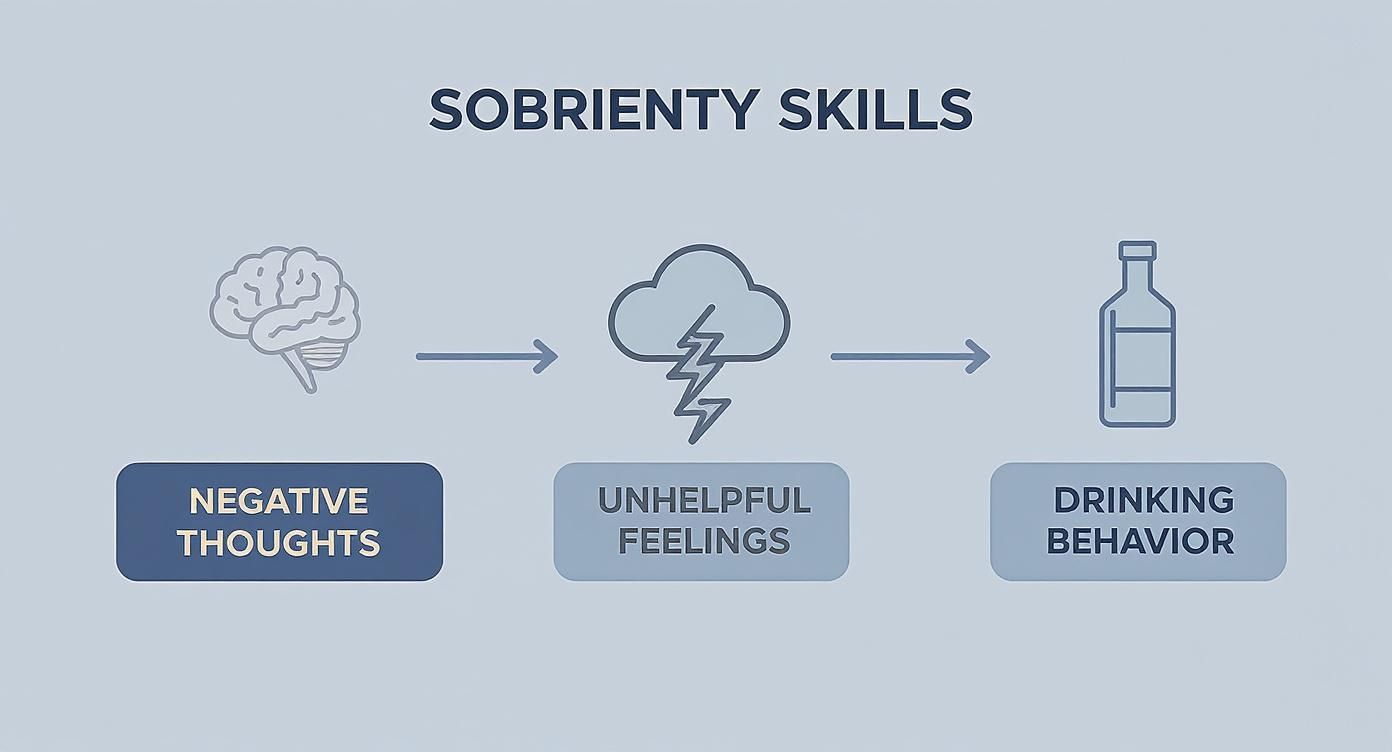
As the visual shows, negative thoughts act like fuel for difficult feelings, which in turn drive the behavior of drinking, locking you into a cycle that can feel impossible to escape.
The table below breaks down how this destructive loop operates and, more importantly, how CBT helps you build a new, constructive one.
The CBT Triangle From Drinking Cycle to Recovery Cycle
| Component | The Drinking Cycle Example | The CBT Intervention Example |
|---|---|---|
| Thought | "I've had a terrible day. I deserve a drink. It's the only thing that will help me unwind." | "I feel overwhelmed, but drinking will only make me feel worse tomorrow. What's a healthy way to manage this stress right now?" |
| Feeling | Overwhelmed, anxious, stressed, tense. | Acknowledges the stress, but feels a sense of control and empowerment by having other options. |
| Action | Stops at the store, pours a drink, and isolates from others. | Goes for a walk, calls a trusted friend, listens to music, or does a 10-minute meditation. |
By consciously shifting just one element of the triangle—the thought, the feeling, or the action—you can change the entire outcome from a cycle of drinking to one of recovery.
Breaking the Chain at Any Point
Here’s the most powerful part: you can step in and break this chain at any point. You don’t have to wait until you’re battling a full-blown craving. CBT gives you the tools to intervene before the cycle ever picks up steam.
The power of CBT lies in its ability to turn a moment of craving into a moment of choice. It teaches you to pause, analyze the thought or feeling, and consciously choose a different, healthier action.
You can learn to challenge the thought right as it appears. When "I need a drink" pops into your head, you can question it: "Do I really need it, or do I just want it? What I truly need is relief from this stress. What else could I do?"
Or, you can jump straight to changing the action. Instead of driving toward the liquor store, you make a different turn and head to the gym or call a sponsor. This is how the synergy between cognitive behavioral therapy and alcoholism treatment works in the real world. By interrupting the sequence, you fundamentally disrupt the loop. Each time you do it successfully, the old, destructive habit gets weaker, and a new, healthier one starts to take its place.
Key Takeaways
- Thoughts, Feelings, and Actions Are Linked: CBT is built on the Cognitive Triangle, where these three elements constantly influence each other.
- Drinking Creates a Feedback Loop: The temporary relief from alcohol reinforces the thought that drinking is a good solution, making the cycle stronger.
- Intervention is Possible at Any Point: You can break the cycle by changing your thought, your feeling (through coping skills), or your action.
- The Goal is a New Cycle: By intervening, you replace the destructive drinking cycle with a positive recovery cycle.
- It Turns Autopilot Off: CBT brings awareness to automatic reactions, turning a moment of craving into a moment of conscious choice.
Frequently Asked Questions
What is the "Cognitive Triangle"?
The Cognitive Triangle is the core concept in CBT that illustrates how your thoughts, feelings, and actions are interconnected. A negative thought can lead to a negative feeling, which drives a negative action (like drinking), creating a self-reinforcing cycle.
Can changing just my thoughts really stop me from drinking?
Yes, because your thoughts are often the trigger for the entire chain reaction. By learning to identify and challenge a thought like "I need a drink to relax," you can stop the cycle before it gains momentum, preventing it from leading to the feeling of craving and the action of drinking.
Your Toolkit of Core CBT Recovery Skills
So, you understand the basic idea behind the cycle of thoughts, feelings, and actions. That's the foundation. Now, we get to the practical, hands-on part: building your toolkit with the core techniques that make cognitive behavioral therapy work for alcoholism. This is where the theory turns into real-world action.
Think of it like being a mechanic for your own mind. You're assembling a specialized set of tools, and each one has a very specific job to do—helping you take apart old, destructive habits and build new, healthier ones in their place.
Let's dive into the main skills you’ll be putting in your recovery toolkit.
Becoming a Detective with Functional Analysis
The first and most important tool you’ll learn is Functional Analysis. This is all about becoming a detective of your own behavior. It's a structured way to examine the chain of events that leads you to drink, helping you pinpoint exactly what pulls the trigger.
Working with your therapist, you’ll start to identify:
- External Triggers: These are the people, places, things, or even times of day that signal your brain to think about alcohol. It could be seeing a certain friend, driving past a specific bar, or just the clock hitting 5 PM on a Friday.
- Internal Triggers: These are the thoughts, feelings, or even physical sensations that kickstart a craving. Maybe it's the stress from a tough day at work, a wave of loneliness, or even the excitement of a celebration.
By mapping out these patterns, you stop feeling ambushed by your cravings. Instead, you start to see them coming. This awareness is everything—it’s the crucial first step that allows you to make a conscious plan instead of just reacting on autopilot.
Rewriting the Script with Cognitive Restructuring
Once you know your triggers, the next tool you'll grab is Cognitive Restructuring. This technique is all about learning to challenge and reframe the automatic, unhelpful thoughts that give you "permission" to drink. You're essentially learning to rewrite the internal script that fuels the desire for alcohol.
Cognitive restructuring isn’t about pretending everything is fine or forcing "positive thoughts." It’s about cultivating balanced, realistic thinking that actually supports your recovery, rather than sabotaging it.
For example, an automatic thought might be: "I completely bombed that presentation. I'm such a failure. I need a drink."
CBT teaches you to press pause on that thought. You learn to challenge it and replace it with something more realistic, like: "Okay, that presentation didn't go as planned, but it doesn't define my worth. A drink will only make me feel worse tomorrow. What's a constructive way to handle this stress right now?"
Building a Defense with Skills Training
The final piece of the puzzle is Skills Training. This is where you actively learn and practice concrete strategies to navigate high-risk situations without reaching for a drink. It's about building a strong defense system so you're not caught off guard when life throws you a curveball.
This training often includes things like:
- Stress Management: Getting good at techniques like deep breathing, mindfulness, or progressive muscle relaxation to calm your nervous system.
- Assertiveness Training: Practicing how to say "no, thanks" confidently and politely when you're offered a drink.
- Problem-Solving Skills: Developing a step-by-step approach to tackling life's challenges without using alcohol as an escape hatch.
These skills are vital components of a solid sobriety plan. You can discover more powerful coping skills for addiction in our detailed guide. Mastering these gives you real, practical alternatives, ensuring you have a healthy response ready to go for any trigger that comes your way.
Key Takeaways
- Functional Analysis is Your Map: This tool helps you identify the specific people, places, feelings, and thoughts that trigger your cravings for alcohol.
- Cognitive Restructuring Challenges Your Thoughts: It teaches you to question the automatic, negative thoughts that justify drinking and replace them with more balanced, helpful ones.
- Skills Training Builds Your Defenses: This is where you learn practical, real-world abilities—like managing stress and refusing drinks—to give you healthy alternatives to alcohol.
- Awareness Is the First Step: You can't change your patterns until you truly understand them. Identifying your unique triggers is the essential starting point.
- Practice Makes Permanent: These CBT skills are like muscles. The more you use them in your daily life, the stronger and more second-nature they become.
Frequently Asked Questions
Is CBT just about thinking positively?
Not at all. It's about thinking realistically. CBT doesn't ask you to ignore problems or pretend you're happy when you're not. Instead, it helps you acknowledge difficulties and gives you practical tools to respond to them constructively, rather than with forced or fake positivity.
How does CBT help with a sudden, intense craving?
CBT prepares you for those moments. It teaches you to spot the early warning signs of a craving and immediately use a specific skill to ride it out. This might mean "urge surfing" (a mindfulness technique of observing the craving without acting on it), using a distraction method, or actively challenging the thoughts that are making the urge feel so powerful.
Can I use these CBT skills on my own?
While anyone can learn and practice the principles, working with a trained therapist is critical when you're dealing with alcohol use disorder. A professional provides essential guidance, helps tailor the techniques specifically to you, and offers support in a structured, safe environment where you can truly make progress.
How CBT Fits into a Full Recovery Plan
While the connection between cognitive behavioral therapy and alcoholism is powerful, CBT isn’t a magic bullet. Think of it less as a standalone cure and more as a crucial tool within a complete, medically supervised recovery program. It provides the psychological skillset you need to stay sober for the long haul, working hand-in-hand with other essential treatments.
Imagine building a house. Medical detox is the foundation—it's absolutely essential for stabilizing your physical health by safely getting you through withdrawal. But a foundation isn’t a house. CBT is the framing, the wiring, and the plumbing. It builds the internal structure you need to actually live a healthy, sober life once the immediate physical crisis is over.
This integrated approach creates a powerful advantage. Once medical detox clears the fog from your body and mind, you’re in a much better position to dive into the deep, meaningful work that therapy requires.
The Power of a Multi-Layered Approach
A solid treatment plan addresses the whole person—mind, body, and spirit. CBT truly shines when it’s woven together with other key parts of recovery, creating a support system with no weak links.
This is especially critical for anyone dealing with mental health challenges on top of an alcohol use disorder. To see why treating both at once is so vital, you can explore the deep connections between mental health and substance abuse in our guide.
Here’s a practical look at how CBT fits in with other core treatments:
- Medical Detox: Detox handles the physical side of alcohol dependence, but CBT gets to the why behind the drinking. It gives you the skills to stay on track long after withdrawal is done.
- Group Therapy: While your individual CBT sessions are for digging into personal triggers, group therapy is where you find your community. It’s a safe place to practice the new communication and coping skills you’re learning with people who get it.
- Relapse Prevention Planning: CBT is the engine driving relapse prevention. The skills you learn, like functional analysis and cognitive restructuring, are exactly what you need to spot and navigate high-risk situations without turning to alcohol.
Combining CBT with Medication
For many people, medication-assisted treatment (MAT) can be a game-changer. Certain medications can reduce alcohol cravings or create an unpleasant reaction to drinking, giving you the mental space you need to fully engage in therapy.
When your brain isn't in a constant, exhausting battle with physical cravings, you have so much more energy to learn and apply new cognitive skills. This dual approach tackles both the biological and psychological drivers of addiction at the same time.
Research backs this up. A systematic review showed that adding medication to CBT provided extra benefits in approximately 53% of trials. While it’s not a guarantee for everyone, it strongly suggests that for many, a combined strategy offers the best shot at success. You can review the findings on combined therapy to see how this multi-pronged approach gets results.
Key Takeaways
- CBT is a Team Player: It works best as part of a complete recovery plan, not as a standalone fix.
- Detox Handles the Physical, CBT Handles the Psychological: Detox clears your body, but CBT helps you rewire the thinking patterns that led to drinking in the first place.
- Medication Can Boost CBT: Easing physical cravings with medication can make it much easier to focus on and get the most out of your therapy sessions.
- A Holistic Plan Gives the Best Support: A strong foundation for sobriety is built by combining individual therapy, group support, medical care, and relapse prevention.
- Synergy is the Goal: Every piece of a solid recovery plan reinforces the others, creating a result that is far more powerful than any single treatment could be on its own.
Frequently Asked Questions
Does everyone in rehab for alcoholism need CBT?
While CBT is one of the most effective and widely used therapies for alcohol use disorder, every treatment plan is personalized. A clinical team will look at your unique situation to figure out the right mix of therapies. This often includes CBT but might also involve other approaches like Dialectical Behavior Therapy (DBT) or Motivational Interviewing.
How does CBT work with 12-step programs like AA?
CBT and 12-step programs complement each other incredibly well. CBT gives you the structured, evidence-based psychological tools to manage your thoughts and behaviors. Programs like Alcoholics Anonymous (AA) provide something just as valuable: peer support, a strong community, and a long-term framework for personal and spiritual growth in recovery.
Digital CBT and the Future of Accessible Treatment
Getting help for alcohol use disorder used to mean one thing: in-person appointments. But technology has completely changed the game. Now, thanks to digital CBT programs and online platforms, effective therapy is more accessible than ever, breaking down old barriers and bringing support directly to you.

These tools, often called computerized CBT, offer a level of privacy and convenience that’s a game-changer for anyone hesitant about face-to-face therapy. You can work through the material on your own schedule, when you feel most comfortable and ready to engage.
How Digital Platforms Deliver CBT
So, how does this actually work? Digital platforms are designed to mirror the powerful techniques of in-person cognitive behavioral therapy and alcoholism treatment, just in an interactive, online format.
Most programs will guide you through recovery using a mix of features:
- Interactive Modules: Think of these as step-by-step lessons that teach you core concepts like the cognitive triangle or how to analyze your drinking triggers.
- Guided Exercises: You'll get digital worksheets and thought records that help you pinpoint and reframe those automatic negative thoughts.
- Video Lessons: Short, easy-to-digest videos from therapists who break down complex CBT skills into practical steps you can start using right away.
This isn't just a convenient idea; it's backed by solid research. A major study from Yale University found that a digital program called CBT4CBT actually outperformed traditional therapy over an eight-month period. The people using the digital tool increased their days of abstinence by more than 50%. You can learn more about these encouraging findings directly from the source.
Digital CBT is not just about convenience; it’s about providing evidence-based, structured support that empowers individuals to take an active role in their recovery journey from anywhere, at any time.
It's important to see this technology for what it is—not necessarily a replacement for traditional therapy, but a powerful alternative or supplement. For someone dealing with a difficult schedule, living in a remote area, or just needing more privacy, digital CBT can bridge the gap and make recovery possible.
Key Takeaways
- Accessibility is Key: Digital platforms make CBT for alcoholism available to more people by removing barriers like location and stigma.
- Privacy and Convenience: Online tools give you a private, self-paced way to learn and practice crucial recovery skills.
- Proven Effectiveness: Research shows that digital CBT programs can be incredibly effective, sometimes even more so than traditional methods.
- Interactive Learning: Engaging modules, videos, and exercises are used to teach core CBT principles.
- A Powerful Supplement: Digital CBT can work as a strong standalone option or as a great addition to an in-person recovery plan.
Frequently Asked Questions
Are digital CBT programs as effective as seeing a therapist in person?
For many people, they absolutely are. Studies show that well-designed digital programs can be just as, and sometimes more, effective for treating alcohol use disorder. The right choice really comes down to your personal needs, motivation, and how comfortable you are using technology.
Do I need to be tech-savvy to use an online CBT program?
Not at all. The vast majority of these platforms are built to be user-friendly and intuitive. If you can browse a website, you can use a digital CBT program. They’re designed with simple navigation and clear instructions to guide you every step of the way.
Wrapping It Up: Your Action Plan for Recovery
Think of recovery not as a battle of willpower, but as a process of building new skills. When you approach sobriety through the lens of Cognitive Behavioral Therapy (CBT), you're essentially creating a personalized roadmap for navigating the challenges ahead.
The whole idea is to shift from being a passenger to being the driver of your own recovery. You're learning practical techniques to manage old habits, and the points below are your quick-reference guide to keep you on track.
The Big Ideas to Remember
- Recovery Is a Learned Skill: Sobriety isn't something you either have or you don't. CBT gives you the tools to understand why you drink and how to change that behavior. It puts you back in control by framing recovery as a set of skills you can master over time.
- Question Your "Automatic" Thoughts: That nagging thought, "I need a drink," feels like a command, but it's just a deeply ingrained habit. CBT teaches you to hit the pause button, challenge that thought, and actively replace it with something more helpful and true.
- Know Your Triggers: To stay sober long-term, you have to become a detective of your own life. Pinpointing those high-risk people, places, and feelings allows you to see trouble coming and have a solid, non-alcoholic game plan ready to go.
- Build Your A-Team: CBT is powerful, but it works best as part of a bigger picture. It should slot into a comprehensive recovery plan that might also include medical support, group therapy, or medication.
- Progress Isn't a Straight Line: Slips and relapses can happen. The key is to view them not as failures, but as data. They're learning opportunities that show you where your skills need a little more work, helping you refine your strategy for next time.
A Few Common Questions
What makes CBT different from just talking about my problems?
That's a great question. While traditional talk therapy often explores your past to understand why you feel a certain way, CBT is much more focused on the here and now. It’s structured and goal-oriented. We’re not just talking; we’re actively building a toolkit of practical, real-world skills to change the thoughts and behaviors that are causing problems today.
How fast can I expect to see results with CBT for alcoholism?
It really varies from person to person. CBT is designed to be a relatively short-term therapy, and many people start to feel a shift within the first few sessions. As soon as you begin applying the techniques—like challenging a craving or avoiding a trigger—you're making progress. Lasting, durable change, though, comes from consistent practice over the full course of your treatment.
Your Questions About CBT and Alcoholism, Answered
When you're exploring the path to recovery, it's natural to have a lot of questions. Let's tackle some of the most common ones about using cognitive behavioral therapy for alcoholism to give you the clarity you need to move forward with confidence.
How Long Does CBT for Alcoholism Last?
This is one of the first things most people want to know. CBT isn't meant to be an endless process; it's a short-term, goal-focused therapy.
While there's no magic number that works for everyone, a typical course of CBT runs for about 12 to 20 weekly sessions. The whole point is to give you a practical, lifelong toolkit for managing your thoughts and behaviors, not to keep you in therapy forever. You learn the skills, and then you take them with you.
What Happens if I Relapse?
First, let's get one thing straight: in CBT, a relapse is not a failure. It’s not a moral failing or a sign that the therapy isn't working. It's just data.
Think of it as a learning opportunity. Your therapist will help you unpack exactly what happened—what the triggers were, what thoughts popped into your head, and what feelings felt overwhelming. By analyzing the slip-up, you can build a much more specific, stronger plan to handle that exact situation if it ever comes up again. It actually makes your relapse prevention strategy even more robust.
Can CBT Work on Its Own, Without Medication?
Absolutely. CBT can be incredibly effective all by itself because it gets to the very heart of what drives addiction—the patterns of thinking and behaving that keep you stuck. It empowers you to take control of those patterns.
That said, for some people, combining therapy with medical support provides the best of both worlds. You can learn more by reading our guide on medication-assisted treatment, which explains how certain medications can ease cravings. This can make it much easier to concentrate on the hard work you’re doing in your therapy sessions.
How Do I Find a Therapist Who Specializes in This?
Finding the right person to guide you is a huge step. A great place to start is with online directories from trusted sources like the Association for Behavioral and Cognitive Therapies (ABCT) or Psychology Today. Their search tools let you filter for specialists in "addiction" or "substance use," so you're not just scrolling through endless lists.
Don't forget about the resources you already have. Your primary care doctor can often provide a solid referral, and your insurance company can give you a list of qualified therapists who are in your network.
Key Takeaways
- CBT is Time-Bound: It's designed as a short-term approach, usually 12-20 sessions, focused on building skills you can use for the rest of your life.
- Relapse is a Learning Tool: A slip is never a failure. It’s a chance to analyze what happened and strengthen your coping strategies for the future.
- CBT Can Stand Alone: It’s powerful on its own but can be integrated with medication to create an even stronger foundation for recovery.
- Finding Help is Accessible: You have clear starting points—use professional directories, ask your doctor, or check with your insurance provider.
- The Goal is Empowerment: The whole point of CBT is to equip you with lasting skills to manage your recovery long after your last session.