
A Partial Hospitalization Program, often called PHP drug rehab, is a powerful, intensive option that sits right between inpatient care and standard outpatient therapy. It gives you the structure and clinical depth of a residential program during the day, but you get to go home or to a sober living house at night. This setup offers a unique advantage: you get immersed in deep therapeutic work while immediately practicing what you learn in the real world.
Key Takeaways
- PHP is a "step-down" option: It bridges the gap between intensive inpatient care and standard outpatient therapy.
- Structured days, flexible nights: You receive comprehensive treatment during the day and return home or to a sober living environment at night.
- Real-world application: This model allows you to immediately practice new coping skills in your daily life.
- High level of support: PHPs provide a significant level of clinical care and structure without requiring a full-time residential stay.
- Focus on intensive therapy: The program is built around a rigorous schedule of individual, group, and other evidence-based therapies.
What Is a PHP Drug Rehab Program?

The best way to think about a PHP is to imagine recovery as your full-time job for a little while. It’s a serious commitment—you'll be at the treatment center for several hours a day, five to seven days a week, participating in a packed schedule of therapy, counseling, and skill-building groups. It’s designed to be that crucial bridge for someone who needs more than a weekly therapy session but doesn't necessarily need 24/7 medical monitoring.
This highly structured environment is incredibly effective at breaking the cycle of addiction. It creates a stable, supportive container where you can focus entirely on building a solid foundation for a life in recovery.
Who Benefits Most From a PHP?
A PHP isn't the right fit for everyone, but for certain people at specific points in their journey, it’s a game-changer. It’s especially helpful for individuals who are ready to do the work but need a high level of support to make it stick.
This program is an excellent match for people who:
- Are transitioning from inpatient care. Coming out of a residential program can be a shock. A PHP acts as a perfect "step-down," helping you apply your new coping skills while still having a clinical safety net.
- Need more support than weekly therapy. If standard outpatient care isn’t cutting it and you're still struggling with cravings or triggers, the intensity of a PHP provides the necessary reinforcement.
- Have a safe and sober living situation. This is key. The model works because you can return to a stable, substance-free home or sober living environment each night.
- Are medically stable. While there’s medical oversight, PHPs are for those who have completed detox and aren’t at risk of severe withdrawal.
A PHP offers the intensity of inpatient treatment with the flexibility of outpatient care. It's designed for those who are serious about making recovery their top priority while maintaining a connection to their home and community.
To give you a clearer picture, here's a quick rundown of what a PHP typically involves.
PHP Drug Rehab At a Glance
| Feature | Description |
|---|---|
| Time Commitment | 20-30 hours per week, typically 5-7 days. Think of it as a daily, structured schedule. |
| Location | You attend treatment at a clinical facility during the day and return home or to a sober living environment at night. |
| Clinical Intensity | High. Includes a mix of individual therapy, group counseling, family sessions, and psychiatric support. |
| Ideal Candidate | Medically stable individuals needing significant structure but not 24/7 supervision. |
| Primary Goal | To build and practice real-world recovery skills in a supportive, therapeutic environment. |
Ultimately, a PHP strikes a critical balance. You receive the high-level clinical care necessary to untangle the complexities of addiction, and at the same time, you start living your recovery from day one.
A Look Inside a Typical Day in PHP Treatment
So, what does a day in a Partial Hospitalization Program actually look like? Think of it less like a hospital and more like a full-time job—where your only responsibility is getting well. You're committing to a highly structured, therapeutic routine, typically clocking in for five to eight hours of programming, five to seven days a week.
This intensive schedule isn't about just filling time. It’s a carefully designed immersion into recovery. Every single day is built to arm you with the insights, skills, and support you’ll need to navigate life without turning to substances. You'll be working closely with a whole team of professionals—therapists, doctors, counselors—who are all focused on one thing: your personalized path forward.
The Core Therapeutic Activities
A day in PHP is a powerful blend of different evidence-based therapies that tackle addiction from every angle. While your specific plan will be unique to you, it will almost always be built on a mix of individual, group, and sometimes family-focused work. The idea is to create a rich, supportive clinical experience that helps you heal on multiple levels.
These are the pillars of your daily schedule:
- Individual Therapy: This is your dedicated one-on-one time with a therapist. Here, you'll dig deep into the personal roots of your addiction, tackle any co-occurring mental health challenges, and map out your private recovery goals.
- Group Therapy: You’ll join facilitated sessions with peers who just get it. It's a space to build real communication skills, gain perspective from others' journeys, and start forming the kind of support network that is vital for staying sober.
- Cognitive Behavioral Therapy (CBT): A cornerstone of modern treatment. CBT teaches you how to spot, challenge, and ultimately change the destructive thought patterns and behaviors that have been driving your substance use.
- Family Therapy: Addiction doesn't happen in a vacuum. These sessions are designed to heal strained relationships, teach your family how to best support you, and create a healthier home environment for your return.
Rewiring Your Brain and Building Support
Cognitive Behavioral Therapy (CBT) is a game-changer for many, and it’s central to the PHP model. It’s based on a simple but profound idea: your thoughts, feelings, and actions are all linked. Your therapist helps you become aware of your triggers and the automatic negative thoughts that pop up, then gives you practical tools to reframe them. For instance, instead of stress immediately triggering the thought, "I need a drink," you learn to hit pause and use a healthy coping skill you’ve practiced in session.
At the same time, group therapy offers a dynamic you just can't get anywhere else. There's incredible power in sharing your story with people walking the same path; it chips away at the isolation and shame that so often come with addiction. It’s a safe place to try out new communication skills and get honest feedback, which is exactly what you need to build the sober friendships that will help sustain you long after treatment ends.
"A well-structured PHP combines introspective work like CBT with the communal healing of group therapy. One helps you rebuild your internal framework, while the other builds your external support system—both are critical for lasting change."
This two-pronged approach of deep internal work and strong peer support really works. In fact, research shows that Partial Hospitalization Programs have impressive success rates. A major review found that 85–95 percent of people who complete a comprehensive rehab program that includes PHP are still sober nine months later. Even better, most also reported a significantly higher quality of life. This just goes to show the power of committing to an intensive, well-rounded treatment schedule. You can discover more insights about the effectiveness of PHP treatment programs on eastcoastrecovery.com.
Your Multidisciplinary Care Team
Behind every productive day in a PHP is a dedicated team of professionals working in sync. This isn’t just one therapist—it’s a coordinated group that might include licensed therapists, medical doctors, nurses, and case managers. They meet regularly behind the scenes to discuss your progress, fine-tune your treatment plan, and make sure all your needs—medical, psychological, and social—are being met. It's this collaborative approach that makes the care so comprehensive and effective.
Key Takeaways
- A typical PHP day involves five to eight hours of structured therapy, five to seven days a week.
- Core activities are a mix of individual therapy, group counseling, and family sessions.
- Cognitive Behavioral Therapy (CBT) is a key tool for changing the thought patterns that fuel addiction.
- Group therapy is essential for building a strong peer support network for long-term recovery.
- A whole team of clinicians works together to provide personalized, well-rounded care.
Comparing PHP With Other Levels Of Addiction Care
Trying to make sense of the addiction treatment landscape can feel overwhelming. It helps to think of it like different levels of education—each one is built with a specific intensity and purpose, designed to meet you right where you are. A Partial Hospitalization Program, or PHP drug rehab, holds a unique and vital spot on this spectrum of care.
To figure out if a program is the right fit, you have to see how it stacks up against the others. Let’s use an analogy. If inpatient residential care is a fully immersive boarding school where you live on campus 24/7, then a PHP is like a demanding, full-time university program. You're committed to a rigorous daily schedule of classes (your therapy sessions) but get to go home each evening. This really gets to the core strength of a PHP: it gives you serious clinical structure without totally disconnecting you from your life.
PHP vs. Inpatient Residential Treatment
The biggest, most obvious difference here is the living situation. Inpatient programs require you to live at the treatment center, giving you around-the-clock medical supervision in a completely controlled environment. This is absolutely essential for anyone with a severe substance use disorder, significant medical issues, or an unstable home life that could put their recovery at risk.
A PHP, on the other hand, is a step down in intensity while keeping the clinical care at a very high level. You get the same depth of therapy during the day, but you have the autonomy to live at home or in a supportive sober living environment. This makes it a perfect bridge for people who are medically stable but still need far more structure than traditional outpatient therapy can give.
PHP vs. Intensive Outpatient (IOP) And Outpatient
Let's go back to our school analogy. If PHP is that full-time university schedule, an Intensive Outpatient Program (IOP) is more like a flexible, part-time college course load. IOPs demand fewer hours each week—usually around 9-12 hours, a big difference from the 20+ hours of a PHP. Standard outpatient care is even less intensive, often just one or two therapy sessions a week.
For a deeper dive into these two popular outpatient models, you can check out our detailed guide on the difference between PHP and IOP.
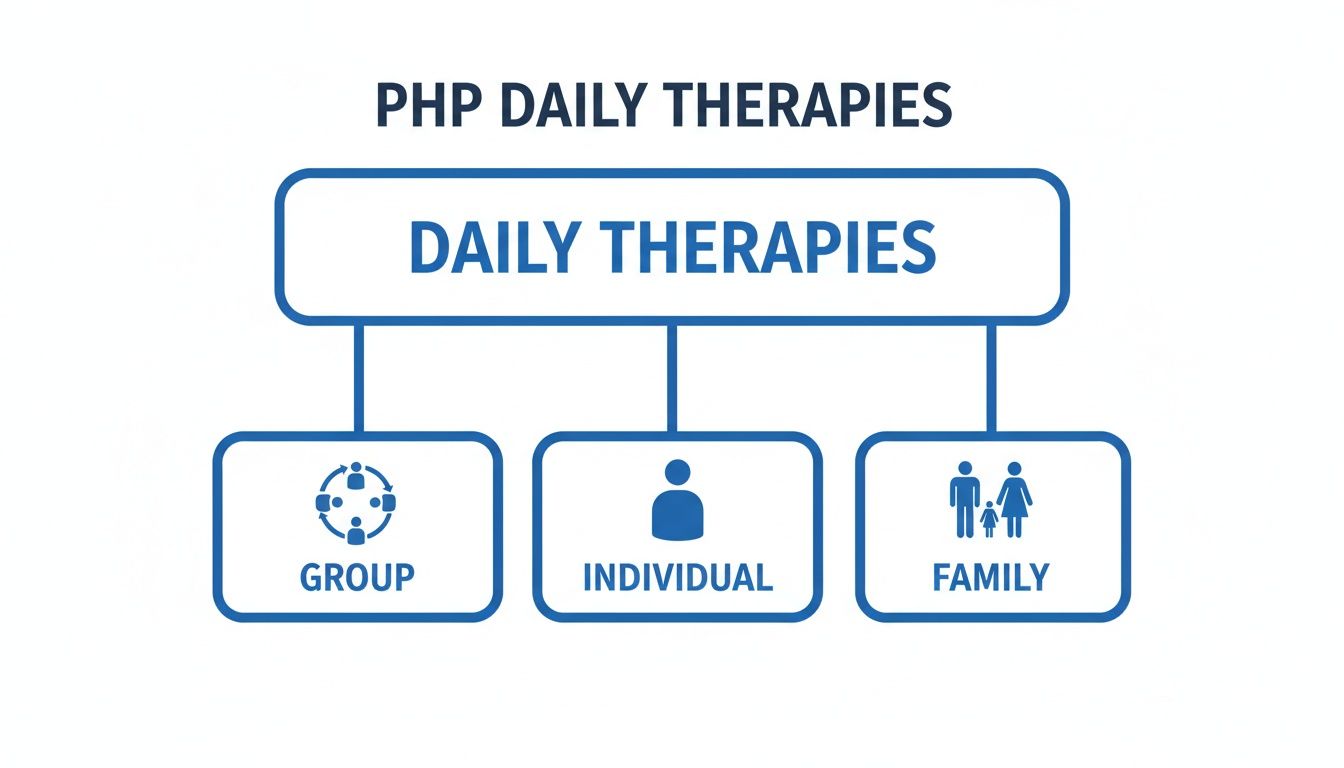
As you can see, a strong PHP drug rehab program weaves together group, individual, and family therapy to create a truly well-rounded and supportive recovery experience.
This balanced approach is meeting a massive need. The global market for addiction treatment is projected to hit USD 31.20 billion by 2032. But here in the U.S., there's a huge gap. In 2022, only 26% of the 54.6 million people who needed treatment actually got it. PHPs help close that gap by providing an intensive, accessible option that sits right between costly inpatient care and less-structured outpatient services.
Choosing the right level of care isn't about finding the "best" program. It's about finding the program that's best for you, right now. It all comes down to matching the clinical intensity to your specific recovery needs and life situation.
To make this clearer, let's look at a direct, side-by-side comparison.
Comparing Addiction Treatment Levels PHP vs. Inpatient vs. IOP
This table breaks down the key differences between these three common levels of care, helping you see where a PHP fits in.
| Feature | PHP (Partial Hospitalization) | Inpatient/Residential | IOP (Intensive Outpatient) |
|---|---|---|---|
| Time Commitment | 20-30 hours per week, 5-7 days | 24/7 residential stay | 9-12 hours per week, typically 3 days |
| Living Arrangement | Live at home or in a sober living facility | Reside at the treatment center | Live at home or in a sober living facility |
| Clinical Intensity | High; structured daily therapy sessions | Very high; constant medical and clinical supervision | Moderate; less frequent sessions |
| Ideal Candidate | Medically stable, needs structure, has a supportive home environment | Needs medical detox, has severe addiction, lacks a safe home | Needs continued support while balancing work or school |
Ultimately, understanding these distinctions empowers you to make an informed choice for yourself or a loved one. Each level of care serves a critical purpose on the path to lasting recovery.
Weaving Together MAT and Dual Diagnosis Treatment in PHP

Real recovery rarely means just putting down the substance. Lasting healing comes from getting to the root of what drives addiction, which often involves a tangled web of physical dependence and underlying mental health struggles. This is where a modern php drug rehab program truly makes a difference—by seamlessly integrating Medication-Assisted Treatment (MAT) and dual diagnosis care.
Think of these two elements not as optional extras, but as the core foundation for building a stable, sober life. By treating the whole person, mind and body, a PHP provides a much stronger, more resilient defense against relapse.
The Role of Medication-Assisted Treatment in PHP
Imagine trying to build a house in the middle of a constant earthquake. That’s a pretty good picture of what it feels like to do the hard work of therapy while your body is screaming with cravings and withdrawal. Medication-Assisted Treatment (MAT) is what calms the ground beneath your feet.
MAT isn't just about medication; it's a comprehensive clinical approach. We use specific, FDA-approved medications to help normalize brain chemistry, block the high from opioids or alcohol, and quiet the relentless physical cravings. It's always paired with dedicated counseling and behavioral therapy.
- Taming Cravings: Medications like buprenorphine or naltrexone can dramatically reduce the urge to use. This frees up incredible amounts of mental energy, allowing you to actually focus on your therapy sessions.
- Easing Withdrawal: MAT makes those first, tough stages of recovery much safer and more bearable by soothing the physical hell of withdrawal.
- Creating Stability: By getting your body stable, MAT makes it possible for you to show up and fully engage in individual and group therapy. The entire treatment process becomes far more effective.
Here at Tru Dallas Detox & Recovery Center, our medical team builds MAT right into your personalized PHP plan. We make sure your physical needs are met so you have the strength and clarity to focus on your psychological healing. To dig deeper into the specifics, check out our guide on what is Medication-Assisted Treatment.
Addressing the Co-Occurring Challenge of Dual Diagnosis
Addiction rarely shows up alone. It often brings friends—unwanted ones, like anxiety, depression, PTSD, or bipolar disorder. When a substance use disorder and a mental health disorder are present in the same person, we call it a dual diagnosis or a co-occurring disorder.
Trying to treat one without the other is like trying to fix a leaky roof on only one side of the house. The rain is still going to find a way in. A person might drink to numb their anxiety, or their drug use might trigger a deep depressive episode. The two are almost always connected.
An integrated PHP drug rehab is built to treat both conditions simultaneously, with the same dedicated team. This unified strategy stops one untreated issue from sabotaging the progress you're making on the other—a critical factor in preventing relapse.
This integrated model isn't just a good idea; it's proven to be incredibly effective. The numbers tell a powerful story. The structured support found in a PHP, delivering intensive therapies like CBT alongside MAT, leads to genuinely promising outcomes. In fact, success metrics show 85-95% of people who complete these programs are still drug-free nine months later.
While the general relapse rates for addiction are 40-60% (similar to other chronic diseases), the all-encompassing nature of a well-run PHP gives you the tools to manage both addiction and mental health for the long haul.
Key Takeaways
- MAT Creates a Stable Foundation: Medication-Assisted Treatment manages cravings and withdrawal, clearing the way for you to focus on therapy.
- Dual Diagnosis is the Norm, Not the Exception: Many people struggling with substance use also have a co-occurring mental health condition.
- Integrated Care is Non-Negotiable: Treating addiction and mental health at the same time is essential for a real shot at long-term recovery.
- PHP is Built for Integration: The structure of a Partial Hospitalization Program is perfectly suited for combining medical support (MAT) with intensive dual diagnosis therapy.
- Better Results: When you address both physical dependency and mental health, recovery success rates improve dramatically.
How to Navigate Insurance and the Admissions Process
Taking that first step toward recovery is a huge deal, but figuring out the logistics of insurance and admissions can feel overwhelming. We get it. The good news is that the process is more straightforward than most people think, and our job is to clear the path so you can focus on healing.
The cost of treatment is usually the first question on everyone's mind. Thankfully, the Affordable Care Act (ACA) made substance use treatment an essential health benefit. This means that most health insurance plans, including those on the marketplace, provide coverage for programs like a PHP drug rehab. Your very first call to Tru Dallas Detox & Recovery Center will connect you with an admissions specialist who is an expert at navigating this.
Understanding Your Insurance Coverage
One of the first things our team does is a verification of benefits. This isn't as complicated as it sounds. We simply call your insurance provider for you to get the exact details of what your plan covers. This gives you a clear financial picture from day one.
We'll help you make sense of the key terms:
- Deductible: The amount you pay for care before your insurance starts chipping in.
- Copay/Coinsurance: Your share of the cost for treatment after you've met your deductible.
- Out-of-Pocket Maximum: The absolute most you'll have to pay for covered care in a plan year. Once you hit this, your insurance typically covers 100% of the costs.
Getting this information upfront means no surprises down the road. For a deeper dive, you can learn more about how insurance covers drug rehab in our detailed guide.
The Admissions Journey Step-by-Step
Once the financial side is clear, the process moves into the clinical part of admissions. This entire journey is handled with compassion, confidentiality, and efficiency to get you the help you need without delay.
- Confidential Phone Call: It all starts with a private phone call to one of our admissions coordinators. This is your chance to share what's going on, ask questions, and just get a feel for our program.
- Clinical Pre-Assessment: The coordinator will gently guide you through some questions about your substance use, mental health history, and any medical concerns. This initial chat helps us start to see if PHP is the right fit.
- On-Site Assessment: When you arrive, you’ll meet one-on-one with a clinical professional for a more thorough evaluation. This isn't an interrogation; it's a conversation that becomes the foundation of your entire treatment plan.
- Personalized Treatment Plan: Using everything we’ve learned, our team crafts a unique PHP plan just for you. It will outline your therapy schedule, clinical goals, and the specific path we'll take together.
The admissions process is not a test to pass. It’s a collaborative first step to ensure your treatment plan is built specifically for your needs, giving you the best possible chance at a lasting recovery.
Key Takeaways
- Most insurance plans cover PHP as an essential health benefit.
- A "verification of benefits" is a free service we provide to clarify your deductible, copay, and out-of-pocket maximum.
- The entire process starts with a simple, confidential phone call.
- A comprehensive clinical assessment ensures your treatment plan is truly personalized.
- Our goal is to make getting into treatment as smooth and stress-free as possible.
Wrapping Up: Key Points on PHP Drug Rehab
Think of a Partial Hospitalization Program as a bridge. It’s the perfect connection between the 24/7 supervision of inpatient rehab and the independence of outpatient therapy. You get the high-impact, structured treatment of a residential program but with the chance to go home at night and put your new skills to the test in the real world. This setup is a game-changer for people who are medically stable but still need a serious level of daily therapeutic support.
Here’s a quick rundown of the most important things to remember about a PHP drug rehab:
- A Full-Time Commitment: A PHP isn't a casual affair. It requires 20-30 hours a week, spread over five to seven days. This intensive schedule makes your recovery the top priority, just as it should be.
- The Ideal Step-Down: For many, PHP is the logical next step after completing a residential or detox program. It provides a crucial clinical safety net as you begin to navigate daily life, responsibilities, and triggers again.
- Whole-Person Healing: The best programs don’t just focus on the substance. They weave together individual and group therapy, Medication-Assisted Treatment (MAT) for cravings, and dual diagnosis care to address underlying mental health issues like anxiety or depression.
- Insurance Often Covers It: Don't let cost be an immediate barrier. Most major health insurance plans recognize PHP as a vital level of care and typically provide coverage.
Frequently Asked Questions
What is the main difference between PHP and IOP?
The primary difference is the time commitment and intensity. A PHP (Partial Hospitalization Program) is more intensive, typically requiring 20 or more hours of treatment per week. An IOP (Intensive Outpatient Program) is a step-down from PHP, usually involving 9-12 hours of therapy per week, allowing more flexibility for work or school.
How long does a PHP drug rehab program last?
The duration of a PHP varies depending on individual needs and progress, but most programs last from two to eight weeks. Your clinical team will work with you to determine the appropriate length of stay to ensure you have a strong foundation for recovery.
Can I work while attending a PHP?
It is generally not recommended. A PHP is designed to be an immersive, full-time commitment to your recovery, with a daily schedule that resembles a full-time job. The focus should be entirely on healing without the added stress of work or school obligations.
Will my insurance cover a PHP program?
Most insurance plans do cover PHP as it is considered an essential health benefit for substance use disorder treatment. The best way to confirm your coverage is to contact the treatment center's admissions department. They can perform a free verification of benefits to explain your specific coverage, deductibles, and any out-of-pocket costs.
What happens after I complete a PHP?
Completing a PHP is a significant achievement, and the next step is typically transitioning to a lower level of care, such as an Intensive Outpatient Program (IOP). This "step-down" approach ensures you continue to receive support while gradually reintegrating into your daily life and responsibilities. Your treatment team will create a comprehensive aftercare plan tailored to your needs.