
When you’re looking for the right level of support for mental health or substance use recovery, two of the most common options you'll encounter are Partial Hospitalization Programs (PHP) and Intensive Outpatient Programs (IOP). At first glance, they might seem similar, but the core difference really comes down to time commitment and the overall intensity of the program.
Think of it this way: a PHP is structured almost like a full-time job focused entirely on your recovery. On the other hand, an IOP is more like a part-time commitment, giving you structured support while allowing you to keep up with other major responsibilities in your life. The right choice depends entirely on whether you need immersive, daily therapeutic work or a robust program that fits into your existing routine.
Key Takeaways
- PHP is High Intensity: It functions like a full-time job for your recovery, requiring 20-30 hours per week, ideal for those needing significant daily support.
- IOP is Flexible: It's a part-time commitment of 9-15 hours per week, designed to fit around work, school, or family responsibilities.
- Time is the Main Difference: The primary distinction is the weekly hours and daily structure, with PHP being far more immersive.
- PHP is a Step-Down from Inpatient: It often serves as a bridge from 24/7 residential care back into the community.
- IOP Focuses on Reintegration: It helps you apply recovery skills in real-world situations while maintaining a strong support system.
Understanding Your Outpatient Treatment Options
When you're leaving an inpatient facility or looking for a serious level of support without 24/7 supervision, PHP and IOP are often the next logical steps. Both provide a high-quality, structured therapeutic environment, but they are built for people at different stages of their recovery journey.
The biggest distinction is in the schedule and intensity. A PHP is designed to be a direct step-down from—or an alternative to—inpatient care. We're talking 5 to 6 hours of therapy a day, 5 days a week. It’s a significant commitment. In contrast, an IOP offers a more flexible but still powerful structure, typically involving 2 to 3 hours of treatment a day, just 3 to 5 days per week. This setup is often perfect for people who need to balance recovery with work or school. You can find more helpful context on these treatment models at mentalhealthhotline.org.
Quick Comparison: PHP vs. IOP at a Glance
To make things a bit clearer, here’s a straightforward table that breaks down the most important differences between a PHP and an IOP.
| Feature | Partial Hospitalization Program (PHP) | Intensive Outpatient Program (IOP) |
|---|---|---|
| Time Commitment | 20-30 hours per week (e.g., 5-6 hours/day, 5 days/week) | 9-15 hours per week (e.g., 3 hours/day, 3-5 days/week) |
| Intensity Level | High; often serves as a direct alternative to inpatient care. | Moderate; provides more structure than traditional weekly therapy. |
| Daily Structure | Full-day, highly structured schedule with various therapies. | Part-day or evening sessions, designed for greater flexibility. |
| Ideal Candidate | Needs significant daily support but has a stable home life. | Needs structured support while balancing work, school, or family. |
| Medical Supervision | More frequent access to medical and psychiatric staff. | Less intensive medical oversight; primary focus is on therapy. |
Essentially, you can think of PHP as a bridge from 24/7 care back into the world, offering a solid, daily therapeutic safety net. IOP is the next step toward independence, designed to help you practice and reinforce your recovery skills as you re-engage with your community and daily responsibilities.
A Detailed Comparison of PHP and IOP Programs
Once you move past the basic definitions, really understanding the day-to-day differences between a Partial Hospitalization Program (PHP) and an Intensive Outpatient Program (IOP) is what matters most. While they’re both powerful steps in recovery, they're built for people with very different needs and life situations. The biggest distinctions come down to the time you'll spend in treatment each week, the intensity of the therapy, and the level of medical support available.
Making the right choice really boils down to an honest look at where you are right now—your stability, your home support system, and your daily responsibilities. Let's dig into what sets PHP and IOP apart in the real world.
Weekly Time Commitment: The Full-Time vs. Part-Time Approach
The first and most obvious difference between PHP and IOP is the schedule. It’s what you’ll feel every single day. A PHP is structured a lot like a full-time job, but your job is recovery.
-
Partial Hospitalization Program (PHP): You can expect to be in programming for 20 to 30 hours per week. That usually means sessions running five or six hours a day, five days a week. This immersive schedule is intentional; it provides a ton of structure and support, leaving very little unstructured time for triggers or old habits to creep back in.
-
Intensive Outpatient Program (IOP): This is a much more flexible, part-time approach. The typical commitment is 9 to 15 hours per week, often broken into three-hour sessions, three to five days a week. Many programs, including ours at Tru Dallas, offer evening IOP sessions specifically to help people keep up with work, school, or family life.
This infographic gives a great visual snapshot of how the time commitment and overall intensity stack up.
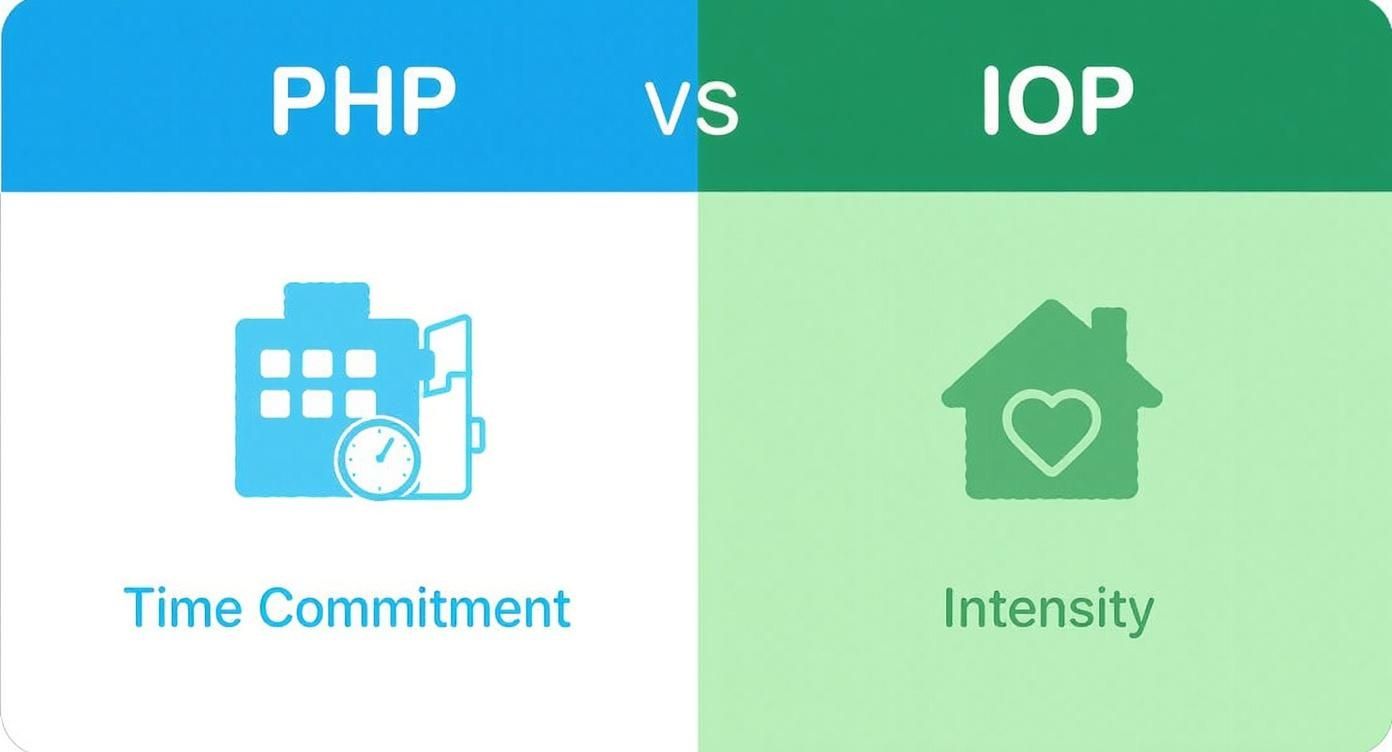
As you can see, PHP is a much bigger daily investment. It's designed to function as a step-down from residential care or a way to prevent hospitalization, whereas an IOP is built to fit into your existing life.
To help you see the practical differences side-by-side, here's a closer look at what you can expect from each program's structure and services.
Detailed Feature Breakdown PHP vs IOP
| Aspect of Care | Partial Hospitalization Program (PHP) | Intensive Outpatient Program (IOP) |
|---|---|---|
| Weekly Hours | 20-30 hours (5-6 hours/day, 5 days/week) | 9-15 hours (3 hours/day, 3-5 days/week) |
| Best For | Individuals needing significant daily structure; stepping down from inpatient/residential care. | Those with a stable home environment who need robust support while working or going to school. |
| Individual Therapy | Frequent sessions, often weekly or even twice-weekly. | Regular sessions, typically weekly or bi-weekly. |
| Group Therapy | Daily, intensive, and covers a wide range of foundational recovery topics. | 3-5 times a week, focusing on skill application and processing real-world challenges. |
| Medical/Psychiatric | On-site medical staff; regular psychiatric evaluations and medication management. | Psychiatric oversight is available but less frequent (e.g., bi-weekly or monthly). |
| Life Integration | Focus is on stabilization in a controlled environment. Work/school is often paused. | Designed to integrate with your existing life; you apply skills learned in therapy immediately. |
| Overall Goal | To stabilize acute symptoms and build a strong foundation for long-term recovery. | To reinforce recovery skills, prevent relapse, and manage life's stressors effectively. |
This table highlights that while both programs share therapeutic goals, their intensity and structure are fundamentally different.
Intensity of Clinical Services
The difference isn't just about the number of hours; it’s about what fills those hours. The clinical intensity in each program is carefully calibrated to the level of support a person needs at that point in their journey.
A PHP packs a comprehensive, multi-disciplinary treatment experience into every single day. The schedule is dense and includes a wider variety of services. You'll often find:
- More frequent one-on-one therapy sessions.
- Daily group therapy that dives deep into everything from relapse prevention to emotional regulation.
- Regular psychiatric evaluations and medical check-ins.
- Specialized workshops for building life skills like mindfulness, communication, or job readiness.
An IOP, on the other hand, is all about reinforcing recovery skills while you're out there living your life. The clinical support is still incredibly strong, but the focus shifts from stabilization to integration. Our guide on what is intensive outpatient treatment breaks down this structure and its goals in more detail. The therapy is potent, but it’s designed to help you apply coping strategies to the real-world challenges you faced just hours before.
A good way to think about it: PHP gives you the tools and helps you build the foundation in a highly supportive environment. IOP is there for you as you start using those tools in your day-to-day life.
Medical Supervision and Medication-Assisted Treatment
The amount of medical oversight is another huge factor that helps determine the right fit, especially for anyone with co-occurring medical issues or those using medication-assisted treatment (MAT).
In a PHP, you'll have more direct and frequent access to medical and psychiatric professionals. This is crucial for people who are still dealing with acute symptoms or need close monitoring as their medications are fine-tuned. Key features usually include:
- On-site psychiatric staff for regular, in-person consultations.
- Medical monitoring to manage post-acute withdrawal or other health concerns.
- Fully integrated Medication-Assisted Treatment (MAT), where medications like Suboxone or Vivitrol are administered and managed closely by the medical team.
An IOP generally works for individuals who are more medically stable. While medication management is still part of the plan, it's less hands-on. Psychiatric appointments might be every other week or once a month instead of weekly. The program fully supports ongoing MAT, but the expectation is that the person has more stability and autonomy. The primary focus shifts to psychotherapy rather than acute medical care.
Who Is the Ideal Candidate for Each Program?
Deciding between a PHP and an IOP isn't about finding the "better" program—it's about finding the right fit for you, right now. The real difference between php and iop comes down to who they're built to serve. By looking at a few real-world scenarios, it becomes much clearer whether the intensive, daily structure of a Partial Hospitalization Program (PHP) or the flexible support of an Intensive Outpatient Program (IOP) makes the most sense.
This decision really hinges on a few key things: the severity of your symptoms, what your home life looks like, and how well you're able to juggle daily responsibilities. Getting a handle on these details is the first step toward making an informed choice for your recovery.

Profile of a PHP Candidate
A Partial Hospitalization Program provides a heavy dose of clinical support for people who need daily structure but don’t require round-the-clock medical monitoring. You can think of it as a full-time job focused entirely on your stabilization and healing.
The perfect PHP candidate might be someone we'll call "Alex." He just finished a 30-day inpatient program for alcohol use disorder. While Alex is medically stable now, the idea of going right back to an unstructured home environment feels terrifying. He needs the daily accountability and deep therapeutic work of a PHP to build a truly solid foundation for his recovery.
PHP is often the right call for individuals who:
- Are stepping down from inpatient care. They’ve completed detox and residential treatment but still need that high level of structured support to safely ease back into their community.
- Are dealing with severe symptoms. This could be someone whose depression, anxiety, or trauma symptoms make it impossible to function at work or home, but who isn't an immediate danger to themselves or others.
- Have co-occurring disorders. A person managing both a substance use disorder and a mental health condition like bipolar disorder will benefit immensely from the integrated medical and psychiatric oversight that a PHP provides.
The whole point of a PHP is to offer an intensive, stabilizing environment. It acts as a powerful alternative to inpatient hospitalization or as a crucial bridge back to everyday life.
For these folks, the immersive, five-day-a-week structure creates the container they need to do deep, meaningful therapeutic work. You can get a closer look at this structured care model in our guide on the Partial Hospitalization Program in Euless, Tarrant County, Texas.
Profile of an IOP Candidate
An Intensive Outpatient Program is geared toward people who have already found some stability but need consistent, structured support to stay on track while navigating their real-world responsibilities. It’s more about reinforcement than initial stabilization.
Consider "Maria," a professional who just wrapped up a PHP for a panic disorder. Her symptoms are under control, and she feels ready to go back to work part-time. An IOP gives her the perfect balance—she can attend therapy sessions three evenings a week to process work-related stress and sharpen her coping skills while easing back into her career.
IOP is usually the best choice for individuals who:
- Have completed a higher level of care. This is the classic step-down from a PHP, offering a continuation of care but with more personal freedom.
- Have a stable and supportive home environment. Since you aren’t in treatment all day, having a safe, encouraging place to live is critical for success in an IOP.
- Must balance treatment with life. This includes parents, students, and working professionals who need a strong therapeutic program that can fit around their existing schedules.
The focus in an IOP is fundamentally different. It's less about getting stable and more about actually applying recovery skills to the challenges and triggers that pop up in daily life. This makes it an absolutely vital step for building long-term, sustainable wellness.
Key Takeaways
- PHP is for stabilization: It’s best for those with severe symptoms or co-occurring disorders, or for anyone stepping down from inpatient care who needs that intensive, daily structure.
- IOP is for integration: It’s a great fit for people who are already stable but need ongoing support to balance recovery with work, school, or family.
- Consider your support system: A PHP provides its own structure if your home life isn't fully supportive, whereas an IOP depends more on your existing stability.
- It's a continuum of care: Many clients successfully move from a PHP to an IOP as they make progress, gradually taking on more independence while keeping that clinical safety net.
- A professional assessment is vital: The absolute best way to know which program is right is to talk with an admissions specialist who can perform a clinical assessment of your unique situation.
Navigating Insurance Coverage and Program Costs
Let's talk about the money side of things. It's a huge piece of the puzzle, and thankfully, both Partial Hospitalization Programs (PHP) and Intensive Outpatient Programs (IOP) are well-established levels of care that insurance providers recognize.
When you're weighing the difference between PHP and IOP, it helps to know that insurance companies often see them as smart, effective alternatives to expensive inpatient stays. Because of this, they've become a standard part of the treatment landscape. Most major PPO insurance plans will cover both, but what that coverage actually looks like comes down to your specific policy. You'll want to get familiar with terms like your deductible (what you pay first), co-pays (your flat fee per visit), and coinsurance (the percentage of the cost you're responsible for).

Verifying Your Benefits and Understanding Costs
Before you even think about starting a program, the absolute first step is to verify your insurance benefits. This isn't just a suggestion—it's essential. It’s the only way to know exactly what your plan covers and what you'll be expected to pay out of pocket. Here at Tru Dallas, our admissions team can take care of this entire process for you, giving you a clear financial breakdown so there are no surprises down the road.
To approve coverage, insurance companies use a process called pre-authorization or pre-certification. This is basically a clinical review to make sure the level of care you’re seeking—whether it's PHP or IOP—is medically necessary for your situation.
Because PHP is more intensive, the clinical bar for proving medical necessity is higher than it is for IOP. Your insurance provider will need a more detailed clinical picture to sign off on the higher level of care.
It's also worth pointing out that the whole behavioral health world is shifting. Payers are showing more support for these programs, with Medicare even expanding its coverage in 2024. This trend reflects a wider acceptance of PHP and IOP as sound, financially responsible alternatives to inpatient care. With the U.S. mental health market growing at a compound rate of 5.9% to roughly $31.4 billion, these outpatient models are leading the charge in making quality treatment more accessible.
What Is Typically Covered by Insurance
Once you get the green light from your insurance, your plan will generally cover a whole host of services that are considered medically necessary for your treatment. Knowing what’s included is crucial for planning. For a really detailed look at this, you can learn more about how insurance covers drug rehab in our detailed guide.
Here’s what’s usually on the list of covered services:
- Individual Therapy Sessions: Your one-on-one time with a licensed therapist.
- Group Therapy Sessions: The cornerstone of both PHP and IOP, where you’ll do much of your work.
- Psychiatric Evaluations: Initial assessments and ongoing check-ins with a psychiatrist.
- Medication Management: Services to prescribe and monitor medications for mental health or substance use disorders.
- Case Management: Help coordinating all the different aspects of your care and planning for what comes next.
Figuring out the financial side of recovery can feel overwhelming, but it doesn't have to be a roadblock. When you work with an experienced admissions team, you can get the clarity you need to move forward with confidence and put your energy where it belongs: on your healing.
Key Takeaways
- Insurance Prefers Outpatient Care: Most major PPO plans cover PHP and IOP because they are seen as cost-effective alternatives to residential treatment.
- Verification is Your First Step: Before committing, always verify your benefits to get a clear picture of your deductible, co-pays, and potential out-of-pocket costs.
- Medical Necessity is Crucial: Insurance companies require clinical justification (pre-authorization) that the level of care matches your diagnosis, with PHP needing a stronger case.
- Core Services are Usually Covered: Key therapeutic services like individual and group therapy, psychiatric care, and medication management are typically included.
- Expert Guidance is Available: You don't have to figure this out alone. Our admissions team is here to help you make sense of your coverage and find a path forward.
Why Outpatient Care Is Gaining Ground
The world of behavioral healthcare is changing, and for the better. We're seeing a major move away from a one-size-fits-all approach and toward treatment that's more flexible and fits into real life. At the heart of this shift are two powerful options: Partial Hospitalization Programs (PHP) and Intensive Outpatient Programs (IOP).
Think of them as the crucial middle ground. They’re a huge step up in support from weekly therapy, but they don’t require you to put your entire life on hold for a 24/7 inpatient stay. This structure is what makes them so effective.
Treatment That Works in the Real World
The reason so many people—and clinicians—are embracing PHP and IOP is simple: they deliver serious, structured care while letting you stay connected to your life. You get to go home at night, see your family, and maybe even keep up with work or school. This isn't just about convenience; it's about practicing new coping skills exactly where you'll need them most—in your day-to-day environment.
This model allows for healing within the community, which is fundamental for building lasting resilience. It’s a practical, sustainable way to get better.
The real magic of PHP and IOP is that they close the gap between inpatient facilities and traditional therapy. They create a seamless path for recovery, giving people the right level of support at the right time.
A Clear Shift in Healthcare and Investment
This isn't just a trend we're seeing on the ground; the numbers back it up. From psychiatrists to ER doctors, more and more medical professionals see these programs as a smart first step for treatment, often preventing the need for a more disruptive hospital stay. They’re also the go-to for people transitioning out of residential care, providing a soft landing back into daily life.
Even investors are taking notice, which shows just how much confidence there is in the future of outpatient treatment. The financial world sees what we see: this model works.
The Market Agrees
A recent behavioral health business report put some hard numbers to this trend. In 2023, there were 17 major deals involving PHP and IOP facilities. That’s more than the 12 deals seen for residential treatment centers in the same year.
When both clinical experts and financial markets show this much trust, it’s clear that PHP and IOP are here to stay. They’ve become essential tools for tackling our country’s mental health and addiction challenges in a way that’s both effective and sustainable.
What This Means for You
- A Middle Ground That Works: PHP and IOP provide the structure of a serious program without the 24/7 commitment of inpatient care.
- Clinically Trusted: Doctors and therapists see these programs as a vital option for starting treatment or stepping down from a higher level of care.
- Smart and Sustainable: This model delivers high-quality care that’s often more affordable than residential treatment, which is good for both patients and their insurance providers.
- Growing Confidence: The rise in investment in PHP and IOP facilities shows that experts believe in the long-term success of this approach.
- Healing in Your Community: Outpatient care lets you build recovery skills while staying connected to your job, family, and support system.
PHP vs. IOP: The Bottom Line
Deciding between a Partial Hospitalization Program (PHP) and an Intensive Outpatient Program (IOP) is a huge step. It’s all about finding the right fit for where you are right now in your recovery. The biggest difference between php and iop really comes down to structure and time.
To cut through the clinical jargon, here are the essential things to keep in mind when you're weighing your options.
-
PHP is all about stabilization. Think of it as a full-time job focused on your recovery. It’s the perfect step for someone who needs a lot of daily support and structure, especially if you're coming out of inpatient care or are still struggling with intense symptoms that demand close clinical attention (but not quite 24/7 monitoring).
-
IOP is about integration. This is your part-time support system. IOP is designed to help you practice what you've learned while navigating the real world. It's the right move when you have a solid footing in your recovery and need to start balancing treatment with your job, school, or family life.
-
The time commitment is the clearest difference. A PHP is a serious time investment, usually 20-30 hours a week. That intensity creates a deeply therapeutic environment. IOP, on the other hand, is much more flexible at 9-15 hours a week, giving you the space to live your life while still getting consistent support.
-
Medical support is scaled to your needs. With PHP, you’ll have more regular access to doctors and psychiatric staff, which is critical if you're managing medications or dealing with co-occurring health issues. IOP offers less frequent medical check-ins because it’s designed for individuals who are medically and psychiatrically more stable.
-
Recovery is a journey, not a single destination. It's incredibly common—and often very successful—for people to move through different levels of care. Many start with PHP to build that strong, stable foundation before transitioning to an IOP to continue growing with greater independence.
Your Questions About PHP and IOP, Answered
When you're exploring treatment options, it's natural to have a lot of questions. Getting clear on the difference between PHP and IOP is a great start, but the real-world details are what truly help you make an informed choice. Here are straightforward answers to the questions we hear most often from people just like you.
Our goal is simple: to give you the confidence you need to take that next, crucial step.
Can I Switch Between Programs?
This is a big one, and the answer is an emphatic yes. Think of your treatment plan not as a rigid contract but as a living document that adapts to your progress. It's not just possible to move between levels of care—it’s often a key part of a successful recovery journey.
A common and highly effective path is to "step down" from a more intensive program. For instance, someone might begin in our PHP to get stabilized and build a solid recovery foundation in a highly structured setting. Once they've gained some traction and feel more confident, they can transition to an IOP. This allows them to continue their therapeutic work while having more flexibility to re-engage with work, school, or family life. It’s a smart, gradual process that reinforces independence without sacrificing support.
Of course, the reverse is also true. If someone in an IOP finds they’re struggling and need more daily structure to stay on track, stepping up to a PHP is a proactive and supportive move.
How Long Do These Programs Last?
There's no magic number here. The length of your stay in either a PHP or an IOP is determined by your clinical progress, not a calendar. You and your care team will work together to decide the right duration based on your unique needs and goals.
That said, we can talk about typical timeframes:
- Partial Hospitalization Program (PHP): Most people find that two to four weeks in a PHP is enough to stabilize acute symptoms and develop essential coping skills. The goal is to get you ready to step down to a less intensive level of care.
- Intensive Outpatient Program (IOP): An IOP journey is usually a bit longer, often lasting anywhere from four to twelve weeks. This extended timeframe is by design; it gives you the space to really practice and integrate new recovery skills into your actual daily life, all while having a consistent support system to lean on.
The real objective isn't to hit a certain number of weeks in treatment. It's about making sure you walk away feeling genuinely equipped with the tools and confidence you need for a lasting, sustainable recovery.
What Does a Typical Day Actually Look Like?
This is where the difference between PHP and IOP becomes crystal clear. Seeing the daily schedule really helps paint a picture of the commitment.
A day in PHP feels a lot like a workday, typically running from around 9 AM to 3 PM. It’s an immersive experience packed with a variety of therapeutic activities:
- Multiple group therapy sessions on core topics like relapse prevention, managing emotions, and mindfulness.
- One-on-one sessions with your primary therapist to dig into personal challenges.
- Appointments with a psychiatrist to handle medication management.
- Even lunch breaks are therapeutic, offering a chance to build community with your peers.
An IOP, on the other hand, is much more condensed. A session usually lasts for three hours. If you’re in an evening program, you might come in around 6 PM after you’re done with work for the day. The core of the session is a structured group therapy meeting, giving you a dedicated space to process the day's challenges and wins with others who get it, all guided by a professional.
Deciding between the two is a major step, but it’s not one you have to take on your own. A professional assessment is the absolute best way to figure out which level of care is the right fit for you right now.
Frequently Asked Questions about PHP and IOP
What is the main difference between PHP and IOP?
It really boils down to time and intensity. A PHP requires a full-day schedule (5-6 hours a day, 5 days a week), providing a higher level of care and more direct medical supervision. An IOP is a part-time commitment (3 hours a day, 3-5 days a week) built to be more flexible around your life.
Can I work while attending a PHP or IOP?
Holding down a full-time job while in a PHP is extremely challenging due to the daily time commitment. An IOP, however, is structured specifically so you can continue working or going to school. Many programs even offer evening sessions to make it more manageable.
Which program is better for me?
That completely depends on your unique situation. If you need intensive, daily support and consistent medical monitoring but have a safe and stable home to return to each night, a PHP is likely the right fit. If your symptoms are more manageable but you still need structured support to stay on track while handling your daily responsibilities, an IOP is probably the better choice.
Is a PHP the same as inpatient rehab?
No, they aren't the same. With inpatient or residential treatment, you live at the facility 24/7. In a PHP, you attend an intensive, full-day treatment program but go home or to a sober living house in the evenings.
What happens when I'm done with the program?
Completing a PHP or IOP is a huge accomplishment, but the journey doesn't end there. The next step is usually transitioning to an even less intensive level of care. This might look like "stepping down" to traditional outpatient therapy—maybe a weekly session with your therapist and occasional check-ins with your psychiatrist. We also strongly encourage joining aftercare or alumni groups to stay connected to the recovery community that supported you.
