

When you're looking for help with mental health or addiction, the different levels of care can feel like a maze. There's weekly therapy, inpatient programs, and somewhere in between, there's intensive outpatient treatment (IOP). This option offers a serious level of support without requiring you to put your entire life on hold and live at a facility.
It’s built for people who need more than a once-a-week chat with a therapist but are stable enough to live at home and keep up with work, school, or family commitments.
Key Takeaways
- A Middle Ground: IOP is more structured than weekly therapy but less restrictive than inpatient care.
- Flexibility is Key: You can continue with your job, classes, and family life while getting treatment.
- Real-World Application: It allows you to immediately practice new coping skills in your daily life.
- Structured Support: Programs typically involve 9-15 hours of therapy per week over several days.
- Step-Up or Step-Down: IOP serves as a transition from inpatient care or an escalation when weekly therapy isn't enough.
What an Intensive Outpatient Program Actually Looks Like

So, where does an IOP fit into the bigger picture? Let's break it down with a simple analogy.
Think of standard weekly therapy as having a personal tutor for an hour a week—great for targeted help and maintaining progress. On the flip side, residential or inpatient treatment is like enrolling in a full-time boarding school; it provides 24/7 structure and a totally immersive environment.
An intensive outpatient program is the perfect middle ground. It’s like a rigorous after-school program. You show up for several hours on multiple days each week for focused, structured sessions, but then you go home. This lets you immediately put what you've learned into practice in your real life.
This blend of intensive support and real-world freedom is what makes IOPs so effective for so many people.
The Building Blocks of a Strong IOP
While no two programs are exactly the same, most IOPs share a few core components that work together to help you build a solid foundation for recovery. It's a model that balances clinical guidance with the autonomy you need to heal.
The demand for this kind of flexible yet structured care is growing. As of 2025, the global market for outpatient centers is being tracked across 195 countries, reflecting a major shift toward accessible treatment that doesn't require hospitalization. If you're curious about the trends, you can read the full research about outpatient market growth to get a deeper look.
IOP Core Components at a Glance
To give you a clearer picture, here’s a quick summary of what you can generally expect from an intensive outpatient program. This table breaks down how the different pieces come together to create a supportive and practical treatment experience.
| Feature | Description |
|---|---|
| Time Commitment | Typically 9 to 15 hours of programming per week, spread across 3 to 5 days. |
| Living Arrangement | You live at home and commute to the treatment facility for your scheduled sessions. |
| Primary Therapy | Group therapy is the cornerstone, creating a space for peer support and shared learning. |
| Individual Support | Regular one-on-one counseling with a dedicated therapist to work on personal goals. |
| Skill Building | Workshops focused on practical skills like relapse prevention, stress management, and communication. |
This structure is designed for people who have a safe and stable home life and are ready to do the work, but just need more support than a weekly appointment can offer. It’s all about getting the intensity you need to make real progress while empowering you to use your new skills day in and day out.
A Look Inside a Typical Week in an IOP
Thinking about an intensive outpatient program can be a little nerve-wracking if you don’t know what to expect. So, let's pull back the curtain and paint a picture of what a typical week actually feels like. The whole idea is to weave structured treatment into your daily life, not pull you out of it entirely.

Picture this: you attend sessions three or four days a week, usually for about three hours at a time. Many programs offer these sessions in the morning or evening, which means you can still get to work, attend classes, or be there for your family. A common schedule might be Monday, Wednesday, and Thursday evenings from 6:00 PM to 9:00 PM.
Group Therapy: The Heart of the Program
The real engine of almost any IOP is group therapy. This is so much more than just a chat session. It's a dynamic, supportive space where you connect with others who truly get what you’re going through because they’re going through it too. That shared understanding is incredibly powerful; it chips away at the isolation that so often comes with mental health struggles and substance use.
A licensed therapist guides every session, steering the conversation through important topics like developing healthy coping skills, recognizing unhealthy communication habits, and learning how to handle triggers. You'll share your own story, cheer on others, and learn from everyone's unique experiences—both the wins and the setbacks. It’s this process that builds accountability and creates real, lasting bonds.
An IOP schedule is designed for impact and integration. It delivers a high level of clinical care while empowering you to immediately apply new skills in your home, work, and social environments.
Individual Counseling and Skill-Building
Beyond the group dynamic, your week will also include one-on-one time with your own therapist. These individual sessions are your private space to dig into personal challenges, map out specific recovery goals, and check in on your progress. This is where your treatment plan gets fine-tuned to fit you perfectly.
A huge part of the program is also dedicated to psychoeducational workshops. Think of these as practical, hands-on classes for life. You'll actively build a toolkit of real-world skills in sessions covering things like:
- Stress Management: Learning healthy ways to handle life’s pressures without falling back on old habits.
- Relapse Prevention: Pinpointing your personal triggers and creating a solid game plan to navigate them.
- Emotional Regulation: Gaining the skills to understand and manage intense emotions in a constructive way.
- Healthy Communication: Practicing how to clearly express your needs and set boundaries with the people in your life.
This blend of group support, individual therapy, and practical skill-building creates the weekly rhythm of an IOP. To see exactly how these pieces fit together, you can learn more about our specific outpatient treatment programs in Dallas and how they’re structured to help people succeed.
Key Takeaways
- Structured Schedule: IOPs usually involve 9-12 hours of programming each week, spread out over 3-4 days.
- Group Therapy is Central: Most of your time is spent in therapist-led group sessions, which are vital for peer support.
- Personalized Attention: Regular one-on-one therapy sessions make sure your unique needs are always being met.
- Focus on Practical Skills: You’ll leave with concrete tools for stress management, communication, and relapse prevention.
- Real-World Integration: The schedule is built to accommodate your existing responsibilities at work, school, or home.
Who Is a Good Fit for an IOP?
Trying to figure out if an intensive outpatient program is the right move can be tricky. It's not a one-size-fits-all solution, but the people who tend to thrive in this setting often share a few key characteristics.
An IOP is often a perfect fit for someone who has a safe and supportive home life but needs something more substantial than just one therapy appointment a week. It hits that sweet spot between structure and freedom.

This level of care also acts as a crucial "step down" for people leaving a residential or inpatient program. Think of it as a bridge back to the real world—it provides a safety net as they start putting new coping skills to the test in their day-to-day lives.
Key Signs an IOP Might Be Right for You
A few things can signal that someone is well-suited for an intensive outpatient setting. Above all else, personal motivation is huge. You have to be ready to show up, do the work in group sessions, and practice what you're learning when you go home. It's an active process.
Another non-negotiable is medical stability. An IOP is not the place for someone who needs 24/7 medical supervision or is going through acute withdrawal. The focus here is on psychological support and building skills, not around-the-clock medical care.
An IOP works best when a person has the internal drive to get better and a safe environment to go home to. That combination is a powerful recipe for building a recovery that truly fits into your life.
Who Is an Ideal Candidate?
Does any of this sound familiar? An IOP could be a game-changer for:
- Someone with a moderate substance use disorder who is medically stable.
- A person whose depression or anxiety is starting to get in the way of daily life, but doesn't require hospitalization.
- An individual who just finished inpatient treatment and needs a solid support system to stay on track and prevent relapse.
- Those dealing with both mental health and substance use issues. A good dual diagnosis rehab program is built to handle this, and an IOP can be a core part of that integrated care.
If you see yourself in these descriptions, an IOP might offer just the right blend of intensive support and personal independence.
Key Takeaways
- Supportive Home Life: A stable and safe place to live is essential.
- Strong Motivation: You have to be personally committed to the recovery process.
- Medical Stability: IOP is for those who don't need detox or constant medical attention.
- Step-Down Support: It's an ideal transition from inpatient care.
- Moderate Symptoms: It's designed for people whose symptoms are significant but manageable outside of a hospital setting.
Where Does an IOP Fit in the Spectrum of Care?
Trying to figure out the right kind of treatment can feel like navigating a maze. There are so many options, and it’s not always clear which one is the right fit. An Intensive Outpatient Program, or IOP, holds a crucial spot right in the middle of the care spectrum. It offers a lot more support than a weekly therapy session but gives you far more freedom than living at a residential facility.
Think of it this way: the main difference between treatment levels is the time you dedicate and how intensive the support is. A standard outpatient appointment might be just one hour a week. At the other end, a Partial Hospitalization Program (PHP) feels almost like a full-time job, with sessions running most of the day, five days a week. IOPs bridge that gap perfectly.
This visual gives you a great snapshot of how the clinical hours stack up.
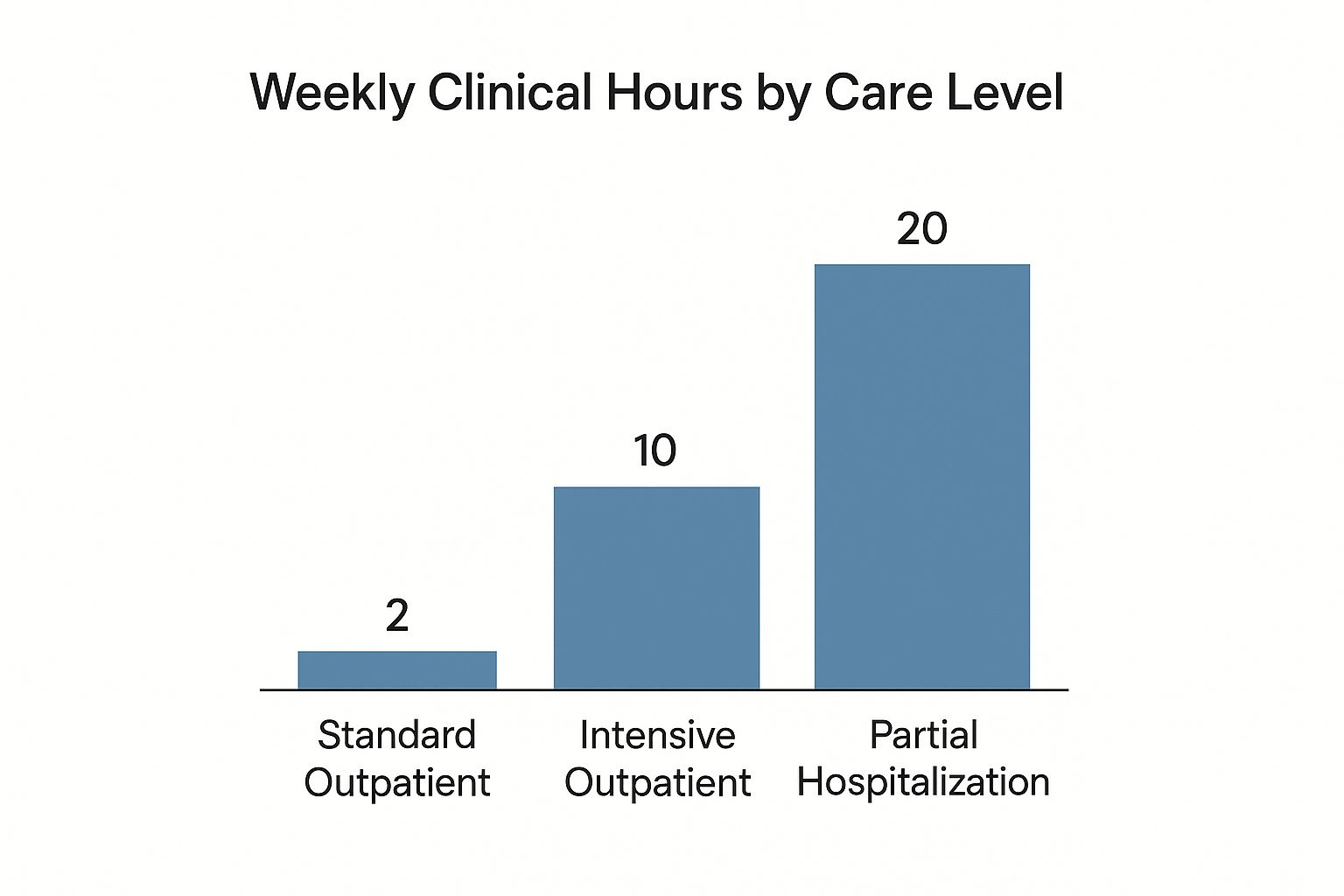
You can see right away that an IOP is a serious commitment, much more involved than traditional therapy, and that’s by design.
IOP vs. Standard Outpatient Therapy
A weekly therapy session is fantastic for maintaining stability and getting consistent, long-term support. But sometimes, you hit a point where you need more—more connection, more structure, and more tools to really gain traction. An IOP is that next step up. It takes you from a weekly check-in to a comprehensive therapeutic program that meets multiple times a week.
IOP vs. Partial Hospitalization (PHP)
A PHP is even more structured and time-intensive than an IOP. It's often called "day treatment" for a reason. Requiring 20 or more hours of programming each week, a PHP is typically for people who need hospital-level care but are stable enough to live at home. The trade-off is that it’s nearly impossible to keep up with a job or school. An IOP provides a powerful, effective alternative without completely pausing your life.
IOP vs. Residential Treatment
This is the most significant jump in care. In residential or inpatient treatment, you live at the treatment center 24/7. This around-the-clock supervision and immersive environment is absolutely essential for people who need medical detox, stabilization, or a safe space completely removed from triggers and daily stressors.
An IOP delivers the clinical rigor you need to make real, lasting change while keeping you grounded in your everyday life. The real magic is that you get to practice the skills you’re learning in your own home and community, in real-time. That’s how you build a recovery that sticks.
To make these distinctions even clearer, here’s a table that lays it all out. If you want to dig even deeper, check out our guide on the key differences between inpatient and outpatient care.
Comparing Treatment Levels: IOP vs Other Options
This breakdown helps clarify the core differences in time, living arrangements, and who each level is designed for.
| Treatment Level | Time Commitment | Living Arrangement | Best Suited For |
|---|---|---|---|
| Standard Outpatient | 1-3 hours per week | Live at home | Ongoing support and managing stable symptoms. |
| Intensive Outpatient (IOP) | 9-15 hours per week | Live at home | Individuals needing more structure than weekly therapy who have a stable home environment. |
| Partial Hospitalization (PHP) | 20+ hours per week | Live at home | Those needing daily, high-intensity care as an alternative to hospitalization. |
| Residential/Inpatient | 24/7 | Live at the facility | Individuals requiring constant medical supervision or a fully immersive therapeutic environment. |
Ultimately, choosing the right level of care is a deeply personal decision. But by understanding exactly what an IOP is and how it stacks up against the alternatives, you’re empowered to find the path that truly aligns with your needs and recovery goals.
Key Takeaways
- IOP is a Middle Ground: It is more intensive than standard therapy but less restrictive than PHP or residential treatment.
- Time Commitment Varies: IOP requires 9-15 hours weekly, compared to 1-3 for standard therapy or 20+ for PHP.
- Freedom to Live at Home: Unlike residential care, IOP allows you to maintain your daily life and responsibilities.
- Care is Tiered: The spectrum of care allows individuals to "step up" or "step down" to the level they need.
- Informed Choice is Key: Understanding these differences helps you choose the right program for your recovery goals.
Does Intensive Outpatient Treatment Actually Work?
https://www.youtube.com/embed/CATj2bc-0bw
When you're committing to a treatment program, you need to know it's more than just a good idea—you need to know it gets results. The great news is that Intensive Outpatient Programs (IOPs) are not a shot in the dark. Their effectiveness is backed by years of solid research, showing just how powerful this approach can be.
For many people, particularly those dealing with substance use, the outcomes of an IOP are on par with inpatient or residential programs. Think of it less as a "step down" and more as a different, clinically powerful path. It's a serious program designed to deliver serious results, all while letting you stay connected to your everyday life. The magic is in the structure, which is built to create a sustainable recovery right from the start.
The Science of IOP Success
What makes an IOP so effective? It’s not just about the time commitment. It’s about a few core principles that work together to create real, lasting change by weaving recovery directly into your life.
- Practice What You Learn, Instantly: You might learn a new way to handle stress in a group session in the afternoon and then use that exact skill when you get home that evening. This immediate, real-world application is what makes new, healthy habits stick.
- The Power of Shared Experience: Group therapy builds an incredible sense of community. You’re not alone in your struggles. Sharing your journey with people who genuinely get it breaks down isolation and creates a built-in network for support and accountability.
- Healing Within Your World: By staying connected to your job, your classes, or your family, you’re building a foundation for recovery in the place you’ll actually be living it. An IOP helps you heal in your environment, not apart from it.
Intensive outpatient treatment bridges the gap between the therapy room and real life. It gives you the power to build a new future by practicing recovery skills in the very environment you'll need them most.
Decades of studies back this up. Research consistently finds that 50% to 70% of people who complete an IOP report abstinence at follow-ups. What’s truly remarkable is that these outcomes are often nearly identical to those from more restrictive inpatient settings. Considering the lower cost and easier access, this makes IOPs a highly effective and practical choice for a huge number of people. You can learn more about these important findings from the research itself.
The evidence is clear and confirms what countless people have already experienced: an IOP delivers the intensity, skills, and community you need to build and maintain a lasting recovery.
Key Takeaways
- Proven Results: Research shows IOP success rates are comparable to inpatient care for many people.
- Real-World Practice: The structure lets you immediately use new coping skills in your daily life, making recovery stronger.
- Community is Central: Peer support creates connection, fights isolation, and builds a powerful sense of accountability.
- Life Doesn't Stop: IOPs allow you to keep your job, stay in school, and live at home, weaving recovery into your existing life.
- The Data Doesn't Lie: Studies show that 50% to 70% of IOP participants achieve abstinence after finishing their program.
Wrapping It Up: What Really Matters About IOP
If you're walking away with just a few key ideas about intensive outpatient treatment, let these be the ones. Think of this as the CliffsNotes version—the core concepts that define this unique and effective path to recovery.
The Big Picture in a Nutshell
At its heart, intensive outpatient treatment is a powerful middle ground. It gives you the structure and professional support of a serious recovery program but doesn't ask you to put your entire life on hold. It’s a solution that fits into your world.
Here’s what to remember:
- A Bridge, Not a Barrier: IOP lets you get the help you need while still living at home. You can keep up with work, school, and family, making recovery a part of your life, not a pause from it.
- A Real Commitment: This isn’t just a weekly check-in. Expect to be in therapy for 9 to 20 hours per week, with much of that time spent in group sessions where you can connect with and learn from others.
- Who It's For: IOP is a fantastic fit if you're medically stable and have a supportive home life but know you need more than a standard once-a-week therapy session.
- It Simply Works: Don't just take our word for it. Study after study shows that for the right person, IOP is just as effective as living at a residential facility, leading to lasting, meaningful recovery.
- Skills for the Real World: The goal isn't just to talk about coping strategies; it's to practice them day in and day out as you navigate your actual life. You learn it in therapy in the morning and apply it at home that evening.
Your IOP Questions, Answered
If you're looking into treatment options, you've probably got a lot of questions. That's completely normal. Let's walk through some of the most common things people ask when they're trying to figure out if an intensive outpatient program is the right fit.
Can I Keep Working or Going to School During IOP?
Yes, absolutely. In fact, that’s one of the biggest reasons people choose an IOP. These programs are built for real life.
Most offer sessions at different times—mornings, afternoons, or evenings—so you can fit treatment around your existing schedule. The whole point is to get the support you need without having to put your entire life on hold. You can keep up with your job, stay in school, and be there for your family while you heal.
How Long Does an Intensive Outpatient Program Usually Take?
There's no single answer here, as the timeline is really based on your individual needs and how you're progressing. That said, a typical program usually runs somewhere between 8 to 12 weeks.
As you start hitting your goals and feeling more confident, your care team will likely talk about a "step-down" plan. This means transitioning to a less frequent level of care, like weekly therapy, to make sure you have ongoing support for the long haul.
An IOP is designed to integrate into your life, not disrupt it. The goal is to provide robust, evidence-based care that supports your daily responsibilities and prepares you for sustained recovery.
Will My Insurance Cover Intensive Outpatient Treatment?
For most people, the answer is yes. Thanks to laws like the Mental Health Parity and Addiction Equity Act (MHPAEA), most health insurance plans are required to cover mental health and substance use treatment in the same way they cover medical care. And as of January 1, 2024, Medicare now covers IOP services, which has opened the door for many more people to get help.
Of course, it's always smart to check with your specific insurance provider to get the details on your plan. Our admissions team is also here to help you navigate that process and verify your coverage.
What Happens When the Program Ends?
Finishing an IOP is a huge achievement, but it's not the end of the road—it’s more like a major milestone on a longer journey. Recovery is an ongoing process.
Before you graduate, any good program will sit down with you to create a solid aftercare plan. Think of this as your personal roadmap for what comes next. It usually includes things like:
- Setting up regular outpatient therapy, maybe once a week.
- Finding local support groups you can connect with.
- Mapping out relapse prevention strategies to help you handle challenges down the line.
This planning is essential. It ensures you walk out the door with a strong support system already in place, ready to build on all the progress you've made.
Key Takeaways
- You can keep your life: IOPs are designed to be flexible, so you can balance treatment with work, school, and family.
- It’s a commitment, not forever: Most programs last about 8-12 weeks, and the timeline is based on your personal journey.
- Insurance usually helps: Most insurance plans, including Medicare, now cover this level of care.
- You'll have a plan for what's next: A good IOP doesn't just end; it helps you build a strong aftercare plan for continued success.
- Don't be afraid to ask: If you have questions about scheduling, insurance, or anything else, just ask. That's what we're here for.
Frequently Asked Questions
What is the main goal of intensive outpatient treatment?
The primary goal is to provide structured therapeutic support to help individuals build coping skills, manage symptoms, and prevent relapse. It aims to achieve this while allowing them to live at home and maintain daily responsibilities like work or school.
How is IOP different from regular outpatient therapy?
The main differences are time commitment and intensity. Standard therapy is typically one hour per week. An IOP involves a more significant time commitment—usually 9 to 15 hours per week, spread over several days—and includes a combination of group therapy, individual counseling, and skill-building workshops.
Who is a good candidate for an IOP?
An ideal candidate is someone who is medically stable and does not require 24/7 supervision or detox. They should have a safe and supportive home environment but need more structure and support than traditional weekly therapy can provide. It's also an effective "step-down" for those transitioning from inpatient care.
Can I keep my job while in an IOP?
Yes. One of the primary benefits of an IOP is its flexibility. Programs are often scheduled in the mornings or evenings, specifically to accommodate work, school, and family commitments, allowing you to integrate treatment into your existing life.
How long does an IOP typically last?
While the duration varies based on individual needs and progress, most intensive outpatient programs last between 8 and 12 weeks. After completion, a comprehensive aftercare plan is created to ensure continued support and long-term recovery.
