

The fundamental difference between inpatient and outpatient treatment boils down to two things: where you live and how intensive the care is. With inpatient care, you move into a dedicated facility for round-the-clock medical supervision and a deep dive into therapy. On the other hand, outpatient care lets you live at home, fitting scheduled treatment sessions into your existing life.
The right choice hinges on a simple question: Do you need a highly structured, immersive environment free from daily triggers, or a more flexible approach that you can integrate with your current responsibilities?
Key Takeaways
- Inpatient Care: Involves living at a treatment facility 24/7. It’s best for severe addictions, co-occurring mental health disorders, or unstable home environments due to its highly structured, trigger-free setting and constant medical supervision.
- Outpatient Care: Allows you to live at home while attending scheduled therapy sessions. It’s ideal for mild to moderate addictions, strong support systems, and for those who need to maintain work or family commitments.
- Core Difference: The primary distinction is the level of structure and supervision. Inpatient provides an immersive, controlled environment for stabilization, while outpatient focuses on integrating recovery skills into daily life.
- Choosing a Path: The best choice depends on a professional clinical assessment of your specific needs, including the severity of addiction, your mental health, and the stability of your home life.
Understanding the Foundations of Addiction Treatment
When you decide to seek help for addiction, choosing the right level of care is one of the first and most critical steps. This decision shapes your entire recovery experience, from your day-to-day schedule to the therapeutic methods you’ll engage with. The two main paths, inpatient and outpatient, offer very different approaches, each tailored to specific needs and life situations.
Inpatient vs Outpatient Treatment at a Glance
To get a quick handle on how these two models work, a side-by-side comparison is incredibly helpful. It cuts through the jargon and lays out the core distinctions.
| Feature | Inpatient Care (Residential) | Outpatient Care (Ambulatory) |
|---|---|---|
| Living Arrangement | Reside at the treatment facility 24/7 | Live at home and travel to the facility for sessions |
| Environment | Highly structured, controlled, and free from external triggers | Integrated with daily life, requiring self-management of triggers |
| Supervision | Continuous medical and clinical monitoring around the clock | Scheduled supervision during treatment hours only |
| Intensity | High-intensity; typically includes 3-5 hours of therapy daily | Varies from low to high intensity (1-9+ hours per week) |
| Best Suited For | Severe addictions, co-occurring disorders, or unstable home environments | Mild to moderate addictions, strong support systems, and daily obligations |
| Focus | Stabilization, detoxification, and intensive therapeutic work | Skill-building, relapse prevention, and real-world application |
This table shows that inpatient care acts as a protective bubble, giving you the space to focus entirely on healing without outside distractions. In contrast, outpatient care provides the structure you need while allowing you to immediately practice your new coping skills in the real world as you manage work, family, and social life.
Ultimately, picking the right program requires an honest assessment of your personal circumstances, including the severity of the addiction, the stability of your home life, and your professional commitments.
Inpatient Treatment: A Deep Dive into Structured Recovery
When you hear the term “inpatient” or “residential” treatment, think of it as a complete reset. It’s about stepping away from your everyday life—the people, places, and routines tied to your addiction—and entering a protected space built exclusively for healing. You live at the facility, fully immersed in a community and a schedule designed to help you focus on one thing: getting well.
The cornerstone of this model is 24/7 medical supervision and clinical care. This isn’t just a minor detail; it’s a critical safety net, especially during the initial detox phase when withdrawal can be physically dangerous. Having medical staff available around the clock is one of the most significant factors that separates inpatient from outpatient care.
The Power of a Structured Routine
One of the first things you’ll notice in an inpatient program is the structured daily schedule. There’s very little unstructured downtime, and that’s by design. Idle time can quickly lead to cravings, so the days are filled with purpose-driven activities that keep you engaged and moving forward.
A typical day might look something like this:
- Individual Therapy: Deep, one-on-one work with a counselor to unpack the root causes of your addiction, from personal history to trauma.
- Group Therapy: Sessions with peers where you can share struggles and victories, realizing you aren’t alone in this fight. It builds an incredible sense of camaraderie.
- Family Counseling: These sessions are meant to mend broken trust, teach healthy communication, and give your family the tools to support you effectively.
- Holistic Activities: Things like yoga, meditation, art therapy, or even just time at the gym. These activities help heal the mind and body together.
This kind of routine helps bring back the discipline and stability that addiction so often takes away. It creates a predictable, safe environment where you can start building healthier habits from the ground up.
When Is Inpatient Care the Right Choice?
So, who is this immersive approach really for? Inpatient care is often the best path for people dealing with more than just substance use. It’s a powerful tool for those who need a higher level of support to get sober and stay that way. The choice between inpatient and outpatient care has a massive impact on how healthcare is delivered. Inpatient programs require admission to a facility for at least one night, which is crucial for managing acute conditions that would be unsafe to handle at home. You can learn more about healthcare delivery trends from JLL.
Let’s look at a real-world example. Imagine someone who has been battling a severe, long-term alcohol addiction and also lives with a co-occurring anxiety disorder. Their home life is chaotic, and every time they’ve tried outpatient treatment, they’ve relapsed because triggers are everywhere.
For this person, an inpatient program is more than just a good idea—it’s likely a necessity. The 24/7 medical oversight means doctors can manage both alcohol withdrawal and their psychiatric needs at the same time. The controlled setting removes access to alcohol and provides a much-needed break from outside stressors, allowing them to finally stabilize before diving into the deeper psychological work of recovery.
In the end, the inpatient model is for anyone who needs to hit the pause button and build a new foundation from scratch. It’s an intense, powerful combination of medical safety, round-the-clock support, and a trigger-free environment to start building a lasting recovery.
The Outpatient Model: Flexible Treatment for Daily Life
Where inpatient care creates a protective bubble, the outpatient model offers something else entirely: the chance to build a new life in recovery while still living it. This approach is all about flexibility. You attend scheduled treatment sessions—whether that’s therapy, group meetings, or medical check-ins—and then head home to work, take care of your family, and sleep in your own bed.
From the very beginning, outpatient treatment is designed to foster independence. It’s a practical path for those who can’t just press pause on their entire lives.

Unlike the all-in, 24/7 nature of inpatient programs, outpatient care isn’t a single thing. It operates on a spectrum, with different levels of intensity that can be dialed up or down to meet you where you are. This tiered system is precisely what makes it a realistic choice for so many people in so many different circumstances.
Levels of Outpatient Care
To really get the difference between inpatient and outpatient care, you have to look at the different flavors of outpatient treatment. Recovery isn’t one-size-fits-all, and these programs reflect that reality.
Here’s a breakdown of the most common levels you’ll encounter:
- Traditional Outpatient Therapy: This is the most flexible option, usually involving just one or two therapy sessions a week. It’s a great fit for people who have a strong support system at home and need ongoing guidance to stay on track.
- Intensive Outpatient Program (IOP): An IOP kicks things up a notch. Clients typically attend treatment for at least nine hours per week, often spread out over three to five days. It provides a solid support structure while leaving enough time for work or school.
- Partial Hospitalization Program (PHP): This is the highest level of outpatient care. A PHP involves treatment for several hours a day, five to seven days a week. Think of it as a bridge program—it offers a level of care that’s close to residential treatment but without the overnight stay, making it ideal for those who need significant support but are medically stable.
Who Benefits from a Flexible Approach
Outpatient care works best for individuals who are medically stable and have a safe, supportive home environment. It’s also a crucial next step for many people leaving an inpatient facility. This “step-down” approach allows for a gradual return to daily life, helping to reinforce the new, healthy habits learned in treatment.
Imagine someone with a moderate substance use disorder who has a stable job and a supportive partner. Taking 30 days off isn’t an option. An IOP allows them to get intensive therapy during the evenings while still going to work and being with their family. Recovery becomes possible without turning their world completely upside down.
This model is quickly becoming a cornerstone of modern healthcare. In the United States, outpatient volumes are projected to climb by 10.6% over the next five years, a shift powered by patient demand, new technologies, and a focus on cost-effective care. You can read more about the growth of outpatient services from JLL.
Ultimately, outpatient care is about building resilience and self-reliance right where you live. It demands a high level of personal accountability, but the payoff is huge: you gain the skills to navigate life’s real challenges while sober. A solid plan is key, and you can find the tools you need in our guide to building a relapse prevention plan template.
Comparing Inpatient and Outpatient Treatment Criteria
Choosing between inpatient and outpatient care goes far beyond just where you’ll sleep at night. The real difference between inpatient and outpatient treatment boils down to the intensity of therapy, the level of daily structure, the community you build, and, of course, the cost. The best choice isn’t universal; it’s deeply personal and depends entirely on your specific circumstances, home environment, and recovery needs.
To figure out which path is right for you, we need to move past a simple pros-and-cons list and look at how these models work in the real world. This breakdown will give you a clear, honest picture of what to expect from each.
Structure and Daily Commitment
Inpatient care is all about structure. Think of it as a total immersion experience where your days are planned from morning to night. You’ll be busy with a mix of individual therapy, group sessions, medical check-ins, and even holistic activities like yoga or art therapy. This intense schedule removes the guesswork and eliminates the idle time that so often becomes a trigger in early recovery.
Outpatient care, on the other hand, is designed to fit into your life. While intensive programs (IOPs and PHPs) still demand a serious time commitment—often 9 to 20+ hours a week—you’re responsible for managing your time outside of the clinic. From day one, this model requires a strong sense of personal accountability to stay on track.
This infographic helps visualize how the short, intense period of an inpatient stay fits into the much longer overall recovery timeline, which is often supported by ongoing outpatient care.
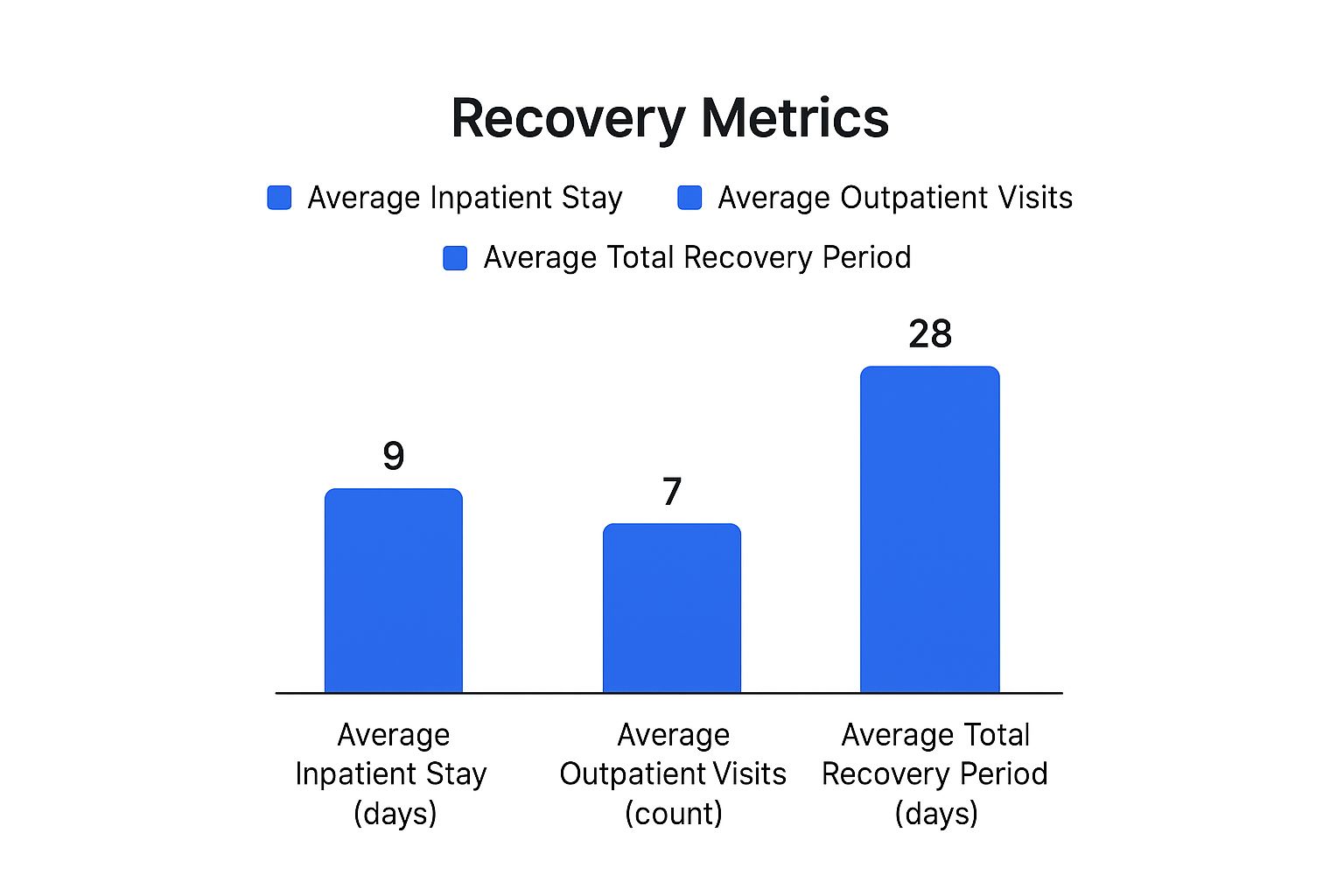
As you can see, the initial stay is just the first step. The journey to lasting recovery is a marathon, not a sprint, involving many touchpoints over time.
Therapeutic Intensity and Focus
The therapeutic intensity in an inpatient setting is consistently high. With clinical staff available around the clock, you are completely immersed in the healing process. A typical day can include 3-5 hours of formal therapy, giving you the time and space to dig deep into underlying issues like trauma or co-occurring mental health disorders without any outside distractions.
Outpatient therapy is also intensive, but it’s concentrated into specific blocks of time. The focus here is often more practical, zeroing in on skills you can use immediately. It’s all about developing coping strategies and relapse prevention techniques for the real world. For example, you might learn a new way to handle conflict in a group session and get to practice it with your family that same evening.
Understanding that recovery happens in phases is key to staying the course. For a deeper dive into what to expect at each step, our guide on understanding the stages of the recovery process is a great resource.
Peer Support and Community
Both treatment models rely heavily on the power of peer support, but the experience is quite different. In an inpatient facility, you live side-by-side with your peers, creating an incredibly powerful, 24/7 support system. This shared, immersive experience builds deep bonds and a powerful sense of camaraderie because everyone is 100% focused on the same goal in a safe, protected space.
In an outpatient program, that peer support is built during scheduled group sessions. These connections are still vital, but they exist within the context of everyone returning to their own lives—and their own challenges—after each meeting. This structure more closely mirrors what it’s like to build a sober support network out in the world.
Detailed Comparison of Treatment Models
To really grasp the trade-offs, a direct, feature-by-feature look is the best way to see how these two approaches stack up. The table below breaks down the key differences to help you see which model might be a better fit for you or your loved one.
| Comparison Criteria | Inpatient Care Analysis | Outpatient Care Analysis |
|---|---|---|
| Medical Supervision | 24/7 on-site medical and nursing staff is a core feature, essential for managing acute withdrawal and co-occurring medical conditions. This constant oversight provides the highest level of safety. | Medical support is available during program hours but not around the clock. This model is suitable for individuals who are medically stable and do not require constant monitoring. |
| Environment | The environment is highly controlled and trigger-free. By removing access to substances and stressful external situations, it allows individuals to focus solely on healing and stabilization. | Treatment is integrated into the individual’s real-world environment. This requires navigating daily triggers but provides immediate opportunities to practice and apply new recovery skills. |
| Impact on Daily Life | Requires a complete pause on work, school, and family obligations. Individuals must arrange for leave from their responsibilities for the duration of the stay, typically 30 to 90 days. | Allows individuals to maintain most daily responsibilities. The flexible scheduling is designed to fit around work, academic commitments, and family life, minimizing disruption. |
| Anonymity and Privacy | Offers a higher degree of anonymity from one’s local community, as treatment occurs in a secluded facility. However, it requires explaining a prolonged absence from daily life. | Privacy is maintained as you live at home, but you may encounter familiar faces within your local community while attending sessions. It does not require explaining a long absence. |
Ultimately, this comparison shows that one is not inherently “better” than the other. The right choice is the one that offers the right level of support and structure for a person’s unique clinical needs and life circumstances.
Navigating Costs and Insurance Coverage
Let’s talk about the financial side of things. It’s a huge part of the decision between inpatient and outpatient care, and honestly, it’s where a lot of people get stuck. The price difference can be stark, but understanding how to work with your insurance can make all the difference.
The higher cost of inpatient treatment makes sense when you break it down. You’re not just paying for therapy sessions; you’re paying for everything. That includes 24/7 medical supervision, a place to live, all your meals, and access to a full team of professionals around the clock. It’s an all-inclusive, immersive environment, and that comprehensive support is reflected in the price.
Outpatient care is structured differently. Think of it more like an à la carte menu. You pay for the specific services you use—an individual therapy session here, a group meeting there, an appointment for medication management. Because the costs are itemized and you’re not paying for room and board, it’s almost always the more affordable option upfront.
Understanding Your Insurance Benefits
Trying to figure out your insurance plan can feel like learning a new language. But getting a handle on a few key terms will put you in the driver’s seat. Before you sign up for any program, you absolutely have to call your insurance provider and verify your benefits.
Here’s what you need to ask about:
- Deductible: This is the magic number you have to pay out-of-pocket before your insurance even starts to chip in.
- Copayment (Copay): Your share of the cost for a specific service, like a doctor’s visit. It’s a fixed amount you’ll pay each time.
- Coinsurance: After you’ve hit your deductible, you’ll likely still pay a percentage of the bill. That’s your coinsurance.
- Out-of-Pocket Maximum: The absolute most you’ll have to pay for covered care in a year. Once you hit this cap, your insurance picks up 100% of the tab.
This push for cost-effective care is happening everywhere. A recent Deloitte survey on 2025 global healthcare executive outlooks found that over 70% of health system leaders are focused on becoming more efficient. Outpatient care is a big piece of that puzzle because it delivers great results without the overhead of a residential facility, which is why you see so much investment in outpatient clinics.
Exploring Alternative Financial Resources
What if your insurance coverage is thin or you don’t have any? Don’t panic. Cost should never be the reason you don’t get help. Many treatment centers are committed to working with people to find a solution.
Here are a few avenues to explore:
- Sliding-Scale Fees: Many facilities will adjust their rates based on what you can realistically afford to pay.
- Payment Plans: You don’t always have to pay the full amount at once. Ask about spreading the cost out over time.
- State-Funded Programs: Your state likely has government-funded programs that offer treatment at a low cost—or even for free—to residents who qualify.
- Grants and Scholarships: Some non-profits and foundations offer financial aid specifically to help people access addiction treatment.
It might take some digging, but by looking into all of your options, you can find a way forward that doesn’t break the bank.
How to Choose the Right Treatment Path
Deciding between inpatient and outpatient care is probably the single most important choice you’ll make at the start of your recovery. It’s not just a detail; it’s the foundation of your entire journey. The right fit aligns the intensity of care with your personal needs, and this guide is designed to help you figure out what that looks like for you.

Let’s be clear: this isn’t about which option is “better.” It’s about which one is better for your specific situation. That requires taking an honest look at your life, the severity of your addiction, and the support system you have in place.
Key Questions for Your Self-Assessment
Before you even speak with a professional, it helps to do a little self-reflection. Answering these questions honestly will give you—and any specialist you talk to—a much clearer picture of what you’re up against.
- How severe is the addiction? Have you tried to stop on your own before, only to relapse? Is your use getting worse and starting to cause real health issues? If you’re dealing with a history of relapse or strong physical dependency, that’s often a sign that the structure of inpatient care is needed.
- Do you have co-occurring conditions? Many people struggling with addiction are also dealing with mental health challenges like depression, anxiety, or PTSD. Inpatient facilities are built to handle this, offering integrated psychiatric care and addiction therapy under one roof.
- Is your home environment stable and supportive? This is a huge factor. If your home is full of triggers, stress, or conflict, an inpatient program can provide a much-needed safe space. On the other hand, if you have a rock-solid support system at home, outpatient care can be a very effective route.
Considering Your Personal Responsibilities
Recovery needs to be the priority, but we all know that life doesn’t just stop. Your daily obligations will absolutely play a part in what’s practical for you.
Take stock of your commitments:
- Can you realistically take a leave of absence from your job?
- Do you have kids or parents who depend on you for care?
- Can you reliably get to and from a clinic multiple times a week?
Thinking through these practical questions helps clarify the difference between inpatient and outpatient in a real-world context. While inpatient care provides that deep, immersive experience, it’s worth noting how healthcare is shifting. The U.S. has around 674,000 hospital inpatient beds with a 69% occupancy rate, yet outpatient services are growing rapidly. This trend, highlighted in hospital service trends on Medpac.gov, shows that while intensive care remains critical, more flexible models are becoming available to meet people where they are.
The Final and Most Important Step
Self-assessment is a great start, but it can’t replace a professional medical opinion. The final step should always be a clinical assessment with an addiction specialist, doctor, or licensed therapist. They have the expertise to look at your physical and mental health, review your history with substance use, and make a formal recommendation.
This professional evaluation ensures your decision is grounded in a complete clinical picture, giving you the best possible shot at a lasting recovery. When you’re ready to take that step, a good place to start is by researching different rehabilitation centers that can provide these crucial assessments.
Frequently Asked Questions (FAQ)
Making the right choice between inpatient and outpatient care can feel overwhelming. It’s natural to have questions. Let’s tackle some of the most common ones to help you see the path forward a little more clearly and understand the real-world difference between inpatient and outpatient care.
What is the main advantage of inpatient care?
The biggest benefit is the 24/7 structured environment. It removes you from people, places, and things that trigger substance use and provides constant medical and emotional support, which is often crucial in the fragile, early stages of recovery.
Who is a good candidate for outpatient care?
Someone with a solid support system at home, a high level of motivation to get sober, and the ability to manage daily life without constant supervision is an ideal candidate. Outpatient programs work best for those who can reliably get to their sessions and apply what they learn.
Can I switch from inpatient to outpatient care?
Absolutely. In fact, it’s a very common and often recommended path. Think of it as a “step-down” process that’s a key part of a solid, long-term recovery plan. Many people start in an inpatient facility to get through detox safely and build a stable foundation. Once they’re on solid ground, they transition to an outpatient program to slowly ease back into their everyday life while still having a strong support system.
Which one has a better success rate?
This is a tricky question because “success” isn’t a single metric. The treatment with the best chance of success is the one that’s the right clinical fit for the individual.
- Inpatient care tends to be more effective for severe, long-standing addiction or co-occurring mental health conditions.
- Outpatient care can be highly successful for people with mild to moderate addictions who have a strong, supportive home environment.
Ultimately, a professional assessment is the best way to determine which level of care offers the highest likelihood of lasting recovery.
Will I lose my job if I enter inpatient rehab?
This is a valid concern, but there are federal laws designed to protect you. The Family and Medical Leave Act (FMLA) and the Americans with Disabilities Act (ADA) can protect your job while you get help, as addiction is recognized as a treatable medical condition. It’s best to have a confidential conversation with your Human Resources (HR) department to understand your rights and company policies.
