

Dallas intensive outpatient treatment often averages $3,487 per month without insurance, and many buyers see lower out-of-pocket costs once PPO benefits are applied. That gap is why the essential question isn't just what IOP costs, it's what a family may ultimately owe after coverage is checked.
When someone is trying to get help in Dallas, the bill can feel like the thing that stops everything. Rent, work schedules, childcare, and the fear of surprise charges all pile up at once, and that uncertainty can keep a person from making the call they already know they need to make.
Table of Contents
- Putting a Price on Recovery Can Feel Impossible
- Understanding IOP Costs in the Dallas Area
- Key Factors That Influence Your Final IOP Cost
- How PPO Insurance Makes IOP Treatment Affordable
- Comparing IOP and Inpatient Rehab Costs
- Get a Clear Cost Estimate at Tru Dallas Today
Putting a Price on Recovery Can Feel Impossible
A Dallas family may know treatment is needed and still hesitate at the same point. The question is simple, but the answer is not. Will the first step lead to a manageable bill, or turn into a financial strain that is hard to absorb?
For local planning, families usually need a concrete starting point, not a vague range. That is why a Dallas-area benchmark matters so much. It gives people in Dallas, Euless, Irving, Arlington, and nearby neighborhoods something real to work from before they call a program or compare benefits.
Why IOP often fits working families
Intensive outpatient programs give people structured addiction care without requiring them to live at a facility around the clock. In Dallas, that matters because work shifts, school schedules, and family responsibilities can make residential treatment difficult to hold together.
A typical IOP schedule uses several treatment hours each week instead of 24/7 staffing. The cost reflects the services delivered across the week, such as therapy, clinical check-ins, and other support, rather than room and board. That makes IOP a middle-ground option, more structured than standard outpatient therapy, but usually far less disruptive than inpatient rehab.
Practical rule: when a program quote sounds vague, ask what is included in the rate, therapy, medication management, psychiatric support, or family sessions.
A local admissions team can make those trade-offs easier to understand. At Tru Dallas Detox & Recovery Center, the goal is to give people clear cost information and a practical path to care, so the next step feels more manageable instead of more overwhelming.
Understanding IOP Costs in the Dallas Area
A Dallas family can get a quote that looks manageable at first, then realize the total depends on how many hours of care are included, what kind of clinical support is built in, and whether insurance is paying part of the bill. That is why a local cost check matters. It turns a broad national estimate into something you can use while comparing options in Dallas, Euless, Irving, Arlington, and nearby communities.
The national price range for IOP is often framed as $3,000 to $10,000 per month for a full course of care, with some programs also quoted at $200 to $500+ per day and $30 to $300 per session depending on frequency and services American Addiction Centers. That spread is easy to understand once you look at what the program delivers, because intensive outpatient treatment is not a single fixed package. If you want a plain-language overview of the structure itself, what is intensive outpatient treatment explains the format in direct terms.
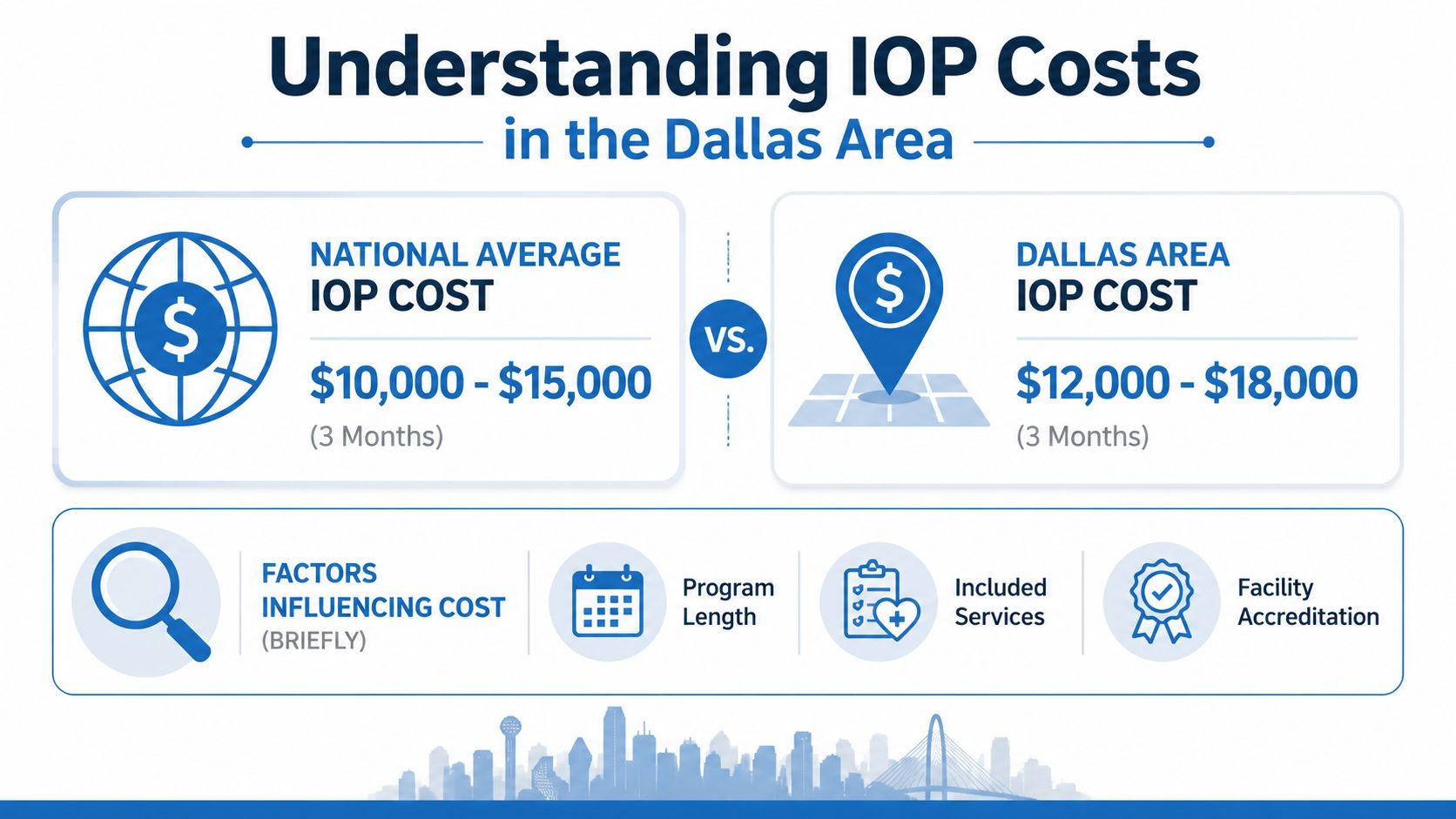
Dallas-area pricing gives families a more grounded reference point. Local rehab cost data shows $10,461 total for a 3-month period without insurance, or $3,487 per month Start Your Recovery, while Texas-focused pricing guides commonly place IOP at $250 to $350 per day before insurance and $2,000 to $5,600 per month for a typical schedule of 2 to 4 days per week Basepoint Breakthrough. In practice, that means two programs in the same city can quote very different numbers if one offers basic counseling and another includes more clinical contact.
What that money usually covers
IOP pricing is tied to the treatment bundle, not just the visit itself. A typical week can include group therapy, individual counseling, education, check-ins, and sometimes medication management or psychiatric support when the program is built that way. Families comparing bills should ask what is included before they compare the final number.
Medicare's outpatient IOP benefit is structured around at least 9 hours of therapeutic services per week, and those services can include individual and group therapy, education, medication management, occupational therapy, family counseling, and diagnostic services Medicare. That benchmark helps explain why costs vary so much, since each added layer of care requires more clinician time and coordination. It also helps families in Dallas see why one quote may cover far more than another, even if the program names sound similar.
A practical comparison for readers weighing treatment budgets can also be useful in other health contexts. For example, managing medication costs in the UK shows how the same idea applies elsewhere, the billed amount depends on what is included, not just the label on the service.
Dallas buyers often get tripped up by the label “IOP” and assume every program is priced the same. The better comparison is always services per week, not the acronym on the brochure.
At Tru Dallas Detox & Recovery Center, the most useful first step is a benefits check and cost review, so you can see where PPO coverage may reduce your out-of-pocket expense before you commit. That kind of review gives you a clearer picture of the true IOP cost and helps you decide whether the program fits your budget.
Key Factors That Influence Your Final IOP Cost
No two IOP quotes are identical because the final cost is built from several layers. A short program with basic counseling can look very different from a longer, more clinically dense program that includes psychiatric visits, family work, or co-occurring disorder support.
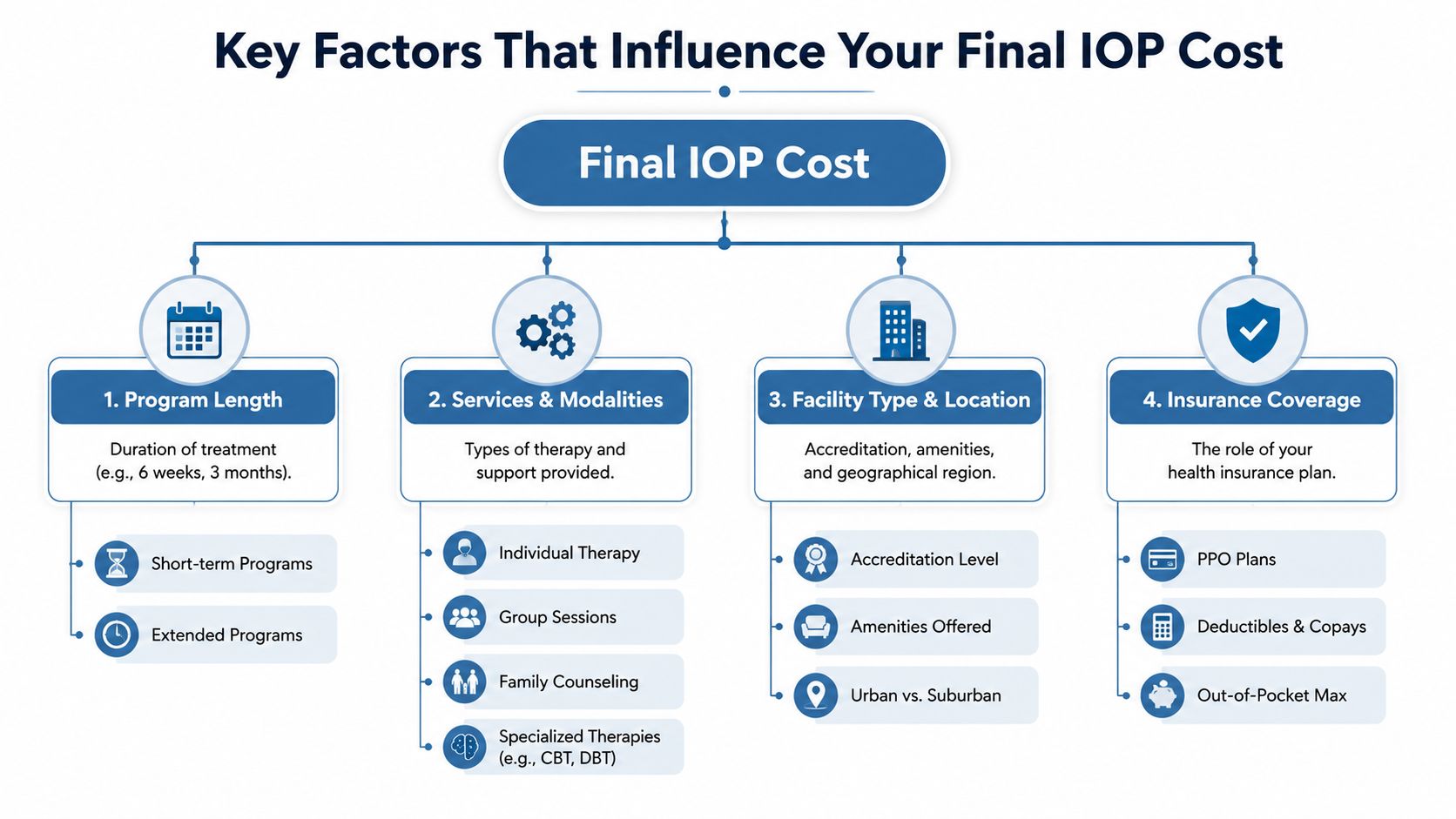
A 2026 outpatient-cost guide reports that IOPs usually involve 9-12 hours of treatment weekly across three to four days, and that programs with specialized services such as trauma care, co-occurring disorder treatment, medication management, family involvement, or peer support can cost 20-40% more than basic counseling models Lighthouse Recovery TX. That price difference is not random, it reflects clinical complexity.
The biggest price drivers
Program length matters first. A shorter track usually costs less overall, while a longer course spreads more services over more weeks and raises the total.
Service mix matters next. A program built around group sessions alone will usually price differently from one that includes individual therapy, family counseling, medication review, or dual-diagnosis care.
Facility type and location also shape the number. Hospital-based outpatient programs and private facilities often price differently because staffing, accreditation, and overhead aren't the same.
Insurance structure can change the final bill dramatically, which is why a quote without benefits review is only half the picture.
For readers comparing treatment budgets across everyday health expenses, a resource like managing medication costs in the UK can be helpful for understanding how prescription coverage changes a household budget in other settings, even though treatment financing works differently in the U.S.
Cost insight: a higher quote isn't automatically a bad sign. If it includes psychiatric support, family participation, or co-occurring treatment, the price may reflect a more complete care plan rather than padding.
How PPO Insurance Makes IOP Treatment Affordable
The most important number isn't always the sticker price. For many Dallas families, the out-of-pocket amount is the amount left after deductible, copay, coinsurance, and network status are applied.
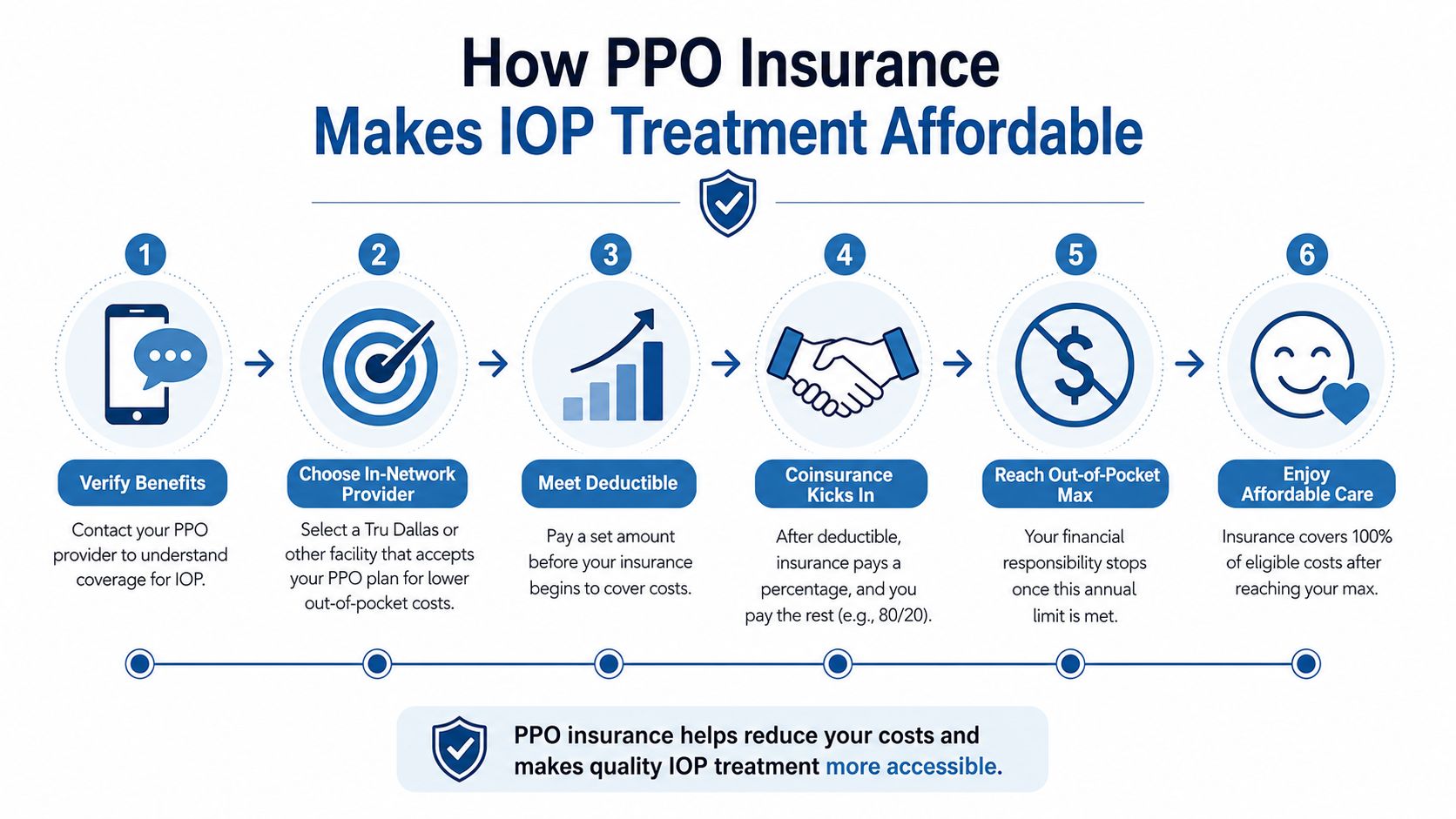
Most coverage questions still start with “How much does IOP cost without insurance?” but the more useful question is, What is the expected out-of-pocket cost after deductible, copay, coinsurance, and network status are applied? Trifecta Healthcare Institute. That shift matters because the full billed amount and the patient's actual share are often very different.
PPO terms that matter in plain English
Deductible is the amount a patient usually pays before the plan starts sharing more of the bill.
Copay is a set amount for a covered visit or service.
Coinsurance is the percentage split after the deductible has been met.
Out-of-pocket maximum is the annual cap on what the patient has to pay for eligible care.
PPO plans can be especially helpful because they usually give more flexibility than tightly restricted plan designs, but the final cost still depends on whether the program is in network. A patient who chooses an in-network IOP typically has a better shot at lower out-of-pocket spending than someone using an out-of-network provider.
What the verification call should answer
A strong benefits check should confirm whether IOP is covered, whether prior authorization is needed, whether the program is in network, and what the patient responsibility may be after benefits are applied. That is also where a treatment team can catch hidden friction before it becomes a denial.
For readers who want another plain-language explanation of benefits, the guide on does insurance cover drug rehab is a useful companion read.
Another helpful reference is psychiatric services pricing and fees, because psychiatric care is often one of the services that changes the total treatment bill when it's bundled into a program.
Bottom line: a free insurance check can turn a vague estimate into a realistic payment expectation.
Tru Dallas Detox & Recovery Center can verify PPO benefits before admission, which helps families understand whether treatment is likely to be affordable before they commit.
Comparing IOP and Inpatient Rehab Costs
IOP is often the right fit when someone needs structure but can still sleep at home and keep some part of daily life going. Inpatient rehab is different, because it includes housing, meals, and 24/7 supervision, which is why it usually costs more.
A Texas treatment-cost guide estimates that a complete episode of care can include medical detox at $2,000 to $10,000 for 5 to 14 days, inpatient rehab at $15,000 to $60,000 for 30 days, and intensive outpatient treatment at $3,000 to $10,000 for 8 to 12 weeks Clear Cost Recovery. That range shows why many people start with IOP when they're clinically appropriate for a lower-acuity setting.
| Feature | Intensive Outpatient Program (IOP) | Inpatient / Residential Rehab |
|---|---|---|
| Living arrangement | Patient lives at home | Patient lives at the facility |
| Daily structure | Several sessions per week | Continuous supervision |
| Cost profile | Lower total cost for many families | Higher because housing and 24/7 care are included |
| Best fit | Stable home environment, work or family obligations | Need for round-the-clock support |
| Flexibility | Higher | Lower |
The comparison on how much does inpatient rehab cost helps clarify why the added room-and-board layer changes the budget so much.
IOP is not a lesser form of care. For the right patient, it's the more practical one because it preserves work, school, parenting, and transportation routines while still delivering treatment on a structured schedule. That balance can matter just as much as the total price.
Get a Clear Cost Estimate at Tru Dallas Today
A Dallas family can move from guesswork to a real number with one benefits check. Once the plan details are verified, the difference between a rough estimate and the actual out-of-pocket amount becomes much easier to see.

IOP costs vary by program design, session frequency, and insurance status. For families in Dallas, PPO coverage can make the difference between a manageable bill and a harder one, especially when the plan includes in-network behavioral health benefits and the deductible has already been met or is close to being met.
A simple way to get clarity today
- Call for a confidential benefits check. The first question should be whether IOP is covered under the current plan and whether Tru Dallas can verify the benefits before admission.
- Have the insurance card ready. The plan name, member ID, and network information help the admissions team give a more accurate estimate.
- Ask what the out-of-pocket cost may be. Deductible status, copay, coinsurance, and whether the plan is in-network all affect the final amount.
- Request the treatment bundle in writing if possible. Families should know whether psychiatric visits, family work, or medication management are included.
This process removes the guesswork. A verified estimate gives families a clearer view of what treatment may cost and what the plan is likely to cover, so the decision can be based on care needs instead of uncertainty.
For Dallas-area support, Tru Dallas Detox & Recovery Center can run a free, confidential insurance review and explain what the plan may cover before treatment starts. For many families, that first verification call is the fastest path to a realistic number and a calmer next step.