
Cognitive Behavioral Therapy (CBT) for addiction is a skills-based approach that helps individuals break the cycle of substance use by changing destructive thought and behavior patterns. It operates on the principle that your thoughts, feelings, and actions are interconnected, empowering you to identify triggers and develop healthier coping mechanisms for lasting recovery.
Key Takeaways
- CBT is an evidence-based therapy that helps you understand the link between your thoughts, feelings, and actions related to substance use.
- It equips you with practical skills like trigger identification, cognitive restructuring, and coping strategies to manage cravings.
- A core part of CBT is learning to challenge and change cognitive distortions—unhelpful thinking patterns that justify addiction.
- The therapy is highly effective for building a detailed, proactive relapse prevention plan.
- CBT works best as part of a comprehensive treatment program that may also include medication-assisted treatment (MAT) and care for co-occurring mental health disorders.
How CBT Helps You Break Free from Addiction
If you're trying to find a way out of the cycle of addiction, Cognitive Behavioral Therapy provides a practical, proven path forward. At its heart, CBT for addiction works on a straightforward but profound idea: your thoughts, your feelings, and your actions are all linked.
Think of it as a chain reaction. A negative thought can spark an intense craving, which then drives the action of using a substance. CBT gives you a structured way to break that chain. It's not just about talking; it's an active, hands-on approach to reclaiming control over your responses. Once you learn to spot the specific thoughts that fuel your addiction, you gain the power to challenge and change them.
Understanding the CBT Framework
Imagine that your addiction has created a deeply worn path through a forest. Whenever you feel stressed, lonely, or anxious, your mind automatically takes that familiar path because it's the easiest, most traveled route.
CBT acts like a trail guide, showing you how to forge new, healthier paths. It gives you a map and a compass to navigate the forest of your emotions without defaulting to that old, destructive trail.
This therapy helps you get to the "why" behind your substance use by carefully examining what happens right before you use. This process, known as a functional analysis, is crucial for pinpointing the exact triggers—both external and internal—that set the cycle in motion.
A core concept in CBT is that it’s not the events themselves that cause our feelings, but rather our thoughts about those events. By changing our thoughts, we can change our feelings and, ultimately, our actions.
Building Your Recovery Toolkit
The real goal of using CBT for addiction is to equip you with skills that you can rely on for the rest of your life. Instead of feeling helpless when a craving hits, you learn to see it as a signal—one that you can manage with a specific, constructive strategy.
CBT is all about building a set of practical, real-world abilities. These include:
- Trigger Identification: Getting really good at recognizing the specific people, places, emotions, or even times of day that spark the urge to use.
- Cognitive Restructuring: Learning how to catch, challenge, and reframe the automatic negative thoughts that tell you using is a good idea.
- Coping Skills Development: Creating a go-to list of healthy ways to handle stress, boredom, or sadness without turning to drugs or alcohol.
- Problem-Solving Skills: Strengthening your ability to tackle life's challenges head-on in a clear and effective way.
Ultimately, CBT empowers you to become your own therapist. It gives you the tools to navigate recovery and maintain your sobriety long after you've completed a formal treatment program. It shifts recovery from being something you hope for into something you actively manage, one day at a time.
Rewiring Your Brain for a Life Beyond Addiction
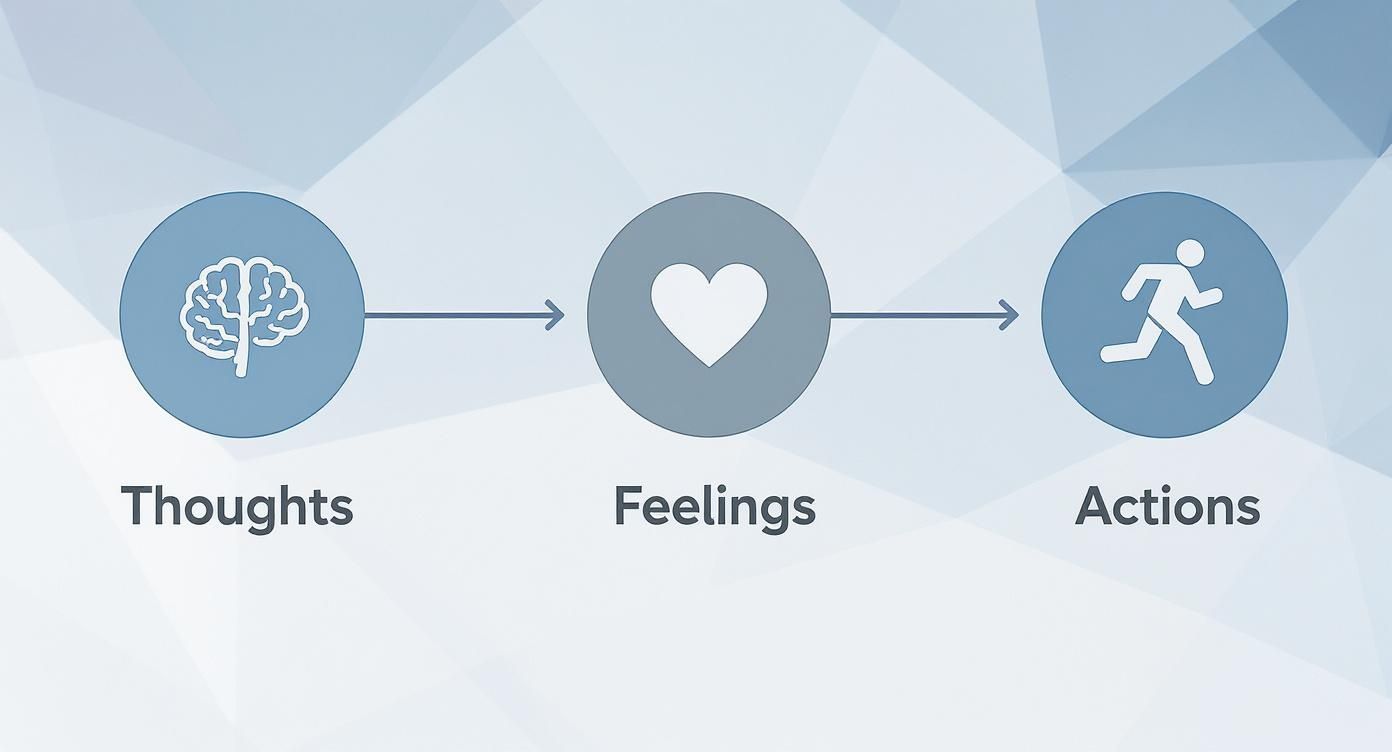
Cognitive Behavioral Therapy works on a simple but profound idea: you can change your life by changing your mind. It’s a practical, hands-on approach to systematically rewiring the deep-seated neural pathways that addiction carves into the brain. At its heart, CBT for addiction is built on what’s called the cognitive triangle—a framework that reveals the powerful, direct link between your thoughts, feelings, and actions.
Think about it this way. A stressful day at work doesn't magically create a craving. Instead, that event triggers an automatic thought: "I deserve a drink to relax." That thought then sparks a feeling, like anxiety or a sense of anticipated relief. Finally, that feeling drives the action of reaching for a substance. CBT gives you the power to step in and break this chain reaction right at the start—at the level of the thought itself.
This diagram shows how thoughts, feelings, and actions are all connected, creating a feedback loop that can either trap you in addiction or set you free.
By learning to intercept that first thought, you gain control over the entire sequence, stopping the automatic slide toward addictive behavior before it even gathers momentum.
Unpacking Your Cognitive Distortions
Addiction doesn't just exist in a vacuum; it’s fueled by distorted thinking patterns that justify and sustain substance use. These cognitive distortions are like funhouse mirrors for your mind. They twist reality just enough to make using drugs or alcohol seem like a logical, even necessary, choice in the moment. CBT is all about learning to spot these mental traps so you can sidestep them.
Some of the most common cognitive distortions in addiction include:
- All-or-Nothing Thinking: Seeing everything in black-and-white. For example: "I had one beer, so my recovery is ruined. I might as well finish the six-pack."
- Catastrophizing: Automatically assuming the worst-case scenario will happen. "If I go to this party sober, I’ll be awkward, no one will talk to me, and it will be a total disaster."
- Emotional Reasoning: Believing something is true simply because it feels true. For instance: "I feel this intense craving, which must mean I'm powerless to stop myself from using."
These aren't character flaws—they are learned mental habits. And the best news is that any habit that can be learned can also be unlearned and replaced with something better.
A landmark meta-analysis of 409 clinical trials involving over 52,700 patients provided powerful evidence for CBT. It found that 42% of patients who received CBT showed a positive response, compared to just 19% in control groups. Even more impressively, 36% of CBT patients achieved remission—more than double the 15% seen in those who didn't receive it. You can read more about these CBT success rates and see the data for yourself.
How CBT Changes Your Automatic Responses
The process of fixing these distorted thoughts is called cognitive restructuring. This isn’t about pretending difficult feelings don't exist. It's about taking a hard look at the unhelpful thoughts that crank up the volume on those emotions and push you toward destructive actions.
Think of an automatic negative thought as a weed in a garden. Ignoring it won't make it go away; it will just keep growing and choke out the healthy plants. Cognitive restructuring is like methodically pulling that weed out by the roots and planting a flower in its place.
For example, when the thought "I need a drink to deal with this stress" pops into your head, CBT trains you to follow a three-step process:
- Catch the Thought: First, just notice it. Recognize it for what it is—an automatic, unhelpful belief, not a command you have to obey.
- Challenge the Thought: Interrogate it. Ask yourself, "Is that really true? Is a drink the only way I can possibly relax? What happens if I do? What are some other, healthier ways to unwind?"
- Change the Thought: Consciously replace it with a more balanced and true statement. For instance: "I'm feeling stressed, and while a drink seems easy, going for a 20-minute walk will actually help me clear my head without the fallout."
The following table shows how this process works in practice, turning the destructive thoughts that fuel addiction into the kind of adaptive thinking that supports recovery.
Cognitive Restructuring From Addictive to Adaptive Thinking
| Cognitive Distortion | Example Addictive Thought | CBT-Based Restructured Thought |
|---|---|---|
| All-or-Nothing Thinking | "I slipped up and had a drink. My whole recovery is a failure, so I might as well keep going." | "A lapse is not a relapse. This is a setback, not a failure. I can get back on track right now and learn from this." |
| Emotional Reasoning | "I feel a huge craving. It's so overwhelming, I have no choice but to give in." | "I feel a craving, which is a temporary urge. I have tools to manage this feeling, and it will pass." |
| Catastrophizing | "If I go to this event sober, everyone will notice, I'll be miserable, and it will ruin the night." | "I might feel a little awkward at first, but I can focus on talking to a few people. Staying sober means I'll remember the night and wake up feeling good tomorrow." |
| Minimization | "It's just a couple of pills. It's not a big deal and helps me cope." | "Even 'a couple' is part of the pattern I'm trying to break. This is a big deal for my health and my recovery goals." |
By practicing this catch, challenge, and change method over and over, you literally start building new, healthier neural pathways in your brain. Eventually, the balanced thoughts become the automatic ones, and your go-to response shifts from seeking a substance to using a constructive coping skill. This is the foundation of a strong, lasting recovery.
Building Your Toolkit of CBT Recovery Skills
Knowing the theory behind CBT is one thing, but putting it into practice is where recovery really takes hold. This isn’t just about talking; it’s about building a tangible set of skills you can pull from when life gets tough. Think of it like assembling a personal toolkit for recovery, filled with specific strategies to handle triggers, cravings, and difficult emotions without reaching for a substance.
This toolkit isn't some abstract idea—it’s full of real, actionable techniques that give you back a sense of control. Every skill you master is another tool in your belt, building the confidence you need to face high-risk situations head-on.
Let's break down three of the most important tools you'll develop.
Mapping Your Addiction with Functional Analysis
The first and most fundamental tool in your CBT for addiction toolkit is Functional Analysis. You can think of this as creating a detailed "map" of your substance use. After all, you can't change a behavior if you don’t truly understand what’s driving it.
Working with a therapist, you'll deconstruct moments of substance use by breaking them down into three key parts, often called the "ABC model":
- A – Antecedents: What happens right before you use? These are your triggers—the specific people, places, feelings, or thoughts that set off the urge.
- B – Behavior: This is the act of using the substance itself.
- C – Consequences: What happens after you use? This includes both the immediate positive feelings (like a moment of relief) and the long-term negative outcomes (like damaged relationships or health issues).
By laying out these ABCs, you start to see a clear pattern. Cravings no longer feel random or out of your control; they become predictable events with obvious starting points. This insight is incredibly powerful because it shows you exactly where you can step in to break the cycle.
Acquiring New Skills for High-Risk Situations
Once you’ve used Functional Analysis to pinpoint your triggers, the next step is to build practical skills to deal with them. This is where Skills Training comes in. Instead of feeling helpless when a trigger pops up, you'll learn a new, healthier way to respond.
This part of CBT is incredibly hands-on and is always customized to what you actually need. The goal is to pack your toolkit with a variety of coping strategies so you’re never left with substance use as your only option.
The core idea behind skills training is simple: you can't just take away an old, unhealthy behavior without putting something new and constructive in its place. CBT gives you that "something new."
Here are a few examples of skills you might work on:
- Stress Management: You’ll learn techniques like deep breathing, mindfulness, or progressive muscle relaxation to calm your body's stress response in the moment. This helps reduce that overwhelming feeling that you need a substance to cope.
- Assertive Communication: This is all about learning how to say "no" to offers of drugs or alcohol and set firm boundaries without feeling guilty or starting a fight. It's a crucial skill for navigating social situations where others might be using.
- Problem-Solving: Instead of feeling overwhelmed by life's challenges, you'll learn a structured way to break problems down into smaller, more manageable steps. This cuts down on the stress that so often leads to relapse.
The Hands-On Work of Cognitive Restructuring
The final essential tool is Cognitive Restructuring, which we touched on earlier. This is where you get your hands dirty, learning to actively catch, challenge, and change the automatic negative thoughts that fuel addiction. It's the "cognitive" part of Cognitive Behavioral Therapy in action.
You can think of it like mental self-defense. You learn to spot a destructive thought as it appears, question whether it’s actually true, and then replace it with a more balanced, rational one. For example, a thought like, "This craving is unbearable, I have to give in," can be restructured into, "This craving is intense, but I know it's temporary, and I have the skills to ride it out." You can find a great breakdown of how Cognitive Behavioral Therapy for alcoholism specifically targets these thought patterns to build lasting resilience.
With practice, this process starts to rewire your brain's default settings. The toxic thoughts that once felt like facts lose their grip, and healthier, recovery-focused thinking becomes your new automatic response. With these three core tools—Functional Analysis, Skills Training, and Cognitive Restructuring—your recovery toolkit becomes your best defense against addiction.
Using CBT to Build a Strong Relapse Prevention Plan
One of the biggest fears in early recovery is relapse. It’s a completely understandable anxiety, but CBT for addiction gives us a powerful, structured way to turn that fear into a proactive strategy. Instead of just crossing your fingers and hoping for the best, CBT helps you build a detailed, personalized relapse prevention plan—think of it as your roadmap for long-term sobriety.
The process starts by helping you become an expert on your own triggers. You’ll learn to identify not just the obvious high-risk situations, like being around certain people or places, but also the more subtle internal warning signs. These could be small shifts in your mood or specific thought patterns that, in the past, have paved the way for a lapse.
This proactive approach is so important, especially when you look at the reality of early recovery. For people with alcohol use disorder, for example, the relapse rates can be disheartening. Studies have shown that between 71.5% to 82.1% of people relapse within the first few months after treatment.
But here's the good news: CBT has been proven to significantly improve those outcomes. In fact, it produces results that are 15% to 26% better than what we see in untreated groups. For a closer look at the data, you can explore the full study on CBT's effectiveness in preventing relapse.
Overcoming the Abstinence Violation Effect
A critical concept that CBT helps dismantle is something called the Abstinence Violation Effect. This is that intense, gut-wrenching cycle of guilt, shame, and self-blame that can ignite after a single slip-up. It’s the voice in your head that says, "I've ruined everything, so I might as well give up completely." This all-or-nothing thinking is what turns a minor setback into a full-blown relapse.
CBT goes right after that distorted thinking. It teaches you to reframe a lapse not as a total failure, but as a valuable learning opportunity.
A slip-up doesn't erase your progress. It's a data point that reveals a weak spot in your recovery plan. CBT gives you the tools to analyze what went wrong and strengthen your strategies for the future, turning a moment of weakness into a source of strength.
By changing your thoughts about the slip, you completely change your emotional and behavioral response. Instead of spiraling into shame, you learn to calmly assess the situation, figure out what trigger you missed, and adjust your plan. This reframing is an absolutely vital skill for staying resilient on the recovery journey.
Creating Your Personalized Prevention Plan
Working with a therapist, you’ll create a detailed, written relapse prevention plan. This isn't just a vague idea in your head; it’s a concrete document you can physically turn to when you feel vulnerable. A strong plan, built on CBT techniques, has a few key components.
Your plan will map out exactly what to do in high-risk scenarios. It typically includes:
- A List of Triggers: A clear, honest list of your personal internal and external triggers.
- Specific Coping Skills: A menu of go-to coping strategies for each trigger, like calling your sponsor, doing a five-minute mindfulness exercise, or jumping into a healthy distraction.
- Supportive Contacts: An emergency contact list of supportive friends, family members, and your therapist—people you can call the moment an urge hits.
- Actionable Steps: Clear, immediate steps to take if you do have a lapse, which helps stop it from escalating.
This kind of structured plan transforms anxiety about the future into a feeling of genuine preparedness. Knowing you have a solid, well-thought-out strategy in your back pocket provides the confidence you need to navigate challenges and sustain your recovery for the long haul. You can also get more ideas for building a sober support network by checking out our guide on relapse prevention activities for groups.
How CBT Fits into a Comprehensive Treatment Program
Cognitive Behavioral Therapy is a powerhouse in modern addiction treatment, but it rarely works in isolation. Think of CBT for addiction as a high-performance engine. It’s incredibly effective, but it needs to be part of a complete, well-built vehicle—a comprehensive treatment program—to get you where you need to go.
At a professional medical detox or rehab center, CBT is woven together with other therapies to address every part of your well-being. This ensures your recovery is supported from all sides. While CBT gets to work rewiring the thoughts and behaviors that fuel the addiction, other parts of your treatment plan address the physical, social, and emotional needs that are just as vital for a lasting recovery.
Individual and Group Therapy Settings
One of the great things about CBT is its flexibility. It's delivered in different formats, and each one has a specific job to do. Both individual and group sessions are crucial parts of a strong treatment plan, creating space for deep personal reflection and for building essential social skills.
-
Individual Therapy: This is your private, one-on-one time with a therapist. It’s a confidential space where you can dig into your most personal triggers, past experiences, and anxieties without any fear of judgment. This is where you’ll do the detailed work of mapping out your addiction patterns and building a relapse prevention plan that’s customized just for you.
-
Group Therapy: In a supportive group setting, you get to put the skills you're learning into practice. It’s a safe place to work on communicating more assertively, get honest feedback from people who get it, and realize you are absolutely not alone in this fight. The shared experience builds a powerful sense of community and accountability.
Integrating CBT with Other Medical Treatments
We now understand that substance use disorders are complex medical conditions. For treatment to really work, it has to address the brain's biological response to substances right alongside the psychological drivers. That’s why CBT is almost always combined with other evidence-based medical treatments.
True recovery isn’t about choosing between therapy or medication; it's about combining the best tools available to give you the strongest possible foundation for sobriety.
Medication-Assisted Treatment (MAT)
For many people, especially those recovering from opioid or alcohol addiction, Medication-Assisted Treatment (MAT) is a game-changer. MAT involves using FDA-approved medications to dial down cravings and manage the often-brutal symptoms of withdrawal.
CBT and MAT are a perfect team. While the medication helps stabilize your brain chemistry, making it physically easier to stay sober, CBT gives you the practical skills to handle the psychological triggers. This one-two punch provides the mental clarity you need to fully show up for therapy and build a new life, free from the constant noise of intense physical cravings.
Dual Diagnosis Care
It’s incredibly common for addiction to show up alongside mental health conditions like anxiety, depression, or PTSD. When this happens, it’s called a dual diagnosis or a co-occurring disorder. Trying to treat the addiction without addressing the underlying mental health issue is like fixing a leaky pipe but ignoring the water damage—you haven't solved the real problem.
CBT is uniquely suited for dual diagnosis care because it was first developed to treat conditions like depression and anxiety. It gives therapists a single, powerful framework to tackle the negative thought loops that fuel both the substance use and the mental health disorder. This integrated care is absolutely essential for building a stable, sustainable recovery. Many people move from residential care to programs that carry on this support, and you can learn more by exploring what intensive outpatient treatment involves.
Frequently Asked Questions about CBT for Addiction
When you're considering a path to recovery, it's natural to have a lot of questions. Here are answers to some of the most common ones about using CBT for addiction.
How long does CBT for addiction usually take?
There's no one-size-fits-all answer, as the duration of therapy is tailored to your unique needs. However, a typical outpatient course of CBT often involves 12 to 20 weekly sessions. In a residential treatment setting, the therapy is more intensive and integrated into your daily schedule. The ultimate goal isn't just to complete a set number of sessions, but to empower you with the skills to manage your recovery independently for life.
Does CBT work for every kind of addiction?
Yes, one of the greatest strengths of CBT is its versatility. It has a proven track record of success with a wide range of substance use disorders, including alcohol, opioids, and stimulants. The core principles of identifying and changing thought-behavior patterns are also highly effective for behavioral addictions, such as gambling.
What if I’m also struggling with anxiety or depression?
CBT is an excellent therapy for a dual diagnosis, where an addiction co-occurs with a mental health condition like anxiety or depression. It was originally developed to treat these very conditions, so it provides a unified framework to address the negative thought patterns that fuel both the substance use and the mental health disorder simultaneously. This integrated approach is critical for a stable, long-term recovery.
How does CBT help with cravings?
CBT equips you with practical tools to manage cravings effectively. You learn to identify the specific thoughts that trigger cravings, challenge the validity of those thoughts, and then use behavioral skills—like mindfulness, distraction, or reaching out to a support person—to navigate the urge without giving in. It teaches you that cravings are temporary and manageable.
What is the difference between a lapse and a relapse in CBT?
In CBT, a lapse is seen as a single, temporary slip-up, while a relapse is a full return to old patterns of substance use. A key goal of CBT is to prevent a lapse from turning into a relapse by helping you reframe it as a learning opportunity rather than a total failure. This mindset helps you get back on track quickly without being derailed by guilt or shame.