

Cognitive Behavioral Therapy, or CBT, isn't about endlessly digging into your past. It’s a practical, hands-on approach that gives you the tools to deal with addiction in the here and now. Think of it as a way to identify and change the destructive thought patterns and behaviors that keep the cycle of substance use going.
At its core, CBT helps you learn how to manage triggers, cravings, and high-risk situations, effectively rewiring your brain for a lasting recovery.
Key Takeaways
- Focus on the Present: CBT is a practical, hands-on therapy that deals with current thoughts and behaviors driving substance use.
- Rewire Your Brain: The goal is to create new, healthy mental pathways to replace automatic reactions to triggers.
- Thoughts, Feelings, Actions: CBT is built on the idea that these three are linked; changing one can change them all.
- Empowerment: It equips you with skills to become your own therapist, building long-term resilience.
- Proven Effectiveness: Research, especially in digital CBT, shows high success rates in achieving abstinence.
How CBT Helps Rewire Your Brain for Recovery
Addiction forges powerful, automatic connections in the brain. A certain feeling, a specific place, or even just seeing a particular person can set off an immediate, overwhelming urge to use. These are like well-worn mental shortcuts that lead straight back to substance use. The goal of using CBT and substance abuse treatment is to carve out new, healthier pathways, giving you the power to pause, think, and choose a different response.
This entire approach is built on a straightforward but powerful idea: your thoughts, feelings, and actions are all deeply connected. A negative thought ("I'll never get through this craving") can spark a difficult feeling (hopelessness), which can then trigger a self-destructive action (using). By learning to step in and challenge that initial thought, you can stop the entire chain reaction before it even starts.
The Scope of the Problem
Substance use is a global challenge, which makes finding proven, effective treatments all the more critical. Research shows that about 5.5% of the global population has used drugs, and Alcohol Use Disorder (AUD) affects roughly 4.1% of adults, contributing to over 3 million deaths each year. These numbers aren't just statistics; they represent people who need real solutions.
Thankfully, innovative approaches are making a difference. Digital CBT, for instance, is showing incredible promise, with some studies reporting abstinence rates over 80% six months after treatment—a significant step up from many traditional methods. You can read the full research about these findings on Frontiers to dive deeper into the data.
This infographic helps put the global scale of substance use into perspective, while also highlighting the success of modern CBT interventions.
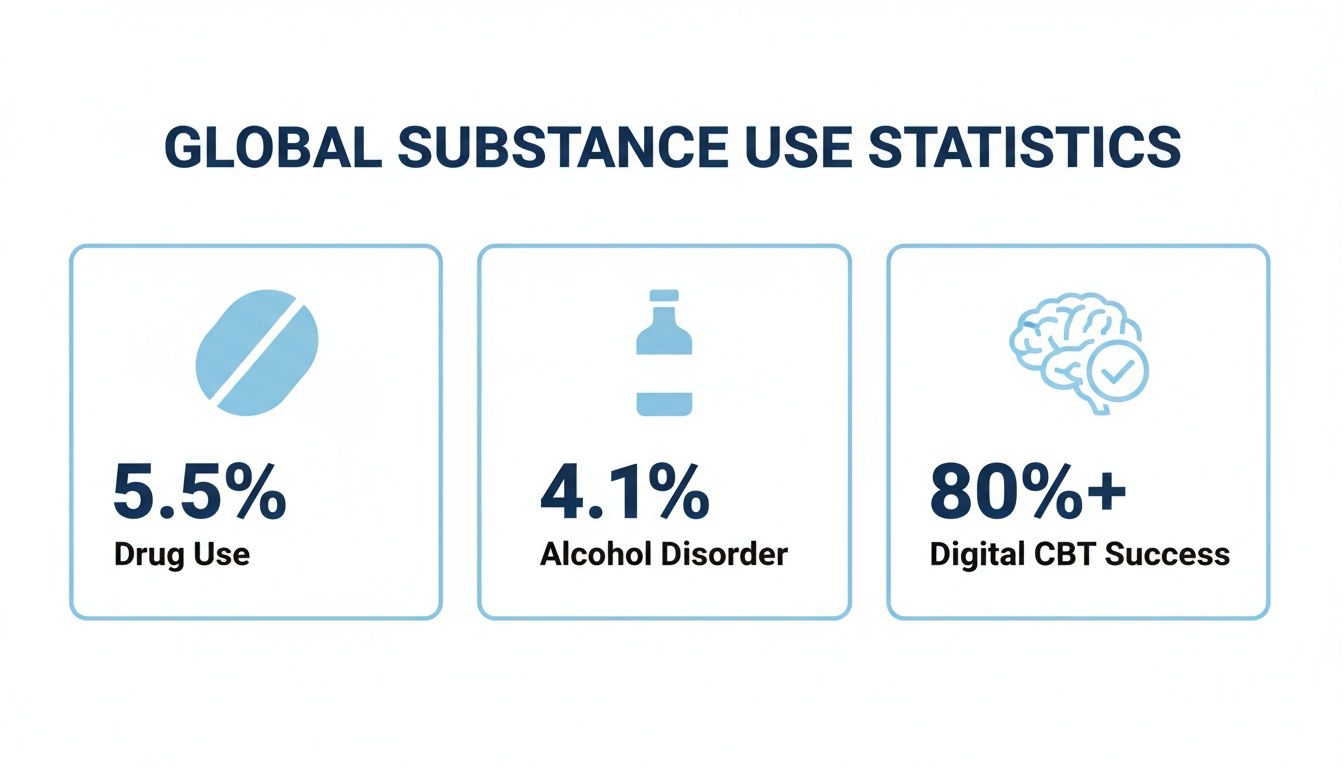
The data paints a clear picture: while the problem is vast, there is real hope through evidence-based therapies that work.
CBT empowers you to become your own therapist. It's not about a clinician telling you what to do; it's about learning the skills to analyze your own thinking and make conscious, healthy choices that align with the life you want to build in recovery.
True recovery isn’t just about stopping a behavior. It's about fundamentally changing your relationship with your own thoughts, building resilience from the ground up, and creating a personal toolkit of strategies that will support you for a lifetime. This is what makes CBT a cornerstone of modern addiction treatment.
CBT for Substance Abuse At a Glance
The table below breaks down the core components of how CBT tackles addiction. It shows the specific problems CBT addresses, the techniques it uses, and the ultimate goal for each area of focus.
| Core Problem | CBT Approach | Goal of Treatment |
|---|---|---|
| Automatic Negative Thoughts | Cognitive Restructuring | Challenge and reframe distorted thinking |
| Avoidance & Unhealthy Habits | Behavioral Experiments & Skills Training | Develop and practice new, healthy coping mechanisms |
| High-Risk Situations & Triggers | Relapse Prevention Planning | Identify triggers and create a plan to manage cravings |
| Lack of Coping Strategies | Functional Analysis & Problem-Solving | Understand the "why" behind use and find new solutions |
Essentially, CBT provides a clear, structured roadmap to move from reactive, destructive patterns to intentional, healthy behaviors.
The Core Techniques You'll Learn in CBT
Cognitive Behavioral Therapy isn't just about talking through your problems; it's an active, hands-on approach. Think of it as getting a practical playbook for navigating the real-life challenges of recovery. In CBT for substance abuse, you'll learn concrete tools to manage your thoughts and behaviors, building a solid foundation for a life free from addiction. It all centers on learning how to respond to triggers and cravings in new, healthier ways.

This approach works so well because it directly interrupts the cycle of addiction. A ton of research confirms that CBT significantly cuts down on substance use for everything from alcohol and opioids to cannabis. The evidence is clear: it’s a powerful tool, especially in those crucial first six months after treatment, making it a go-to method for building a sober life worldwide. You can explore these CBT findings on PMC to see the data for yourself.
Cognitive Restructuring: Catching Destructive Thoughts
One of the very first skills you'll work on is Cognitive Restructuring. The best way to think about it is becoming a detective of your own mind. The whole point is to spot the automatic, negative thoughts that pop up right before a craving hits or you think about using.
For instance, a bad day at work might trigger the thought, "I can't handle this stress, I need a drink to calm down." Cognitive restructuring gives you the tools to catch that thought in the act, put it on trial, and challenge whether it's actually true. You’ll learn to ask yourself a few key questions:
- Is this thought really 100% true?
- What’s a more balanced, realistic way to look at this?
- What’s a healthier step I can take to deal with this stress right now?
By doing this, you start to reframe that thought into something more accurate and helpful, like, "This day is stressful, but I have other ways to cope that are much better for me." That small mental shift can be enough to stop a craving in its tracks.
Skills Training: Building a New Toolkit
Next up is Skills Training, which is all about loading your toolbox with practical strategies for high-risk situations. Instead of turning to substances to deal with stress, boredom, or social events, you’ll build a whole new set of healthy habits.
Let's say you get invited to a party where you know there will be drinking. A CBT therapist will help you game-plan for it. You might role-play the situation and practice exactly what you’ll say and do. You can read more about how this works for alcohol in our article on Cognitive Behavioral Therapy and alcoholism.
CBT gives you a concrete plan. It’s not about just crossing your fingers and hoping for the best; it’s about preparing for triggers with proven tools. You learn exactly what to do and say, building real confidence every time you navigate a tough situation successfully.
These aren't just theories you talk about. They are skills designed for the real world, helping you tackle challenges one at a time and steadily building your resilience against relapse.
Key Takeaways
- CBT is an action-oriented therapy focused on building practical recovery skills.
- Cognitive Restructuring teaches you to identify, challenge, and reframe negative thoughts that lead to substance use.
- Skills Training gives you a toolkit of new coping strategies for managing stress, boredom, and social triggers.
- CBT helps you create a solid plan for navigating high-risk situations with confidence.
- The techniques are evidence-based and proven to work for a wide range of substance use disorders.
Building a Strong Defense Against Relapse
One of the most powerful things we do with CBT is build a rock-solid, personalized relapse prevention plan. I like to think of it as creating a fire escape plan for your recovery; you map it all out before there’s an emergency, so you know exactly what to do when things get tough. During therapy, we’ll work together to pinpoint your unique high-risk situations—the specific people, places, feelings, or even times of day that kickstart your cravings.
This whole process is about putting you back in the driver's seat. Instead of just trying to dodge triggers, which is often impossible, you learn how to see them coming and handle them with confidence. This turns what could be a crisis into a real opportunity to use and sharpen your recovery skills, building genuine resilience with every success.

Developing Your Proactive Plan
The first step is always to map out your personal triggers. Your therapist will guide you through what's called a functional analysis, which is just a structured way of looking at what happens before, during, and after substance use. This process illuminates the precise patterns that have been tripping you up.
Once your triggers are crystal clear, we start building your defenses. This means creating a go-to list of healthy coping mechanisms you can deploy the second a craving hits. These are practical, in-the-moment skills designed to give you a powerful alternative to using. Our guide on coping skills for substance abuse dives deeper into these essential tools.
Strengthening Your Support System
Let's be clear: relapse prevention isn't a solo mission. A huge part of your CBT plan is identifying and reinforcing your support network. This could be friends, family, or support groups who get what you're trying to achieve and can offer real encouragement when you need it most. You'll even practice how to communicate your needs clearly and ask for help without feeling guilty or ashamed.
A relapse prevention plan transforms recovery from a reactive battle against cravings into a proactive strategy for building a stable, sober life. You're no longer just surviving difficult moments; you're actively creating a future where you are in control.
Research has consistently shown CBT to be highly effective in reducing the risk of relapse, although success always depends on the individual. The secret sauce is active participation, especially with the "homework" assignments that help you practice new behaviors in the real world. That commitment is what builds the skills and confidence needed for lasting sobriety. By integrating a personalized relapse prevention strategy into CBT and substance abuse treatment, you build a foundation that can truly stand the test of time.
Key Takeaways
- Think of your relapse prevention plan as a fire escape plan for recovery—it’s proactive and built just for you.
- The first step is identifying your unique high-risk triggers, from people and places to specific emotions.
- You’ll develop a toolbox of immediate, go-to coping skills to manage cravings right when they appear.
- Leaning on and strengthening your support system is a non-negotiable part of a successful plan.
- This approach empowers you to manage triggers with confidence instead of just trying to avoid them.
How CBT Fits into Your Complete Recovery Plan
Lasting recovery isn’t about finding one magic bullet. It’s about building a strong, interconnected support system where every piece makes the others stronger. Think of Cognitive Behavioral Therapy as the mental and emotional framework for that system. It provides the core skills that make every other part of your treatment—from medication to group therapy—that much more effective. CBT doesn't operate in a vacuum; it's a powerful partner to the other critical services you'll receive.
This kind of integrated approach is what creates a truly comprehensive care plan, one that addresses every angle of addiction. By weaving different therapies together, you're building a multi-layered defense against relapse.
Working with Medication-Assisted Treatment
Medication-Assisted Treatment (MAT) is a game-changer, especially for anyone dealing with opioid or alcohol addiction. Medications are incredibly effective at easing cravings and managing withdrawal symptoms, giving your body the stability it needs so you can finally focus on the real work of healing. But medication on its own doesn't untangle the underlying thoughts and habits that drive addiction.
This is where CBT and substance abuse treatment form a perfect partnership. While MAT takes care of the physical side of things, CBT gets to work on the psychological side. It hands you the tools to navigate triggers, challenge self-defeating thoughts, and build healthier ways to cope when life gets stressful.
Medication gives you the stability to fully engage in therapy. Therapy gives you the skills to build a life where the substance is no longer needed. Together, they create a powerful, dual-action approach to recovery.
This combination ensures you aren't just putting a band-aid on the physical symptoms. You're actually rewiring the very behavioral patterns that kept the addiction going.
Addressing Co-Occurring Disorders
It's incredibly common for substance use to be tangled up with mental health conditions like anxiety, depression, or PTSD. We call this a dual diagnosis, and successfully treating both at the same time is non-negotiable for long-term recovery. CBT is one of the best therapies out there for this because its principles work just as well for addiction as they do for most mental health challenges.
Using CBT, you can start to see how the exact same negative thought patterns might trigger both a depressive episode and a craving to use. This unified approach helps you build skills that strengthen your mental health and your sobriety simultaneously. Whether you're in a structured residential program or a more flexible outpatient setting, CBT provides the consistent foundation for holistic healing. If you’re weighing your options, our article on what is intensive outpatient treatment can offer some clarity.
Ultimately, integrating CBT into a complete recovery plan means that from the moment you start detox all the way through to aftercare, you're building the mental resilience needed to make every other part of your journey a success.
Key Takeaways
- CBT is the mental framework that makes other treatments, like medication and group therapy, more effective.
- It forms a powerful partnership with Medication-Assisted Treatment (MAT), tackling both the physical and psychological sides of addiction.
- CBT is highly effective for dual diagnosis, treating co-occurring substance use and mental health disorders simultaneously.
- A comprehensive plan integrates CBT across all levels of care, from detox to aftercare.
- The goal of an integrated approach is to build a multi-layered defense against relapse for lasting success.
What to Expect in Your First CBT Sessions
Walking into your first therapy session can feel a little nerve-wracking. That’s completely normal. But with Cognitive Behavioral Therapy (CBT), you can expect a practical, goal-oriented approach from day one. Your therapist isn’t there to be a passive listener; they’re more like a coach or a guide, working right alongside you.
The first couple of meetings are really about getting on the same page. You'll talk about what brought you in, your history with substance use, and what a better future looks like to you. This isn't just small talk—it's the crucial first step in building a clear, practical roadmap for your recovery.
The Rhythm of a Typical Session
One of the best things about CBT is that it’s not mysterious. Sessions have a predictable rhythm that helps keep things focused and productive. It’s a structure designed to make sure you’re always moving forward, not just talking in circles.
Most sessions follow a simple, effective flow:
- Check-In: You’ll start by touching base on how your week went. What were the wins? What were the challenges? This is also where you’ll discuss how you did with the “homework” or skills you practiced from the last session.
- Set the Agenda: Together, you and your therapist will decide what to focus on for that day. Maybe it was a tough craving you dealt with or a specific negative thought pattern you want to tackle. You’re in the driver's seat.
- Learn and Practice: This is the heart of the session. You’ll dig into a new tool—like a technique for challenging automatic negative thoughts or a strategy for handling a high-risk situation without using.
- Make a Game Plan: Before you leave, you’ll work out a concrete plan for how you’ll apply this new skill in the real world over the next week. This makes the therapy stick.
CBT in Different Treatment Settings
While the core principles of CBT are the same everywhere, the experience can feel a bit different depending on the setting. Whether you’re in a residential program or attending outpatient sessions, the goal is the same: to equip you with lasting skills for recovery.
The main difference between inpatient and outpatient CBT isn't the what—it's the how. It's all about the intensity of the support you receive as you learn to master new coping skills.
In an inpatient or residential program, you’re immersed in therapy. You can expect daily CBT sessions, both one-on-one and in groups. This intensity allows you to do deep, focused work in a safe environment, away from the triggers of your daily life.
An outpatient program offers more flexibility. Sessions are usually once or twice a week, which means you get to immediately put your new skills to the test at home, at work, and in your community. It’s a great way to build confidence managing real-world challenges as they happen.
Key Takeaways
- Your first CBT sessions are about building a partnership with your therapist and setting clear, meaningful goals.
- Sessions are structured and predictable: you'll review progress, learn new skills, and create a plan for the week ahead.
- CBT is an active, collaborative process—you’re a key player on your own team.
- Inpatient care provides an intensive, highly supportive environment for deep work.
- Outpatient care helps you apply recovery skills directly to your everyday life.
Your Key Takeaways for Lasting Recovery
Think of this section as your go-to guide for the core ideas of using CBT and substance abuse treatment together. These are the daily reminders that you have the power to reshape your thinking and build a new, sober future.
Each point is a practical, actionable concept that strengthens the skills you learn in therapy and reinforces your commitment to long-term recovery.
Keep this handy for those moments when you need a boost of confidence or a clear reminder of how far you’ve come.
- Thoughts Are Not Facts. Your mind will throw automatic, often unhelpful, stories at you. CBT gives you the tools to press pause, question those thoughts, and consciously choose a more balanced perspective instead of letting them dictate your behavior.
- Identify Your Triggers. Recovery feels much more manageable once you know exactly which people, places, or emotions spark cravings. The first step to a solid plan is pinpointing your own high-risk situations.
- Build a New Toolkit. Staying sober isn't just about willpower; it’s about having the right skills. You’ll learn real, practical strategies to handle stress, boredom, and social pressure without turning to substances.
- Practice Makes Progress. The skills you learn in therapy are like muscles—they only get stronger when you use them. Applying CBT techniques consistently in your everyday life is what truly rewires your brain for lasting change.
- Relapse Is a Learning Opportunity. A setback is not a sign of failure. It's just data. It gives you a chance to see what isn’t working, refine your approach, and make your recovery plan even stronger.
Answering Your Questions About CBT
When you're looking into treatment for substance use, it’s natural to have a lot of questions. We get it. Below, we've answered some of the most common things people ask about CBT and substance abuse treatment. We want you to have clear, straightforward information so you can feel confident about your path forward.
How Is CBT Different From Other Kinds of Therapy?
The biggest difference is its focus. While some therapies spend a lot of time digging into your past to find the root of your problems, CBT is all about the here and now. It’s a very practical, goal-oriented approach designed to give you skills to manage the thoughts and behaviors driving your substance use today.
Think of it less like an archaeological dig into your childhood and more like a training program for your mind. Sessions are structured and focused. You won’t just talk aimlessly about your problems; you’ll actively work on building specific coping strategies you can walk out the door and use immediately.
At its core, CBT is about empowerment. The goal is to teach you how to become your own therapist by equipping you with a toolkit of skills you can use for the rest of your life, long after you’ve completed a formal program.
Does CBT Work for Every Type of Addiction?
CBT is one of the most well-researched therapies out there, and the evidence is clear: it’s effective for a very wide range of substance use disorders. It has become a foundational treatment for addictions including:
- Alcohol
- Opioids like heroin and fentanyl
- Stimulants such as cocaine and methamphetamine
- Cannabis
The reason it’s so versatile is that its core principles—learning to spot triggers, challenge unhelpful thoughts, and develop healthier behaviors—can be adapted to almost any situation. A skilled therapist can tailor the CBT framework to fit the specific challenges that come with different substances and, more importantly, with your unique life circumstances.
What If I Have a Dual Diagnosis?
This is an area where CBT is especially powerful. It’s incredibly effective for treating co-occurring disorders, which is when someone is dealing with a substance use disorder and a mental health condition like anxiety, depression, or PTSD at the same time.
Often, the same negative thought patterns and behavioral loops fuel both issues. CBT provides a unified strategy to tackle them together. You learn one powerful set of skills that helps you manage both your mental health symptoms and your substance cravings, which builds a much stronger, more stable foundation for recovery.
At Tru Dallas, we weave CBT into every level of our care, making sure you get the support and skills you need for real, lasting change. If you're ready to learn more, our team is here. Contact us to see how a treatment plan designed for you can make all the difference.
Key Takeaways
- Focus on the Present: CBT is an action-oriented therapy that gives you practical skills for the challenges you're facing right now.
- Highly Adaptable: It’s a proven, effective approach for a wide variety of addictions, from alcohol to opioids.
- Ideal for Dual Diagnosis: CBT provides a single, powerful strategy for treating co-occurring substance use and mental health disorders.
- Skills for Life: The goal isn't endless therapy; it's to empower you with tools you can use independently for life.
- A Collaborative Process: You and your therapist work as a team to set goals and build a recovery plan that works for you.
Frequently Asked Questions (FAQ)
What is the main goal of CBT for substance abuse?
The primary goal is to help you recognize, avoid, and cope with the situations where you're most likely to use. It’s all about changing those ingrained, problematic thought patterns and building a toolkit of practical coping skills for the real world.
How long does CBT treatment for addiction usually take?
The timeline can vary based on your specific needs, but CBT is generally considered a short-term therapy. A typical course runs between 12 to 20 sessions. The focus isn't on keeping you in therapy forever but on equipping you with skills you can carry with you for the rest of your life.
Is CBT effective for all types of substance abuse?
Yes, it's one of the most well-researched therapies for a reason. CBT has been proven effective for a wide range of substance use disorders, including addiction to alcohol, cocaine, methamphetamine, and cannabis. The techniques are adaptable and can be tailored to meet the unique challenges that come with each substance.
What happens if I relapse while in CBT?
In CBT, a relapse is never seen as a failure. It’s a learning opportunity. If it happens, you and your therapist will simply dissect what led to it—the trigger, the thought process, and the response—to make your prevention plan even stronger for the future.
Will I have to talk about things I'm not ready to discuss?
Absolutely not. A good therapist knows that trust is everything. CBT is a partnership, and you always have control over the pace. You’ll never be pushed to talk about anything before you’re ready.