

Some people in Dallas wake up already bargaining with the day. Maybe they'll use less. Maybe they'll stop after work. Maybe they'll make it through dinner without withdrawal, panic, or the pull to disappear and start over tomorrow. Families feel it too. They watch someone they love cycle through promises, fear, and exhaustion, and they start wondering whether anything works.
That's where medication assisted treatment, often called MAT, changes the conversation. It treats opioid or alcohol addiction as a medical condition that needs structure, monitoring, and support, not shame. For many people seeking addiction treatment in Dallas, MAT becomes the turning point between repeated relapse and a plan that finally feels possible.
Recovery doesn't get easier because someone is told to be stronger. It gets more reachable when the body stabilizes, cravings quiet down, and therapy can finally do its job.
Table of Contents
- Understanding Your Path to Lasting Recovery in Dallas
- What Medication-Assisted Treatment Really Means
- The Evidence-Based Benefits of MAT
- Understanding the Medications Used in MAT
- Debunking Common Misconceptions About MAT
- How MAT Supports Dual Diagnosis Treatment in Dallas
- How to Start Your Recovery with MAT at Tru Dallas
Understanding Your Path to Lasting Recovery in Dallas
In Dallas, Fort Worth, Euless, Irving, and the surrounding metroplex, many people reach treatment after months or years of trying to manage opioid use alone. They've tried stopping at home. They've promised family members they were done. They may even have made it through a few difficult days, only to relapse when cravings, pain, or depression returned.
Medication assisted treatment offers a different path. It isn't built on punishment or sheer willpower. It's built on medical support, therapy, and a plan that recognizes how addiction changes the brain and the nervous system.

For someone using fentanyl, heroin, or prescription pain pills in North Texas, the first problem is often immediate and physical. Withdrawal hits hard. Sleep disappears. Anxiety spikes. The mind narrows to one goal, which is getting through the next hour. In that state, even motivated people struggle to engage in counseling or make sound decisions.
Recovery starts to move when the body is no longer in constant crisis.
That's why MAT matters. According to a Pew fact sheet on medication-assisted treatment improving outcomes for opioid use disorder patients, medication-assisted treatment is the most effective intervention for opioid use disorder, and long-term retention on medications such as methadone or buprenorphine is linked to an approximate 50% reduction in all-cause and overdose mortality.
Why this matters for people in Dallas
Dallas-area families often ask the same question. Is there a treatment approach that gives someone a real chance to stay alive long enough to rebuild life? MAT answers that question with a clear medical framework.
- It reduces immediate risk: MAT can lower overdose risk while reducing the chaos that often drives repeated use.
- It improves treatment engagement: When withdrawal and cravings are better managed, people can participate in therapy more consistently.
- It supports long-term recovery: Stability makes it easier to return to work, repair relationships, and follow through with aftercare.
In a Dallas detox center or a broader continuum of addiction treatment in Dallas, MAT often becomes the foundation that lets everything else work.
What Medication-Assisted Treatment Really Means
Many people hear the phrase medication assisted treatment and assume it means medication only. That's not what effective care looks like. MAT combines FDA-approved medication with counseling, behavioral therapies, and practical support so the person isn't just getting through withdrawal, but building a workable recovery.
A simple way to understand it is this. Using medication for addiction can be similar to using insulin for diabetes or an inhaler for asthma. The medication isn't a shortcut. It's a medical tool that helps manage a chronic condition safely enough for the rest of treatment to work.
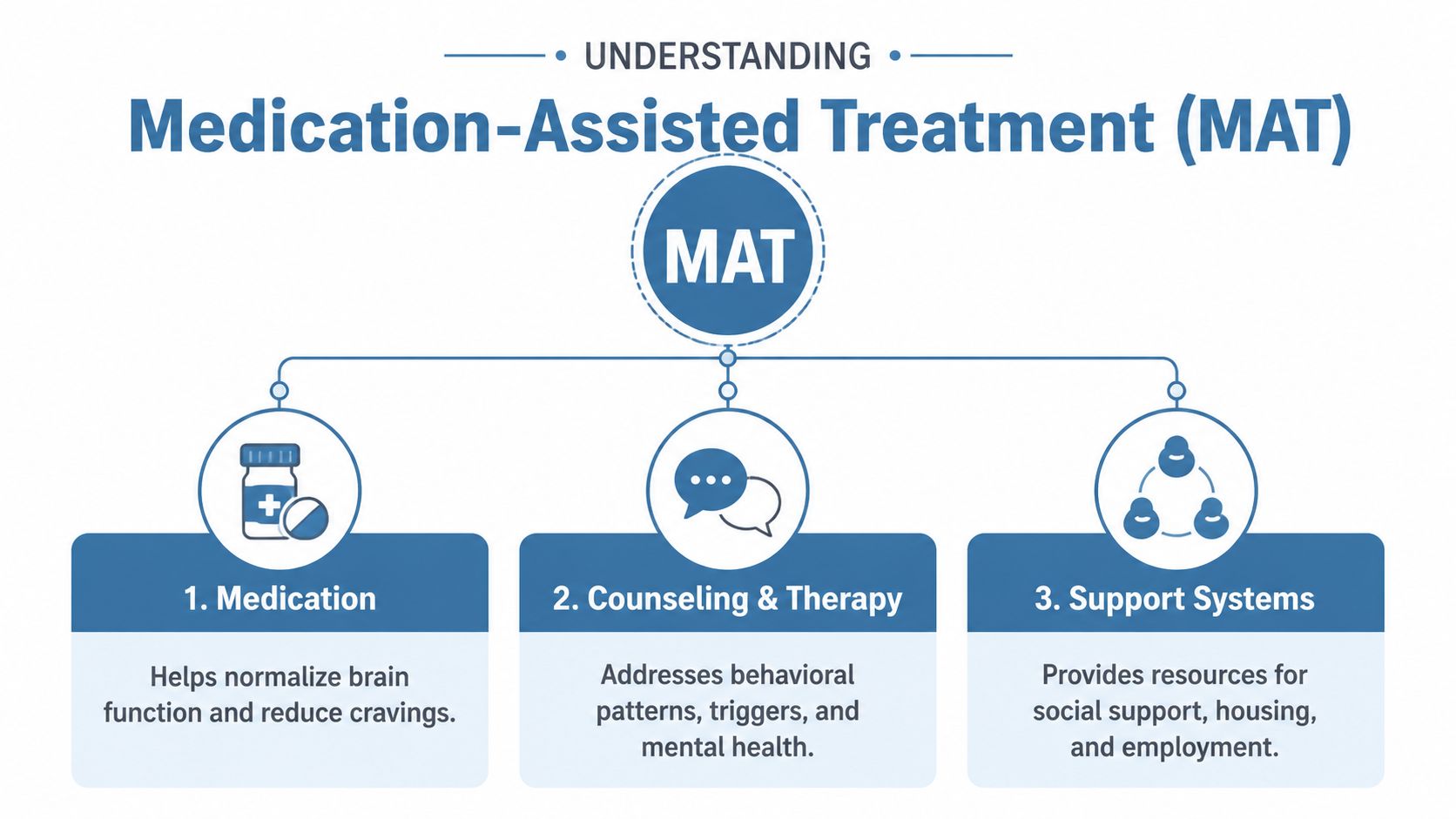
People who are new to the idea often benefit from a fuller explanation of what medication-assisted treatment is. The basic principle is straightforward. Medication helps stabilize the physical side of addiction, while therapy addresses behavior, trauma, stress, and the patterns that keep substance use going.
MAT is a whole-patient approach
A strong MAT plan usually includes several layers of care working together:
- Medication for stabilization: This can reduce cravings, ease withdrawal, or block the effects of opioids or alcohol, depending on the medication used.
- Counseling and therapy: Individual therapy, group counseling, and evidence-based treatment help a person understand triggers, thought patterns, and relapse risks.
- Support for daily life: Recovery often also depends on transportation, housing stability, work planning, family support, and follow-up care.
What MAT is not
The biggest misunderstanding is that MAT is “just replacing one drug with another.” That view misses the difference between chaotic, harmful substance use and supervised medical treatment.
Street opioid use creates instability, risk, secrecy, and repeated exposure to overdose. Properly managed medication is prescribed, monitored, and integrated into a treatment plan. The purpose is not intoxication. The purpose is stability.
Practical rule: If a treatment approach helps a person stop chasing withdrawal, show up for therapy, and stay alive, it's doing medical work, not enabling addiction.
This is one of the core benefits of medication assisted treatment. It gives the brain enough steadiness for recovery skills to take hold.
The Evidence-Based Benefits of MAT
The benefits of medication assisted treatment show up in more than one area of life. Good treatment doesn't only aim for abstinence. It aims for safety, retention, mental clarity, and the ability to function again.
Clinical benefits people can feel
The first changes are often practical. People sleep longer. They stop organizing the day around avoiding withdrawal. They can sit in a therapy session without feeling physically overwhelmed.
Clinical improvement also extends beyond cravings. In one study summarized in a review of medication-assisted treatment outcomes, patients in MAT programs reported anxiety symptoms dropping from 49.7% to 23.2% and depression dropping from 54.1% to 23.3%. The same study also noted improved employment outcomes.
Safety benefits that protect health
When opioid use continues unchecked, the danger isn't limited to overdose. Active addiction often brings exposure to unsafe use patterns, unstable supply, and repeated crisis care. MAT lowers that pressure by helping patients stay engaged in structured treatment rather than cycling through intoxication, withdrawal, and relapse.
That matters in any setting, but especially in a large metro area like Dallas where people may be trying to keep jobs, hide symptoms from family, or travel across the region while struggling to function.
Social and life stability benefits
MAT can create the breathing room people need to rebuild ordinary life. That's often the part families notice first. The person becomes more available, more predictable, and more able to follow through.
- Work and routine return: Employment often improves because attendance, focus, and reliability improve when someone isn't fighting withdrawal every day.
- Family relationships become calmer: Fewer crises usually mean fewer broken promises, fewer disappearances, and more room for trust to rebuild.
- Treatment retention improves: Staying in care long enough to benefit from therapy is one of the strongest predictors of better recovery outcomes.
The best outcomes usually come from consistency, not intensity. A person who remains engaged in treatment has more opportunities to recover than a person who repeatedly detoxes and leaves early.
For Dallas families looking at options, that's the true value. MAT helps people survive the dangerous part of addiction and re-enter the parts of life that addiction has pushed aside.
Understanding the Medications Used in MAT
The medications used in MAT don't all do the same thing. Each one has a different role, a different level of structure, and a different fit depending on the person's history, substance use pattern, and treatment setting. For someone entering a Dallas detox center, knowing the differences can lower fear and help treatment decisions feel less mysterious.
A side by side view
| Medication | How It Works | Used For | Administration |
|---|---|---|---|
| Buprenorphine | Partial opioid agonist that binds strongly to opioid receptors and reduces cravings and withdrawal | Opioid use disorder | Commonly prescribed in sublingual form and used as part of ongoing treatment |
| Naltrexone | Opioid antagonist that blocks opioid effects and can also support alcohol recovery | Opioid use disorder and alcohol use disorder | Often given as an oral medication or extended-release injection |
| Methadone | Full opioid agonist used in a controlled medical setting to stabilize opioid dependence | Opioid use disorder | Dispensed through structured treatment programs |
Why medication choice matters
Buprenorphine is often a strong fit when the main need is to reduce cravings and withdrawal without producing the same level of respiratory risk seen with full agonists. Its effectiveness is tied to high affinity for mu-opioid receptors and a ceiling effect that minimizes overdose risk. Clinical trials summarized in a review of buprenorphine and medication-assisted treatment found 60% opioid abstinence at 6-month follow-up for patients on buprenorphine MAT, compared with 20% in non-medicated groups.
That matters because early recovery often falls apart when the body remains unstable. If cravings are still driving the day, a person may agree with treatment in theory but still feel pulled back toward use in practice.
Naltrexone works differently. It blocks opioid receptors rather than activating them. For some patients, especially those who've already completed detox and want a non-opioid option, that can be appealing. It can also play a role in alcohol treatment, which makes it useful when substance use patterns are mixed.
Methadone remains an important treatment option for opioid use disorder, particularly for people who need a highly structured approach and consistent daily support. It can be life-saving when monitored appropriately and paired with counseling.
A good treatment team doesn't choose a medication based on ideology. It looks at what the patient is using, what withdrawal looks like, whether there's fentanyl involvement, whether there's a history of relapse after detox, and whether mental health symptoms are also shaping the picture.
Some patients do well with one medication after a single assessment. Others need the plan adjusted as treatment progresses. That isn't failure. It's clinical care.
Debunking Common Misconceptions About MAT
Stigma still keeps many people from starting the care that could help them. Some of that stigma comes from family pressure. Some comes from old treatment beliefs. Some comes from the patient's own fear that using medication means they've somehow failed.

Myth and fact
Myth: MAT is just trading one addiction for another.
Fact: Addiction is compulsive, harmful substance use despite consequences. MAT is supervised medical treatment designed to reduce harm, stabilize brain function, and support recovery. The goal is not to create a high. The goal is to make recovery possible.
Myth: Real recovery means no medication at all.
Fact: Real recovery means improved health, safety, functioning, and sustained engagement in treatment. For many people, medication is part of that process. A person using prescribed treatment appropriately while rebuilding life is in recovery.
Myth: MAT only helps with cravings, not with the damage addiction causes.
Fact: MAT is associated with broader behavior change. Data summarized in a review of how medication-assisted treatment is transforming addiction care shows it can decrease injection drug use by 70%, reduce HIV/HCV transmission risk by over 50%, and lower criminal justice involvement by 45%.
Families often relax when they stop asking, “Is this medication perfect?” and start asking, “Is this person safer, steadier, and more able to participate in treatment?”
Myth: If someone relapses while on MAT, the treatment didn't work.
Fact: Relapse can happen in any chronic condition. It doesn't erase progress or prove that the medication was wrong. It usually signals that the care plan needs review, more support, or a better fit.
For many people in addiction treatment in Dallas, misinformation is one of the last barriers before real help begins. Once that barrier falls, decisions become clearer.
How MAT Supports Dual Diagnosis Treatment in Dallas
A large share of people with opioid use disorder also carry depression, anxiety, trauma symptoms, bipolar disorder, or another mental health condition. In Texas, nearly 45% of OUD patients have mental health comorbidities, and a recent meta-analysis found that combining MAT with therapy increased treatment retention by 40% and reduced depressive symptoms by 25% in patients with comorbid depression compared to therapy alone, as summarized in this discussion of MAT benefits for co-occurring conditions.
That matters because dual diagnosis treatment can stall when addiction remains medically untreated. A person can't do consistent work on trauma, grief, panic, or mood instability if every day begins with withdrawal, cravings, or the fallout from recent use.
Why stabilization matters in mental health care
MAT often creates the floor that therapy stands on. When opioid use is driving constant distress, it becomes hard to tell what belongs to withdrawal, what belongs to anxiety, and what belongs to depression. Stabilization helps clinicians and patients see the picture more clearly.
This is especially important for people across Dallas-Fort Worth who have been self-medicating mental health symptoms with opioids, alcohol, or prescription pills. Once the substance use cycle settles, treatment can become more precise.
What integrated care looks like
People looking for dual diagnosis treatment programs often need care that addresses both conditions at the same time, not one after the other. In practice, that usually means:
- Medication for substance use disorder: To reduce cravings, ease withdrawal, or block rewarding effects.
- Psychiatric evaluation: To identify depression, anxiety, bipolar disorder, PTSD, or other co-occurring conditions.
- Therapy that matches the patient's needs: Some patients need trauma-informed work. Others need skills for panic, sleep disruption, shame, or relationship conflict.
- Ongoing monitoring: Symptoms shift during early recovery, and the treatment plan should shift with them.
When addiction and mental health are intertwined, treating only one problem usually leaves the other one strong enough to pull the person backward.
This is one of the most important benefits of medication assisted treatment in Dallas. It helps people become stable enough to benefit from the deeper work that lasting recovery requires.
How to Start Your Recovery with MAT at Tru Dallas
Starting treatment often feels bigger before the first call than it does after. Individuals often share these concerns. Will anyone understand what's happening? Will treatment be confidential? Will insurance cover it? Will the plan fit opioid use, alcohol use, or both?
The first steps are simple
Reach out confidentially
A private conversation can clarify what substances are involved, whether detox is needed first, and whether MAT may be appropriate.Complete a clinical screening
The treatment team reviews substance use history, current symptoms, medical needs, and any co-occurring mental health concerns.Verify insurance benefits
Many patients want clear answers about PPO coverage before committing. That step can often happen quickly and removes a major barrier to care.Build a personalized plan
Some people need medically supervised detox before beginning medication. Others may transition into ongoing care that includes therapy, relapse prevention, and follow-up support.
For patients struggling with alcohol as well as opioids, it also helps to understand how medication-assisted treatment for alcohol can fit into a broader recovery plan.
The most important step is the first one. Waiting for a perfect moment usually means letting addiction keep control. For anyone searching for addiction treatment in Dallas, a Dallas detox center, or support near Euless and the wider DFW area, help is available now.
If opioid or alcohol use has taken over daily life, Tru Dallas Detox & Recovery Center offers confidential support, medically supervised detox, integrated mental health care, and personalized MAT planning for adults across Dallas-Fort Worth. Call now, ask questions, and verify PPO insurance benefits. A clear next step can start today.