
A Dallas resident might search for a calmer evening, better sleep, or relief from pain and end up choosing between two plant products that are often marketed as if they belong in the same category. They don’t.
Kava and kratom are both sold as “natural” options. That label can make them sound safer than they are, especially for someone with a history of alcohol use, opioid use, anxiety, trauma, or relapse. In North Texas, that matters. People looking for an alcohol substitute, a way to self-manage withdrawal, or a quick fix for stress can easily run into both.
Some people first see kava in social settings. Others find kratom in smoke shops, convenience stores, or online. The core question isn’t whether either plant is trendy. The essential question is whether either one is safe for a person in or near recovery.
Table of Contents
- Kava and Kratom in Dallas An Introduction
- Understanding the Origins of Kava and Kratom
- How Kava and Kratom Affect Your Brain and Body
- Comparing Effects Uses and Typical Experiences
- Addiction Potential Withdrawal and Health Risks
- Legal Status and Practical Safety Concerns in Texas
- When to Seek Professional Help for Kratom Use in Dallas
Kava and Kratom in Dallas An Introduction
In Dallas, it’s easy to see why this comparison matters. Someone dealing with work stress, grief, chronic pain, panic, or early sobriety might want something that feels less risky than alcohol or pills. Kava and kratom are often presented as that option.

That’s where the confusion starts. Kava is generally sought out for calm. Kratom is often used for energy, mood, pain relief, or to blunt withdrawal. On the surface, both can look like herbal shortcuts. In practice, they carry very different risks.
For people in recovery, the difference is even more important. A substance that seems harmless because it comes from a plant can still become a problem if it changes tolerance, reinforces compulsive use, or masks a deeper mental health issue.
Clinical reality: “Natural” isn’t a safety category. It’s a marketing word.
In Dallas-Fort Worth, that question often lands in families, counseling offices, workplaces, and detox screenings. A loved one may say kratom helps them function. Another may insist kava helps them avoid alcohol. Both claims can contain part of the truth while still leaving out the biggest issue, whether use is making life smaller, less stable, and more dependent on a substance.
The safest way to compare kava vs kratom is to strip away the branding and look at three things:
- What each substance is
- How each one affects the brain
- What happens when use starts to control mood, sleep, pain, or daily functioning
Understanding the Origins of Kava and Kratom
Kava comes from a ceremonial root tradition
Kava comes from Piper methysticum, a plant associated with Pacific Island traditions. The part used is the root. Historically, it has been prepared as a drink and used in ceremonial or social settings tied to calm, connection, and relaxation.
Modern use looks different. Many people don’t encounter kava in a traditional preparation. They find powders, capsules, concentrates, and ready-to-drink products. That shift matters because the context changes. A ceremonial substance used slowly in a communal setting isn’t the same as a packaged product bought for quick relief after work.
Kava is usually sought out by people who want to unwind, reduce tension, or settle down at night. It is not generally chosen for strong pain relief. That difference helps explain why it’s often compared with alcohol alternatives rather than with pain medications.
Kratom comes from a leaf with a very different purpose
Kratom comes from Mitragyna speciosa, a tropical tree native to Southeast Asia. The leaf is the part used. Unlike kava, kratom has long been associated with effects that can range from stimulating to sedating, depending on how it’s taken and how much is used.
Today, kratom is sold in powders, capsules, extracts, and drinks. It’s frequently marketed with “strain” language such as red, green, or white vein. Those labels make the product sound organized and predictable, but they can also give buyers a false sense of precision. In real life, product strength and composition can vary.
People usually don’t turn to kratom for the same reason they turn to kava. Kratom is more often used to push through a workday, improve mood, reduce pain, or soften opioid withdrawal symptoms. That puts it in a very different risk category from the start.
A simple way to think about the origin story is this:
- Kava started as a relaxation-focused root preparation
- Kratom started as a leaf used for effects that can include stimulation and pain relief
- Modern commercial products blur those distinctions, but the underlying pharmacology doesn’t change
A person in recovery shouldn’t judge either substance by where it came from. The better question is what role it’s playing now. Relief, escape, dependence, or all three.
How Kava and Kratom Affect Your Brain and Body
A person in recovery in Dallas might tell me, “Kava helps me calm down at night, and kratom helps me get through the day.” That sounds manageable on the surface. In practice, those two substances pull on very different brain systems, and that difference matters a great deal if relapse risk, withdrawal history, or mental health symptoms are already part of the picture.
Kava affects calming systems in the brain
Kava is generally associated with calming effects. Its active compounds, called kavalactones, are linked to brain pathways involved in relaxation, reduced tension, and a quieter sense of physical and mental arousal.
People often describe kava in ways that sound familiar to clinicians who treat anxiety and substance misuse. They may report:
- Less social tension
- A calmer body
- Reduced mental chatter
- An easier time winding down at night
That profile helps explain why some people use kava as a substitute for alcohol or other sedating substances. For a person without a history of addiction, that may sound like a lower-risk choice. For a person in recovery, the question is different. The issue is whether relief is becoming tied to a substance routine again, especially one that starts to feel necessary at the end of every stressful day.
Kava is not in the same category as kratom from an addiction standpoint. It still deserves caution.
Kratom acts more like an opioid than some may understand
Kratom raises more concern in treatment settings because its effects are not limited to simple relaxation or mood support. Its main alkaloids interact with opioid receptors, which helps explain why some people use it for pain, emotional numbing, or self-managed opioid withdrawal.
That mechanism changes the risk picture fast. A person may start with kratom for energy or mood, then begin using more for sedation, pain relief, or to avoid feeling sick. In recovery work, that pattern is familiar. The substance may be different, but the cycle of relief, tolerance, and increased reliance can look very similar.
Kratom can also feel inconsistent from one product or dose to the next. Some people report a more stimulating effect at lower amounts and a heavier, more sedating effect at higher amounts. That unpredictability is one reason it creates problems in real life. Someone may believe they are taking a “natural” product for focus or pain, then end up chasing sleep, relief, or emotional shutdown instead.
For people with a history of opioid use, that overlap is especially risky. For people with no opioid history but strong anxiety, trauma symptoms, or depression, kratom can still become a shortcut to relief that slowly trains the brain to depend on it.
Mental health symptoms often increase that risk. People do not always reach for kratom or kava to get high. Many are trying to sleep, settle panic, blunt grief, or keep functioning through untreated symptoms. This overview of how mental illness and substance abuse affect each other helps explain why quick relief can turn into a more serious substance problem.
The body effects matter too
Kava and kratom also place different kinds of stress on the body.
Kava is more often associated with sedation, slowed reaction time, and concerns about liver safety in some cases. Kratom is more likely to create a push-pull pattern in the body. Users may feel increased energy, then irritability, then fatigue, then a need to take more. In heavier use, people can report nausea, constipation, sweating, sleep disruption, and a withdrawal pattern that starts to shape daily decisions.
Co-use adds another layer of risk that generic comparison articles often miss. Someone may use kratom to function and kava to come down. That can look like balance from the outside. Clinically, it can become an around-the-clock chemical coping system that keeps the brain focused on the next dose, the next shift in mood, or the next way to avoid discomfort.
Here is the practical distinction:
| Substance | Primary brain effect | What that often looks like |
|---|---|---|
| Kava | Calming activity tied to relaxation pathways | Reduced tension, sedation, evening use, habit-forming coping rituals |
| Kratom | Opioid-receptor activity with dose-dependent effects | Energy or sedation, pain relief, tolerance, withdrawal, relapse risk |
In treatment, the question is rarely whether a substance produces a noticeable effect. The question is what it trains the brain to expect next, and whether that pattern moves a person closer to stability or back toward dependence.
Comparing Effects Uses and Typical Experiences
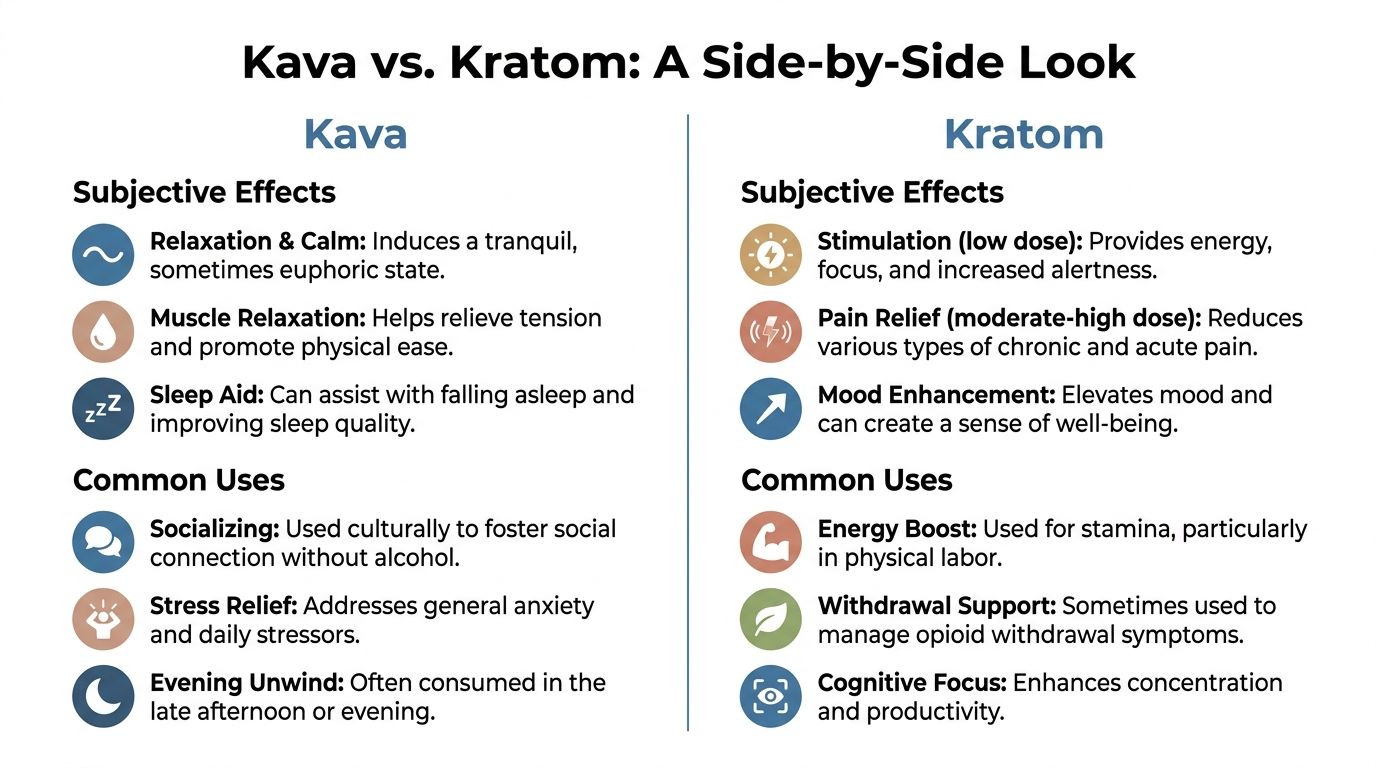
A common Dallas recovery scenario looks like this. Someone wants help with anxiety at night, low energy during the day, or lingering opioid cravings, and they start comparing “natural” options online. On paper, kava and kratom can seem like they belong in the same category. In practice, they lead people in very different directions.
Kava vs Kratom at a Glance
| Attribute | Kava | Kratom |
|---|---|---|
| Plant source | Piper methysticum root | Mitragyna speciosa leaf |
| Main direction of effect | Calming | Can be stimulating or sedating |
| Main reason people seek it out | Stress relief, relaxation, evening unwind | Energy, mood, pain relief, self-managed withdrawal |
| Opioid-like effect | No direct opioid agonism described in the cited data | Yes, due to opioid receptor activity |
| Recovery concern | Can become another coping ritual and may carry liver concerns | Can reinforce dependence, tolerance, withdrawal, and relapse patterns |
| Best clinical summary | Lower-risk than kratom, but not harmless | Higher addiction liability and a poor fit for recovery self-management |
According to this 2024 survey on kava, kratom, and co-use, lifetime kratom use was 91.3%, lifetime kava use was 49.0%, and 40.3% of respondents reported co-use. The same survey found past-year Kratom Use Disorder in 35.3% of kratom-only users and 44.1% of people who used both.
For people in recovery, that co-use figure matters. I often see people treat kava as the “safe” product for evenings and kratom as the “functional” product for daytime stress, pain, or fatigue. What develops is not balance. It is a two-substance routine organized around relief.
What people usually notice with kava
Kava usually produces a narrower, more sedating experience. People describe less tension, more physical relaxation, and a quieter social edge. That is why it is often used in the evening or as an alcohol substitute.
Typical reasons people use kava include:
- Stress relief
- Social relaxation
- Help winding down at night
That profile can sound reassuring, especially to someone trying to avoid alcohol or prescription medications. But in treatment, I still pay attention to the pattern around it. If a person cannot attend a gathering, settle down at night, or tolerate discomfort without reaching for kava, the substance has started to take on too much psychological importance.
What people usually notice with kratom
Kratom is more complicated from the user’s perspective. Some people report energy and focus at lower amounts. Others use it for pain, emotional relief, or to blunt opioid withdrawal. Some feel sedated instead of stimulated. The effect can shift with dose, product strength, and frequency of use, which makes self-management especially risky.
Common reported reasons people use kratom include:
- Energy and focus
- Mood lift
- Pain relief
- Trying to ease withdrawal without medical care
These motives raise concern quickly in addiction treatment because kratom gets attached to several high-pressure problems at once. A person may start using it to get through work, then to manage back pain, then to steady their mood, then to avoid feeling sick. Once one substance is carrying that much weight, stopping it becomes much harder.
Kratom also creates practical safety issues that generic wellness articles often miss. Someone may drive, work long shifts, mix it with other substances, or use it while assuming a product sold legally must be predictable. It is not. Concerns can include blood pressure changes, palpitations, and other potential cardiac health risks of various substances, which matter even more when kratom is combined with stimulants, alcohol, sedatives, or recovery medications without medical oversight.
For someone in or considering recovery in Dallas, the primary difference is simple. Kava is usually sought for calming down. Kratom is often used to keep functioning, control discomfort, or manage withdrawal outside treatment. That second pattern causes far more disruption, and it is one of the fastest ways a “natural alternative” turns into another dependency problem.
Addiction Potential Withdrawal and Health Risks
Why kratom creates more addiction risk
When someone in recovery asks which is more dangerous, kratom is the harder answer by a wide margin.
The reason is straightforward. Kratom interacts with opioid receptors. Once that happens, the same familiar addiction concerns come into play. Tolerance can rise. Withdrawal can appear. The person may start taking it not to feel good, but to feel normal.
That’s the pattern clinicians watch for. A person begins with a “natural” product for pain, energy, or stress. Then the dose creeps up. Then sleep depends on it, or work depends on it, or getting out of bed depends on it. At that stage, the plant label has become irrelevant. The behavior looks like dependence.
Common warning signs include:
- Needing more for the same effect
- Feeling sick, anxious, restless, or achy without it
- Planning to cut back and repeatedly failing
- Using despite work, family, financial, or mental health fallout
Kava isn’t in the same category from an addiction standpoint. That doesn’t mean it’s harmless. It means the core dependency pattern is usually less severe than what’s seen with kratom.
Why co-use is a serious recovery problem
One of the most overlooked issues in kava vs kratom discussions is what happens when people use both.
Among people who met criteria for past-year kratom use disorder, those who also used kava reported significantly higher symptoms of “using more kratom than intended” (p=0.032) and “needing larger amounts for the same effect” (p=0.011) in this clinical study on co-use and kratom symptoms. That finding matters because it suggests co-use may worsen tolerance and loss of control.
For a person trying to stay sober, that has real implications.
A few common high-risk situations look like this:
- Alcohol recovery substitution: Someone stops drinking, starts using kava to relax, then adds kratom for mood or energy.
- Opioid self-detox: Someone tries to get off opioids with kratom, then adds kava to sleep or calm down.
- Dual-diagnosis coping: Someone with anxiety or depression uses one plant by day and the other by night.
Those patterns can hide escalating addiction under the language of wellness.
Recovery gets unstable when a person starts swapping one dependence pattern for another instead of treating the reasons they were using in the first place.
Health concerns that shouldn’t be brushed off
Kratom’s main health concern is dependence, but that’s not the only concern. Any substance with opioid-like activity can complicate mood, sleep, bowel function, stress tolerance, and relapse risk. It can also muddy the clinical picture when someone is entering detox or psychiatric care.
Kava raises a different concern profile. The verified data notes FDA warnings around hepatotoxicity, which means liver risk needs to be taken seriously, especially with heavy use, prolonged use, or use alongside other substances that strain the body.
People also forget a simple point. “Herbal” products still affect multiple body systems. For anyone trying to understand the broader potential cardiac health risks of various substances, it helps to look at how drug effects can place stress on the heart, circulation, and overall physical stability. That matters in detox because withdrawal is never just psychological.
A practical risk screen looks like this:
| Concern | Kava | Kratom |
|---|---|---|
| Tolerance and dose escalation | Possible, but not the main defining issue | Major concern |
| Physical dependence | Lower concern | Significant concern |
| Withdrawal problems | Less central | Common clinical concern |
| Liver concerns | Important | Not the main comparison point in the verified data |
| Complicates addiction recovery | Yes, especially as substitute coping | Yes, and often much more directly |
Anyone in Dallas considering kratom because it seems easier than treatment should take that seriously. Self-managing opioid-like dependence with an unregulated product often delays care, increases distress, and makes the eventual detox process more complicated.
Legal Status and Practical Safety Concerns in Texas
Someone in Dallas buys kratom or kava from a smoke shop, uses it for stress or sleep, then shows up to treatment, probation check-in, or work screening assuming the fact that it was sold legally will protect them. In practice, that assumption causes problems fast.
According to this overview of kava and kratom safety concerns, neither kava nor kratom are federally controlled substances, but they are not regulated by the FDA, leading to inconsistent product purity. In clinical settings, that matters because legal sale is not the same as reliable dosing, clean manufacturing, or predictable effects.
For people in recovery, uncertainty is its own risk. A person may think they are using a mild “natural” product, but the actual batch may be stronger, contaminated, or mixed in a way that changes how they feel. If kava or kratom is also being used with alcohol, prescription medication, or other substances, it gets harder to sort out what is causing sedation, anxiety, irritability, or medical instability. Co-use is one of the biggest treatment problems and one of the least discussed.
The practical concerns are straightforward:
- Purity can vary. The product may contain more or less of the active compound than the label suggests.
- Effects can shift from one batch to the next. That makes self-monitoring unreliable.
- Treatment can get delayed. Medical and psychiatric teams may need extra time to identify what was taken, how often, and what else was in the system.
- Recovery rules can get complicated. A legally purchased substance can still violate program expectations, court requirements, or sober living agreements.
Families in Dallas often ask whether legal use will create problems with employment, custody, probation, or treatment participation. It can. This guide on how to handle legal requirements while seeking treatment can help clarify what to address first.
Drug testing and recovery accountability
Drug testing creates another practical issue, especially for people trying to prove stability. The source cited earlier notes that kratom metabolites can trigger false positive results for opioids on some drug tests. Even when a person is being truthful, that kind of result can create conflict with employers, courts, family members, or treatment providers.
I tell patients the same thing regularly. If a substance puts your sobriety record, program compliance, or credibility at risk, it is not a harmless workaround.
This is especially relevant for people who are:
- Trying to document abstinence
- In outpatient or monitoring programs
- Working in safety-sensitive jobs
- Meeting court, probation, or family court expectations
If loved ones are unsure whether a legal product has become part of a larger addiction pattern, recognizing the signs of substance abuse can help them identify what they are seeing.
In Texas, the practical question is not just whether kava or kratom is legal to buy. The better question is whether its use makes recovery, treatment, testing, or family stability harder. For kratom in particular, the answer is often yes.
When to Seek Professional Help for Kratom Use in Dallas
Signs it’s time to stop handling this alone
A lot of people don’t reach out because they think kratom doesn’t “count” as a serious addiction problem. That delay can keep the cycle going for months or years.
Professional help makes sense when use has moved beyond occasional choice and into dependence, fear, or damage control. Some people notice it when they can’t get through a morning without it. Others notice it when they try to stop and feel physically or emotionally off balance.
Useful warning signs include:
- The dose keeps creeping up
- Stopping leads to withdrawal symptoms
- Use is hiding anxiety, pain, depression, or trauma rather than solving it
- Relationships, work, or finances are starting to take hits
- The person feels ashamed, secretive, or trapped around use
Families sometimes need an outside framework to name what they’re seeing. This resource on recognizing the signs of substance abuse can help clarify whether the pattern has crossed into something more serious.
What professional support can look like
The safest approach for kratom dependence is usually not self-detox with more substances. It’s structured care that addresses both the withdrawal and the reasons the person reached for kratom in the first place.
That may include:
- Medical detox support: Helpful when withdrawal, instability, or co-occurring substance use is involved.
- Dual-diagnosis treatment: Important when anxiety, depression, trauma, or other mental health symptoms are part of the picture.
- Medication-assisted care when appropriate: Especially relevant when opioid history overlaps with current use patterns.
- Relapse prevention planning: Because many people return to kratom when pain, insomnia, stress, or cravings resurface.
For Dallas-area readers specifically worried that their kratom use has become unmanageable, this page on kratom addiction treatment offers a useful starting point.
The key message is simple. A person doesn’t have to wait for a dramatic collapse to get help. If kratom has become the thing that regulates mood, energy, pain, or withdrawal, that’s enough reason to talk to a professional. Early treatment is usually safer, less chaotic, and more effective than waiting until the situation forces a crisis response.
Getting help early protects more than sobriety. It protects work, relationships, physical health, and the ability to think clearly again.
If kava or kratom use is starting to feel confusing, risky, or hard to control, Tru Dallas Detox & Recovery Center offers confidential help for people across Dallas-Fort Worth. The team provides medically supervised detox, dual-diagnosis care, ongoing treatment planning, and insurance verification for many PPO plans. A simple call can clarify the next step and help someone move toward safe, evidence-based recovery.