

For anyone struggling with substance use, the idea of change can feel like a constant tug-of-war. One part of you desperately wants to stop, while another part, for a hundred different reasons, just isn't ready. This feeling is called ambivalence, and it’s a completely normal part of being human—not a sign of weakness.
Motivational Interviewing (MI) is a counseling approach built for that exact moment. It’s not about a therapist lecturing you or telling you what you should do. Instead, it’s a partnership designed to help you untangle those mixed feelings and find your own reasons to move forward. Here in Dallas, it's a foundational part of the effective, compassionate care we provide at Tru Dallas Detox.
A Healthier Conversation About Change

Think about the last time someone tried to force you to do something. It probably made you dig your heels in, right? That’s human nature. Old-school, confrontational approaches to addiction treatment often created that same dynamic, leading to arguments and resistance. Motivational interviewing flips that script entirely.
It’s less like a debate and more like a collaboration. The therapist’s job isn’t to push you toward a finish line but to walk alongside you, helping you explore where you want to go and why. This compassionate approach is a cornerstone of how we help individuals in the Dallas-Fort Worth area find lasting recovery.
Finding Your "Why"
The entire goal of motivational interviewing is to help you resolve your own ambivalence and strengthen your personal motivation for change. It’s grounded in a simple but powerful belief: you already have what it takes to get better. The therapist is there to help you find and amplify that inner strength.
At Tru Dallas Detox, we’ve found this evidence-based approach creates a safe, non-judgmental space where you can finally be honest—with us and with yourself—about your goals.
This patient-centered philosophy is a game-changer for a few key reasons:
- You’re in the driver’s seat. We respect your autonomy. Your goals, your values, and your decisions are what guide the entire process.
- It builds a foundation of trust. By listening with genuine empathy, our clinicians create a therapeutic relationship where you feel heard and respected. This is crucial, especially when healing from past trauma, a concept we explore in our guide to trauma-informed care.
- It uncovers your own reasons for change. MI helps you connect your desire for sobriety to what truly matters to you—your family, your health, your future. Those internal motivators are infinitely more powerful than any external pressure.
The difference between MI and older, more directive methods is night and day. This table breaks down why a collaborative style is so much more effective for addiction treatment.
Motivational Interviewing vs. Confrontational Approaches
| Aspect | Motivational Interviewing (MI) | Traditional Confrontational Style |
|---|---|---|
| Therapist's Role | A collaborative partner or guide | An authority figure or expert |
| Core Belief | Change comes from within the client | Change is imposed by external pressure |
| Handling Ambivalence | Explored as a normal part of the process | Seen as resistance or denial to be broken down |
| Communication Style | Listening, asking open-ended questions | Directing, confronting, and arguing |
| Client Response | Feels empowered, understood, and motivated | Often becomes defensive, resistant, or demoralized |
| Primary Goal | Strengthen the client's own motivation for change | Convince the client they have a problem and must change |
Ultimately, the MI approach just works better. It recognizes that no one can be argued into recovery. Lasting change happens when a person feels empowered to choose it for themselves.
At our addiction treatment center in Dallas, we see MI as the key that unlocks the door to lasting recovery. It transforms the therapeutic process from an intimidating mandate into a supportive partnership right here in your community.
By focusing on collaboration instead of confrontation, motivational interviewing for substance abuse makes the journey toward healing feel personal and achievable. It prepares you to fully engage with every stage of your treatment, setting a strong foundation for the work ahead at Tru Dallas Detox.
The Four Pillars of Motivational Interviewing at Tru Dallas Detox
At its core, Motivational Interviewing isn’t about a specific script or technique. It’s a fundamental shift in how we approach the conversation about change—a guiding “spirit” that shapes every interaction. This spirit rests on four essential pillars, which we often remember with the simple acronym PACE: Partnership, Acceptance, Compassion, and Evocation.
At Tru Dallas Detox, these aren’t just abstract concepts. They are the bedrock of the trusting, effective care we provide every single day to individuals from Dallas, Plano, Fort Worth, and beyond. This framework turns what could feel like an intimidating process into a supportive alliance, creating a space where you can honestly explore your hopes for a life free from substance use.
Partnership
The very first pillar, Partnership, throws out the old, top-down model of treatment. We’re not here as authority figures to lecture you or tell you what to do. We are your partners, walking alongside you on this journey.
- We work with you, not on you. This means you are always recognized as the expert on your own life, your feelings, and your experiences.
- Your perspective is what matters most. We truly believe the most profound wisdom for your recovery will come from you. Our role is to help you find it.
- This is a team effort. Recovery is a collaborative process, plain and simple. We’re on your team, fully invested in your success.
This sense of partnership breaks down the walls that can get in the way of real progress. It creates a level playing field where honest conversations can finally happen, right here in Dallas.
Acceptance
Acceptance is all about creating a space that is completely free of judgment. It’s our promise to recognize your basic human worth and to respect your right to make your own choices—a concept clinicians call autonomy. For us at our Dallas treatment center, this is non-negotiable.
Acceptance means we hold what’s known as "unconditional positive regard" for you. It’s the deep-seated belief that you are doing the best you can, and it creates the safety needed for total honesty—both with us and, more importantly, with yourself.
This pillar is what makes it feel safe enough to talk about your ambivalence toward change without fearing shame or criticism. That safety is absolutely essential when you’re facing a substance use disorder.
Compassion
Compassion is the genuine heart of this work. It is our active and unwavering commitment to your well-being, always prioritizing your needs and best interests.
This isn’t just about being nice. It’s a deep, professional dedication to helping you heal and find relief from suffering. The entire team at Tru Dallas Detox is driven by a powerful desire to see you build a healthier, more fulfilling future.
Evocation
Finally, Evocation is built on a simple but powerful belief: you already have the motivation and the resources you need to change. Our job isn’t to install something new inside you, but to help draw out the strengths and wisdom that are already there.
Instead of lecturing you or handing you a list of solutions, we ask the right questions to help you find your own answers. We know the keys to your recovery are already in your hands. Our role is just to help you find them and learn how to use them. This is the very essence of motivational interviewing for substance abuse—empowering you to be the one who drives your own recovery.
Core MI Techniques in a Counseling Session at Tru Dallas Detox

So, what does motivational interviewing for substance abuse actually look and feel like in a real session at our Dallas facility? While the spirit of MI is all about partnership and compassion, the conversation itself is guided by a set of very practical, powerful skills.
We use the acronym OARS to remember them. It's a fitting image.
- Open-Ended Questions
- Affirmations
- Reflective Listening
- Summarizing
Think of these skills as the oars on a boat. They aren't a motor that forces the boat in one direction. Instead, they provide the steady, purposeful strokes needed to navigate the water together, guiding the conversation toward positive change at a pace that feels right for you.
Open-Ended Questions
The first thing you'll probably notice is the kind of questions your therapist asks. We steer clear of anything that can be answered with a simple "yes" or "no." Instead, we use open-ended questions to open up a real conversation.
A confrontational style might ask, "Don't you see how your drinking is ruining your life?"—a question that just makes people defensive. A Tru Dallas Detox therapist, on the other hand, will ask something like, "What are the most important things in your life right now?" or "If you did decide to make a change, what might life look like a year from now?"
These questions aren't a trap. They're an invitation for you to think, reflect, and do most of the talking. Your insights are what matter here, because the best motivation for change always comes from within.
Affirmations
When you're caught in a cycle of substance use, it’s all too easy to fixate on past mistakes and feel completely discouraged. That's where affirmations come in. This isn't about empty praise; it's about our therapists genuinely noticing and pointing out your strengths, your efforts, and your resilience.
It's an authentic acknowledgment of what you're doing right. A therapist might say, "It took real courage to walk through our door today, especially with everything you've been managing."
This simple act of validation is incredibly powerful. It builds your confidence and helps you see that you already possess the strength needed for recovery—a core belief that's vital for anyone starting their journey at an addiction treatment center in Dallas.
Reflective Listening
If there’s a secret weapon in the MI toolkit, this is it. Reflective listening is so much more than just hearing words. It’s about listening for the deeper meaning, then reflecting it back as a statement.
Let's say you mention, "I just can't quit. All my friends drink, and it's what we do together." A Tru Dallas Detox therapist won't argue or lecture. They'll simply reflect, "It sounds like you're worried you'll lose your friends if you stop drinking."
See what that does? First, it tells you that you've been truly heard and understood. Second, it lets you hear your own thoughts from a slightly different angle, validating your concern while gently opening the door to explore it further.
Summarizing
As you talk through your feelings and conflicts, a lot can come up. Summarizing is the skill of weaving the threads of the conversation together, organizing your thoughts, and shining a spotlight on your own "change talk."
A therapist might pull things together by saying, "Let me make sure I've got this. So, on one hand, the social side of drinking is really important to you. But on the other, you're starting to get concerned about your health and how it's impacting your work. Did I get that right?"
This helps you see your own internal debate laid out clearly, often making the path forward feel more obvious. The skills used in these sessions are in high demand; for those interested in the field, there are growing opportunities in remote counseling jobs where these techniques are applied daily.
Boosting Engagement in the First Days of Treatment in Dallas
Making the decision to get help for an addiction is a monumental act of courage. But anyone who has been there will tell you the first few days of treatment can be a brutal test of that courage. This is the window where motivation often dips and the urge to walk away can feel overwhelming. This is exactly where motivational interviewing for substance abuse comes in, acting as a powerful anchor right when you need it most.
Its real magic isn't in forcing change, but in helping you find and hold onto the resolve you need to fully commit to your own healing. At Tru Dallas Detox, even the administrative side of things, like completing initial patient registration forms, is handled with a compassionate, MI-based approach to make it feel like the first supportive step of your journey.
The Power of Early Commitment
How well a person engages during the first few weeks of treatment is one of the single best predictors of their long-term success in recovery. It’s that simple. And research has shown time and again that motivational interviewing has a unique ability to improve attendance and participation during this make-or-break period.
One landmark study, for example, found that people who received MI attended significantly more treatment sessions in the first 28 days—an average of 5.0 sessions compared to just 4.0 sessions for those in standard programs. While MI on its own might have a modest direct impact on substance use, its true power is in getting people through the door and keeping them in their seats.
At Tru Dallas Detox, we see MI as the key that unlocks a person’s own willingness to show up for the rest of our comprehensive program. You can explore these treatment engagement findings for a deeper look at the data. This early buy-in is absolutely essential. It builds the foundation needed for the deeper therapeutic work that follows.
Building Momentum for Lasting Change
The first few days at any addiction treatment center in Dallas can feel like a whirlwind. Motivational interviewing helps cut through the noise and ground you by connecting you back to your own powerful reasons for being there in the first place.
By focusing on your personal goals and values, MI helps you build a bridge between the life you have and the life you want. This internal motivation becomes your anchor, helping you push through the toughest moments of early recovery.
Suddenly, recovery stops feeling like a treatment you have to endure and starts feeling like a journey you are actively co-creating. This shift in perspective—this feeling of ownership—is what builds the momentum to push past the initial hurdles and dive into the life-changing work of a complete treatment plan at Tru Dallas Detox.
By embracing this compassionate approach, we help you find the strength not just to start your recovery journey, but to see it through.
If you’re ready to see what that journey looks like, our team is here to walk you through it. You can get a clearer picture by reading our guide on what happens in rehab.
MI's Role in Dallas Detox and Aftercare Planning
The journey to recovery is full of make-or-break moments. Two of the biggest are the shift from active use into detox, and then from the structure of a program into long-term aftercare. These transitions are where people are most vulnerable, but they're also moments of incredible opportunity.
This is where motivational interviewing for substance abuse becomes so essential at Tru Dallas Detox. It’s the connective tissue that holds the early stages of recovery together, acting as a stable bridge during these incredibly challenging times.
Walking into our Dallas detox center is a massive first step, but the physical and emotional gauntlet of withdrawal can wear down even the strongest resolve. During this phase, our clinicians use MI to help you stay connected to why you're doing this. It's not about just toughing it out. It's about finding that internal fire to push through the discomfort, reminding you that every hard moment is a step toward the life you want.
The Critical Handoff to Aftercare
Getting through detox and an inpatient program is a huge accomplishment, but the real work is just beginning. The handoff to aftercare—whether it's an outpatient program or sober living—is arguably one of the most important moments in recovery. Without a strong, motivated transition, the risk of relapse skyrockets.
MI is perfectly built for this. We're not just handing you a schedule of appointments. We're working with you to build up your own internal drive to follow through.
At Tru Dallas Detox, our entire approach to discharge planning is built on MI. We focus on making sure you feel confident and ready for what’s next. You don’t just leave our program; you leave motivated for the next chapter.
This changes aftercare from a chore you have to do into a goal you’re personally invested in. This infographic shows just how much MI-based approaches move the needle on keeping people engaged in their own recovery.
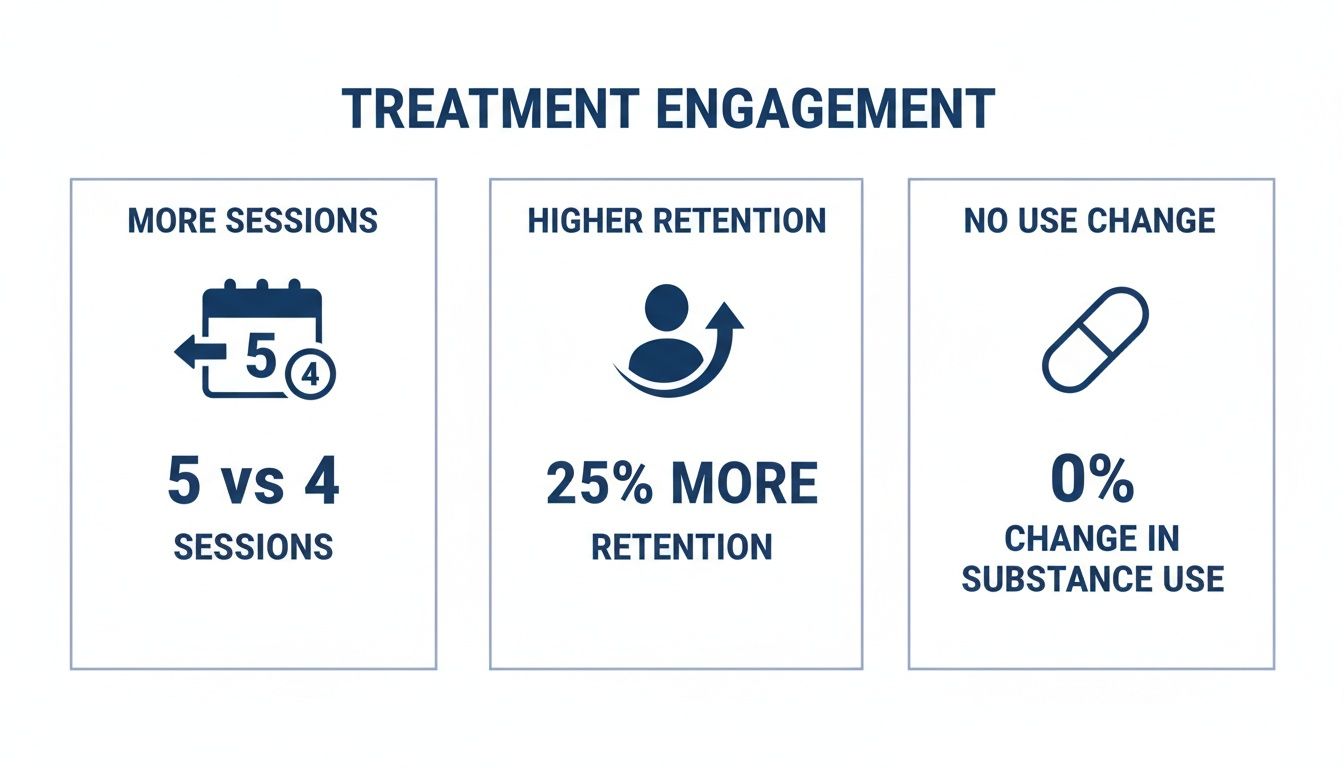
You can see that while MI might not single-handedly stop substance use, its real magic is in getting people to show up and stick with it—two of the biggest predictors of long-term success.
Ensuring a Warm and Timely Connection
The need to connect with ongoing care right away cannot be overstated. Research is crystal clear: any delay in that transition dramatically increases the risk of relapse. This is why using MI during discharge planning is so vital.
Studies looking at motivational enhancement therapy, which is a structured form of MI, found it made a huge difference in whether people actually made it to their next appointment.
One major study showed that people who got this MI-based handoff had a 79% increased likelihood of connecting with their follow-up care. Even more important, they were 65% more likely to get connected within the critical first 10 days. For anyone seeking addiction treatment in Dallas, this means the MI work we do at Tru Dallas Detox is specifically designed to close that dangerous gap between our program and your ongoing support system.
This focus on creating a motivated, seamless transition is a core part of how we build a strong relapse prevention plan. If you are ready to take the first step toward a supported recovery, we are here to help. Contact Tru Dallas Detox today to verify your insurance and speak with a compassionate admissions specialist.
How We Make Sure Motivational Interviewing Actually Works at Tru Dallas Detox
Just saying you offer Motivational Interviewing is one thing. Actually delivering it in a way that creates real change is something else entirely. For motivational interviewing for substance abuse to be more than just a buzzword on a website, it has to be delivered with incredible skill and consistency. That’s a serious challenge many treatment centers don't quite meet.
At Tru Dallas Detox, we don’t just have MI on our list of services—we’ve built our clinical culture around mastering it. We know that real expertise doesn’t come from a weekend seminar. It’s built through a deep, ongoing commitment to getting it right.
The Problem with "One and Done" Training
Here's a tough truth about the treatment industry: just sending therapists to a training workshop on MI often isn't enough. The research is startlingly clear on this. A major systematic review found that in 11 out of 12 different training studies, clinicians didn't even reach a basic level of skill.
Even more troubling, most studies found no real link between the training a therapist received and whether their patients actually got better. You can read the full research on MI training effectiveness to see the data for yourself.
This paints a pretty clear picture: a one-time training, without any follow-up, simply doesn't work. This is exactly why we knew we had to set a much higher standard at Tru Dallas Detox. True skill isn't a certificate on a wall; it’s honed over time with dedicated practice and expert mentorship.
Our Commitment to True Clinical Excellence in Dallas
We've built our entire program on a system of quality control and accountability to make sure our MI delivery is second to none. This gives individuals and families across the Dallas area peace of mind, knowing their loved one is in the hands of skilled professionals who are masters of their craft.
We believe that providing evidence-based care means delivering a therapy exactly as it was designed to be effective. For us at Tru Dallas Detox, sticking to the MI model isn't just a goal; it's our promise to the people we serve.
To make good on that promise, we invest heavily in our clinical team in a few key ways:
- Continuous Staff Training: This isn’t a one-off event. Our therapists are always in ongoing workshops and education, constantly refining their skills and staying on top of the latest best practices.
- Rigorous Clinical Supervision: Our clinicians participate in regular one-on-one and group supervision. This is where they can review cases, get direct feedback, and sharpen their MI approach under expert guidance.
- Ongoing Fidelity Monitoring: We don't just hope our therapy is on point—we check. We actively and ethically monitor sessions to ensure our team is consistently applying the principles of MI with the integrity and compassion every client deserves.
This relentless dedication means that when you or someone you love comes to our Dallas detox center, you’re getting therapy that doesn't just work in theory—it works in the real world. If you're ready to experience this level of dedicated, expert care, call Tru Dallas Detox today. An admissions specialist is ready to talk and help you start on the path to recovery.
Your Questions About Motivational Interviewing, Answered
It’s completely normal to have questions when you hear about a different approach to addiction treatment. People across Dallas often wonder what motivational interviewing for substance abuse actually feels like and if it can really make a difference for them or their family. Let's clear up some of the most common questions with direct, honest answers.
Is Motivational Interviewing Effective If Someone Is in Denial?
Yes, and this is exactly where MI shines. Traditional approaches often hit a wall trying to confront "denial," which just leads to arguments and pushes people further away. MI takes a completely different road.
Instead of fighting about whether there’s a problem, the therapist works with the person to explore their own mixed feelings. The whole conversation is about looking at how their substance use fits—or, more often, doesn't fit—with their own goals and what they truly value in life. It’s a respectful, gentle way to help someone find their own reasons to change, making it one of the best tools for those who aren't quite ready to commit.
How Long Does Motivational Interviewing Take to Work?
It helps to stop thinking of MI as a long-term therapy and see it more as a powerful way of communicating. It’s often used in just a handful of sessions as a brief intervention, designed to build the internal motivation needed to dive into a full treatment program.
At Tru Dallas Detox, we weave the principles of MI into everything we do—from the first time you call us to the day you graduate to your aftercare plan. The idea isn't to "finish" MI, but to use its collaborative spirit to empower you at every single stage of your recovery journey.
The real goal is to build a strong, trusting partnership that makes the incredibly hard work of recovery feel more personal and manageable. That supportive foundation is what helps you truly succeed at our Dallas treatment center.
How Can I Use These Principles to Help a Loved One in Dallas?
While a trained professional should always deliver formal MI, you can absolutely borrow from its playbook to have more productive conversations. The biggest shift is moving from confrontation to collaboration.
- Ask, don't tell: Instead of making accusations, try open-ended questions like, "What does that feel like for you?" or "Help me understand what's been going on."
- Listen to understand, not to reply: Your main job is to create a safe space where they feel heard without judgment.
- Acknowledge their strengths: Notice and mention any positive step, no matter how small it seems. "I know how hard that must have been, and I'm proud of you for trying."
- Drop the lectures: Shaming and lecturing almost always backfire. They create distance and defensiveness when you need connection the most.
Your goal is to become an ally, not an opponent. The most powerful thing you can do, however, is to encourage them to talk to a professional. Our addiction treatment team in Dallas can coach families through these tough but essential conversations.
Does MI Work for Opioid and Fentanyl Addiction?
Yes, absolutely. Motivational Interviewing is an incredibly flexible approach that works across the entire spectrum of substance use disorders, including addiction to alcohol, stimulants, and powerful opioids like heroin and fentanyl.
That's because MI targets the universal human experience of feeling two ways about something—that ambivalence—rather than focusing on the specific substance. It’s about strengthening a person's own motivation to change. At Tru Dallas Detox, we use MI to build that solid foundation, which makes other critical treatments like Medication-Assisted Treatment (MAT) and dual diagnosis care that much more effective.
The journey to recovery begins with one courageous decision. If you or someone you love in the Dallas-Fort Worth area is struggling, you don’t have to figure this out alone. The compassionate, expert team at Tru Dallas Detox is here to help you find your motivation and build a path toward lasting healing. Call us today to verify your insurance or to speak with an admissions specialist who can answer all your questions with confidentiality and care.
