
When you first suspect your husband is struggling with addiction, it can feel like the ground is crumbling beneath your feet. The life you've built together suddenly feels fragile, and it’s completely normal to feel lost, scared, and overwhelmed.
Figuring out how to handle your husband's addiction starts right here, not with a big confrontation, but with quiet, deliberate steps to protect your own stability and safety.
This isn't about placing blame or drawing a line in the sand just yet. It's about grounding yourself in reality and preparing for the difficult road ahead. Addiction often brings chaos, and your very first job is to create a pocket of calm for yourself and any children involved.
Key Takeaways
- Prioritize Safety First: Before anything else, ensure your physical, emotional, and financial safety. Addiction can make behavior unpredictable.
- Educate Yourself: Understanding the specifics of your husband’s addiction and the science behind it is a powerful tool for making informed decisions.
- Observe and Document: Keep a private journal of specific incidents. This provides clarity and factual grounding for future conversations.
- Your Well-being is Critical: The stress of dealing with a loved one's addiction takes a massive toll. Acknowledging and protecting your own mental health is essential.
- Prepare, Don't Confront: The initial steps are about grounding yourself and gathering information, not starting a fight.
First, Prioritize Your Immediate Safety
Before you do anything else, you have to assess your safety. Addiction can make people unpredictable, and sometimes that can lead to volatile or even abusive behavior. Nothing is more important than your well-being.
- Physical Safety: If you ever feel physically threatened, your only priority is getting yourself and your kids out of the situation. Have a go-bag and a plan. Know where you can go and who you can call at a moment's notice.
- Emotional Well-being: The constant stress, worry, and walking on eggshells take a huge toll. Acknowledge that your mental health is a critical part of your safety.
- Financial Security: Addiction and money problems often go hand-in-hand. Start taking quiet steps to understand and protect your family's finances. This might mean opening a separate bank account in your name.
Get Educated About the Addiction
Knowledge is your most powerful tool right now. The more you understand about the specific substance he's using and the science of addiction, the better equipped you'll be to make clear-headed decisions.
You don't need to become a doctor, but you do need to understand what you're up against. For example, did you know that withdrawal from substances like alcohol or benzodiazepines can be fatal without medical help? Knowing these risks is crucial. You can learn more about the top signs you or a loved one may need medical detox to help you recognize a true crisis.
For years, I covered for Tom and cleaned up his messes. I made excuses to his family, my family, and all our friends… I had convinced myself that, if I left him, I would be abandoning him. As if his choices were somehow a result of my actions.
Calmly Assess the Situation
Once you've taken steps to ensure you're safe, try to take a breath and observe the situation as objectively as possible.
Start a private journal or a note on your phone. Write down specific incidents—not to build a case against him, but to give yourself clarity. Note dates, specific behaviors, and the impact they had on you or your family.
This simple act helps you see the pattern and distinguish between a period of heavy use and a full-blown addiction, which is really defined by that loss of control and the pile-up of negative consequences. Believe me, this log will be invaluable later when you decide it's time to talk, because it grounds your concerns in facts, not just feelings.
How to Have a Conversation That Actually Helps
The thought of sitting down to talk with your husband about his addiction is probably terrifying. I get it. This isn't just another tough conversation; it feels like everything is on the line. The way you approach this talk can either open a door to real change or slam it shut for good.
The goal here isn't to win an argument, deliver an ultimatum, or make him feel ashamed. It’s about expressing your love and deep concern from a place of strength, making it clear that things simply cannot continue this way.
Timing and setting are everything. You absolutely must plan to have this talk when he is sober and clear-headed. Trying to reason with someone who is under the influence is a losing battle and almost guarantees it will escalate into a fight.
Choose a moment when you won't be rushed or interrupted. That means phones off, kids asleep or out of the house, and no other looming distractions. You're trying to create a calm, private space where both of you can feel as safe as possible to be vulnerable.
Frame Your Concerns with Care
How you say things matters just as much as what you say. The most critical shift you can make is to avoid blame and accusations, which are guaranteed to put him on the defensive. Instead, lead with "I" statements to share your own feelings and experiences.
- Instead of: "You're always drinking and it's ruining our family."
- Try: "I feel so scared for our future when I see how much alcohol has taken over."
- Instead of: "You lied to me again about where you were."
- Try: "I feel heartbroken and my trust shatters when I find out you haven't been honest with me."
This isn't about being soft; it's about being strategic. It shifts the conversation from an attack on his character to a discussion about the real-world impact of his actions. It makes your concerns much harder to dismiss and invites a discussion instead of a full-blown confrontation.
Use Specific Examples, Not Generalizations
Vague complaints are easy to argue with. "You're always checked out" can be met with "No, I'm not!" But specific, undeniable examples are much more powerful. Before you talk, look back at the notes you've been taking. Pick out a few clear, recent examples that show how his behavior has affected you and your family.
"When I'm speaking with my husband about his addiction, I need to remind myself to talk about the behavior, not the person. The goal is to show him the disconnect between the man I love and the actions the addiction is causing, creating a space for him to see the problem without feeling like a total failure."
Focus on concrete events and their emotional fallout.
- "Last Tuesday, you missed our son's soccer game. He was so let down, and I felt completely alone having to make excuses for why you weren't there."
- "When I checked our bank account yesterday, I saw that $500 was gone. I feel terrified about our finances and how we're going to pay the mortgage."
These facts ground the conversation in reality. They move it away from a messy battle of opinions and toward a discussion about what is actually happening and how it’s tearing your family apart. Remember, learning how to support someone in recovery starts long before treatment; it begins right here, with these honest, difficult conversations.
Prepare for Difficult Reactions
Even if you do everything right, this conversation will be hard. Be prepared for him to react with denial, anger, or blame. He might try to minimize the problem ("It's not that bad") or even turn it back on you ("Well, you stress me out!"). This is the addiction talking, trying to protect itself.
Your job is to stay calm and centered in your message. Don't get pulled into a pointless argument about minor details or let him derail the entire conversation. Gently but firmly, guide it back to your core feelings and the facts you've presented. This conversation is just the beginning, but it's a vital first step on a long road.
Setting Boundaries That Protect You and Encourage Change
When you love someone struggling with addiction, the line between helping and enabling gets blurry, fast. You find yourself making excuses for him, covering his debts, or calling in sick to his boss, thinking you're just helping him keep his head above water. But these actions, while rooted in love, often do more harm than good. They cushion the fall, softening the real-world consequences of his addiction and making it easier for him to keep going.
This is the hard truth: enabling props up the addiction, not the person. Learning how to navigate your husband's addiction means breaking this cycle. The single most powerful shift you can make is to stop enabling and start setting healthy boundaries. These aren't punishments. They're acts of self-preservation that also create the space he needs to finally see the true cost of his addiction.
The Difference Between Helping and Enabling
Figuring out what's truly helpful versus what's just enabling is a huge hurdle. Think of it as the difference between throwing someone a life raft and jumping into the treacherous water with them. Real help empowers recovery; enabling just keeps the addiction going.
- Helping is an action that supports his well-being and recovery. This could be driving him to a therapy appointment or celebrating a sobriety milestone with him.
- Enabling is any action that shields him from the natural consequences of his addiction. This looks like lying to his family about where he is or giving him money you know he’ll use for drugs or alcohol.
Making this shift is one of the toughest things you’ll do. It means you have to step back and let him feel the full weight of his choices. But often, that's the only thing powerful enough to spark a real desire for change.
I was no longer there cleaning up all the fallout for him—I know now that I was just enabling his addiction. At the time, though, I really thought I was helping him.
How to Communicate Boundaries Clearly and Firmly
A boundary is simply you defining what you will and will not accept in your own life. The trick is to communicate them with love, but also with unshakable resolve. You need to use clear, simple language that focuses on your actions, not on controlling his.
For instance, instead of saying, "You have to stop using in the house," you reframe it as a boundary you control: "I will not allow drugs or alcohol in our home. If you choose to use, you will need to do it somewhere else."
Here are a few more real-world examples of firm, loving boundaries:
- "I will no longer lie to your family or your boss for you. You'll have to handle those conversations yourself."
- "For me and the kids, our home has to be a safe, substance-free space. I cannot have you here when you are under the influence."
- "I will not give you money that might be used to buy substances. I am more than happy to buy groceries or pay a treatment provider directly."
- "I am no longer willing to argue with you when you are intoxicated. If you start yelling, I will leave the room."
See the pattern? Every statement starts with "I will" or "I will not." This isn't about giving him orders; it's about declaring what you are going to do to protect your own sanity and safety. It's a game-changer for your well-being.
Managing Guilt and Pushback
When you first lay down these new ground rules, brace yourself for resistance. He might get angry, try to manipulate you, or make a flood of promises he has no intention of keeping. He’s used to the old system—the one where you enabled him—and you've just disrupted what his addiction depends on to survive. This is completely normal.
You’ll also probably fight your own internal battle with guilt. You might feel like you're being cruel or abandoning him. Remind yourself, as often as you need to: you are not abandoning the man you love; you are detaching from his addiction. You are simply refusing to be a co-pilot in his self-destruction. This is why getting your own support, whether from a therapist or a group like Al-Anon, is absolutely essential. You need people in your corner to reinforce your resolve.
Finding the Right Professional Treatment
When your husband finally agrees to get help, you might feel a rush of relief followed by a wave of uncertainty. What now? Navigating the world of addiction treatment can feel like learning a new language, but this is where your support becomes both practical and powerful. Understanding the options is the first step toward guiding him onto a path of lasting recovery.
The gap between people who need help and those who get it is staggering. In 2023, drug use surged globally, with 316 million people using drugs—a 28% jump in just a decade. In the United States alone, nearly 54.2 million people needed substance abuse treatment in 2023, but only 12.8 million received it. That means over 41 million people went without care. This is the critical gap where a loving partner can make all the difference by helping to find professional help.
Key Takeaways
- Know the Levels of Care: Understand the difference between medical detox, inpatient rehab, and outpatient programs to help find the right fit.
- Detox is Often Non-Negotiable: For substances like alcohol or benzodiazepines, medically supervised detox is critical for safety.
- Consider Specialized Programs: Look into dual-diagnosis treatment if mental health issues are also present, or couples rehab to heal the relationship.
- Lean on Professionals: You don't have to be the expert. Call admissions departments at treatment centers to get guidance on insurance, assessment, and next steps.
- Your Role is Support, Not Curation: Your job is to help research and encourage him, but the ultimate decision and commitment to recovery must be his.
Understanding the Different Levels of Care
Not all treatment is created equal. The right program really depends on the substance being used, how deep the addiction goes, and your husband's unique situation. It helps to think of it as a spectrum of care, from the most intensive and structured to more flexible options.
- Medical Detox: This is almost always the first, and most critical, step. It provides a safe, medically supervised space for the body to clear itself of substances. For things like alcohol and benzodiazepines, trying to detox at home isn't just difficult—it can be deadly. Professional detox is non-negotiable in these cases.
- Inpatient or Residential Rehab: After detox, this is the most immersive level of care. Your husband would live at a facility for a period, usually 30 to 90 days. He’d be immersed in intensive therapy, group sessions, and structured routines, all while being safely away from daily triggers.
- Outpatient Programs: These programs offer more flexibility, letting him live at home while attending therapy and group sessions several times a week. This can be a great fit for someone with a less severe addiction or as a "step-down" to transition back to normal life after finishing an inpatient program.
Specialized Treatment Tracks You Should Know
Beyond the basic levels, many facilities offer specialized programs that dig deeper into the root causes of addiction. These can be incredibly effective because they're not a one-size-fits-all solution.
A crucial one to know about is dual-diagnosis treatment. This is for people who are struggling with both an addiction and a co-occurring mental health condition, like depression, anxiety, or PTSD. These issues often feed each other, so treating them at the same time is vital for any real, lasting success.
Another powerful option is couples rehab. This unique approach allows both of you to attend treatment together. You’ll work with therapists to not only address the addiction but also to heal the relationship itself. It’s all about rebuilding trust, learning to communicate again, and figuring out how to be a team in sobriety. For a deeper dive, check out our guide on how to get someone into rehab.
This decision tree is a great visual tool to help you distinguish between behaviors that genuinely support his recovery and those that might unintentionally be enabling his addiction.
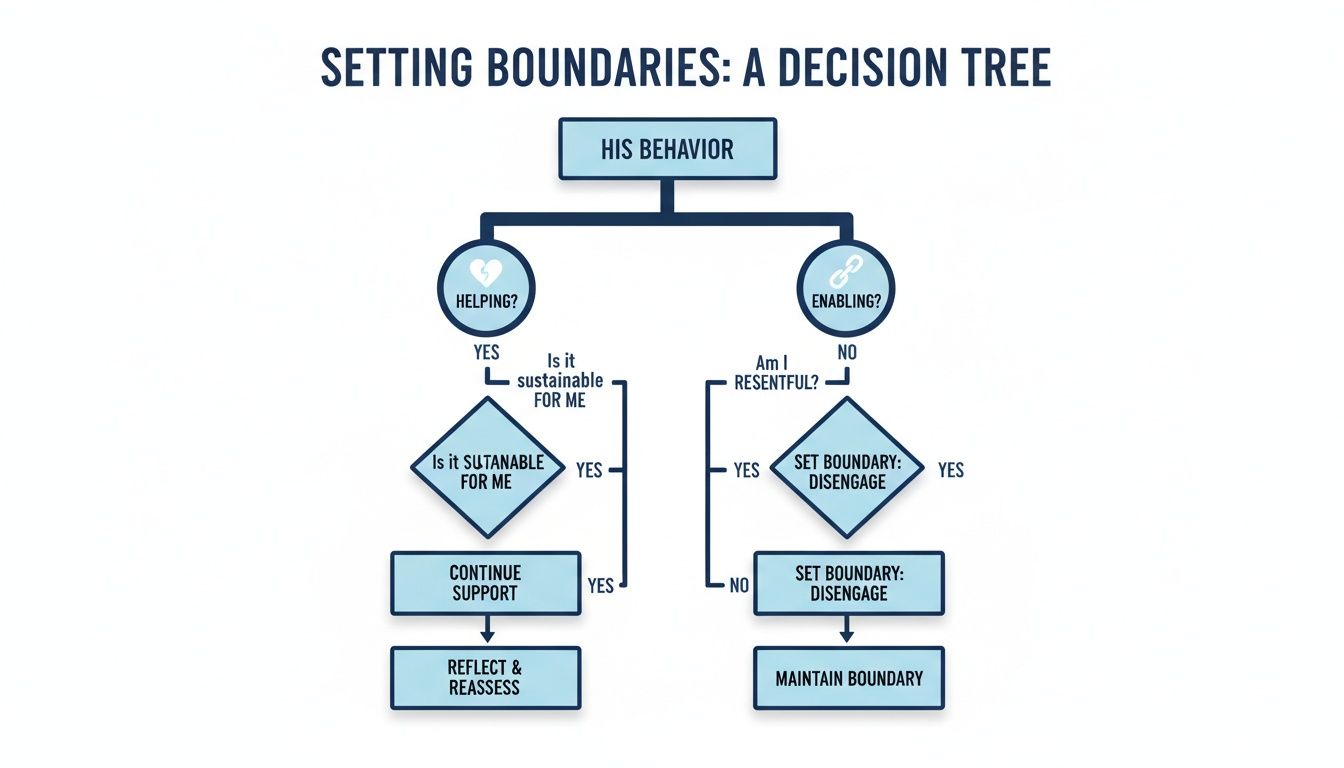
As the flowchart shows, helpful actions build accountability and focus on recovery, whereas enabling behaviors often shield him from the natural consequences of his choices.
To make sense of the different programs available, this table breaks down the most common options and who they're best suited for.
Comparing Addiction Treatment Programs
| Program Type | Level of Care | Best For | Key Features |
|---|---|---|---|
| Medical Detox | Highest (short-term) | Individuals with physical dependence on substances like alcohol, opioids, or benzodiazepines. | 24/7 medical supervision, medication to manage withdrawal, safe and stable environment. |
| Inpatient/Residential | High | Severe addictions, unstable home environments, co-occurring mental health disorders. | Live-in facility (30-90 days), intensive individual and group therapy, structured routine. |
| Outpatient (PHP/IOP) | Medium | Moderate addictions, strong home support system, or as a step-down from inpatient care. | Live at home, attend treatment several hours a day, multiple days per week. |
| Dual Diagnosis | Specialized | Individuals with both a substance use disorder and a mental health condition (e.g., depression, PTSD). | Integrated therapy that addresses both conditions simultaneously. |
| Couples Rehab | Specialized | Partners where addiction has significantly damaged the relationship and both are committed to healing. | Joint therapy sessions, communication skill-building, rebuilding trust. |
Choosing the right program can feel overwhelming, but an admissions specialist can help you pinpoint the exact level of care your husband needs based on his specific circumstances.
Navigating the Practical Steps of Admission
Once you've zeroed in on a few potential treatment paths, the logistics can feel like a whole new challenge. The best place to start is by calling the admissions department of a few reputable centers. They are pros at walking families through this exact process.
When you call, have your husband's insurance information handy. The admissions team can verify his benefits and give you a clear picture of what's covered. They’ll also do a confidential pre-assessment over the phone to get a sense of his history and recommend the right level of care.
"The first call to a treatment center can be the hardest one to make, but it's also the most hopeful. An admissions coordinator isn't there to judge you; they are there to light up the path forward when you're standing in the dark."
You don’t have to figure this out on your own. Leaning on professional guidance can make all the difference in finding the right help and setting your husband on the road to a healthier future.
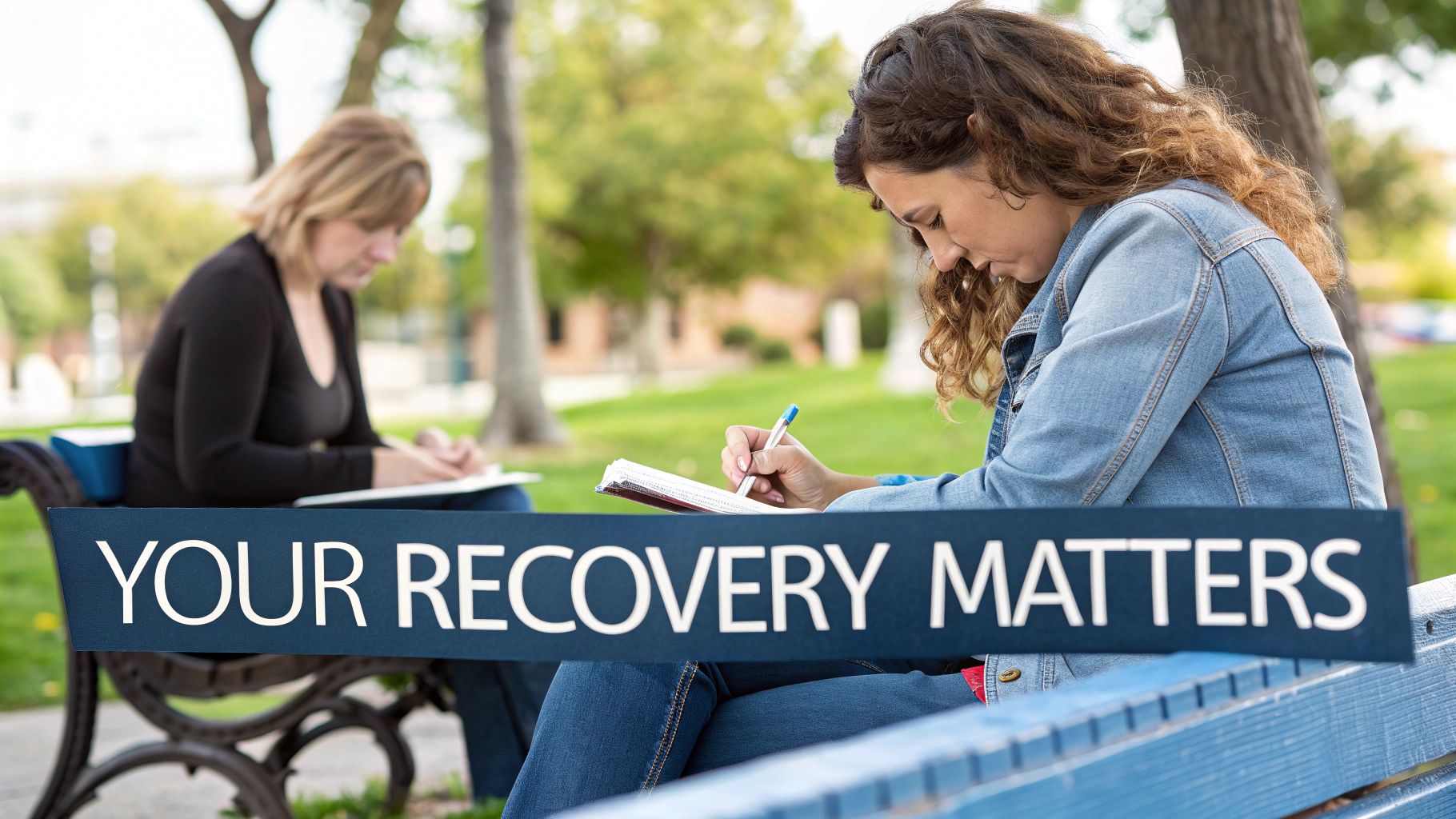
Why Your Own Recovery Matters Just as Much
When you're living with a partner's addiction, your world slowly shrinks. Over time, their addiction takes up all the space, pushing your own needs, friendships, and mental health further and further into the background. You've probably found yourself playing the role of crisis manager, detective, and secret-keeper all at once, and it is absolutely exhausting.
Let me be clear: reclaiming your own well-being isn't selfish. It's a fundamental act of survival. Your recovery journey runs parallel to his, but it’s also entirely your own. It's what creates a stable foundation for you to stand on, no matter which path he ultimately chooses. Focusing on yourself is the single most powerful thing you can do to take back control of your life.
Finding Support That Understands
You can’t do this alone, and you shouldn't have to. The isolation that comes with a spouse's addiction is profound, but there are people out there who genuinely understand what you're going through. Finding the right support system is your lifeline.
- Therapy for You: Look for a therapist who specializes in how addiction impacts families. They can give you a safe, confidential space to unpack the tangled mess of emotions you’re feeling—the anger, the grief, the resentment, and the love that somehow still exists alongside it all.
- Support Groups: I can't recommend groups like Al-Anon or Nar-Anon enough. They are specifically for the friends and family of those struggling with addiction. Here, you will find people who speak your language, who have walked in your shoes, and who can share practical wisdom without an ounce of judgment.
This is your space to be heard. The emotional toll on partners is immense, especially when you look at the bigger picture. Globally, drug-related deaths have more than doubled, from 61,774 in 1990 to 137,278 in 2021, and the number of people with a drug use disorder climbed 34% to 53 million cases. You can read more about the global impact of drug addiction on News-Medical.net. Witnessing this struggle up close means you absolutely have to build your own robust support system to cope.
Reconnecting with Your Own Life
Addiction has a sneaky way of erasing your identity. The hobbies you once loved, the friends you used to see, and even simple, quiet moments get swallowed by the chaos. A huge part of your recovery is intentionally rediscovering the person you are outside of this crisis.
"I’ve learned that it’s okay to detach myself from toxic situations, and I’ve set boundaries that define what I will and will not tolerate from others. Most importantly, I’ve found happiness and peace with my past and the decisions I made."
Think back. What brought you joy before his addiction took center stage?
- Did you love to hike? Get out for a walk on a local trail.
- Was there a book club you enjoyed? See if you can rejoin.
- Did you find peace in painting, gardening, or going for a run? Carve out just 30 minutes this week to start again.
It might feel frivolous or even impossible at first, but these small acts are incredibly powerful. They’re a reminder that you are a whole person with your own passions. This isn’t just self-care; it’s an act of defiance against the chaos that addiction thrives on.
Processing the Emotional Rollercoaster
Loving someone with an addiction is a wild, unpredictable ride. You might feel white-hot anger one minute and a deep, aching pity the next. It’s completely normal to grieve for the man you married and the future you thought you’d have. All of these feelings are valid.
Let yourself feel them without judgment. Journaling can be a fantastic tool here—it’s a private outlet where you can pour out all the frustration, sadness, and confusion without holding back. Acknowledging your pain is the very first step toward healing from it. Building your own support network is the best thing you can do for your own future, ensuring you can stand strong regardless of his choices.
A Final Word of Encouragement
Walking this path is, without a doubt, one of the hardest things you'll ever do. But I want you to know that you absolutely have the strength to get through this. As you move forward, hold onto these core ideas to keep yourself grounded—focused on his recovery, yes, but just as importantly, on your own.
This journey demands that you prioritize your own well-being just as fiercely as you do his recovery. Think of it this way: your stability is the foundation that any lasting, healthy change for your family will be built upon.
The Most Important Things to Remember
If you feel overwhelmed, just come back to these five points. They will give you clarity and help you act with both compassion and strength.
-
Your Safety and Sanity Come First. This is not negotiable. Your physical safety, emotional health, and financial stability are the priority. You simply can't pour from an empty cup, so make your own healing a non-negotiable part of your routine. This means therapy, support groups like Al-Anon, and carving out time just for you.
-
Boundaries are an Act of Love. It’s time to shift from enabling the addiction to establishing clear, firm boundaries that protect you and your peace. Frame them as "I will not…" statements. This isn't about controlling him; it's about defining what you will and won't accept, which often creates the natural consequences that can motivate change.
-
You Are a Powerful Influence. Never underestimate the power of your support. While statistics show that only a fraction of people who need treatment actually get it, a 2023 report highlighted that adults over 26 often get help because of their spouse's encouragement. You can be the catalyst. For a deeper look, check out these substance use treatment statistics.
-
You Don't Have to Be the Expert. Please, don't try to figure all this out by yourself. Lean on the people who do this for a living. Addiction professionals, interventionists, and admissions coordinators can help you make sense of detox, rehab, and therapy so he gets the right care for his specific situation.
-
Practice Detaching with Love. This is a tough one, but it’s crucial. You cannot control his choices, and you cannot cure his disease. You can only control your own actions and how you respond. Detaching with love means you can still care deeply for him without carrying the crushing weight of his addiction on your shoulders.
Frequently Asked Questions
How do I know if my husband is an addict or just drinking too much?
The key difference is loss of control and negative consequences. A heavy drinker might overdo it on weekends but can stop when they need to and generally maintains their responsibilities. An addict continues to use despite clear negative impacts on their health, job, finances, and relationships. They cannot reliably control their use, even when they want to.
What is the single most important thing I can do right now?
Find support for yourself. I can't stress this enough. Joining a group like Al-Anon or finding a therapist who truly understands addiction gives you an immediate lifeline. It provides the outside perspective and strength you need to set healthy boundaries and make clear-headed decisions.
How can I tell if I'm helping or just enabling him?
It's a fine line, but here’s a good gut check. Helping supports his recovery (like driving him to a meeting). Enabling supports his addiction (like calling his boss to lie for him). Before you act, ask yourself: "Is what I'm about to do making it easier for him to keep using?" If the honest answer is yes, it's probably enabling.
Is it possible for our marriage to survive this?
Absolutely. Many relationships don't just survive addiction—they can become stronger, more honest, and more intimate than before. But it's not a given. It takes a massive commitment from both of you to your own separate recovery paths, plus a shared commitment to rebuilding the relationship through professional help, radical honesty, and a whole lot of patience as you learn to trust again.
Is his addiction my fault?
Let me be perfectly clear: No. You are not responsible for his addiction. Addiction is a deeply complex disease, often tied to things like genetics, past trauma, and the way a person's brain is wired. While the stress of a relationship can sometimes be a trigger for substance use, it is never the fundamental cause. It’s also very common for someone struggling with addiction to deflect and cast blame. It's a defense mechanism.
What do I do if he relapses?
First, take a breath. A relapse can feel like the world is crashing down, but it's often a part of the recovery journey—not a total failure. It’s a sign that something in his recovery plan needs to be re-evaluated. How you respond in that moment is critical. Focus on safety first, maintain your boundaries, point him back toward his professional support system, and lean heavily on your own.