

When you're trying to fix a complex engine, the first thing you do is turn it off. It’s nearly impossible to make meaningful repairs while all the parts are still moving. The same logic applies to our mental health. Trying to heal from deep-seated anxiety, depression, or trauma while juggling the constant demands of work, family, and daily life can feel like an uphill battle.
This is where mental health rehab comes in. It’s a dedicated, structured treatment program that gives you the space to press pause. It offers a supportive environment, free from everyday triggers and stressors, where you can focus entirely on healing with intensive therapy and professional guidance. Think of it less like a hospital and more like a specialized physical therapy for your mind—a place to rebuild strength, learn new skills, and get back on your feet.
Key Takeaways
- Mental health rehab provides a structured, immersive environment to focus solely on healing, away from daily stressors.
- It's designed for individuals whose mental health challenges are significantly impacting their life, work, or relationships.
- Signs you might benefit include feeling constantly overwhelmed, strained relationships, or relying on unhealthy coping mechanisms.
- The goal is to equip you with long-term skills for resilience, moving from merely surviving to thriving.
- Choosing rehab is a proactive step toward reclaiming control over your well-being and building a stable future.
What Is Mental Health Rehab and Who It Helps
A mental health rehab program is designed for anyone whose mental health challenges have started to consistently get in the way of their life. It's not just for moments of crisis; it's a proactive choice for individuals who find their emotional state is impacting their job, their relationships, or their basic ability to find joy and function day-to-day.
The goal isn't just to get you through a rough patch. It's about fundamentally changing your relationship with your mental health, equipping you with the tools to build genuine, long-lasting resilience so you can move from just surviving to truly thriving.
Recognizing the Signs You Might Benefit
So, how do you know if rehab is the right step? It’s less about a specific diagnosis and more about the real-world impact your mental health is having on your life.
Take a moment and see if any of these situations sound familiar:
- You're constantly overwhelmed. Simple tasks feel monumental, and you find yourself avoiding responsibilities because you just don't have the capacity to deal with them.
- Your relationships are suffering. Your mental state is causing friction with loved ones, making you withdraw, or preventing you from connecting in a meaningful way.
- Your performance has dropped. You can’t focus at work or school like you used to, and your productivity has taken a noticeable hit.
- You’re relying on unhealthy coping mechanisms. Whether it’s substance use, isolating yourself, or other harmful behaviors, you’re using them to numb out or get through the day.
- Weekly therapy isn't enough. You've been trying traditional therapy, but the one-hour-a-week-format just isn't creating the deep, lasting change you need.
If you’re nodding along, it’s a strong sign that a more intensive, immersive level of care could help you break the cycle. You're not alone in this feeling. Globally, over one billion people live with a mental health condition, but huge gaps in care—caused by everything from workforce shortages to underfunding—mean many never get the support they need. You can learn more about these global mental health service gaps from the WHO.
Mental health rehabilitation provides a safe harbor—a place to learn how to navigate the storms of your own mind with new tools and a renewed sense of direction. It’s an investment in your long-term stability and happiness.
Ultimately, choosing to go to rehab is a powerful act of self-advocacy. It's you saying that you deserve the time, space, and expert support to heal properly. It's an opportunity to build a stronger foundation and reclaim the story of your life.
Navigating the Different Levels of Care in Mental Health Rehab
Finding the right mental health treatment isn't about picking a one-size-fits-all program. Think of it more like a journey with different paths available, each designed to give you the exact support you need, right when you need it. Understanding this "continuum of care" is key, because it shows how a good mental health rehab program adapts to you as you heal.
It's a bit like learning to swim. You wouldn't start in the deep end alone. You'd begin in the shallow water with an instructor right there, gradually moving to deeper water as you gain strength and confidence. This approach makes sure you're never overwhelmed by too little support or held back by too much.
Inpatient or Residential Treatment: The Highest Level of Support
When symptoms are acute or life feels completely unmanageable, inpatient or residential treatment provides the most intensive level of care. This means living at a treatment facility 24/7, creating a safe, structured environment completely removed from the stressors and triggers of daily life. This is the "shallow end of the pool," where help is always within arm's reach.
This level of care is often the right choice for someone who is a potential danger to themselves, is struggling with overwhelming symptoms, or needs medical supervision to get stable. With round-the-clock access to clinical staff, you can focus entirely on healing. These programs typically last 30 to 90 days and are packed with intensive therapy designed to build a strong foundation for recovery.
The flowchart below shows how this intensive support helps people begin to manage conditions like severe depression, anxiety, and trauma.
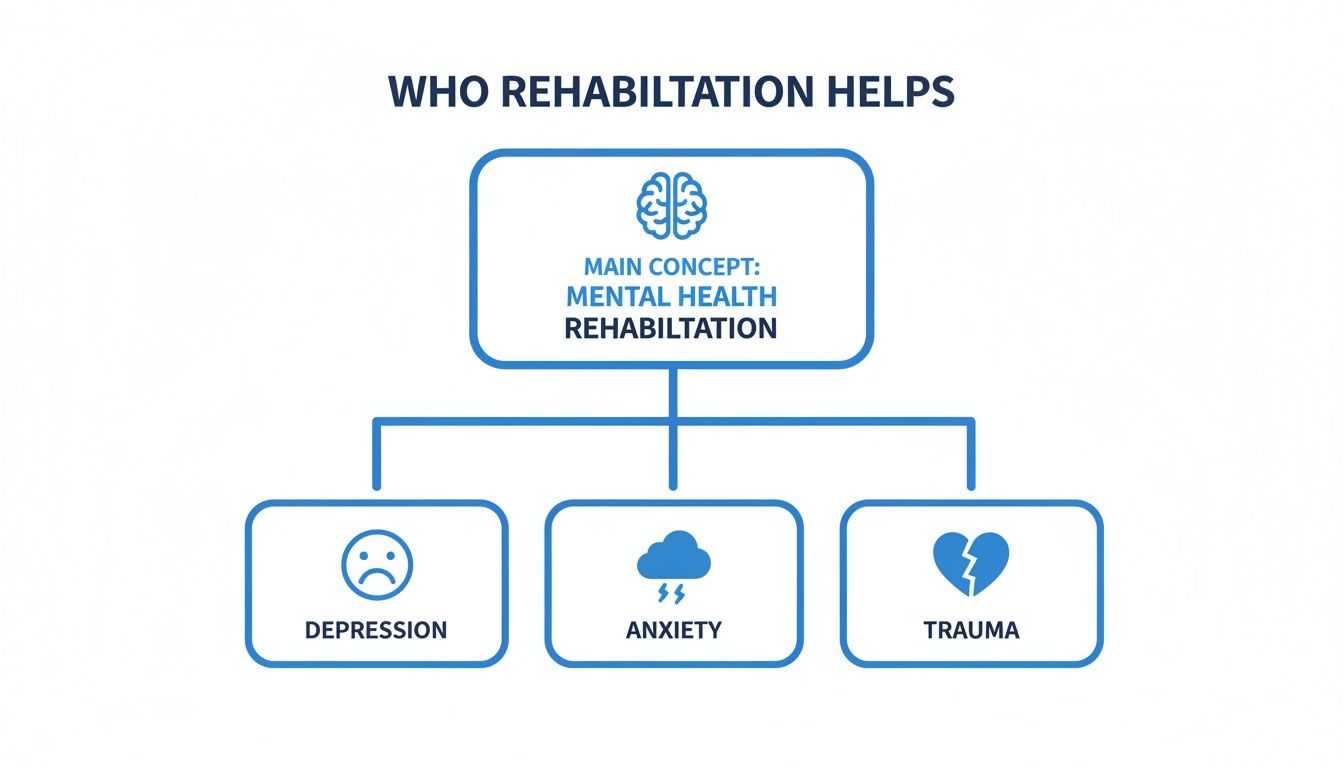
This structure is what allows for deep, focused work on the core issues driving these challenges.
Stepping Down: Partial Hospitalization and Intensive Outpatient Programs
Once you're stable and don't need that constant, 24/7 supervision, it’s time to "step down." This transition is a critical part of recovery, allowing you to slowly and safely ease back into your everyday life while still having a strong safety net of support.
Partial Hospitalization Programs (PHP) are usually the very next step. In a PHP, you’ll spend your days at the treatment facility—often five days a week for several hours—but you get to go home at night. It provides the structure of a full-time commitment without requiring you to live on-site.
Intensive Outpatient Programs (IOP) offer even more flexibility. IOPs typically involve treatment for a few hours a day, maybe three to five days a week. This model is perfect for those who are ready to get back to work or school but know they still need consistent, structured support to keep their new coping skills sharp.
Think of it like this: After a major injury, you wouldn't go straight from the hospital bed to running a marathon. You’d go to physical therapy a few times a week to rebuild strength. PHP and IOP are the physical therapy for your mental health—they bridge the gap between intensive care and everyday life.
Comparing Mental Health Rehab Care Levels
To make it clearer, this table breaks down the key differences between the primary levels of care. It can help you see the time commitment, living situation, and ideal fit for each option.
| Level of Care | Weekly Time Commitment | Living Arrangement | Best Suited For |
|---|---|---|---|
| Inpatient/Residential | 24/7 | Live at the facility | Individuals with acute symptoms, those needing medical stabilization, or anyone in an unsafe environment. |
| Partial Hospitalization (PHP) | 20-30 hours | Live at home | People who have completed inpatient care or need more structure than traditional outpatient therapy. |
| Intensive Outpatient (IOP) | 9-15 hours | Live at home | Individuals who are stable enough for work/school but still require significant, structured support. |
| Standard Outpatient | 1-2 hours | Live at home | Ongoing maintenance for long-term stability and continued growth after completing a higher level of care. |
Seeing it laid out like this really highlights how treatment can be tailored to meet you exactly where you are in your recovery journey.
Maintaining Progress: Outpatient Therapy and Aftercare
The journey doesn't just stop when a program ends. The final, and arguably most important, stages are all about maintaining your hard-won progress for the long haul.
Standard Outpatient Therapy usually means meeting with a therapist once a week or every other week. This ongoing connection gives you a dedicated space to navigate life's challenges, fine-tune your coping skills, and continue growing. It's the essential maintenance that keeps your mental wellness on track.
Aftercare planning is the personalized roadmap you build before you leave a program. A high-quality rehab center will work with you to create this plan, ensuring you don't walk out the door without a clear path forward.
A solid aftercare plan often includes:
- Support Groups: Finding a community of peers is invaluable. Groups like the National Alliance on Mental Illness (NAMI) or the Depression and Bipolar Support Alliance (DBSA) offer powerful, ongoing encouragement.
- Continued Therapy: Setting up appointments with a local therapist in the Dallas-Fort Worth area so there's no gap in your support.
- Healthy Routines: Reinforcing positive habits around sleep, nutrition, and exercise that you learned in treatment, as these are foundational to mental stability.
This full spectrum of care—from immersive inpatient treatment all the way through long-term aftercare—is designed to support you at every single step, creating a flexible and compassionate path toward lasting wellness.
Core Therapies Used in Modern Rehab Centers
When you step into a quality mental health rehab program, you’re not just going to sit in a room and talk about your feelings. You'll be actively engaging with a whole toolkit of proven, evidence-based therapies. "Evidence-based" is just a way of saying these methods have been put to the test in countless studies and are shown to actually work.
Think of it like a master carpenter's toolbox. A hammer is great for nails, but you need a saw to cut wood. In the same way, different therapeutic approaches are used to tackle specific challenges, whether it's learning to manage intense emotions or untangling deep-rooted thought patterns. This multi-tool strategy makes sure your treatment is both precise and effective.
Cognitive Behavioral Therapy: The Blueprint for Your Brain
One of the first and most fundamental treatments you’ll likely encounter is Cognitive Behavioral Therapy (CBT). The idea behind CBT is refreshingly simple: your thoughts, feelings, and actions are all linked. A negative thought can spark a painful feeling, which then leads to an unhelpful behavior, trapping you in a frustrating cycle.
CBT helps you become a detective of your own mind. A therapist works with you to spot these automatic negative thought loops and question if they're actually true. It’s like rewriting the buggy code in your brain that keeps causing crashes, replacing it with new logic that helps the whole system run smoothly.
For instance, you might learn to reframe the thought "I'm a complete failure" into "I made a mistake, and I can learn from this." It seems like a small shift, but it can have a huge ripple effect on your emotional state and what you do next. We go into more detail on this process in our guide on CBT for addiction and mental health.
Dialectical Behavior Therapy: The Skills for Emotional Regulation
While CBT is great for examining thoughts, Dialectical Behavior Therapy (DBT) is built for people who feel emotions with overwhelming intensity. It was first developed for borderline personality disorder, but its practical skills have proven so useful that they're now applied to a wide range of conditions.
DBT is all about teaching four core skill sets that essentially act as a user manual for navigating emotional storms:
- Mindfulness: Learning to stay in the present moment, observing your thoughts and feelings without judging them.
- Distress Tolerance: Building the skills you need to get through a crisis without making it worse.
- Emotion Regulation: Understanding your emotions and learning how to feel less vulnerable to them.
- Interpersonal Effectiveness: Figuring out how to ask for what you need and build healthier relationships.
Think of DBT as learning emotional first aid. It gives you concrete, in-the-moment strategies to handle distress so you can respond with intention instead of reacting on impulse.
By learning to sit with discomfort instead of running from it, you build the emotional muscle needed to handle life’s inevitable challenges. True strength isn't the absence of difficult feelings; it's the ability to navigate them.
The Power of Community in Group and Family Therapy
Individual therapy is crucial, but healing rarely happens in a vacuum. Group therapy is a cornerstone of rehab because it directly confronts the profound sense of isolation that so often comes with mental health struggles. There's incredible power in sharing your story with people who genuinely get it—it creates a bond and sense of validation that’s hard to find anywhere else.
Family therapy is another vital piece of the puzzle. Mental health issues can strain even the strongest family ties. This therapy helps repair those relationships and teaches everyone involved how to create a more supportive home environment. The goal is to make sure that when you leave rehab, you're returning to a family that understands how to support your recovery, not one that unintentionally triggers old, painful patterns.
Why We Treat Mental Health and Addiction Together: The Dual Diagnosis Approach
Mental health struggles and substance use rarely stay in their own lanes. More often than not, they are deeply tangled together, creating a difficult cycle where one problem fuels the other. This is what we in the field call a dual diagnosis or co-occurring disorder, and tackling it successfully demands a specialized, integrated game plan.
Think of it like trying to fix a leaky boat. If you spend all your time patching a hole on one side while completely ignoring another massive hole on the other, you're still going to sink. It's the same when you try to treat depression without addressing a person's alcohol use. The drinking can make the depression worse, and the despair from depression can trigger the urge to drink. You're just stuck in a loop.
Integrated Treatment: The Only Way Forward
A truly effective mental health rehab for someone with a dual diagnosis doesn't just treat two separate issues; it treats one person dealing with interconnected challenges. This means weaving psychiatric care and addiction counseling into a single, cohesive treatment plan. It’s a strategy built on the reality that mental health and substance abuse are often two sides of the same coin. For a deeper dive, you can explore the intricate link between mental health and substance abuse in our detailed guide.
In a dual diagnosis program here in Dallas-Fort Worth, every part of your treatment is designed to address both issues at once. For instance, a session of Cognitive Behavioral Therapy (CBT) won't just focus on thought patterns that trigger anxiety; it will also explore how those same thoughts lead to cravings. This unified approach is miles more effective than seeing a psychiatrist for medication on Tuesday and a separate addiction counselor on Thursday, with neither one talking to the other.
How We Adapt Therapies for Co-Occurring Disorders
To get this right, we adapt proven therapies to meet the unique needs of a dual diagnosis. The focus isn't just on one issue, but on the complicated relationship between them.
- A Holistic Look: We start with a thorough assessment to understand exactly how your mental health symptoms and substance use patterns feed off each other.
- Targeted Skills: Therapies like Dialectical Behavior Therapy (DBT) are perfect for this. We teach you practical skills to manage overwhelming emotions without reaching for a substance to cope.
- Smarter Relapse Prevention: You'll learn to spot the specific triggers—for both your mental state and your sobriety—and build a solid, personalized plan to navigate them.
Treating a dual diagnosis is about seeing the whole person, not just a collection of symptoms. By addressing both conditions at the same time, we help you build a much stronger, more reliable foundation for lasting recovery.
Sadly, getting this kind of comprehensive care is still a major hurdle for too many people. Globally, an astonishing number of individuals with these disorders get no help at all—some data suggests that fewer than 7% receive care that's even considered effective. Even in the U.S., where about 47% of adults with a mental illness got some form of treatment recently, a huge gap remains, especially for those struggling with co-occurring disorders. You can find more on these treatment statistics at Grow Therapy.
The Role of Medication-Assisted Treatment (MAT)
For many people navigating a dual diagnosis, Medication-Assisted Treatment (MAT) is an absolute game-changer. MAT combines FDA-approved medications with counseling and therapy, giving us a "whole-patient" approach to healing.
These medications aren't a cure-all, but they are incredibly helpful tools. They can help rebalance brain chemistry, block the high from opioids or alcohol, and ease the physical cravings that can make early recovery feel impossible. By stabilizing your body and mind, MAT clears the fog, allowing you to fully engage in the therapeutic work needed to get to the root of both your addiction and your mental health condition.
Navigating Admissions Costs and Insurance
Let's be honest: thinking about the cost of mental health rehab can be overwhelming. You're ready to make one of the most important investments in your life—your own well-being—but the financial side of things can feel like a huge roadblock. It doesn’t have to be.
Figuring out the money part is completely manageable once you know what to look for. Think of it like this: insurance has its own language, and once you learn a few key words, you're in control. Terms like deductible (what you pay first), copay (your set fee for a visit), and out-of-pocket maximum (the most you’ll pay all year) are the basics. Getting a handle on them means no more surprise bills.
Verifying Your Insurance Coverage
Before you go any further, the single most important step is to find out exactly what your insurance will cover. This might sound intimidating, but you don't have to do it alone. Any reputable rehab center in Dallas-Fort Worth will have admissions coordinators who are pros at this. They'll get on the phone with your insurance company and do the heavy lifting for you.
To get the clearest picture, you or the admissions team should ask these questions:
- Is this facility in-network? Being "in-network" means the rehab has a deal with your insurance company, which almost always saves you a lot of money.
- What levels of care are covered? Does your plan cover residential treatment? What about a Partial Hospitalization Program (PHP) or outpatient services? You need to know.
- Do I need pre-authorization? Many insurance plans require a thumbs-up before you start treatment. Skipping this step can lead to a denied claim later.
The demand for quality mental health care is growing, and the numbers show it. The global behavioral rehabilitation market is expected to reach an estimated US$434.00 billion by 2034. While this highlights a greater recognition of mental health needs, it's also a reminder that navigating payment, often through private insurance, is a critical piece of the puzzle. Discover more insights about the expanding behavioral rehab market.
Exploring Your Payment Options
Even with a solid insurance plan, you'll likely have some out-of-pocket costs. But don't let that stop you. Most treatment centers understand this and have systems in place to make it work. Never be afraid to ask an admissions team directly about your financial options.
The cost of treatment is an investment, not just an expense. The long-term benefits of improved mental health—stronger relationships, better job performance, and overall well-being—far outweigh the initial financial commitment.
Many facilities offer flexible solutions to make care more affordable:
- Payment Plans: You can often break down the amount you owe into smaller, more manageable monthly payments.
- Sliding Scale Fees: Some non-profits and state-funded programs can adjust their costs based on your income.
- Financing Programs: There are third-party lenders that offer loans specifically designed for healthcare costs.
Insurance can feel like a maze, but there are resources to guide you. For a deeper dive into how it all works, check out our guide on whether insurance covers drug rehab, as the core principles are very similar for mental health care.
Your Path to Healing in DFW Starts Here
Deciding to seek help is one of the bravest things you can do. As we've explored, mental health rehab isn't a single, rigid path but a structured, hopeful journey with many different routes to feeling better.
Whether you need the round-the-clock support of an inpatient program or the flexibility of outpatient care that fits around your life, the right kind of help is right here in the Dallas-Fort Worth area.

The most important thing to remember is that you don't have to figure this out on your own. It all starts with a conversation—with a treatment provider, a therapist, or even just a friend you trust. Use what you've learned here to take that next step with confidence.
"The journey of a thousand miles begins with a single step." This old saying couldn't be more true for recovery. Making that first call is a powerful move toward a new, healthier life.
Let’s quickly recap the most important points to keep in mind as you think about your next move.
Key Takeaways
- Rehab is focused healing. It's a structured program designed to help you rebuild mental and emotional strength by removing you from daily stressors and providing intensive, evidence-based therapy.
- Care is personalized. Treatment is offered across a full spectrum, from 24/7 inpatient care for acute stabilization to flexible outpatient programs that fit your work and family life.
- Therapies are proven to work. You’ll engage with methods like Cognitive Behavioral Therapy (CBT) and Dialectical Behavior Therapy (DBT), which provide practical skills for lasting change.
- Integrated care is crucial for co-occurring issues. If you face both mental health and substance use challenges, a dual diagnosis program that treats both simultaneously is the most effective approach.
- Financial options are available. Don't let cost be a barrier. Most PPO insurance plans are accepted, and facilities can work with you on payment plans to make this life-changing investment manageable.
Frequently Asked Questions
Who is mental health rehab for?
It’s for adults struggling with conditions like severe depression, anxiety disorders, PTSD, bipolar disorder, or personality disorders that are making it difficult to function in their day-to-day lives. It provides a more intensive level of care than traditional weekly therapy.
Is rehab only for people with substance abuse issues?
Not at all. While many programs treat co-occurring disorders (mental health and substance use), there are many standalone mental health centers that focus exclusively on psychiatric and emotional wellness. Always check if a facility specializes in what you need.
How long does mental health rehab last?
The duration varies based on individual needs. Inpatient or residential programs typically last from 30 to 90 days. Outpatient programs like PHP and IOP can continue for several weeks or months, offering a step-down approach as you regain stability.
Can I keep my job while in treatment?
Yes. Outpatient programs (PHP and IOP) are specifically designed to allow you to live at home and continue working. For inpatient stays, your job may be protected under the Family and Medical Leave Act (FMLA), which allows for unpaid, job-protected leave for specified medical reasons.
How do I choose the right rehab center?
Look for a facility that is licensed and accredited, as this ensures a standard of quality and safety. Ask about their treatment philosophies, the credentials of their clinical staff, and ensure they use evidence-based therapies like CBT and DBT. Most importantly, find a program whose approach resonates with your personal recovery goals.
