

A lot of families in Dallas wait too long because they hope the next weekend will be better, the next promise will stick, or the next scare will be enough to change things. Meanwhile, the house gets tenser, conversations get shorter, money goes missing, work problems pile up, and everyone starts living around the addiction.
That instinct that something is wrong matters. Whether the problem is alcohol, opioids, pills, meth, cocaine, or a mix of substances and mental health symptoms, families usually notice the pattern before they know what to call it. Learning how to help a family member with addiction starts with a hard truth. Love alone isn't a plan. The families who make progress usually stop reacting moment to moment and start acting with structure, boundaries, and clear next steps.
Table of Contents
- Recognizing the Problem and Preparing for Change
- How to Start the Conversation About Treatment
- Arranging Immediate Detox in the Dallas Area
- Understanding Your Treatment and Rehab Options
- How to Support Recovery and Prevent Relapse
- Common Questions from Families in Dallas-Fort Worth
Recognizing the Problem and Preparing for Change
Families rarely need a formal diagnosis before they know the home has changed. A spouse may be covering for missed work. A parent may notice mood swings, secrecy, cash requests, empty bottles, pill count problems, or stories that stop adding up. An adult child may realize every holiday, dinner, or school pickup now depends on whether a parent is using.

What families usually notice first
The earliest signs aren't always dramatic. More often, families see a steady loss of reliability.
That can look like sleeping through obligations, disappearing for stretches of time, becoming defensive over simple questions, isolating from people who used to matter, or swinging between shame and anger. In Dallas-area families dealing with alcohol or drug use, another common pattern is confusion about whether the person is "really that bad" because they still go to work, still pay some bills, or still act normal part of the time.
Practical rule: If substance use is repeatedly changing behavior, trust, safety, finances, or emotional stability at home, the issue is serious enough to act on.
A useful first step is to write down what has happened. Not assumptions. Not labels. Facts. Missed commitments, unsafe driving, intoxication around children, money problems, disappearing medication, panic attacks, threats, blackouts, or repeated promises to stop that don't hold.
That record does two things. It clears the fog for the family, and it keeps the next conversation grounded in reality instead of accusation.
Preparation works better than confrontation
Most families try one of two approaches at first. They either say nothing and absorb the damage, or they explode after the latest crisis. Neither approach usually gets a stable yes to treatment.
A more effective path is a structured, non-confrontational one. The Community Reinforcement Approach and Family Training, or CRAFT, is an evidence-based method that helps family members encourage a loved one into treatment. Studies show CRAFT is successful in getting the individual to enter treatment in nearly 7 out of 10 cases, making it twice as effective as traditional confrontational interventions and significantly more effective than passive approaches like Al-Anon facilitation alone, according to this Recovery Research Institute family guide.
Before anyone starts a major conversation, the family should prepare on three levels:
- Emotional preparation means deciding not to argue with intoxication, not to chase every denial, and not to confuse guilt with responsibility.
- Practical preparation means identifying local detox and rehab options in Dallas-Fort Worth, checking PPO insurance details, and knowing who can make the call if the person says yes.
- Boundary preparation means deciding what the family will stop doing. That may include giving cash, covering up consequences, allowing intoxication in the home, or letting children absorb chaos without protection.
For families struggling with boundary language, Securely Loved's guide to boundaries offers a clear way to think about the difference between controlling someone and protecting the home.
A prepared family sounds different from a panicked one. It sounds calm, specific, and steady. It doesn't threaten what it won't enforce. It doesn't negotiate with intoxication. It doesn't confuse rescuing with helping.
A useful checklist before taking action is simple:
- Write down recent incidents so the conversation stays concrete.
- Choose the right people so only calm, supportive adults are involved.
- Know the next step so treatment options are ready before the talk begins.
- Set one or two firm boundaries that the family is willing to keep.
- Wait for sobriety before discussing treatment.
Preparation won't make the conversation painless. It does make it more effective. That matters when the family is trying to help someone move from denial toward treatment, not just win an argument.
How to Start the Conversation About Treatment
The purpose of the conversation isn't to prove the person is wrong. It's to increase the chance they'll accept help. Families lose that goal when the talk turns into a cross-examination about lies, broken promises, or character flaws.
The setting matters almost as much as the words. The best time is when the person is sober, not rushing out the door, and not already in a fight. The best place is private, quiet, and low-stimulation. A kitchen table in the morning is usually better than a family gathering in Plano, a parking lot in Dallas, or a late-night argument after drinking.

What to say and what to avoid
Good conversations stay focused on concern, impact, and next steps. Bad conversations drift into blame, history lessons, and emotional score-settling.
A stronger way to start sounds like this:
- "This family is scared, and help is ready today."
- "The drinking and drug use are affecting the home, and treatment needs to start now."
- "There is love here, but there won't be any more covering this up."
- "A safe detox and treatment plan are available, and transportation can be arranged."
Notice what those statements do. They don't argue about whether the person "really has a problem." They state reality, reduce debate, and move toward action.
What usually backfires:
| Approach | Why it fails | Better replacement |
|---|---|---|
| Threats made in anger | The person hears rage, not help | Calm consequences the family will actually keep |
| Listing every past mistake | The talk becomes a trial | Use recent examples that show current risk |
| Talking to someone while intoxicated | Judgment is impaired | Wait for sobriety |
| Asking vague questions | Creates room for deflection | Offer a direct treatment option |
Families also need to manage their own tone. A pleading, tearful, unstructured conversation often gives the person space to stall. So does a lecture. The middle ground is direct, compassionate, and brief.
Help isn't the same as endless discussion. If treatment is needed, the conversation should move toward a decision.
A few practical communication rules help:
- Stick to facts: "You missed work and were using at home," is stronger than labels.
- Use short sentences: Long speeches invite interruption and denial.
- Don't debate diagnosis: The immediate issue is safety and treatment.
- Offer one clear path: Detox, assessment, and transport should already be lined up.
Families who want more guidance on the actual wording can use this related resource on how to convince someone to go to rehab.
When professional intervention is the better move
Some situations are too volatile, too emotionally loaded, or too medically risky for a family-led conversation to carry on its own. That is especially true when the person has a history of overdose, severe withdrawal, violence, manipulation, repeated refusals, or co-occurring depression, anxiety, or bipolar symptoms.
In those cases, professional involvement can change the outcome. While family-led attempts to encourage treatment have modest success, professional-led systemic interventions result in 80-90% of individuals agreeing to enter treatment. According to the National Council on Alcoholism and Drug Dependence, when a professional is involved, over 90% of individuals make a commitment to get help, as noted in Mayo Clinic's overview of interventions.
A professional interventionist doesn't just show up for one meeting. The work usually includes family preparation, script rehearsal, treatment coordination, and post-intervention guidance. That matters because the meeting itself is only one part of the process. The true impact comes from structure, unity, and immediate follow-through.
Families in Dallas-Fort Worth should strongly consider professional help when any of these are true:
- Safety is uncertain: There have been threats, weapons, reckless driving, or medical scares.
- The family can't stay united: One person sets limits while another rescues.
- Mental health symptoms are part of the picture: Paranoia, suicidal talk, panic, or severe mood swings complicate everything.
- The person agrees in words but never goes: Repeated delay is its own form of refusal.
The right conversation is rarely the loudest one. It's the one most likely to get a real yes and move that person into treatment before the window closes.
Arranging Immediate Detox in the Dallas Area
When someone says yes to help, speed matters. Families often lose momentum because they stop to debate which place is best, who should drive, what work will say, or whether tomorrow would be easier. Tomorrow is where many treatment opportunities disappear.
In Dallas-Fort Worth, the most important question at that moment is simple. Is this a medical emergency, or is this an urgent admissions situation?
When to call 911 and when to call a detox center
Call 911 if the person is unconscious, difficult to wake, having trouble breathing, seizing, actively hallucinating, expressing imminent suicidal intent, or showing signs of severe medical distress. Families shouldn't try to "sleep it off" with alcohol poisoning, overdose concerns, or dangerous withdrawal symptoms.
Call a Dallas-area detox center immediately if the person is medically stable enough for transport but needs urgent supervised withdrawal and admission. That is often the right next step for alcohol, benzodiazepines, opioids, fentanyl, heroin, and heavy prescription drug misuse. Detox is not a punishment. It's the clinical process of helping the body clear substances while monitoring symptoms and reducing risk.
One reason families need to act decisively is that addiction affects far more than the identified patient. Nearly 19 million U.S. children, or 1 in 4, live with a parent or primary caregiver who has a substance use disorder, according to NIH research on children and parental substance use disorders. For parents in Dallas, Fort Worth, Irving, Arlington, or Euless, that statistic is a reminder that this crisis is common, serious, and bigger than one bad week.
What to have ready before admissions
Once the family makes the call, the process goes smoother when basic information is gathered in advance. It doesn't need to be perfect. It does need to be practical.
A short admissions prep list helps:
- Insurance card and photo ID: PPO verification is often one of the first steps.
- Current substances used: Include alcohol, pills, opioids, stimulants, and anything mixed together.
- Last known use: Even an estimate helps the clinical team plan safely.
- Current medications and health issues: Especially seizure history, heart issues, pregnancy, or psychiatric medications.
- Mental health concerns: Depression, panic, mania, trauma symptoms, or recent self-harm talk matter.
- Transportation plan: Decide who will drive and who will stay calm during the trip.
Families also need realistic expectations about detox. It is the first stage of treatment, not the whole treatment plan. The purpose is stabilization, monitoring, symptom management, and preparing for the next level of care. For a detailed walk-through, this guide on medically supervised detox in Dallas and what to expect can help families understand the process.
If the person has agreed to help, don't send them home to "think about it." Make the call while the willingness is still there.
Logistics matter more than families think. Pack light. Bring essential identification. Leave arguments behind. If children are involved, arrange care before the transport so they aren't watching a chaotic departure.
In the Dallas area, many families also need to ask the right insurance questions early. Is the plan PPO? Is detox covered? Is dual diagnosis care included? Are step-down options available after detox? Those details shape what happens next and help prevent the common mistake of treating detox like the finish line.
Understanding Your Treatment and Rehab Options
Detox gets the person medically stable. It doesn't teach relapse prevention, rebuild judgment, treat trauma, or stabilize depression and anxiety. Families often feel relief once withdrawal is handled, then get blindsided when they realize true recovery work is only starting.
That next stage is where treatment planning matters. The right level of care depends on the substance pattern, withdrawal history, living environment, relapse history, mental health symptoms, motivation, and daily obligations. A person commuting from Uptown Dallas with strong family support may need something very different from someone leaving detox with unstable housing, repeated relapses, and untreated bipolar symptoms.
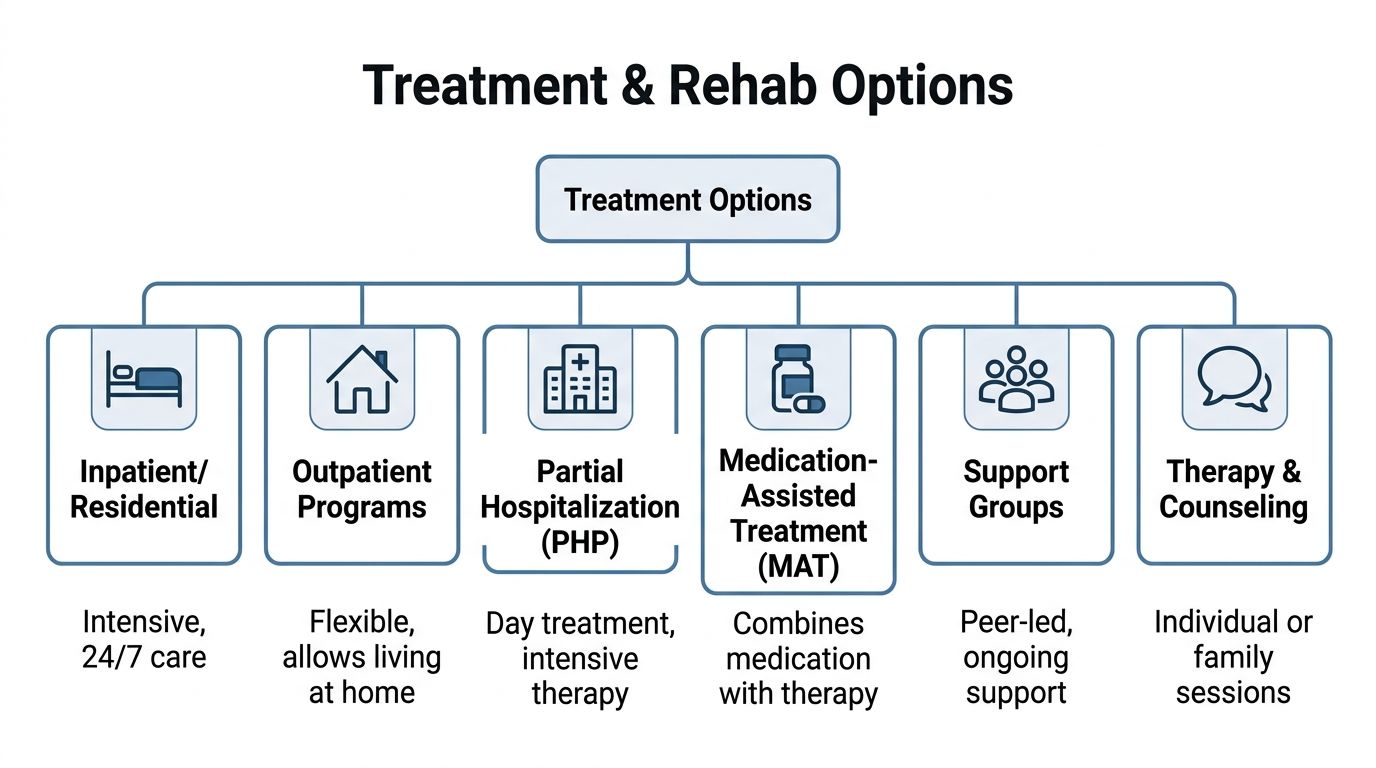
How level of care decisions actually get made
The common treatment options can be easier to understand when families compare them by daily structure and risk.
| Treatment option | Best fit | What families should know |
|---|---|---|
| Inpatient or residential rehab | People with unstable symptoms, high relapse risk, unsafe home environments, or major co-occurring issues | Provides a contained setting with daily structure and distance from triggers |
| Outpatient treatment | People with a stable home environment and lower immediate risk | Allows treatment while living at home, but home conditions must support sobriety |
| Partial hospitalization | People who need intensive daytime care without overnight residential placement | Often a step down from detox or residential treatment |
| Intensive outpatient | People moving into longer-term recovery with ongoing therapy needs | Useful when the person can manage more independence |
| Medication-assisted treatment | Especially important for opioid, alcohol, or certain prescription pill disorders | Uses medication along with therapy, not instead of therapy |
| Family therapy and counseling | Families with conflict, enabling patterns, poor communication, or trust damage | Helps the whole household heal, not just the individual |
Dual diagnosis care deserves special attention. If the person has depression, anxiety, trauma symptoms, panic, or mood instability, addiction treatment alone isn't enough. Families in Dallas often run into trouble when they separate the substance problem from the mental health problem and try to treat one while ignoring the other.
A practical way to think about it is this. If mental health symptoms fuel the substance use, or the substance use worsens the mental health symptoms, both need treatment in the same plan.
Some families also want treatment that includes broader wellness practices alongside clinical care. For a useful overview of that approach, benefits of holistic addiction treatment can help explain why many people do better when recovery includes the body, stress system, and daily routines, not just abstinence.
Why family participation still matters after detox
Families sometimes think the best way to help is to step back entirely once treatment begins. That isn't usually the strongest approach. Healthy participation often improves the odds that treatment will stick.
Research consistently shows that family involvement in substance use disorder treatment leads to better outcomes. When family members participate, treatment engagement increases, and studies show a measurable reduction in substance use. One analysis found that for every dollar spent on family-based treatment, society saves five dollars in reduced healthcare and justice system costs, according to Recovery Answers on family involvement in treatment.
That doesn't mean hovering over every appointment. It means participating in family sessions, learning the recovery plan, understanding medication recommendations, supporting discharge planning, and stopping behaviors that undermine treatment.
A few examples make the trade-offs clearer:
- Helpful support: Joining family therapy, learning relapse warning signs, and asking what kind of communication helps.
- Unhelpful support: Pressuring the person to come home too soon, minimizing psychiatric symptoms, or insisting that detox alone should have fixed everything.
- Helpful support: Coordinating transportation and aftercare while letting clinicians lead the treatment plan.
- Unhelpful support: Demanding discharge decisions based on convenience, work schedules, or family image.
The best families in treatment aren't perfect. They're coachable, consistent, and willing to change their own role in the system.
When a full continuum of care is available, families have a better chance of moving from detox into the right next step instead of scrambling at discharge. That continuity matters in Dallas, where traffic, work demands, insurance details, and home stress can quickly pull someone off course if the plan is vague.
How to Support Recovery and Prevent Relapse
The hardest phase for many families starts after treatment, when daily life returns. The crisis energy fades. Work starts again. Kids need rides. Bills pile up. The person looks better, sounds better, and everyone wants to believe the danger has passed.
That is exactly when old family patterns can subtly restart. A relative stops asking hard questions. A partner softens a boundary to avoid conflict. Someone begins covering for missed therapy or unexplained absences because they don't want another blowup. Recovery usually weakens long before a relapse becomes obvious.

Support vs enabling in real life
Families often understand enabling in theory but struggle with it in practice because fear disguises itself as compassion. The question isn't whether the family loves the person. The question is whether a behavior protects recovery or protects the addiction from consequences.
A simple comparison helps:
| Healthy support | Enabling |
|---|---|
| Driving someone to therapy or meetings | Giving cash with no accountability |
| Allowing them to stay only if house rules are followed | Ignoring use in the home to keep the peace |
| Encouraging honesty after a setback | Accepting obvious lies to avoid conflict |
| Supporting treatment recommendations | Letting them skip care because they "seem fine" |
Research often focuses on getting the patient into treatment but doesn't spend enough time on the family's own recovery needs, especially during relapse. Research also shows that family therapy that reduces enabling and improves communication is highly effective. Because substance use disorders are often linked with psychiatric issues, families in DFW need concrete relapse plans and access to resources like sober living referrals, which are often covered by PPO plans but frequently overlooked, as discussed in this review of family treatment and recovery needs.
That means the family needs its own structure, not just hope. Therapy for relatives, couples counseling when appropriate, support groups, and scheduled check-ins can keep the household from slipping back into chaos.
Families looking for practical aftercare guidance can also review this resource on how to support someone in recovery.
A relapse plan protects the whole household
A relapse plan should be discussed before there is a relapse. Waiting until everyone is scared and angry usually leads to confusion, mixed messages, and avoidable risk.
A workable plan should answer these questions:
- Who notices the warning signs first? It may be a spouse, sibling, parent, or therapist.
- What are the early warning signs in this household? Isolation, irritability, skipped appointments, contact with using peers, sleeping all day, or sudden secrecy.
- What happens if use resumes? The family needs pre-decided responses, not panic-driven ones.
- Where is the next level of care? Detox, outpatient adjustment, sober living, psychiatry, or a higher level of treatment may be needed.
- What boundaries go into effect immediately? No driving children, no cash, no staying in the home while intoxicated, or no access to medications.
A relapse plan isn't pessimistic. It's a safety plan for a chronic condition that can flare under stress.
The family also needs permission to heal independently of the loved one's day-to-day progress. That may be the most overlooked part of long-term recovery. A spouse still needs sleep. A parent still needs support. Children still need predictability. Family recovery isn't selfish. It's how the home stops revolving around active addiction.
Common Questions from Families in Dallas-Fort Worth
What if a loved one refuses help
A refusal today doesn't mean the process is over. It means the family needs a better structure. Calm boundaries, documented consequences, and a more strategic approach often work better than repeated emotional appeals. If the situation is complex or dangerous, professional intervention support may be the right next move.
How can treatment in Dallas be paid for
Many families assume treatment is automatically out of reach and delay making calls because they're afraid of the answer. That mistake costs time. PPO insurance verification can clarify what detox, rehab, dual diagnosis treatment, medication-assisted treatment, and aftercare options may be available. The fastest way to get real cost information is to verify benefits directly with an admissions team.
Will treatment actually work
Addiction is treatable, but results improve when the treatment plan fits the person. Detox alone is usually not enough. Better outcomes come from matching the level of care to the person's needs, addressing mental health symptoms, and keeping the family involved in healthy ways.
Is it normal for the whole family to feel worn down
Yes. Addiction disrupts routines, trust, finances, parenting, and emotional safety. Families often need support of their own, especially after repeated crises or relapses. That isn't weakness. It's part of repairing the system around the person.
What should happen first
If there is a medical emergency, call 911. If there isn't an emergency but the person is ready for help, move quickly to arrange a safe assessment and detox admission. If the person isn't ready, the family should still get guidance, build a plan, and stop waiting for the "perfect" moment.
Families in Dallas-Fort Worth don't need to manage this alone. Tru Dallas Detox & Recovery Center provides medically supervised detox, dual diagnosis care, inpatient and outpatient treatment planning, medication-assisted treatment, and aftercare support from its Euless facility. For a loved one in crisis, the next step is simple. Reach out confidentially, verify PPO insurance, and get a clear plan for safe admission and ongoing recovery.
