
When people talk about addiction recovery, the words “detox” and “rehab” often get thrown around as if they mean the same thing. They don't. While they’re both critical parts of the journey, they serve two very different, very specific purposes.
Think of it this way: detox is the emergency room, and rehab is the long-term physical therapy that follows. One deals with the immediate crisis, while the other rebuilds strength for the future.
Key Takeaways
- Detox vs. Rehab: Detox focuses on safely managing physical withdrawal from substances, while rehab addresses the psychological and behavioral roots of addiction.
- Sequential Process: Detox must come first to stabilize the body. Attempting the deep therapeutic work of rehab during physical withdrawal is ineffective and often dangerous.
- Different Goals: The goal of detox is medical safety and physical stability. The goal of rehab is to build coping skills for long-term sobriety.
- Varying Durations: Detox is a short-term intervention, typically lasting a few days to two weeks. Rehab is a longer commitment, usually 30 to 90 days or more.
- Professional Guidance is Essential: Both stages require expert care. Medical staff are crucial for a safe detox, while licensed therapists and counselors lead the way in rehab.
Understanding the First Steps in Recovery
Starting the journey to get sober can feel overwhelming, and a big part of that confusion comes from not knowing where to begin. Getting clear on the roles of detox and rehab is the first, most important step in making a plan that actually works.
The Two Pillars of Treatment
So, what's the core difference? Detox is a short-term, medically intensive process focused entirely on getting the substance out of your system safely. Its job is to manage the often-dangerous physical withdrawal symptoms. Rehab, on the other hand, is the longer-term therapeutic work that follows. It's where you dig into the behaviors, thought patterns, and emotional issues that fuel addiction.
Here’s a simple breakdown of how they stack up:
| Criterion | Medical Detox | Rehabilitation (Rehab) |
|---|---|---|
| Primary Goal | Physical stabilization and withdrawal management | Psychological healing and behavioral change |
| Typical Duration | A few days to two weeks | 30 to 90 days, or longer |
| Main Focus | The body's immediate needs | The mind's long-term health |
| Professional Role | Medical supervision and clinical care | Therapy, counseling, and skill-building |
This isn't just a technicality; it’s a practical reality. Trying to jump into the deep emotional work of rehab while your body is still in the throes of withdrawal is like trying to run a marathon with the flu. It’s not just ineffective—it can be dangerous. Your mind simply can't focus on healing when your body is in crisis mode.
"Detox addresses the 'what'—the physical substance in your system. Rehab addresses the 'why'—the reasons you turned to it in the first place. Both are absolutely essential for a complete recovery."
At Tru Dallas Detox & Recovery Center, we built our entire approach around this understanding. We guide clients through the full continuum of care, starting with a medically monitored detox to get them physically stable. Once that foundation is solid, they can transition smoothly into our rehab programs to begin the real work of building a sober life. This integrated model ensures you have the right support at the right time, every step of the way.
What Is Medical Detox?
Medical detox is the very first step on the road to recovery. Think of it as hitting the reset button for your body. The entire focus is on one thing: safely managing the physical fallout when you stop using a substance. It's a controlled, medically supervised environment where drugs or alcohol can clear out of your system while a clinical team manages the withdrawal symptoms, which can range from deeply uncomfortable to life-threatening.

This isn't just about "waiting it out." It's an active process involving constant medical oversight to keep you safe and as comfortable as possible. For anyone with a serious physical dependence on substances like alcohol, opioids, or benzodiazepines, trying to detox on your own is not just a bad idea—it can be incredibly dangerous.
Why Unsupervised Withdrawal Is So Risky
Quitting "cold turkey" without professional help can spin out of control quickly, leading to serious medical emergencies. Depending on what substance you’re coming off of, the risks are very real:
- Severe Dehydration: Constant vomiting and diarrhea can quickly lead to dangerous levels of dehydration.
- Seizures: This is a common and potentially fatal risk, especially when withdrawing from alcohol and benzodiazepines.
- Hallucinations: Disconnecting from reality can cause erratic, unpredictable, and unsafe behavior.
- Cardiac Distress: Wild swings in heart rate and blood pressure put an enormous strain on the heart.
Given these dangers, a structured medical detox isn't just recommended; it's essential for a safe start to recovery.
The Three Stages of Medical Detox
People often get detox and rehab confused, but their purpose and timeline are completely different. Detox is all about the body, managing the immediate physical crisis of withdrawal over a short period—usually a few days to two weeks. Rehab, on the other hand, is a much longer process that dives into the psychological and behavioral roots of addiction.
At a dedicated facility like Tru Dallas Detox & Recovery Center, the detox process is broken down into three distinct stages:
- Evaluation: The moment you walk in, our medical team conducts a complete assessment of your physical and mental health. This isn't a one-size-fits-all plan; it's the blueprint for your unique care.
- Stabilization: This is the core of detox. Our clinicians use medications and round-the-clock support to manage withdrawal symptoms, keeping you safe and minimizing discomfort.
- Transition: Once you are physically stable and the worst is over, the team doesn't just send you on your way. We start preparing you for the most important part of your recovery: transitioning smoothly into a comprehensive rehab program.
Detox isn't a cure for addiction. It's the critical preparation needed to do the real work of recovery. It stabilizes the body so the mind has a chance to heal.
This is the key takeaway. Detox breaks the physical hold of a substance, but it does absolutely nothing to address the why behind the addiction. That’s where rehabilitation comes in.
What Is Rehabilitation or Rehab?
If medical detox is all about healing the body, then rehabilitation—or rehab—is where you begin to heal the mind. Think of it this way: detox breaks the physical grip of addiction, but rehab is where you learn how to live freely without it. This is a structured, comprehensive treatment program designed to get to the heart of the psychological and behavioral patterns that fuel substance use.

This is where the real, long-term work of recovery begins. The goal is to give you the tools to understand the root causes of your addiction, develop healthier ways to cope with life, and build a solid foundation for a sober future. In short, rehab teaches you how to navigate challenges without turning back to drugs or alcohol.
The Core Components of Effective Rehab
Rehab isn't just one thing; it's a powerful combination of therapies, support systems, and skill-building exercises all working in concert. At Tru Dallas Detox & Recovery Center, our programs are built on proven, evidence-based practices that focus on healing the whole person. It’s this multi-layered approach that drives lasting change.
A good rehab program will almost always include:
- Individual Therapy: These are your one-on-one sessions with a licensed therapist. It's a safe space to dig into personal triggers, work through past trauma, and address underlying mental health issues like anxiety or depression.
- Group Therapy: Here, you'll connect with peers who understand what you're going through. Sharing experiences in a supportive group setting helps break down the sense of isolation that so often comes with addiction.
- Cognitive Behavioral Therapy (CBT): This is a game-changer. CBT is a practical technique that helps you identify and rewire the destructive thought patterns and behaviors tied to your substance use.
- Holistic Treatments: We also incorporate activities like yoga, meditation, and art therapy. These practices support your mental and emotional well-being, helping to bring your mind, body, and spirit back into alignment.
Rehab moves far beyond just stopping drug or alcohol use. It’s about rebuilding a life where substances are no longer the answer. It addresses the "why" behind the addiction, not just the "what."
Understanding what happens in rehab helps demystify the experience, showing that it’s less about restriction and more about personal growth and empowerment.
Why Rehab Is the Necessary Next Step
Let’s be direct: without rehab, the risk of relapsing after detox is incredibly high. Study after study confirms that detox alone is rarely enough for long-term sobriety. Why? Because it doesn't touch the psychological cravings or the ingrained behavioral habits that keep addiction going.
Rehab is where you get equipped with practical, real-world strategies for relapse prevention. It provides a safe, structured environment to practice new skills before you have to face the triggers of everyday life. This is where you learn to manage stress, communicate your needs, and build a new life centered on health and purpose. It’s an absolutely indispensable part of the recovery journey.
Comparing Detox and Rehab: Key Differences
It’s easy to use the terms “detox” and “rehab” interchangeably, but they represent two very different—and equally critical—stages of the recovery journey. Think of it this way: detox is the emergency medical response for the body, while rehab is the long-term therapeutic process for the mind.
One handles the immediate physical crisis of withdrawal, and the other addresses the underlying reasons addiction took hold in the first place. You can't have one without the other for a real shot at lasting sobriety. Let's break down exactly what sets them apart.
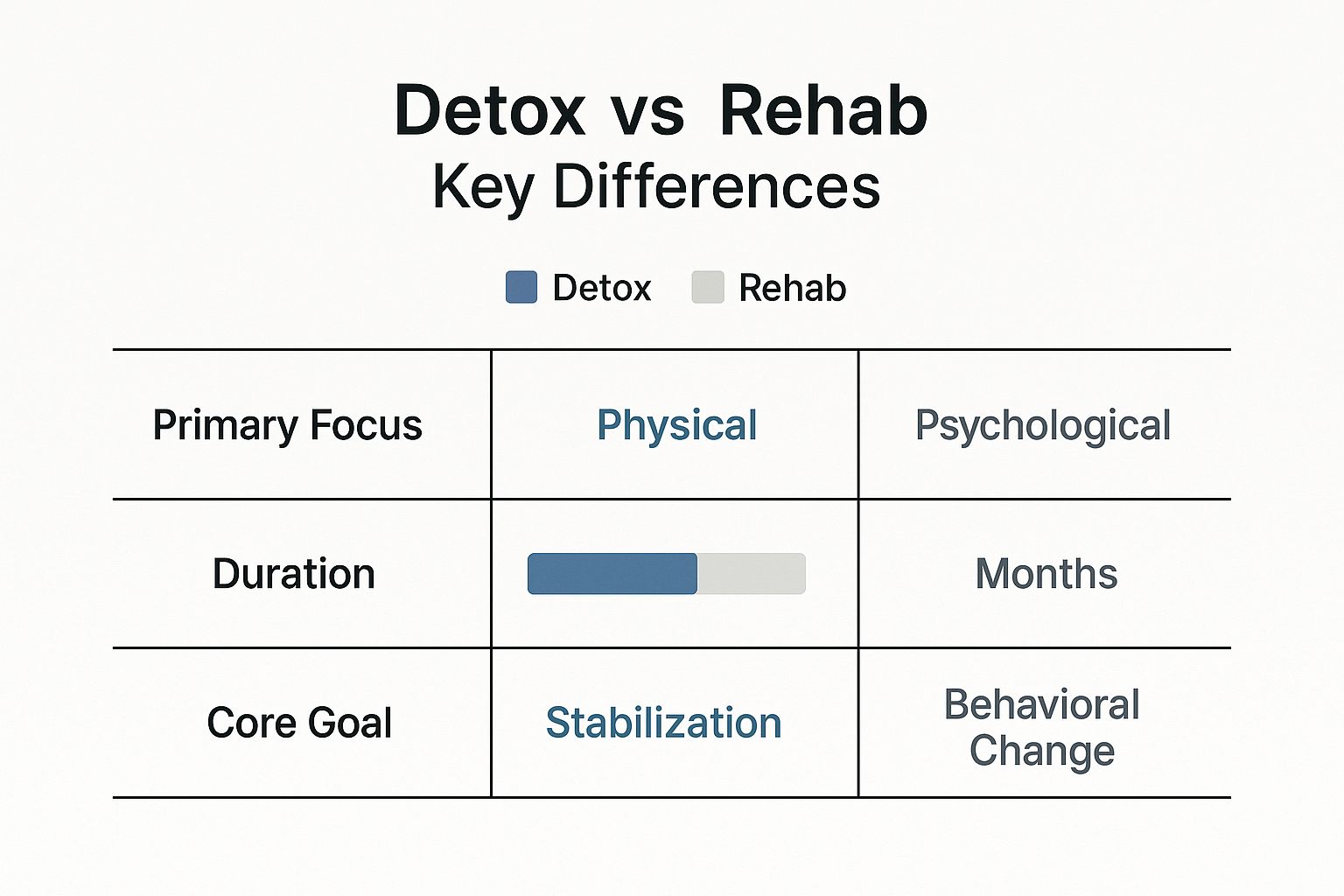
As you can see, detox is about surviving the first few days, while rehab is about building a new life for the months and years ahead.
Primary Focus: Physical vs. Psychological
The biggest distinction lies in what each process targets. Medical detox is purely physical. Its one and only job is to get you through the acute phase of withdrawal safely. The entire focus is on managing symptoms, preventing medical complications, and getting your body stabilized after you stop using.
Rehab, on the other hand, pivots to the psychological and behavioral side of addiction. This is where you dig into the "why." You start exploring the thought patterns, emotional triggers, and core issues that fueled the substance use. It's where the real healing work begins.
Duration and Timeline
Their timelines are also worlds apart. Detox is short and intense, usually lasting anywhere from a few days to two weeks. The exact duration really depends on the substance, how long you've been using, and your overall health.
Rehab is a much longer game. Programs typically run for 30, 60, or 90 days—and sometimes even longer. You need that extended time to truly unpack deep-seated issues, learn new ways to cope, and practice building healthy routines you can take with you.
Detox is the sprint that gets you to the starting line; rehab is the marathon of recovery that helps you finish the race. One is impossible without the other.
Core Goals and Intended Outcomes
Naturally, their goals are completely different.
- Detox Goal: Stabilization. The mission here is singular: get the person through withdrawal without dangerous medical issues. Success is measured by the patient becoming physically stable and free from acute withdrawal symptoms.
- Rehab Goal: Behavioral Change. The aim is to give you the mental and emotional tools for lifelong sobriety. This means understanding your triggers, building healthy coping skills, and healing the root causes of your addiction. Success is measured by your ability to build a meaningful life without substances.
The data backs this up. When detox is followed by rehab, success rates jump significantly. It’s proof that combining medical stabilization with therapeutic work is the key. You can read more about these crucial addiction treatment success rates to see why both steps are vital.
At Tru Dallas Detox & Recovery Center, we designed our programs to ensure a seamless transition from one phase to the next. This integrated approach gives our clients a complete continuum of care without any gaps.
Detox vs. Rehab A Side-by-Side Comparison
This table highlights the fundamental distinctions between medical detox and rehabilitation, showing how each plays a unique and necessary role in the recovery process.
| Criterion | Medical Detox | Rehabilitation (Rehab) |
|---|---|---|
| Primary Goal | Medically supervised, safe withdrawal from substances. | Addressing the psychological and behavioral roots of addiction. |
| Focus | Physical stabilization and symptom management. | Emotional healing, skill-building, and relapse prevention. |
| Timeline | Short-term: 5-14 days on average. | Long-term: 30, 60, or 90+ days. |
| Environment | Clinical, hospital-like setting with 24/7 medical monitoring. | Therapeutic, structured community with counseling and therapy sessions. |
| Staff | Medical doctors, nurses, and addiction specialists. | Therapists, counselors, psychologists, and support staff. |
| Outcome | The body is free from substances and physically stable. | The individual has new coping skills and a relapse prevention plan. |
Ultimately, detox prepares you for the journey, but rehab gives you the map and teaches you how to navigate the road ahead.
Choosing the Right Path: Detox or Rehab?
https://www.youtube.com/embed/g9W2msBUlvk
When you're ready to start the journey to recovery, figuring out where to begin—detox or rehab—can feel overwhelming. But the answer is usually more straightforward than it seems. It’s not really a choice between one or the other; it’s about understanding the proper sequence. The first step almost always comes down to one simple question: is your body physically dependent on a substance?
For a lot of people, the path has to start with medical detox. If you're physically hooked on certain substances, this isn't just a suggestion—it's a critical first step to ensure your safety.
When Detox Is the Essential First Step
You absolutely must start with a medically supervised detox if your body goes into physical withdrawal when you try to stop using. This is especially true for substances where the withdrawal symptoms can be dangerous or even life-threatening.
- Alcohol: Trying to quit cold turkey can trigger seizures, hallucinations, and a severe condition called delirium tremens (DTs), which can be fatal.
- Opioids (Heroin, Fentanyl): While withdrawal isn't usually deadly, it's an incredibly painful and grueling experience. The sheer agony makes relapse almost a certainty without medical help.
- Benzodiazepines (Xanax, Valium): Much like alcohol, stopping suddenly can cause dangerous seizures and requires a slow, medically managed tapering process.
In these cases, detox isn't just a good idea; it's a medical necessity. It stabilizes your body so you can even begin to think about the psychological healing that comes next.
When to Move on to Rehab
Rehab is the crucial second step for anyone serious about long-term recovery. Once the acute physical withdrawal is over and your body is stable, the real work begins. You should transition directly into a rehab program to get to the root of why the addiction took hold in the first place.
This is where you learn to handle the psychological cravings, figure out your personal triggers, and build a toolkit of healthy coping skills to manage life's stresses. Rehab gives you the strategies to rebuild your life without turning back to substances. There are different levels of care, and you can learn more about them by exploring the difference between inpatient and outpatient treatment.
"Self-diagnosing the appropriate level of care is a dangerous gamble. A professional clinical assessment is the only reliable way to determine whether you need medically supervised detox, rehab, or a combination of both to start your recovery safely and effectively."
This one-two punch of detox followed by rehab is a proven model. We see evidence of its success globally, where countries like Germany and the Netherlands have better outcomes in addiction treatment because they focus on seamlessly integrating detox and rehab services. Their approach shows that combining these two phases under one supportive umbrella dramatically improves recovery rates.
The Bottom Line
Figuring out the difference between detox and rehab is a massive first step toward getting well for good. To put it simply, here are the core ideas to hold onto as you navigate this process.
- Detox is for the body. Its entire focus is on getting you through physical withdrawal safely, with medical professionals managing the symptoms.
- Rehab is for the mind. This is where the real work of healing happens, tackling the deep-seated psychological and behavioral reasons behind addiction.
- Detox comes first. For anyone with a physical dependency, your body has to be stable before your mind can truly show up for therapy. It's a necessary sequence.
- You need both. Going through detox without following it up with rehab is like patching a leaky pipe without turning off the water. The odds of relapse are incredibly high.
- Let an expert guide you. Don't try to figure this out on your own. A proper clinical assessment is the only safe way to know where you need to start.
At Tru Dallas Detox & Recovery Center, we understand this sequence is vital. We provide a complete continuum of care, ensuring a seamless and supportive transition from medically supervised detox into our comprehensive rehab programs. This integrated approach removes the guesswork and provides a clear, effective path toward lasting recovery. We can help you determine the right starting point for your journey and answer any questions you have. Contact us for a confidential assessment and learn how we can help.
Frequently Asked Questions
What is the primary difference between detox and rehab?
Detox focuses on the body. Its main goal is to safely manage the physical symptoms of withdrawal under medical supervision. Rehab focuses on the mind. It is a therapeutic process designed to address the psychological and behavioral reasons for addiction, teaching you skills for long-term sobriety.
Can I just do detox and skip rehab?
While you can, it's highly discouraged. Detox only addresses the physical dependency on a substance. Without rehab, the underlying emotional triggers and behavioral patterns that caused the addiction remain untreated, making the risk of relapse extremely high. True recovery requires both steps.
Which substances require a medical detox?
Medical detox is essential for substances where withdrawal can be dangerous or life-threatening. This includes alcohol and benzodiazepines (like Xanax and Valium), as quitting can cause seizures. While not typically fatal, withdrawal from opioids (like heroin or fentanyl) is intensely painful, and medical detox makes the process manageable and safer.
How long does the entire detox and rehab process take?
The timeline is different for everyone. Generally, medical detox lasts from 5 to 14 days. Following that, a residential or outpatient rehab program typically runs for 30, 60, or 90 days. The ideal duration depends on the individual's specific needs, substance use history, and overall health.
Will my insurance cover detox and rehab?
Yes, most major health insurance plans provide coverage for both medical detox and addiction rehabilitation services. Substance use disorder is a recognized medical condition, and treatment is considered an essential health benefit. To understand your specific coverage, you can reach out for a confidential verification of your benefits.