
A speedball is the dangerous and often lethal combination of a stimulant like cocaine with an opioid depressant like heroin or, increasingly, fentanyl. In the United States, 107,000 people died from drug overdoses in 2021, and polysubstance combinations involving opioids represented the majority of fatal cases, which is why speedballing demands immediate medical attention and not guesswork at home (CDC and NIDA summary on speedball overdose risk).
For many people in Dallas, this question doesn't come up in a classroom. It comes up after a frightening phone call, a loved one passed out in a bathroom, or a sudden change in behavior that doesn't make sense. Someone may seem wired and half-asleep at the same time. They may insist they're fine when they clearly aren't.
That's what makes speedballing so dangerous. It confuses the person using it, the family watching it happen, and sometimes even the people trying to help in the first few moments of a crisis. The right response isn't judgment. It's fast action, medical care, and a clear plan for what happens next.
Table of Contents
- What Exactly Is a Speedball
- Why Speedballing Is So Dangerous The Body Under Siege
- Recognizing the Signs of Speedball Use and Overdose
- The Overlooked Crisis of Speedballs and Mental Health
- How to Get Help Now Medically Supervised Detox in Dallas
- Building a Lasting Recovery at Tru Dallas Detox
- Your Questions About Speedball Treatment in Dallas Answered
What Exactly Is a Speedball
A man in Dallas thinks he is taking one drug to stay up and another to take the edge off. Within a short window, he is dealing with a combination that can shut down breathing, strain the heart, and turn into a medical emergency before anyone around him realizes what is happening.
A speedball is the use of a stimulant and an opioid together. The classic combination is cocaine and heroin. The term is also used now for mixes that involve methamphetamine, fentanyl, or other opioids sold in an unpredictable street supply.
That shift matters. In clinical practice, the question is no longer just, "What drugs were intended?" It is also, "What was in the bag or pill?" A person may believe they used only a stimulant and still be exposed to an opioid.
The classic mix and the current reality
People use this combination for a reason. The stimulant can create energy, alertness, and confidence. The opioid can bring euphoria, pain relief, and sedation. Some people chase both effects at once. Others try to blunt the crash from a stimulant or offset the heavy sedation of an opioid.
The trade-off is severe and often deadly.
The brain, heart, and lungs do not experience this as a balanced mix. They experience opposing drug effects at the same time. That makes the response harder to predict, especially when fentanyl or other synthetic opioids are involved.
A speedball may be injected or snorted. Route changes how fast the effects hit. It does not make the combination safe.
Why the definition matters in Dallas-Fort Worth
A speedball is not a fixed recipe. It is a dangerous category of drug use. High-profile overdoses and medical emergencies have brought public attention to it for years, but the current risk is broader than many families realize because the illicit supply is inconsistent and opioid contamination is common.
Some people still use the word "speedball" as if it describes a known formula. In reality, a person may not know the full contents of what they took.
That is why residents across Dallas-Fort Worth need a practical answer to "whats a speedball," not just a dictionary definition. If cocaine, methamphetamine, heroin, fentanyl, or counterfeit pills are part of the picture, the safest response is to treat the situation as urgent and get professional help fast.
At Tru Dallas Detox, we see the same pattern again and again. People wait because they think they can judge the risk based on past use. Street familiarity does not protect against a contaminated supply, and tolerance to one substance does not protect against the effects of another. The right next step is medical evaluation, supervised detox, and a treatment plan that deals with both the drug use and the crash that follows.
Why Speedballing Is So Dangerous The Body Under Siege
A speedball creates a chemical conflict inside the body. One drug pushes the nervous system into overdrive while the other suppresses breathing, alertness, and protective reflexes. In the ER and detox setting, this combination is dangerous because it hides how unstable the person has become until the crash is already underway.
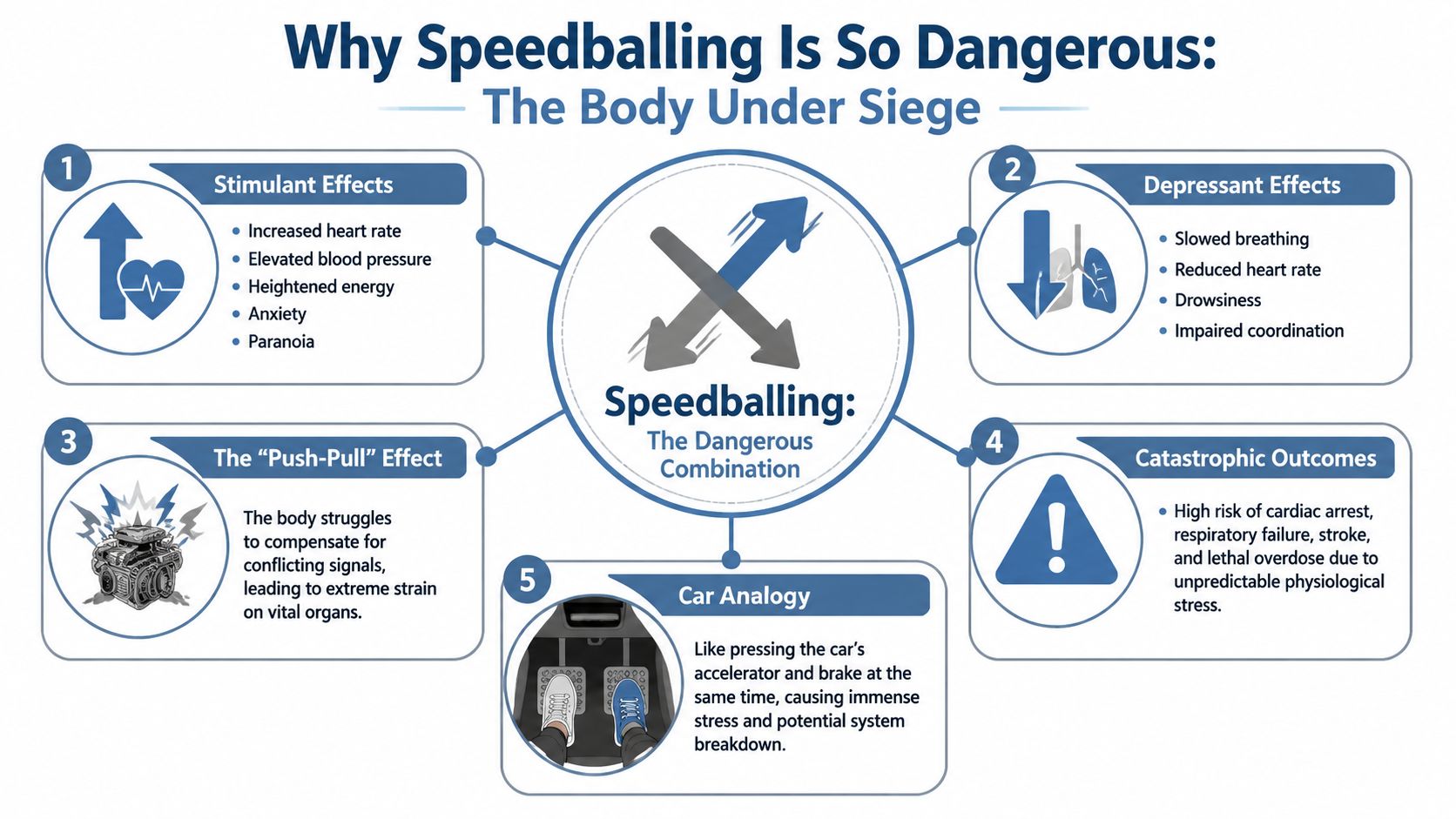
A stimulant such as cocaine can raise heart rate, blood pressure, body temperature, and agitation. An opioid such as heroin or fentanyl can slow breathing, cloud consciousness, and reduce oxygen delivery to the brain. Those effects do not balance each other. They stack risk on top of risk.
The result is intense strain on the heart, lungs, and brain. I have seen families misread the stimulant side as a sign that the person is still "okay." That is one of the most dangerous parts of speedball use. Someone can be talking, moving, or resisting help while their breathing is already becoming inadequate.
Why the push-pull effect turns deadly
The danger often shows up in stages. Early on, the stimulant can mask some of the opioid's sedating effects. Later, as the stimulant wears off, the opioid remains active. That is when breathing may slow sharply, oxygen can drop, and overdose can become obvious too late.
This pattern creates a false sense of control. A person may feel more alert than they truly are, use more than intended, or refuse help because they do not recognize how much danger they are in.
Practical rule: If someone becomes quieter, sleepier, or harder to wake after using a stimulant with any suspected opioid, treat it as a medical emergency.
For families in Dallas-Fort Worth, the safest move is not to debate what was taken or wait for a clearer picture. Call 911, give naloxone if available, and review the signs of a fentanyl overdose so you know what requires immediate action. After emergency care, professional detox matters because the medical risk does not end when the first crisis passes.
Why fentanyl changes the equation even more
Fentanyl has made speedball use more lethal and less predictable. It may be present in heroin, cocaine, counterfeit pills, or multiple substances at once. Many people do not know they were exposed until breathing slows or they lose consciousness.
Here is the practical problem for families and first responders:
| Drug effect | What it may look like at first | What happens as risk rises |
|---|---|---|
| Stimulant effect | Energy, agitation, rapid speech, restlessness | Cardiac strain, panic, overheating, erratic behavior |
| Opioid effect | Drowsiness, nodding, slowed reaction, constricted awareness | Slowed breathing, low oxygen, unconsciousness |
| Combined effect | Mixed signals, uneven alertness, confusion | Respiratory failure, collapse, fatal overdose |
A speedball overdose does not always look neat or obvious. It can look confused, contradictory, and fast-changing. That is why people in DFW need more than information. They need a local medical response plan.
At Tru Dallas Detox, we help patients get through the immediate crash safely and start treatment before another emergency happens. The trade-off is simple. Trying to ride it out at home saves time in the moment but raises the chance of respiratory failure, cardiac complications, and another overdose. Medically supervised detox gives patients monitoring, stabilization, and a real path back.
Recognizing the Signs of Speedball Use and Overdose
Loved ones usually notice that something is off before they know what they're seeing. A person may cycle between talking quickly and drifting off. They may appear agitated, then suddenly detached. They may insist they're sober enough to manage, even while their body is clearly struggling.

The signs below aren't meant to help someone diagnose a loved one at home. They're meant to help people in Dallas recognize when the situation may involve a dangerous stimulant-opioid mix and when hesitation could cost time.
What speedball use can look like
- Extreme shifts in energy: The person may swing between being unusually talkative or restless and then becoming drowsy or slowed down.
- Confusion or incoherence: Sentences may not track. Attention may drift. They may seem mentally "elsewhere."
- Paranoia or panic: Suspicion, agitation, and fear can rise quickly, especially during the stimulant phase.
- Visible sedation: Nodding off, heavy eyelids, slowed responses, and poor coordination can show that the opioid side is taking over.
- Mixed physical cues: Fast movement paired with shallow breathing, or agitation paired with lethargy, should raise concern.
When it's an overdose and 911 needs to be called
Call 911 immediately if any of the following are happening:
- Unresponsiveness: The person won't wake up, can't answer, or slips back out of consciousness.
- Slow, shallow, or stopped breathing: This is one of the most dangerous signs.
- Blue or purple lips or fingernails: This can indicate low oxygen.
- Gurgling or choking sounds: Families often describe this as strange snoring or a wet, struggling sound.
- Cold or clammy skin: The person may feel unusually cool and look pale.
Tell dispatch and first responders that a stimulant-opioid combination may be involved. That information matters.
A 2019 DEA finding on fentanyl-cocaine "super speedballs" noted they contributed to a 30% rise in polydrug overdose deaths. That same clinical summary explains why medical teams use continuous monitoring during detox, because oxygen levels can fall quickly and early intervention matters.
For families trying to learn the warning signs of opioid toxicity, this guide on signs of fentanyl overdose can help clarify what an emergency often looks like.
If a person might be overdosing, the worst move is to wait for them to "sleep it off."
The Overlooked Crisis of Speedballs and Mental Health
Many people who ask whats a speedball aren't only asking about the drug mix. They're also trying to understand behavior that has become darker, more unstable, and more frightening over time. Anxiety gets worse. Mood swings intensify. Depression deepens. Panic appears out of nowhere.
That's not a side issue. It's often part of the cycle that keeps the person trapped.
Why people may use it to self-medicate
Some people combine a stimulant and an opioid because they want to manage two kinds of suffering at once. They want the energy, confidence, or numbness from the stimulant. They also want the relief, calm, or emotional shutdown that comes with an opioid.
That can feel effective for a brief period. Then the crash hits.
According to NIDA-related findings on substance use and co-occurring mental health conditions, over 60% of substance users have a comorbid mental health condition such as depression or PTSD. The same source notes that cocaine's effects can wear off in 20 to 30 minutes, and that this crash can trigger panic attacks or suicidal ideation in 25 to 40% of cases while the opioid's depressive effects remain.
That pattern is one reason families in Dallas often describe a loved one as seeming emotionally unreachable after repeated polysubstance use. The person may not just be intoxicated. They may be cycling through fear, dysphoria, hopelessness, and physical dependence all at once.
Why detox alone often isn't enough
A person can survive withdrawal and still remain at high risk if the mental health side isn't treated. If anxiety, depression, PTSD symptoms, bipolar symptoms, or trauma responses keep driving the urge to use, then detox only addresses the first emergency.
A more durable plan usually needs to address both conditions together:
- Substance use treatment: Medical stabilization, withdrawal support, relapse prevention
- Mental health care: Therapy, psychiatric assessment, medication management when appropriate
- Integrated planning: One treatment strategy instead of two disconnected ones
- Aftercare support: Ongoing structure after discharge, when triggers return
For readers looking for a clearer explanation of that overlap, this resource on mental health and substance abuse breaks down why dual diagnosis care matters so much.
Treating only the drug use and ignoring the mental health condition often leaves the main relapse trigger in place.
How to Get Help Now Medically Supervised Detox in Dallas
When a person has been using a stimulant and an opioid together, home detox is a bad gamble. Families often hope they can supervise it themselves for a night or a weekend. That approach can miss respiratory problems, cardiac complications, severe agitation, dehydration, and rapid changes in mental status.
In Dallas-Fort Worth, the urgency is not abstract. A clinical summary focused on stimulant-opioid combinations in Dallas reports that over 1,200 annual deaths in the Dallas metro are linked to stimulant-opioid combinations. That same source explains why advanced detox protocols matter, including pre-detox toxicology to identify adulterants like fentanyl and individualized medication planning to reduce dangerous complications.

Why home detox is a bad gamble
What doesn't work well:
- Watching and waiting: Families may mistake sedation for rest.
- Trying to taper without medical support: Street drug content is unpredictable.
- Treating only visible symptoms: The most dangerous changes may be happening in breathing, oxygenation, or cardiac stress.
- Separating addiction from mental health: Panic, suicidal thoughts, and severe mood symptoms can intensify during withdrawal.
What works better is a medical setting built for uncertainty. With polysubstance use, clinicians need to assume the drug content may not match what the person thought they took.
What medically supervised detox actually does
A structured detox program in Dallas can provide several protections at once:
- Continuous monitoring so respiratory or cardiovascular changes are recognized early.
- Medication support for the opioid component when clinically appropriate.
- Toxicology-informed care to help identify fentanyl or other adulterants.
- Immediate response capability if symptoms escalate.
- A direct handoff into further treatment instead of discharge into the same crisis that started the cycle.
For readers who want a practical overview, this guide to medically supervised detox in Dallas and what to expect explains the process in more detail.
The first goal isn't to solve a person's whole life in one day. It's to keep them alive, stabilize them safely, and create enough clarity for real treatment to begin.
Building a Lasting Recovery at Tru Dallas Detox
Detox is the beginning. It isn't the full treatment plan. A person recovering from speedball use usually needs care that accounts for opioid dependence, stimulant cravings, mental health stress, relapse triggers, and the practical realities of returning to daily life in Dallas-Fort Worth.

What recovery has to include after detox
A strong plan usually combines several layers of care rather than relying on willpower alone.
| Recovery need | Why it matters | What helps |
|---|---|---|
| Opioid stabilization | Cravings and withdrawal can pull a person back quickly | Medication-assisted treatment when appropriate |
| Stimulant recovery work | The person may chase energy, confidence, or escape | Behavioral therapy and relapse prevention planning |
| Mental health treatment | Anxiety, depression, trauma, or bipolar symptoms may fuel use | Dual diagnosis care |
| Daily structure | Unstructured time and familiar environments can trigger relapse | Inpatient care, outpatient care, therapy schedules, aftercare |
People often ask whether motivation is enough. Motivation helps. It doesn't monitor oxygen levels, treat withdrawal, manage medications, rebuild coping skills, or repair the damage caused by repeated crises.
What families in Dallas should do next
Families usually help most when they focus on action instead of arguments.
- Call promptly: Waiting for the "right moment" often extends the danger.
- Ask about assessment and detox first: The first safe step matters more than promises about long-term change.
- Verify insurance early: That removes one of the most common barriers to admission.
- Support treatment, not negotiation: Recovery tends to move forward when care is concrete, not conditional on one more chance at home.
Recovery becomes more realistic when the person has structure, medical support, and a plan for what happens after the first few days.
For anyone in Dallas, Euless, Fort Worth, Arlington, Irving, or the surrounding area, the best next move is a confidential conversation with a treatment team that can assess urgency, explain options, and help with admission logistics.
Your Questions About Speedball Treatment in Dallas Answered
How long does detox usually take
It depends on the substances involved, how recently the person used, whether fentanyl may be present, the person's medical history, and whether there are mental health symptoms that need stabilization. With speedball use, clinicians don't treat detox as a one-size-fits-all timeline. They watch the actual symptoms and adjust care accordingly.
Will insurance cover treatment
Many people with PPO insurance have some level of coverage for detox or addiction treatment in Dallas. The fastest way to get a real answer is to verify benefits directly with the treatment center, because coverage varies by plan, authorization requirements, and level of care.
What's the difference between inpatient and outpatient care
Inpatient care provides a structured setting with round-the-clock support. Outpatient care allows the person to live at home while attending treatment on a schedule. For someone coming off a dangerous stimulant-opioid pattern, inpatient detox is often the safer starting point when symptoms are acute, the home environment is unstable, or relapse risk is high.
What can family members do right now
Keep the response simple and immediate:
- If overdose is suspected, call 911: Don't wait for the person to wake up fully.
- Use naloxone if it's available: Opioids may be part of the mix even if the person denies it.
- Avoid debates during crisis moments: Focus on safety first.
- Document what is known: What they used, when they used it, what symptoms started, and any medications or substances nearby.
- Reach out for professional guidance: Families don't need to manage this alone.
The most important message is also the most hopeful one. Speedball use is extremely dangerous, but it is treatable. With fast intervention, medical detox, and follow-through into ongoing care, people do find their way back.
If someone in Dallas or the surrounding DFW area is struggling with speedball use, help is available now at Tru Dallas Detox & Recovery Center. The team provides confidential guidance, medically supervised detox, support for co-occurring mental health needs, and help verifying insurance so the next step feels clear instead of overwhelming.
