

A family in Dallas often reaches this point without fanfare. Dinner gets cold. A phone goes unanswered. Someone arrives late, leaves early, or shows up looking unlike themselves. At first, the family explains it away. Stress. Work. A rough patch. Then the pattern hardens, and the question changes from “Is something wrong?” to “What can we do?”
That's usually when people start searching for what is intervention. They don't need drama. They need a plan. They need to know whether an intervention means forcing, accusing, or humiliating someone they love. It doesn't.
An addiction intervention is best understood as a structured way to interrupt a dangerous pattern and connect a person to treatment without waiting for things to get worse. For many families, it also becomes the first time everyone stops reacting and starts acting together.
Table of Contents
- Watching a Loved One Struggle is Heartbreaking
- What an Addiction Intervention Is and Is Not
- Common Types of Interventions for Addiction
- Signs It's Time to Consider an Intervention
- How to Plan an Effective Intervention
- Why Professional Interventionists Are Crucial
- After Yes The Path to Recovery at Tru Dallas
Watching a Loved One Struggle is Heartbreaking
A family in Lakewood, Oak Cliff, Plano, or Arlington might all sound different, but the scene is often the same. One person dominates every conversation without being in the room. Everyone scans their phone. Everyone is waiting for an update, an excuse, or a crisis. Nobody knows the exact right words, and that uncertainty keeps families stuck.
Many relatives already know they can't “love someone out of addiction.” They've tried softer talks. They've tried tougher talks. They've covered rent, called in excuses, watched children, cleaned up messes, and hoped the next scare would be the last one.
When concern turns into paralysis
What makes this stage so painful is the mix of love and fear. Families don't want to push too hard, but they also know doing nothing has become its own decision. Some people begin reading about boundaries, communication, and even strengthening your relationship because addiction affects the whole family system, not just the person using.
The right time to act usually isn't when a family feels fully ready. It's when the cost of waiting has become too high.
An intervention gives that fear somewhere useful to go. It turns scattered worry into a coordinated response. It helps families stop arguing about whether there's a problem and start preparing a safe next step.
Dallas families need a local plan
In the Dallas area, practical details matter. Traffic, distance, work schedules, childcare, and same-day treatment availability can decide whether a “yes” becomes admission. That's why families often benefit from guidance that doesn't just focus on the conversation itself, but on what comes immediately after it.
For relatives who are still trying to understand how to support someone without making the situation worse, this guide on how to help a family member with addiction can clarify what helps and what tends to backfire.
What an Addiction Intervention Is and Is Not
An addiction intervention is a planned conversation in which people close to the individual address substance use and present a clear treatment option. The purpose isn't to punish. The purpose is to break denial, reduce chaos, and create a direct path into care.
It helps to think of it as a bridge. Loved ones build it together so the person struggling with addiction can move from crisis to treatment in one step, not ten.
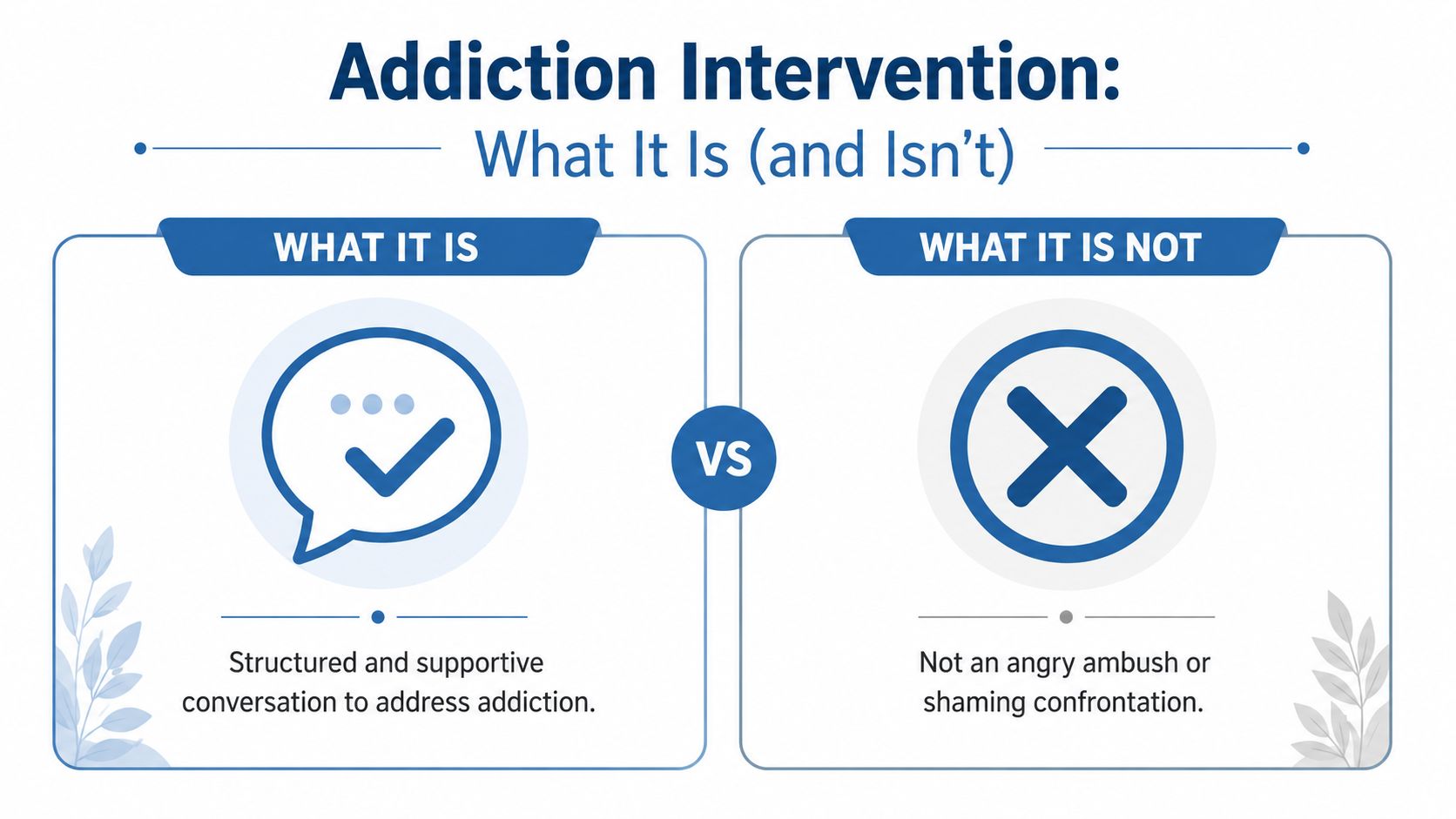
What it is
A good intervention is structured. The participants prepare in advance. They decide who should be in the room, what each person will say, what boundaries will be set, and what treatment option will be offered that same day.
It is also respectful. The language should be direct, but not degrading. Families speak from observed reality. Missed work. Dangerous driving. Isolation. Broken promises. Health decline. Fear in the home.
What it is not
An intervention is not an angry ambush. It isn't a screaming match in the kitchen, a threat made in the middle of an argument, or a vague demand to “get help” without any real plan behind it.
It also isn't repeated nagging. Many families have already spent months saying some version of the same sentence. Stop. Please. Think about the kids. You're ruining your life. Those conversations usually fail because addiction is already controlling the terms of the discussion.
Practical rule: If the family hasn't prepared treatment, transportation, boundaries, and a calm message, they're not planning an intervention yet. They're still in the cycle addiction prefers.
The real target of the conversation
The immediate goal of an intervention is simple. The person agrees to accept help and enter treatment. That first yes matters because addiction often thrives on delay. “Tomorrow” becomes next week, then next month, then after the next crisis.
A professional process keeps the focus where it belongs. Not on winning an argument. Not on forcing confession. On creating a moment where help is close enough, organized enough, and clear enough that the person can step into it.
Common Types of Interventions for Addiction
Not every family should use the same intervention style. Personality, mental health concerns, family conflict, safety issues, and the person's level of denial all shape the approach. That's one reason families searching for what is intervention often feel confused. The term describes a category of strategies, not one script.
Different models fit different families
Some interventions are more direct. Others are more invitational and gradual. What works in one Dallas household may fail completely in another.
Here's a simple comparison.
| Model | Approach | Best For |
|---|---|---|
| Johnson Model | A planned, direct meeting where loved ones present concerns and an immediate treatment option | Families who need a firm, organized turning point and can stay focused |
| ARISE Model | A more collaborative process that may build over several conversations, often with broader family participation | Families who want to reduce defensiveness and involve the person earlier |
| Family system focused intervention | Centers on patterns in the home, boundaries, communication, and coordinated change among relatives | Families dealing with enabling, conflict, or long-standing instability |
Trade-offs matter
The Johnson Model is often what people picture first. It can be powerful because it creates a clear moment of decision. But it requires preparation, emotional control, and a realistic treatment plan already in place. Without that structure, directness can slide into confrontation.
The ARISE Model tends to feel less like a surprise. That can lower resistance in some families. It can also take longer, which isn't ideal when the person is medically unstable, using high-risk substances, or spiraling fast.
A family system focused intervention helps when addiction has reshaped the whole home. In those cases, the issue isn't only the person using substances. The issue is also the pattern around them. People rescue, hide, finance, excuse, and adapt. That pattern has to change too.
What usually works best
The most effective approach is often the one a family can carry out consistently. A model that looks perfect on paper won't help if one relative can't follow boundaries, another turns the meeting into a grievance session, and treatment hasn't been arranged.
The strongest intervention style is the one that matches the family's reality, not the one that sounds most impressive.
That's why selection matters as much as delivery. The right method should fit the person, the family, and the urgency of the situation.
Signs It's Time to Consider an Intervention
Families often wait for one undeniable disaster. An arrest. An overdose. Job loss. A hospitalization. But addiction usually announces itself long before that. The signs tend to build in clusters.

The pattern is getting harder to ignore
If a loved one promises to cut back but doesn't, minimizes obvious consequences, or becomes defensive every time substance use comes up, the family is no longer dealing with a simple bad habit. They're dealing with a problem that's becoming unmanageable.
Common warning signs include:
- Failed attempts to stop: They say they'll quit, slow down, or only use on weekends, but the pattern keeps returning.
- Neglected responsibilities: Work, parenting, school, or financial obligations begin slipping in visible ways.
- Mood and behavior changes: Irritability, secrecy, withdrawal, or sudden anger become normal.
- Physical decline: Sleep disruption, weight changes, poor hygiene, shaking, or looking unwell show up more often.
- Risk-taking: Driving impaired, mixing substances, disappearing for long periods, or staying in unsafe situations becomes part of the pattern.
- Isolation: They avoid family events, stop answering calls, or only spend time with people connected to substance use.
- Repeated crises: The same emergency keeps happening with different details.
Families often notice these signs too
The person's substance use isn't the only issue to watch. The household changes around it.
- Walking on eggshells: Everyone edits what they say to avoid setting the person off.
- Covering consequences: Relatives lend money, make excuses, or clean up fallout to keep life functional.
- Shifting routines: Holidays, childcare, work schedules, and social plans start revolving around one person's instability.
- Fear as a baseline: Family members stay alert, waiting for the next call, lie, or emergency.
If the family is spending more time managing the addiction than the person is, the situation has already crossed a serious line.
When to stop waiting
An intervention should be considered when concern has become a repeating pattern and ordinary conversations no longer lead to change. Waiting for certainty often means waiting for more harm. In Dallas and the wider Fort Worth area, families often feel pressure to “give it one more chance.” Addiction usually uses that extra chance to dig in deeper.
The threshold doesn't have to be catastrophe. It can be repeated evidence that the person can't or won't get help on their own.
How to Plan an Effective Intervention
A successful intervention doesn't begin with a speech. It begins with planning. Families need structure because addiction is chaotic, and chaos wins when preparation is weak.

According to the Association of Intervention Specialists on intervention success rates, interventions for substance use disorders demonstrate a success rate of 80-90% when measured by whether individuals agree to enter treatment. That matters because the main barrier for many families isn't knowing treatment exists. It's getting a loved one to accept it.
Start with professional guidance
The first move shouldn't be gathering everyone in the living room. It should be contacting a qualified intervention professional who can assess safety, family dynamics, and urgency.
A trained specialist helps decide:
- Who belongs in the process
- Which intervention style fits best
- Whether mental health or medical risk changes the plan
- How to prepare for resistance, manipulation, or walkouts
Families often want to act fast. Speed matters, but random action doesn't help. A rushed, emotional confrontation can make the next attempt harder.
Build the right team
The intervention team should be small, credible, and emotionally steady. Not everyone who loves the person should participate.
Useful participants are usually people who can stay calm, speak clearly, and hold boundaries. People who are likely to explode, ramble, shame, or derail the conversation may need a different role, even if their pain is real.
A strong team usually prepares these elements:
- Specific examples: Observable incidents, not vague accusations.
- Short statements: Focused language that doesn't wander into old family fights.
- Unified boundaries: Every participant must mean what they say.
- A transportation plan: If the person says yes, the next step happens immediately.
Rehearse the message
Rehearsal matters more than families expect. Under stress, even loving people can start lecturing, pleading, or arguing facts. Preparation keeps the message steady.
Each person should know what they will say, how long they will speak, and what boundary they are willing to uphold if treatment is refused. The tone should be compassionate and grounded. No sarcasm. No moral scoring. No empty ultimatums.
A rehearsed intervention sounds less dramatic, but it works better because the family stops improvising and starts communicating with purpose.
Secure treatment before the meeting
This is the step families skip most often, and it's the one that can make the difference between action and another delay. If the person agrees to treatment, there should already be an admission path, transportation plan, and practical details handled as much as possible.
That means confirming where they will go, what level of care they need, and how the first hours will unfold. If the answer to “Okay, what now?” is confusion, momentum disappears fast.
Follow through on boundaries
If the person refuses help, the intervention isn't over. The family must follow through on the boundaries stated in the meeting. Without that, the intervention becomes one more emotional event addiction learns to survive.
Boundaries aren't punishment. They are the family's decision to stop participating in the disorder.
Why Professional Interventionists Are Crucial
Families walk into these meetings carrying years of fear, anger, guilt, and hope. That history matters. It also makes it hard to keep the conversation steady once the person starts denying, deflecting, or turning the focus back on the family.
That is where professional guidance changes the outcome in practical ways. An interventionist does not show up to make the room more dramatic. The job is to keep the meeting calm, structured, and pointed toward one result: accepting help and getting to treatment in Dallas without delay.
What changes when a trained interventionist is involved
Families usually know the person better than anyone else. They know the patterns, the excuses, and the warning signs. What they often cannot do, especially under pressure, is stay unified and make sound decisions in real time.
A trained interventionist helps by:
- Keeping the discussion on track: If the loved one argues, blames, or tries to leave, the meeting does not dissolve into chaos.
- Protecting the family from old roles: The rescuer stops rescuing. The angry relative stops prosecuting. Everyone stays in the same message.
- Reading risk clearly: Substance use, mental health symptoms, withdrawal concerns, and volatility can make a family-led attempt unstable or unsafe.
- Turning emotion into action: The goal is not a powerful speech. The goal is a safe handoff into care.
I tell families this often. Love is necessary, but love alone does not run a high-stakes conversation well.
Dallas families need an approach that fits their reality
In Dallas and Fort Worth, families come from different cultural, religious, and language backgrounds. Privacy means different things in different homes. Authority lands differently. Stigma can be intense. Mistrust of treatment systems is real for some families, and a rigid, one-style-fits-all intervention can shut people down before the actual conversation even begins.
One resource page discussing cultural sensitivity in interventions notes that standard models do not always reflect family-centered or culturally responsive care. That point matters here. If a family does not feel respected, they are less likely to hold the line, and the person who needs help is less likely to say yes.
Cultural fit is not a bonus feature. It affects whether the plan can be used.
A professional also helps the family connect to treatment
The meeting itself is only part of the job. A good interventionist helps the family line up the next decision with the right level of care, the right timing, and the right support around admission. That is especially important when a family wants a local option instead of sending their loved one across the country with no continuity.
For Dallas families, that practical bridge matters. The intervention should lead somewhere concrete. It should lead to treatment staff who know how detox, mental health screening, and early recovery planning work together. Families who want a clearer picture of that handoff can review the treatment team and care roles.
This is why families often call for professional help after one or two failed attempts on their own. They do not need more emotion. They need structure, safety, and a direct path to care.
After Yes The Path to Recovery at Tru Dallas
The most important moment in an intervention often comes right after acceptance. Relief floods the room, and then reality hits. The person needs help now. Not after one last weekend. Not after work wraps up. Not after they go home and “pack.”
That's why the path after yes has to be immediate and practical.

What happens next
For many people entering care in the Dallas area, the first step is medically supervised detox. Withdrawal can be physically intense, emotionally destabilizing, and in some cases dangerous. A proper intake should quickly clarify substance use history, immediate medical needs, mental health concerns, and what level of care should follow detox.
The next phase isn't one-size-fits-all. Some people need inpatient structure. Some need dual diagnosis treatment for depression, anxiety, or bipolar symptoms alongside addiction care. Others need medication support as part of a longer recovery plan.
Why evidence-based treatment matters
Once a person says yes, the family needs more than hope. They need competent care. According to the ClinicalTrials.gov protocol definitions page referenced for treatment interventions, evidence-based interventions like Medication-Assisted Treatment can reduce opioid overdose mortality by 50% in the first six months and increase treatment retention by up to two times compared to detox alone.
That doesn't mean every person needs the same clinical path. It does mean the next step after intervention should lead into treatment that uses proven methods, not improvised promises.
Recovery becomes more realistic when the family stops asking for perfect motivation and starts connecting the person to real treatment support.
A practical and hopeful handoff
Families often need help with admissions, insurance verification, transportation timing, and knowing what to expect in rehab. They also need reassurance that saying yes doesn't erase the shame, fear, or spiritual exhaustion that may have built up over months or years. For some families, reading about God's radical grace can offer comfort during that first fragile step into treatment, especially when loved ones are trying to hold both accountability and compassion at the same time.
For a clearer picture of the treatment experience after admission, this guide to what happens in rehab can help families prepare for the next stage.
When a loved one is spiraling, waiting rarely makes the decision easier. Tru Dallas Detox & Recovery Center helps Dallas-Fort Worth families move from fear to action with medically supervised detox, evidence-based treatment, dual diagnosis support, and clear next steps after an intervention. If a family is asking what to do now, the best next move is to reach out, verify insurance, and speak confidentially with an admissions specialist who can help turn concern into a real plan.