

On average, you can expect methamphetamine to be detectable in urine for 1-4 days, in blood and saliva for 1-3 days, and in a hair sample for up to 90 days. These are just general guidelines, though. The actual timeline can shift quite a bit depending on things like how often someone uses, their individual metabolism, and the sensitivity of the drug test.
Key Takeaways
- Urine Test: Detects meth for 1-4 days after last use.
- Blood & Saliva Tests: Detect meth for 1-3 days, ideal for recent use.
- Hair Test: Has the longest detection window, up to 90 days.
- Individual Factors: Metabolism, usage frequency, and overall health can change these timelines.
- Averages Only: These detection times are estimates and vary from person to person.
A Quick Overview of Meth Detection Times
When people ask, "How long does meth stay in your system?" they're usually looking for a straightforward answer. The truth is, it really depends on what you're testing. Each type of drug test—whether it's urine, blood, saliva, or hair—has its own unique detection window.
Think of it this way: a blood or saliva test is like a snapshot, capturing very recent activity from the last day or two. A urine test is more like a short video clip, giving you a look back over the past several days. A hair follicle test, on the other hand, is the long-form documentary, capable of revealing a pattern of use stretching back three months.
This infographic lays out the detection windows for the most common testing methods, giving you a clear visual comparison.
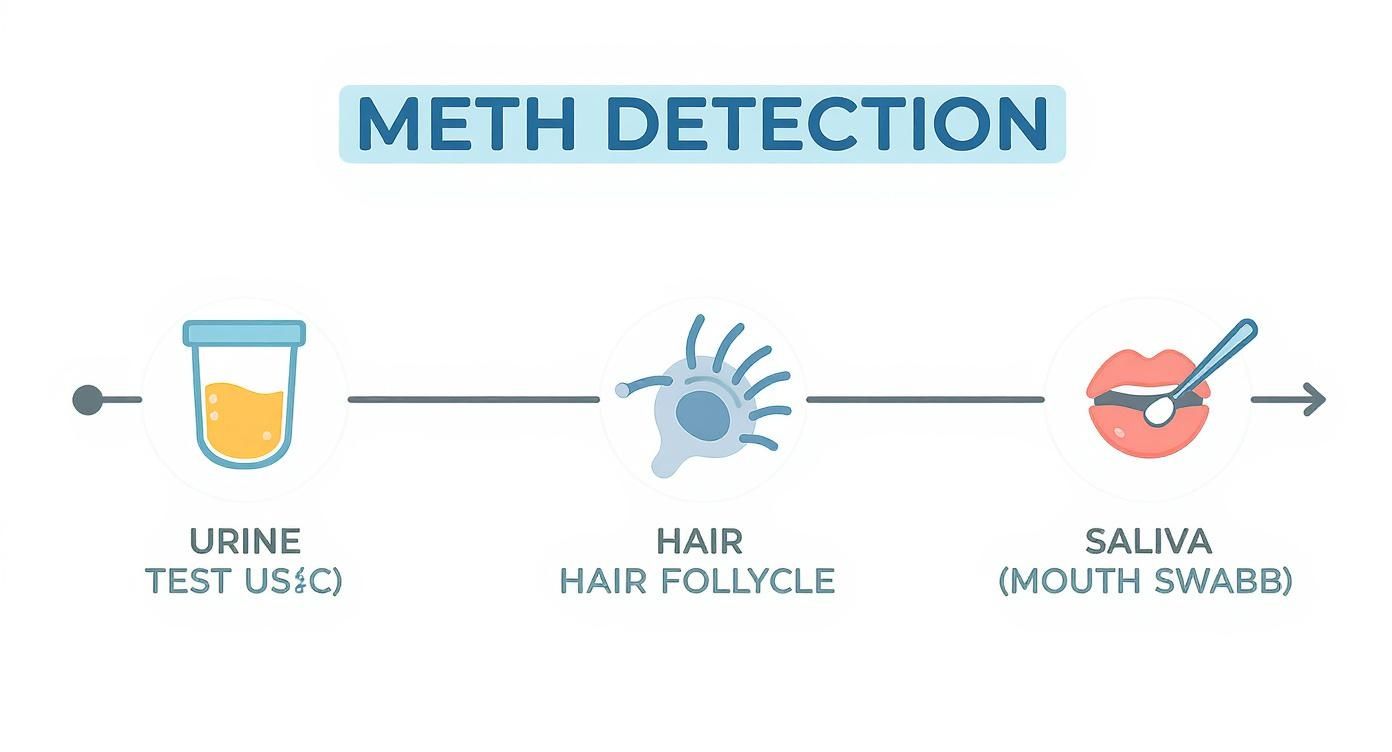
As you can see, hair testing gives by far the longest look-back period. Saliva tests have the shortest window, which makes them useful for checking for very recent, on-the-spot use.
Understanding the Averages
It's crucial to remember that these detection windows are just averages. A whole host of personal factors can make meth stick around longer or clear out faster. It’s a common myth that everyone’s body processes drugs at the exact same speed.
The only guaranteed way to clear meth from your system is to stop using it completely. These timelines are estimates, and everyone's biology is different, which can lead to a lot of variation.
For example, someone who has been using meth heavily and frequently will almost certainly test positive for a longer period than a one-time user. That’s because the drug and its byproducts can build up in the body’s tissues over time. We'll get into the specifics later, exploring how everything from your metabolic rate to your body fat percentage can play a role.
To give you a clearer picture, here’s a breakdown of how the detection times can vary based on usage patterns for each test type.
Average Meth Detection Windows by Test Type
This table summarizes the typical detection timelines for methamphetamine based on the type of test used.
| Test Type | Detection After Single Use | Detection After Chronic Use |
|---|---|---|
| Urine | 1–3 days | Up to 1 week |
| Blood | 1–2 days | Up to 3 days |
| Saliva | 1–2 days | Up to 4 days |
| Hair | Up to 90 days | Up to 90 days or more |
As the data shows, chronic, long-term use consistently extends the detection window across urine, blood, and saliva tests. Hair testing remains the most reliable method for identifying a long-term history of use, regardless of whether it was a single instance months ago or an ongoing pattern.
How Your Body Breaks Down Meth
To get a handle on how long meth can be detected in your system, you first need to understand what happens after it's used. Imagine your body is a sophisticated filtration system. When methamphetamine enters, it doesn't just vanish—it kicks off a complex process, with your liver doing most of the heavy lifting.
This metabolic journey is exactly what determines the detection window for a drug test. Your liver immediately starts breaking the meth down into other compounds, which are known as metabolites. These byproducts travel through your bloodstream until your kidneys filter them out, eventually leaving your body through urine.
Why Metabolites Matter for Drug Tests
The main metabolite of methamphetamine is amphetamine. This is a critical piece of the puzzle because today’s drug tests are sophisticated enough to search for both the original meth and its primary byproduct, amphetamine. When a lab finds both in a sample, it's considered conclusive proof that meth was used.
Think of it like a detective finding a suspect's fingerprints and their distinct footprint at a crime scene. Finding just one is good evidence, but finding both leaves little room for doubt. This two-part confirmation is what makes modern testing so accurate.
What’s interesting about meth metabolism is that a surprisingly large amount of the drug—up to 54% of a dose—can pass through the body completely intact. This means a significant quantity of the original, unmetabolized drug is excreted right alongside its amphetamine metabolite, making it even easier to detect in urine.
This dual-detection method is why the body's processing time is so important. The process is far from instant and requires professional guidance for anyone looking to stop safely. If you or someone you care about is struggling, learning about a medically supervised methamphetamine rehab program is a crucial first step toward recovery.
Understanding a Drug's "Half-Life"
So, how long does all of this take? The key concept here is half-life. A drug’s half-life is simply the time it takes for your body to eliminate exactly half of the initial dose.
- Methamphetamine has an average half-life in blood of about 10 hours.
- In urine, the half-life is longer, averaging around 25 hours.
Let's put that into a real-world context. If you had 100 milligrams (mg) of meth in your bloodstream, it would take about 10 hours for that amount to drop to 50 mg. After another 10 hours, it would be down to 25 mg, and so on.
This steady, predictable decline is why meth doesn't just disappear from your system overnight. It takes several half-life cycles before the drug is reduced to undetectable levels. This biological timeline is what sets the detection windows for the different types of drug tests we'll cover next.
A Detailed Look at Drug Test Detection Windows
When someone asks how long meth stays in their system, there’s no single, simple answer. It all comes down to the type of test being used. Each one tells a different story, offering a unique snapshot of substance use that can range from the last few hours to the last few months.
Think of it like this: a saliva or blood test is like talking to an eyewitness right after an event—you get immediate, fresh information, but the memory fades quickly. A urine test is more like reviewing security footage from the last few days; it gives you a wider but still recent picture. A hair test, on the other hand, is like reading a detailed journal spanning several months, revealing a long-term narrative.
This is exactly why the choice of test is so critical, whether it's for a pre-employment screen, a legal case, or clinical monitoring. Each method has its own purpose, strengths, and blind spots.
Urine Tests: The Go-To Standard
For most routine drug screenings, urine testing is the gold standard. It's the method most people are familiar with from workplace programs and clinical settings because it strikes a great balance between being non-invasive, affordable, and effective.
After someone uses meth, their kidneys get to work filtering the drug and its primary metabolite, amphetamine, out of the body and into the urine. This process allows the drug to be detectable for much longer than in blood or saliva. For a casual user, a urine test can typically spot meth for 1 to 4 days after the last use. For heavy or long-term users, that window can easily stretch to a week or more, which is why it’s so trusted by employers. Understanding these timelines is crucial, and you can see how they compare to other substances in our guide on how long cocaine can be detected in urine.
Blood and Saliva Tests: The Short-Term Indicators
Blood and saliva tests are the sprinters of the drug detection world—they’re incredibly fast but can’t go the distance. These tests are perfect for pinpointing very recent use, making them essential for situations like roadside DUI checks or post-accident investigations where establishing impairment at a specific moment is the top priority.
-
Blood Tests: A blood test is the most direct method, measuring the active meth literally circulating in a person's bloodstream. Since the body metabolizes meth relatively fast, the detection window is quite short, usually just 1 to 3 days.
-
Saliva (Oral Fluid) Tests: These are becoming more common because they’re so easy to administer and hard to cheat. A saliva test can detect meth almost instantly after use and will generally stay positive for 1 to 4 days.
These short-window tests are highly effective for identifying current intoxication. However, their limited look-back period makes them unsuitable for understanding a person's broader pattern of use.
Hair Follicle Tests: The Long-Term Record
If you need a long-term history of someone's drug use, nothing beats a hair follicle test. It’s in a league of its own. As meth moves through the bloodstream, tiny traces of the drug get deposited into the hair follicles. As the hair grows, it essentially creates a timeline, trapping these chemical markers permanently.
By taking a standard 1.5-inch sample of hair from close to the scalp, a lab can uncover meth use going back as far as 90 days. This massive detection window makes it an invaluable tool for sensitive situations like forensic investigations, child custody battles, and screening for high-security jobs where a long-term, drug-free history is non-negotiable.
Globally, the detection timelines for methamphetamine are well-established. Urine tests are the most common and typically detect use for 24 to 36 hours after a single dose, but this can stretch to a week for chronic users. Blood and saliva tests offer a shorter window of about 24 hours, though saliva tests can sometimes detect use for up to 4 days. Hair follicle testing provides the most extended view, capable of identifying meth residues for as long as 90 days. You can explore more about these specific timelines and discover more insights on how long meth stays in the system at Pacific Sands Recovery.
Ultimately, the right test depends entirely on the question you’re trying to answer.
Why Meth Detection Times Vary So Much From Person to Person
If you're asking, "how long does meth stay in your system?" you'll find there’s no simple, single answer. While we can talk about averages, the truth is that every person’s body works on a completely different clock. It’s a bit like two people draining a bathtub—even with the same amount of water, a tub with a wider drain will empty out much faster.
Your body’s “drain” is its unique combination of metabolism and organ function, and it plays a massive role in how quickly methamphetamine gets processed and removed. This is exactly why drug test results are always given as a range, not a hard number. A whole host of personal biological factors can dramatically shorten or lengthen the time that meth remains detectable.
Metabolic Rate and Body Composition
Your individual metabolic rate is one of the biggest players here. Simply put, a faster metabolism breaks down substances more quickly. Just as some people seem to burn through calories without trying, some people’s bodies are just more efficient at processing and eliminating drug metabolites.
Body composition is another crucial piece of the puzzle. Methamphetamine is fat-soluble, which means tiny traces of the drug can get stored away in your fat cells. For someone with a higher body mass index (BMI) or more body fat, their system might hold onto these metabolites for longer, releasing them back into the bloodstream slowly over time.
This can easily lead to a longer detection window when compared to someone with a leaner build and a naturally faster metabolism.
How Often and How Much You Use
The pattern of a person's meth use has a direct and significant impact on how long it sticks around. Your body can only process so much of the substance at one time.
- Occasional Use: A single, smaller dose gets metabolized and cleared out relatively quickly.
- Chronic Use: When someone uses heavily and frequently, meth and its byproducts start to build up in the body's tissues. The system essentially becomes saturated, making it take much longer to clear everything out. This can extend the detection window in a urine test by several days.
Think of it like rain. A light shower on dry ground soaks in and evaporates pretty fast. But if you keep pouring water onto an already soaked sponge, it’s going to keep dripping long after you've stopped.
Overall Health and Organ Function
Your liver and kidneys are the workhorses responsible for filtering and clearing waste from your body. Their health is absolutely critical for how efficiently your system can get rid of methamphetamine.
An individual with compromised liver or kidney function will metabolize and excrete drugs much more slowly. Conditions that affect these organs can significantly prolong the time meth stays in the system, making detection possible for longer than average.
On top of that, things like your age and even how hydrated you are can influence the timeline. Older individuals often have a slower metabolism and some decline in organ function. And while drinking a lot of water won't magically "flush" the drug out, staying properly hydrated helps support your kidneys in doing their job more effectively.
Key Takeaways
- Metabolism is Key: A faster metabolism clears meth from the system more quickly than a slower one.
- Body Fat Matters: Meth can be stored in fat cells, so individuals with higher body fat may have a longer detection window.
- Usage Patterns: Chronic, heavy use causes meth to build up in the body, taking much longer to eliminate than a single dose.
- Organ Health: Healthy liver and kidneys are essential for efficiently processing and removing meth from your system.
- Other Factors: Age, hydration, and overall health all contribute to the variability in detection times.
So, What Are Drug Test Cutoff Levels, Really?
A drug test result seems straightforward—it’s either positive or negative, right? But what happens behind the scenes is far more nuanced. The key to the whole process is something called the cutoff level. This is the specific amount of a drug or its byproducts that has to be in your system to trigger a positive result.
Think of it like a tripwire. If you set the wire high off the ground, only a big jump will set it off. Set it low, and even a small step will do it. In drug testing, the cutoff level is that tripwire.
A test with a lower cutoff level is more sensitive, meaning it can spot even tiny traces of meth. This is a huge deal because it can stretch the detection window, catching substance use for a longer time after someone last used.
Why Cutoff Levels Change Everything
This isn't just a technical detail; it’s the single most important factor in whether a test comes back positive. You could have two different labs test the exact same sample, but if they're using different cutoff levels, you could get two completely different results. This is why standardized levels are so critical, especially for workplace or legal testing.
A more sensitive test—one with a lower threshold—can make all the difference. We have solid research showing that cutoff levels directly impact how long meth can be found. For example, after just one oral dose, the meth concentration in urine can be anywhere from 82 to 1827 µg/L. If a test uses the standard 500 µg/L cutoff, it might detect use anywhere from 1 to 11 hours after the fact. But if you lower that cutoff to 250 µg/L, you could extend that detection window by up to 24 hours. That could add up to a 34-hour longer detection period in total. You can read the full research about these detection findings to see just how these adjustments work.
This level of sensitivity is a game-changer. Simply lowering the cutoff can increase the number of positive results by almost 48%. It’s the difference between a test that only catches recent, heavy use and one that can pick up on less frequent use over a much longer timeframe.
Once you understand cutoff levels, it becomes clear why the question "how long does meth stay in your system?" never has a simple answer. It’s not just about what’s happening in your body—it’s just as much about the science of the test itself.
Key Takeaways
- A cutoff level is the minimum drug concentration needed to flag a test as positive.
- Lower cutoffs mean a more sensitive test that can detect smaller amounts of meth.
- More sensitive tests can extend the detection window, sometimes by over a day.
- Different labs or test types may use different cutoff levels, leading to different outcomes from the same sample.
- The test's sensitivity is as crucial as personal factors like metabolism in determining the final result.
Finding Your Way to Recovery and Detox
Knowing the science of how long meth stays in your system is one thing, but taking that next step toward getting well is what truly matters. The journey away from meth starts with a commitment to your own health and safety, and a huge part of that is understanding the serious risks of trying to detox on your own.
Methamphetamine withdrawal isn't just unpleasant—it can be psychologically grueling. Intense depression, severe anxiety, paranoia, and powerful cravings are the norm. Without professional support, these symptoms can become genuinely dangerous and often send people right back to using.
Why You Shouldn't Go It Alone
Attempting to quit "cold turkey" at home is a path we strongly advise against. The psychological weight of withdrawal can be crushing, sometimes leading to self-harm or other desperate behaviors. A supervised medical environment is crucial for navigating this phase safely.
Medical professionals are there to help ease the most severe withdrawal symptoms and provide a secure, trigger-free space. This controlled setting is, without a doubt, the safest and most effective way to start healing, protecting both your physical and emotional well-being.
Reaching out for professional help isn't a sign of weakness—it's a brave and powerful first move. A structured program gives you the tools and guidance you need to build a successful recovery. To get a better sense of what this looks like, you can learn more about what medical detox for substance use entails and see why it’s such a critical foundation for real change.
Proven Steps on the Road to Recovery
Recovery is a process with clear, structured stages, not a quick fix. Each step is designed to build a solid foundation for a life free from substance use.
- Medical Detox: This is ground zero. It’s where your body safely clears the drug from its system under the watchful care of doctors and nurses.
- Rehabilitation Programs: After detox, programs like inpatient or outpatient rehab help you dig into the root causes of addiction through therapy, counseling, and education.
- Ongoing Support: Staying sober for the long haul is all about continued support. This means things like ongoing therapy, joining support groups such as Narcotics Anonymous (NA), and building a strong community of sober friends.
The most reliable way to get started is by connecting with healthcare providers who specialize in addiction medicine. They can walk you or your loved one through every single step, from that initial detox all the way to building a sustainable aftercare plan.
Key Takeaways
- Never try to detox from meth without professional medical supervision. The psychological withdrawal symptoms can be severe and dangerous.
- Medical detox offers a safe, supportive environment to manage cravings and the intense mental and emotional distress that comes with withdrawal.
- Recovery is a multi-step journey that includes detox, rehabilitation, and long-term aftercare.
- The most effective first step is reaching out to addiction specialists to start building a plan.
- Long-term sobriety is maintained through consistent effort, including therapy and community support groups.
Here’s What You Need to Know

Figuring out how long meth stays in the body isn't a simple calculation, but a few core truths stand out. The detection time really comes down to the type of test being used and a handful of unique personal factors.
-
The Test Type Is Everything: Detection windows can be as short as 1–4 days for tests that check urine, blood, or saliva. Hair follicle tests, on the other hand, can detect meth use for up to 90 days.
-
It's All About Metabolism: Your body works to break meth down into its primary metabolite, amphetamine. Most drug tests are actually designed to look for both substances, and this metabolic process happens at a different pace for everyone.
-
Your Body Sets the Timeline: How quickly you clear meth depends heavily on your personal metabolism, body mass, how often you've used it, and your overall health. There is no one-size-fits-all answer.
-
"Cutoff Levels" Make the Call: Every test has a specific sensitivity level, known as its cutoff. If the amount of meth in your system is below this threshold, the test comes back negative. A more sensitive test with a lower cutoff can find smaller amounts for a longer period.
-
Don't Go It Alone: Trying to detox from meth by yourself is incredibly risky. The psychological withdrawal can be severe, which is why a medically supervised detox is the only safe way to manage the process and protect your health.
Frequently Asked Questions
When it comes to drug testing and meth, there's a lot of confusion and misinformation out there. Let's clear up some of the most common questions people have.
What is the fastest way to get meth out of your system?
Honestly, there's no magic bullet or shortcut here. The only proven way to clear meth from your system is to stop using and give your body the time it needs to break down and eliminate the drug. Trying to flush your system with excessive water doesn't work and can actually be dangerous.
How accurate are at-home meth tests?
At-home drug tests can give you a preliminary idea, but you can't count on them for 100% accuracy like you can with a professional lab test. They're much more likely to give you a false positive or other errors. If an at-home test comes back positive, it’s essential to get it confirmed by a certified laboratory.
Can Secondhand Meth Smoke Cause a Positive Test?
This is a big worry for many, but the short answer is no, it's incredibly unlikely. You'd have to be in a very extreme situation—think a tiny, sealed room with zero ventilation for a long time—for your body to even absorb a measurable amount.
Even then, drug tests aren't looking for just any trace amount. They have specific cutoff levels designed to detect actual use, not accidental exposure. Any initial screening that might flag something would immediately be sent for a confirmation test, like a Gas Chromatography-Mass Spectrometry (GC-MS) analysis. This advanced test is so precise it can easily tell the difference between trace environmental contact and direct drug use.
Can You Flush Meth Out of Your System with Water?
This is probably one of the most persistent myths, but it's just not true. Drinking gallons of water won't speed up the work your liver and kidneys have to do to break down and eliminate meth from your body. That process happens at a set biological pace.
In fact, trying to "flush" your system is a great way to get your test thrown out. Labs are wise to this trick. They check every urine sample for creatinine levels and specific gravity to see if it's been diluted. A sample that's too watery gets flagged as invalid, which in many workplace or legal scenarios is treated just like a positive result. It's a gamble that almost never works.
In the world of drug testing, an invalid or diluted sample often raises the same red flags as a positive one. Don't count on this myth—it's a risk that rarely pays off.
What Medications Can Cause a False Positive for Meth?
This is a legitimate concern. Some perfectly legal prescription and over-the-counter drugs have a chemical structure that can mimic methamphetamine on an initial, less-sophisticated screening test.
A few common culprits include:
- ADHD Medications: Drugs like Adderall are amphetamine-based, so they will absolutely show up.
- Nasal Decongestants: Many cold and allergy medicines containing pseudoephedrine (the active ingredient in many versions of Sudafed) can trigger a false positive.
- Antidepressants: Certain medications, like bupropion (Wellbutrin), have been known to cause issues with initial screening tests.
Here's the crucial part: a positive screening is never the final word. The mandatory confirmation test (GC-MS) is brought in to tell the difference. This test is sophisticated enough to distinguish between a decongestant and illicit meth.
The best thing you can do is be upfront. Always disclose any and all medications you're taking to the person administering the test. It prevents a massive headache and ensures the results are interpreted correctly from the start.
