
When we talk about coping skills for addiction, we're really talking about the practical, day-to-day tools you learn to handle life without turning back to drugs or alcohol. It's about having a real strategy to manage stress, deal with triggers, and navigate difficult emotions. These skills are absolutely critical because, as anyone in recovery knows, sheer willpower just doesn't cut it for the long haul.
Key Takeaways
- Coping skills are your recovery toolkit: They are the practical strategies you use to manage stress, triggers, and emotions without substances.
- Willpower alone is not enough: Addiction physically rewires the brain, making willpower an unreliable defense against intense cravings.
- Recovery is an active process: It involves learning to identify triggers, challenge destructive thoughts, and choose healthy alternative actions.
- Skills build resilience and confidence: Successfully using a coping skill reinforces your ability to manage life sober, rebuilding self-esteem.
- A global health priority: With millions lacking access to formal treatment, developing effective coping skills is essential for public health.
The Foundation of Recovery: Coping Skills in Addiction
Imagine you've been sailing for years, but the only way you know how to steer is by using a substance. Now, you’re in recovery, and that substance is gone. You're left in a stormy sea without a rudder. That’s what recovery feels like without a solid set of coping skills. For so many, drugs or alcohol became the go-to solution for everything—stress, anxiety, boredom, even celebrating. Taking the substance away leaves a huge gap.
Trying to stay sober on willpower alone is like trying to hold your breath underwater. You can do it for a little while, but eventually, your body's instinct to gasp for air will take over. Coping skills are the oxygen. They are active, learnable techniques that give you the power to face cravings and triggers head-on, building real resilience and confidence along the way.
Why Willpower Isn't Enough
Let’s be honest: willpower is a limited resource. It gets worn down by stress, exhaustion, and emotional turmoil—all of which are common, especially in early recovery. Addiction isn't a moral failing; it physically and chemically rewires the brain’s circuits for reward, stress, and self-control. This makes it incredibly difficult to just "decide" not to use when a powerful craving hits.
This is where having a structured set of coping skills in addiction makes all the difference. Instead of just gritting your teeth and resisting an urge, you learn a new, more effective process:
- First, you pinpoint the root cause. What am I feeling right now that’s making me want to use?
- Then, you challenge the thought. Is using really the only way to deal with this?
- Finally, you choose a different path. What is a healthy, constructive thing I can do instead?
This kind of methodical approach shifts recovery from a passive state of just "not using" to an active process of building a new, better life. It’s not about being strong enough to fight addiction; it's about becoming skilled enough to manage it.
Recovery is an active, learnable process that gives you a tangible sense of hope and control from the very start. It’s about replacing old, destructive habits with new, constructive ones.
The Global Need for Effective Skills
Developing these skills isn't just a personal battle; it's a global health priority. The numbers are sobering: in 2022, only about 1 in 11 people worldwide with a drug use disorder received any kind of formal treatment. This means the vast majority are left to figure it out on their own, relying on informal support or self-developed strategies that often aren't enough. The consequences are tragic, contributing to preventable deaths and a staggering loss of healthy years of life. To get a better sense of this global challenge, you can dig into the findings from the United Nations.
Building a strong foundation of coping mechanisms is how we begin to turn this tide. It provides a clear roadmap for the journey ahead.
For recovery to stick, it needs a solid foundation. Think of your coping skills like the four pillars holding up a structure. If one is weak or missing, the entire thing feels unstable and at risk of collapsing. True, lasting sobriety is built on a balanced set of strategies that work together, covering all the ways addiction can try to pull you back in.
These pillars aren't just theories; they're categories of real-world skills you can learn and practice. They help you manage your feelings, challenge your thoughts, change your actions, and connect with people in healthier ways. When you have tools in each of these areas, you're prepared for whatever life throws at you.
Pillar 1: Emotional Regulation Skills
Addiction often starts as a way to escape or numb painful emotions. When you stop using, all those feelings—anxiety, anger, sadness, guilt—can come roaring back with an intensity that feels completely overwhelming. Emotional regulation skills are all about learning how to sit with those feelings without having to run from them.
Instead of an impulsive, knee-jerk reaction, you learn to pause. You identify what you're feeling, get curious about why it's there, and let it pass without letting it control your decisions. It’s like learning to watch a storm from a safe place instead of getting swept up in it.
A few practical skills include:
- Mindfulness: Simple practices like deep breathing or meditation help you stay in the present moment without judgment. This creates a crucial gap between feeling an urge and acting on it.
- Grounding Techniques: Use your five senses to pull yourself out of an emotional spiral. Notice the feeling of your feet on the floor, the smell of coffee brewing, or the sound of traffic outside. This anchors you in the here and now.
- Journaling: Putting your feelings on paper can help you untangle them. It reduces their power by giving you a structured way to understand where they're coming from.
Pillar 2: Cognitive Restructuring Skills
What we think directly impacts how we feel and what we do. During active addiction, the mind gets stuck in automatic negative thought patterns that justify using, like "I can't get through this without a drink," or "Just one time won't hurt." Cognitive restructuring is the work of catching, questioning, and changing these deeply ingrained, destructive thoughts.
This is where you learn to become a detective of your own mind, challenging the "evidence" for thoughts that lead you toward relapse.
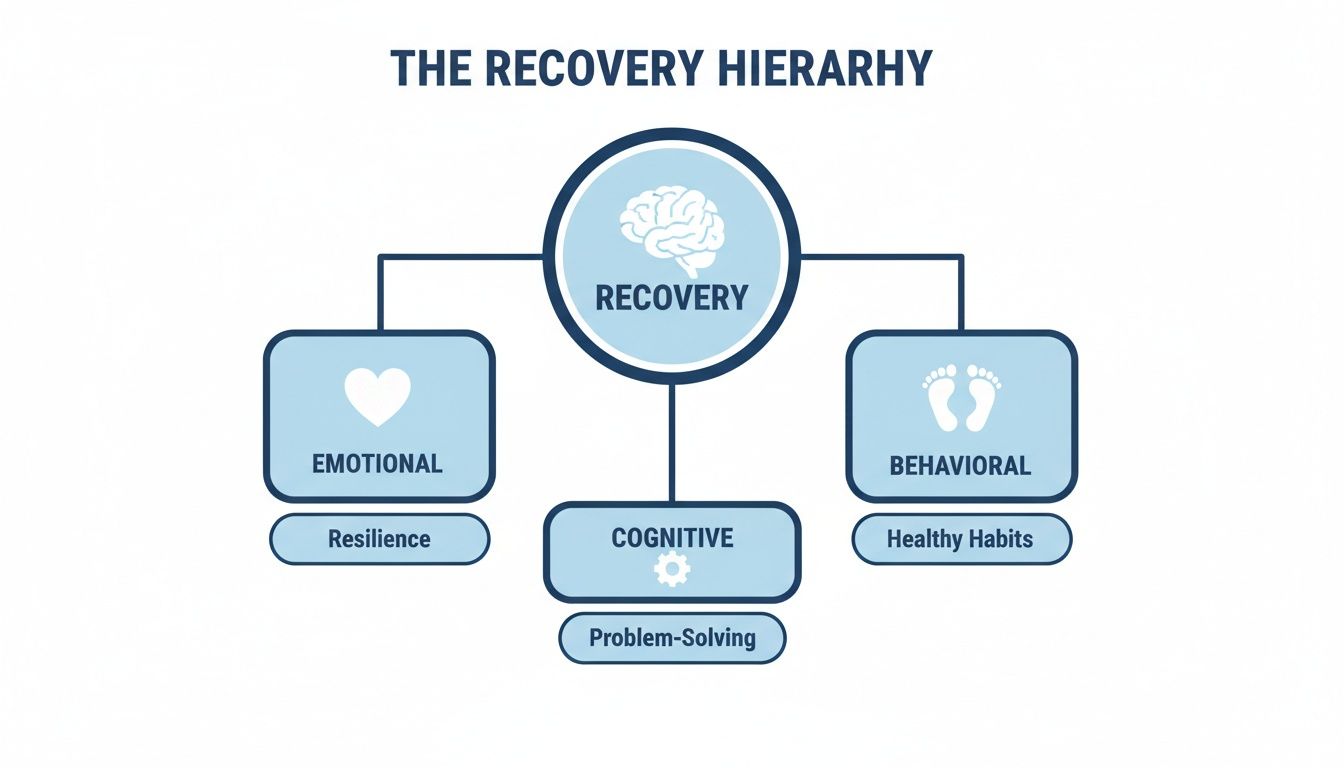
As this diagram shows, your thoughts are a critical link between your emotions and your actions. Gaining control over your cognitive patterns is a game-changer.
This is the central idea behind powerful therapeutic approaches like Cognitive Behavioral Therapy (CBT). By learning to systematically reframe how you think, you can break the chain reaction that starts with a negative thought and ends with a relapse.
Pillar 3: Behavioral Activation Skills
Addiction has a way of hijacking your life, pushing aside meaningful activities and replacing them with a singular focus on using. Behavioral activation is about reclaiming your life by intentionally adding positive, healthy actions back into your daily routine. It works on a simple but profound principle: action comes before motivation.
You don't wait to feel better to do something healthy; you do something healthy to start feeling better. It's about consciously building a life that feels good on its own, without substances.
By replacing the old, destructive habits with new, rewarding ones, you're actively building a life that is more fulfilling sober than it ever was while using. This proactive approach starves addiction of the boredom and emptiness it thrives on.
This could look like:
- Getting Active: Exercise is a natural mood-booster that melts away stress and releases feel-good endorphins. Even a short walk can make a huge difference.
- Finding Hobbies: Rediscover something you used to love or try something new. Painting, hiking, playing an instrument—these things provide a healthy outlet and a sense of accomplishment.
- Building a Routine: A predictable schedule for sleeping, eating, and other activities creates a sense of stability and normalcy, which is incredibly grounding in early recovery.
Pillar 4: Social and Relational Skills
Addiction breeds isolation. It damages trust and creates distance between you and the people who care about you. Rebuilding a strong, healthy support system is one of the most powerful things you can do for your recovery. This goes way beyond just finding sober friends; it means learning a whole new way of relating to people.
This pillar is all about mastering skills like setting firm boundaries, learning to communicate your needs clearly, and saying "no" to risky situations without feeling guilty. It also involves the essential work of building a sober community—people who get what you're going through and can offer support when you're struggling. These connections form a vital safety net, turning recovery from a lonely battle into a team effort.
To bring it all together, here's a quick look at how these four pillars support a stable recovery.
Four Pillars of Coping Skills in Addiction Recovery
| Coping Skill Pillar | Primary Goal | Practical Examples |
|---|---|---|
| Emotional Regulation | To tolerate difficult feelings without needing to escape or numb them with substances. | Mindfulness, deep breathing exercises, grounding techniques, journaling. |
| Cognitive Restructuring | To identify, challenge, and change the negative thought patterns that lead to cravings. | Questioning automatic thoughts, reframing "all-or-nothing" thinking, practicing gratitude. |
| Behavioral Activation | To build a fulfilling sober life by engaging in positive, healthy activities. | Regular exercise, rediscovering hobbies, creating a structured daily routine. |
| Social and Relational | To build a strong support network and navigate relationships in a healthy way. | Setting boundaries, attending support groups (AA/NA), practicing assertive communication. |
By developing skills across all four of these areas, you create a robust and flexible foundation that can withstand the challenges of long-term recovery.
Key Takeaways
- Emotional skills help you tolerate feelings: Learn to manage difficult emotions like anxiety and anger without needing to numb them with substances.
- Cognitive skills change your thinking: Challenge and reframe the automatic negative thoughts that justify substance use.
- Behavioral skills build a better life: Actively add positive routines and hobbies to your life to create fulfillment without drugs or alcohol.
- Social skills create a safety net: Rebuild a strong support system by learning healthy communication and boundary-setting.
- A balanced approach is crucial: A stable recovery requires developing skills in all four of these interconnected areas.
Applying Your Skills at Every Stage of Recovery
Recovery isn’t a single event. It’s a journey, and like any long journey, the terrain changes along the way. The coping skills that get you through your first few days of sobriety aren't the same ones you'll lean on a year down the road. Knowing which tools to use and when is the key to building real momentum and staying on track for the long haul.

Think of it like learning to drive. At first, you're white-knuckling the steering wheel, focused only on the absolute basics—how to brake, accelerate, and stay in your lane. With time and practice, you learn to navigate rush-hour traffic, merge onto a busy highway, and handle a sudden storm. Your coping skills in addiction grow in the exact same way, becoming more refined as you gain confidence in your sobriety.
Skills for the Detox and Early Treatment Phase
The very beginning of recovery, especially medical detox, is a raw, physical fight. Your body is screaming for a substance it no longer has, and cravings can feel like a tidal wave. Trying to use complex mental strategies at this point is like trying to solve a puzzle in the middle of an earthquake—it’s just not practical.
The goal here is immediate relief. You need simple, powerful grounding techniques that put a critical pause between the urge to use and the action.
- Deep Breathing: Inhale for a count of four, hold your breath for four, and then exhale slowly for a count of six. This simple act tells your nervous system to calm down, easing your body's fight-or-flight response.
- The 5-4-3-2-1 Grounding Method: Look around and name five things you can see. Then, four things you can physically feel. Three things you can hear. Two you can smell, and one you can taste. This technique yanks your focus out of the internal chaos and plants it firmly in the present moment.
- Mindful Awareness: Don't fight the craving; just notice it. Acknowledge it without judgment, as if you're a scientist observing a phenomenon. Say to yourself, "I'm having a craving. It feels awful, but I know it will pass."
These skills are about getting through the next five minutes, then the next hour, and surviving the intense physical storm of withdrawal.
Advancing Your Skills in Structured Treatment
As you move out of detox and into a program like inpatient or partial hospitalization, the fog starts to lift. With your body stabilizing, you now have the mental and emotional space to do the deeper work.
This is where you start learning the more advanced cognitive and behavioral skills needed to untangle the old patterns that fueled your addiction.
The mission shifts from just surviving cravings to truly understanding them. You begin to rewire the very thoughts and behaviors that led to substance use, laying the foundation for a recovery that can actually last.
Working with therapists, you'll start practicing skills like:
- Cognitive Restructuring: This is about learning to catch the automatic negative thoughts that trigger you and challenge them head-on. Is that thought really true? What's a more realistic way to see this?
- Behavioral Activation: You'll start intentionally scheduling healthy, enjoyable activities to fill the time you once spent using. This isn't just a distraction; it’s about actively building a life that feels good and meaningful without substances.
- Assertive Communication: You'll practice how to ask for what you need and say "no" to what you don't—clearly, calmly, and respectfully. This is a game-changer for rebuilding healthy relationships.
A structured program gives you a safe arena to try out these new skills before you need them out in the real world.
Applying Skills in Long-Term Sobriety
Once you leave a formal treatment program, the real test begins. This is where you face life on life's terms—a stressful day at work, a fight with a loved one, a holiday party, or even a happy event that you used to celebrate with drugs or alcohol.
Your success now hinges on being proactive. You can't just react to triggers; you have to anticipate them. The data is clear: the risk of relapse is incredibly high at first. Over 85% of relapses occur within the first year after treatment. But we also know that continuing care and ongoing skills practice drastically improve those odds. You can learn more about how structured programs support lasting recovery and why that continued support is so vital.
Your toolkit now needs to include more sophisticated strategies:
- Proactive Planning: Before you walk into a high-risk situation, have a plan. Know what you'll say, what you'll drink, who you'll talk to, and what your exit strategy is.
- Support Network Activation: This means knowing exactly who to call when you feel yourself slipping and—this is the important part—making that call before it becomes a full-blown crisis.
- Lifestyle Integration: True recovery isn't just about not using; it's about building a life that supports your well-being. This means making things like exercise, healthy eating, and a consistent sleep schedule non-negotiable parts of your routine.
Mastering coping skills in addiction is a marathon, not a sprint. Each stage prepares you for the next, giving you the tools you need to not just survive, but to build a rich, fulfilling life.
Key Takeaways
- Skills evolve over time: The coping tools you need in detox are different from the ones you'll use in long-term sobriety.
- Detox focuses on grounding: Early recovery is about using simple, immediate techniques like deep breathing to manage intense physical cravings.
- Treatment builds deeper skills: In a structured setting, you'll learn advanced cognitive and behavioral strategies to get at the roots of addiction.
- Long-term sobriety requires proactive application: Navigating real-world triggers means you have to plan ahead and use your skills consistently.
- Continued practice is crucial: The first year is the most vulnerable time, which is why ongoing skill-building is essential for lasting success.
Building Your Personalized Relapse Prevention Plan
If you think of recovery as a journey, then a relapse prevention plan is your personal roadmap. It’s not just a list of nice ideas you keep in your head; it's a real, written-down playbook you create for your toughest moments. You get to be the architect of your own recovery, thoughtfully building a structure that can withstand your specific challenges and give you confidence instead of fear.
This plan is where the idea of coping skills in addiction gets real. It takes abstract strategies and turns them into concrete steps you can follow the second a craving hits. By creating this guide for yourself, you're getting ahead of the game, preparing for high-risk situations instead of just hoping they don't happen.
Step 1: Identify Your Unique Triggers
First things first: you need to become an expert on what puts your sobriety at risk. Triggers aren't random. They are very specific people, places, feelings, or situations that your brain has wired to substance use over time. Getting brutally honest about them is the only way to build an effective defense.
Your triggers will likely fall into a few key buckets:
- Internal Triggers: These are the feelings that bubble up inside you. Think anxiety, crushing boredom, anger, loneliness, or even the rush of happiness you used to "celebrate" with your substance of choice.
- External Triggers: These are cues from the world around you. It could be driving past a certain bar, hearing a song from your using days, or running into someone you used with.
- Situational Triggers: These are specific events or times of the year that you know are tough—holidays, stressful work deadlines, big family get-togethers, or the anniversary of a painful memory.
Get out a pen and paper and list every single one you can think of. The more detailed you are now, the better prepared you'll be later.
Step 2: Create Your Coping Menu
Once you know what’s coming, you can plan how to react. This is where you create your personal "coping menu"—a list of healthy, go-to actions you can take the moment you feel that pull. The trick is to have options, because what works when you're bored won't be the same thing you need for a full-blown anxiety attack.
A well-stocked coping menu ensures you always have a healthy alternative at your fingertips. It’s about having a plan B, C, and D, so that returning to substance use never feels like your only option.
Make sure your menu has a little of everything, pulling from the four main types of coping skills:
- Distraction Skills: Call a friend to talk about anything else, go for a brisk walk, lose yourself in a movie, or get your hands busy with a hobby.
- Soothing Skills: Take a long, hot shower. Put on some calming music. Focus on your breathing for just two minutes.
- Thinking Skills: Challenge that craving. "Play the tape forward" and force yourself to remember exactly where using will lead.
- Support Skills: Get to a meeting, fast. Call your sponsor or a trusted family member who gets it.
Write these down and put them somewhere you can't miss them, like in your phone's notes app or on a card in your wallet.
Step 3: Assemble Your Support Network
You can't do this alone. No one can. A huge part of your relapse prevention plan is a simple list of people you can call for backup, day or night. This isn't just a list of names; this is your personal first-response team.
Make sure your list has some variety:
- A sponsor or a mentor from your support group.
- A trusted family member who is genuinely supportive.
- A close friend who understands and respects your recovery journey.
- Your therapist or counselor's number.
When this list is ready to go, you don't have to scramble in a crisis trying to figure out who to call. The decision is already made. Reaching out and working with others is one of the most powerful things you can do, and you can learn more about it by exploring relapse prevention activities for groups.
Step 4: Proactively Plan for High-Risk Situations
The final piece of the puzzle is looking ahead at your calendar and planning for the events you already know will be tough. Got a wedding coming up? What's your game plan? Maybe you decide to bring a sober friend, keep a club soda with lime in your hand all night, and set an alarm for when you're going to leave, no exceptions.
When you think through these scenarios beforehand, you take away their power. You walk into that high-risk situation with a clear plan, which puts you firmly back in the driver's seat. This kind of proactive thinking turns what could be a threat into a chance to prove to yourself how strong you really are.
Key Takeaways
- A relapse prevention plan is your roadmap: It's a tangible, written guide that prepares you for challenging situations.
- Identify your specific triggers: Get to know the internal feelings, external cues, and specific situations that threaten your sobriety.
- Build a diverse "coping menu": Have a written list of varied, healthy responses ready to go for when cravings or triggers appear.
- Assemble a support team: Create a go-to list of trusted people you can call for immediate help when you feel vulnerable.
- Plan proactively for challenges: Look ahead, anticipate difficult events, and create a step-by-step strategy for navigating them safely.
What About Co-Occurring Disorders or MAT?
Recovery isn’t always a straight line. For many people, the path isn’t just about stopping substance use—it’s also about navigating a co-occurring mental health condition like anxiety, depression, or PTSD. When you’re dealing with both at once, a situation often called a dual diagnosis, your coping skills in addiction need to work for both problems.
It’s like trying to patch two connected leaks in a boat. If you only focus on one, you’re still going to sink. The good news is that the same coping skill can, and often should, be used to tackle both challenges. A grounding technique, for example, isn’t just for getting through a craving. It’s also an incredibly powerful way to anchor yourself during a panic attack, shifting your focus away from the rising fear and back to the present moment.
This integrated approach is the key to finding real stability and building a life you love.
How Medication-Assisted Treatment Fits In
For many, another vital piece of the puzzle is Medication-Assisted Treatment (MAT). There’s a persistent myth that MAT is just “replacing one drug with another,” but that couldn’t be further from the truth. In reality, MAT involves using FDA-approved medications under strict medical supervision to stabilize brain chemistry, dial down cravings, and ease withdrawal symptoms.
This stabilization isn’t the finish line—it’s the starting block.
By quieting the intense physical and psychological noise of withdrawal, MAT creates the mental clarity and emotional stability needed to actually learn and practice new coping skills. It carves out the breathing room where recovery can truly take hold.
Imagine trying to learn a new instrument while a smoke alarm is screaming in your ear. It’s nearly impossible. MAT is what turns off that alarm. Once your brain isn't in a constant state of emergency, you can finally focus on the real work: changing thought patterns, regulating your emotions, and building healthier habits. To get a better handle on this, it helps to understand what Medication-Assisted Treatment is and how it supports the entire recovery journey.
Ultimately, whether you're managing a dual diagnosis, using MAT, or both, the core ideas behind coping skills don't change. The secret is learning to apply them in a way that honors your unique situation. By doing this, you build a recovery plan that addresses you as a whole person—creating a foundation strong enough to support lasting change.
Key Takeaways
- Dual diagnosis needs an integrated strategy: Your coping skills must be adapted to address both addiction and any co-occurring mental health challenges at the same time.
- Skills can do double duty: A single tool, like mindfulness, can be just as effective for managing a craving as it is for managing symptoms of anxiety or PTSD.
- MAT builds a foundation for learning: By stabilizing your brain chemistry, MAT gives you the mental bandwidth you need to learn and master new coping strategies.
- MAT is a tool, not a replacement for skills: It’s a support system that makes the hard work of behavioral change more accessible and effective.
- Personalization is everything: Your unique circumstances, including co-occurring disorders or MAT, must guide how you build and use your coping skill toolkit.
Your Path Forward: Building a Resilient Recovery
Think of recovery less as a test of willpower and more as a process of skill-building. It isn't about gritting your teeth and forcing your way through. It's about learning, practicing, and building the resilience you need to navigate life on new terms. Every single time you use a healthy coping skill instead of turning to an old habit, you're doing something incredible—you're literally strengthening new pathways in your brain and laying another brick in the foundation of the life you want.
This journey isn't about perfection; it's about preparation. You now have a better understanding of how to spot your triggers, create a personal toolkit of healthy responses, and choose the right tool for the job. This guide is your map, the starting point for that journey.
Taking the Next Step with Confidence
Learning to use coping skills in addiction is a process, and it works best with support. While everything you've read here is a powerful starting point for self-awareness, nothing beats having a professional guide help you tailor these strategies to your unique life. You don't have to figure this all out by yourself.
A structured, evidence-based program gives you a safe space to practice these skills until they feel like second nature. If you’re ready to bridge the gap between knowing what to do and having the confidence to actually do it, help is just a phone call away.
Building a resilient recovery is about arming yourself with the right tools and having the courage to ask for support when you need it. It’s an investment in a future where you are in control, not the substance.
For those in the Dallas-Fort Worth area, Tru Dallas offers the full range of support you might need, from medically supervised detox all the way through comprehensive rehab programs. Our team is here to walk alongside you, helping you craft a recovery plan that truly sets you up for lasting success.
Your journey to a resilient, more fulfilling life can start right now. Get in touch with the admissions team at Tru Dallas to see how our programs can support you.
Key Takeaways
- Recovery is built on skills: Lasting sobriety comes from learning and practicing effective coping skills, not just from relying on willpower.
- Preparation is your best defense: A personalized relapse prevention plan turns good ideas into a concrete, actionable guide for your most challenging moments.
- Skills must be a personal fit: The best coping strategies are the ones tailored to your specific triggers, your lifestyle, and any co-occurring conditions you may have.
- Expert guidance makes a difference: Working with specialists in a structured program gives you the support and feedback needed to master new skills more quickly.
- Asking for help is a sign of strength: Reaching out for professional support is one of the bravest and most important steps you can take toward building a new life.
Frequently Asked Questions (FAQ)
What are the main types of coping skills in addiction?
Coping skills generally fall into four main categories:
- Emotional Regulation: Learning to identify and manage intense feelings without substances (e.g., mindfulness, deep breathing).
- Cognitive Restructuring: Changing the negative thought patterns that lead to cravings (e.g., challenging automatic thoughts).
- Behavioral Activation: Building a sober life filled with positive habits and activities (e.g., exercise, hobbies).
- Social/Relational Skills: Creating a strong support system and learning healthy communication (e.g., setting boundaries, attending support groups).
What's the difference between coping skills and just distracting myself?
Distraction is one type of coping skill, but it's usually a short-term fix. Its goal is to get you through an intense, immediate craving. A complete set of coping skills goes much deeper, helping you understand the root cause of the craving (emotional skills), challenge the thoughts behind it (cognitive skills), and build a life where cravings have less power (behavioral skills).
I’ve tried these skills before and they didn't work. Why would they work now?
This is a common frustration. Often, the issue isn't the skill itself, but the context. Learning skills in a structured, supportive treatment environment makes a huge difference. A therapist can help you tailor the right skills to your specific triggers and practice them until they become second nature. It's like learning to swim—it’s much easier and more effective with a coach than by just jumping in the deep end alone.
How do I know which coping skill to use in the moment?
Think of it like having a first-aid kit. For an immediate, intense craving (a "gushing wound"), you need a quick-acting skill like the 5-4-3-2-1 grounding technique or deep breathing. For a lower-level, nagging trigger (a "dull ache"), you might use a skill that takes more thought, like journaling about your feelings or calling a support person to talk it through. The key is having a pre-planned "menu" of options so you're not trying to decide in a crisis.
Can I really overcome addiction just by learning new skills?
Learning and consistently applying new coping skills is the absolute cornerstone of lasting recovery. While detox addresses the physical side, coping skills address the psychological, emotional, and social factors that drive addiction. It's not a "magic bullet," but it is the most proven, evidence-based path to building a resilient, fulfilling life in sobriety. The numbers bear this out: an estimated 48.5 million people in the U.S. had a substance use disorder in 2023, and skills-based therapies are a primary tool for successful treatment. You can explore these important addiction statistics on TherapyRoute.com.