
Let's get straight to it: Yes, couples can absolutely go to rehab together. For many partners, substance use isn't a solo journey—it's a destructive pattern that has entangled both of their lives. The idea of healing side-by-side isn't just possible; for some, it's the most powerful way to reclaim their future.
This approach is becoming a crucial option for couples who want to rebuild both their lives and their relationship from the ground up, at the same time.
Key Takeaways
- Specialized rehab programs for couples are available and can be highly effective.
- Couples rehab works on two fronts: healing each individual's addiction and repairing the relationship's dynamics.
- A major goal is to rebuild trust, teach healthy communication skills, and dismantle codependent behaviors.
- The process is designed to help partners become each other's strongest support system for long-term sobriety.
- By healing together, the relationship itself can transform from a trigger into a cornerstone of lasting recovery.
Why Attending Rehab Together Can Be So Effective
When addiction weaves its way into a relationship, it does more than just harm individuals. It creates toxic dynamics like codependency and shatters the trust that holds a partnership together. Going to rehab as a couple provides a safe, structured space to tackle not just the substance use, but the relational damage it leaves in its wake.
Think of it less as two separate people getting treatment in the same place, and more like two people learning how to rebuild their home's foundation together after it's been rocked by a storm.
This guide will walk you through what that rebuilding process looks like. We're moving past the idea of just individual recovery and focusing on how the partnership itself can become the biggest source of strength. A dedicated couples rehab program is built around two core goals:
- Individual Sobriety: First and foremost, each person gets the personalized therapy and tools they need to overcome their own battle with addiction.
- Relationship Healing: At the same time, you both learn new ways to communicate, start the long process of rebuilding trust, and create healthier dynamics to support each other for the long haul.
This dual-focus approach is critical because your futures are linked. It prevents the common scenario where one partner gets sober, returns home, and steps right back into the same unchanged, triggering environment. Instead, you grow together, creating a united front against relapse.
So, How Does Couples Rehab Actually Work?
When a couple decides to go to rehab together, it’s not just about two people getting individual treatment in the same building. Think of it like this: if a house's foundation cracks during a storm, you can't just patch up one side and call it a day. To make the house safe again, you have to reinforce the entire structure. That’s the whole idea behind joint recovery.
These programs are built on what’s called a dual-focus model. First, each person gets their own intensive individual therapy. This is where they dig into their personal history, their triggers, and the real reasons behind their substance use. It's an essential step for taking personal responsibility and starting to heal on your own terms.
At the same time, the couple dives into specialized relationship counseling. This is where the heavy lifting of rebuilding the relationship happens. It's all about breaking down toxic communication cycles, healing from the pain that's been caused, and laying a new foundation built on trust and mutual support.
The Integrated Treatment Structure
A typical day in a couples program is designed to blend these two critical parts. You might have your separate therapy sessions in the morning, then come together for a facilitated group or couples session in the afternoon. This setup ensures that individual growth and relational healing are happening at the same time.
The core components usually include:
- Individual Counseling: A confidential space for each partner to work through their own stuff without the other person present.
- Couples Therapy: Guided sessions designed to fix broken communication, resolve deep-seated conflicts, and start rebuilding intimacy.
- Group Therapy: Meetings with other couples who get what you're going through, which can be a huge relief and a great way to feel less alone.
- Educational Workshops: Learning the nuts and bolts of addiction, codependency, and what healthy relationship dynamics actually look like.
This combined approach isn't just a nice idea—it's backed by solid research. Treating partners together can dramatically improve both how happy they are in the relationship and their individual chances of staying sober. In fact, studies show the average person who gets couple therapy is better off than 70%–80% of similar individuals who don't. You can read the full research on couple-based therapy to learn more.
By tackling addiction from both an individual and a relational angle, couples learn how to stop being each other's triggers and start becoming each other's biggest supporters. This integrated method turns the relationship from a potential roadblock into one of the most powerful tools for staying sober for good. You can learn more about what happens in rehab in our detailed guide.
What Are The Real Benefits Of Attending Rehab As A Couple?
Deciding to go to rehab together is a big step, but it comes with some powerful advantages you just can't get when one person goes alone. The single biggest benefit? You’re building a unified support system right from day one.
Think about it. Instead of one partner getting sober and returning to the exact same environment that might have enabled their addiction, you both change and grow together. You’re transforming your home into a true safe zone for recovery, not just for one of you, but for both of you.
This shared journey makes healing happen faster and on a much deeper level. You’re not just reading about healthy communication—you're practicing it with each other, right there, with a therapist guiding the conversation. You learn to spot and stop destructive habits like enabling or codependency as they happen, replacing them with behaviors that actually support long-term sobriety.
Building A Stronger Foundation
Couples rehab isn't about just hoping your relationship survives recovery; it's about actively rebuilding it. By taking on addiction as a team, your partnership can transform from a source of triggers into your single greatest strength. You're laying a new foundation for your relationship, one built on shared tools, mutual respect, and a common goal.
The journey is designed to balance personal healing with relational growth. This visual breaks down the core steps.
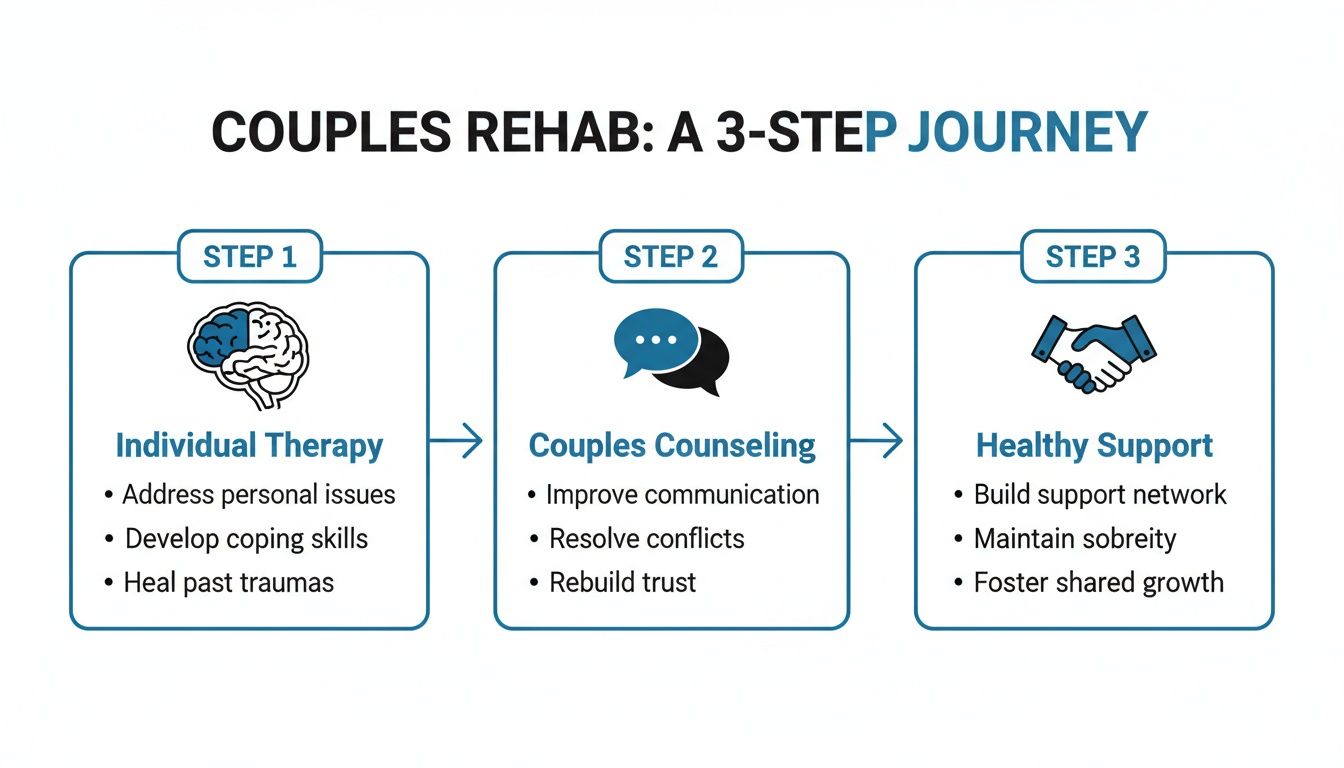
As you can see, the process isn't just about joint therapy. It’s a strategic approach that combines individual accountability with the work you do together to forge a recovery that lasts.
Individual Rehab Vs Couples Rehab Key Differences
To better understand the unique benefits, it helps to compare the two approaches side-by-side. While individual rehab is incredibly effective, couples rehab adds a layer of relational healing that can be crucial for partners.
| Feature | Individual Rehab | Couples Rehab |
|---|---|---|
| Primary Focus | Personal sobriety and individual triggers. | Personal sobriety and relational dynamics. |
| Support System | Builds a new support network outside the home. | Strengthens the primary relationship as the core support system. |
| Environment | Creates a safe space away from home triggers. | Transforms the home environment into a shared safe space. |
| Communication | Teaches general communication skills. | Involves real-time practice and conflict resolution with your partner. |
| Post-Treatment | Individual returns to a potentially unchanged home dynamic. | Both partners return with shared tools and a unified plan. |
Ultimately, the choice depends on your specific circumstances, but for couples where both partners are struggling or the relationship dynamics are intertwined with substance use, the shared approach offers a more comprehensive path to healing.
The Power Of A Shared Experience
Going through such an intense and vulnerable process together forges a bond that’s hard to describe. You see each other at your lowest points, cheer for every small win, and learn how to handle setbacks as a true team. This shared fight builds a profound level of empathy that can make your relationship stronger than ever before.
A key advantage is the ability to address relational dynamics directly. By working on communication and trust within a therapeutic setting, couples can heal old wounds and establish new, healthier ways of interacting that will support their sobriety long after treatment ends.
This approach borrows heavily from the principles of family therapy, where the focus is on healing the entire family unit to support recovery. For more on this, check out our guide on family therapy for substance abuse.
In the end, you’re not just learning how to get sober; you’re learning how to be sober together.
What Are the Challenges of Going to Rehab as a Couple?
Choosing to go through rehab together is a huge step, but it's not without its own unique set of hurdles. The journey to recovery is rarely a straight line, and knowing what bumps might lie ahead is the best way to prepare for them.
One of the biggest concerns we see is when one partner starts making progress faster than the other. This can easily stir up feelings of guilt in the person who's thriving and frustration or resentment in the one who feels left behind. It's a tricky dynamic to navigate.
There's also the very real risk of falling back into old, destructive habits. Addiction often gets tangled up in codependency—where one person's actions enable the other's—or a constant cycle of blame. These patterns don't just disappear at the treatment center door. If you're not careful, they can resurface and pull both of you away from the personal work you each need to do. The goal is to learn a new, healthy way to support each other, not just fall back on the old roles that fed the addiction in the first place.
How Good Rehab Programs Handle These Risks
This is where a quality couples rehab program really shows its value. They anticipate these problems and build their programs specifically to head them off. It’s not just about sitting two people in a room with a therapist; it’s about creating a structured environment where individual healing is treated with the same importance as the relationship's recovery.
The core idea is simple but powerful: a couple must heal together, but each person also has to build their own foundation for lasting sobriety. You can't delegate your recovery to your partner.
To make this happen, a reputable program will have key safeguards in place:
- Mandatory Individual Therapy: This is non-negotiable. Each of you will have your own separate, confidential sessions with a therapist. It’s a safe space to work through personal triggers, resentments, or fears you might not feel comfortable sharing with your partner in the room.
- Clear, Enforced Boundaries: From the very beginning, therapists will help you establish healthy boundaries. This could mean things like having separate rooms or designated time apart each day to focus on self-reflection and break the grip of codependency.
- Two Separate Treatment Plans: You might be a couple, but you’re still two different people. Each partner gets a personalized treatment plan that addresses their specific substance use history, triggers, and individual needs.
These elements create a crucial balance. They ensure that even though you're in rehab together, your individual recoveries are the top priority. This approach provides the structure and support needed to face the complexities of joint recovery and come out stronger on the other side—both as individuals and as a couple.
So, Is Couples Rehab Actually Right for Your Relationship?
Going to rehab together can be a game-changer, but let's be honest—it's not the right move for every couple. Making this decision means having a frank conversation about whether your partnership can handle the intensity and opportunity that comes with joint recovery. It's about more than just wanting to get sober; it's about being ready to rebuild a life, side by side.
Before you even think about enrolling, you have to take a hard look at the foundation of your relationship. If there are serious underlying issues like domestic violence or deep emotional abuse, those have to be dealt with first, separately. Couples rehab only works if there's a baseline of safety and respect, even if it's been buried for a while.
Key Questions to Ask Yourselves
To get a clearer picture, sit down together and really talk through these points. Your answers will tell you a lot about whether you're truly prepared for this journey.
- Are we both all in on sobriety? This is non-negotiable. Both of you must be 100% committed to getting clean. If one person is on the fence, they can easily pull the other person down.
- Is our relationship still supportive at its core? Addiction causes a lot of damage, no doubt. But underneath it all, is there still a fundamental sense of care and respect you can build on?
- Can we handle the raw, unfiltered truth? A huge part of this process is facing how your actions have hurt each other. You both need to be prepared for some radical honesty, which can be incredibly tough to hear.
When kids are in the picture, the motivation to get help often skyrockets. In England, for example, at least 33% of people starting new treatment were parents. This shows just how many couples are trying to manage addiction while raising a family, and it highlights why structured support that considers the entire family is so critical. You can find more data like this in the World Drug Report 2023.
Thinking it through on your own is a great first step, but a professional evaluation is crucial. An addiction specialist can look at your unique situation and help you figure out if couples rehab is genuinely the safest and most effective path for you both.
Finding a Quality Couples Rehab Program in Dallas
You've made the brave decision to pursue recovery together, which is a massive first step. The next, and just as crucial, is finding the right program to guide you both. When you’re looking for a couples rehab, especially around Dallas, you need to dig deeper than the brochures and websites to find a place that truly understands integrated care.

The reality is, most people who need help don't get it. Of the millions of adults with alcohol use disorder, a staggering 7.8% actually receive treatment. That leaves so many couples trying to navigate the storm alone. You can see more alcohol rehab statistics from webserv.io. This gap is exactly why it’s so critical to find a program that is truly set up to help partners heal together.
What to Look For in a Program
Frankly, not every rehab center can handle the unique challenges that come with treating a couple. A top-tier program must have specific, non-negotiable features built in to support both your individual sobriety and the health of your relationship.
Here's what I always tell people to look for:
- Specialized Therapists: Your clinical team absolutely must include licensed therapists who are experts in both addiction medicine and couples counseling. This isn't an either/or situation. That dual expertise is the key to untangling everything.
- Evidence-Based Therapies: Look for programs that use proven methods. I’m talking about things like Cognitive Behavioral Therapy (CBT) and, specifically for couples, Behavioral Couples Therapy for Substance Use Disorders (BCT-SUD). These are the tools that actually work.
- A Real Aftercare Plan: Recovery is a marathon, not a 30-day sprint. A good facility won't just send you on your way. They will work with you to build a detailed, long-term aftercare plan for you as a couple to help you stay on track.
A program's ability to provide both individual and joint therapy is the cornerstone of effective couples rehab. It ensures personal accountability while actively rebuilding the partnership.
I know finding the right fit can feel like a huge task, but if you focus on these core elements, you'll be able to sift through the options and find a place that can genuinely help. For more detailed tips, you can read our guide on finding a couples rehab near me.
The Bottom Line on Healing Together
Embarking on the road to recovery is a monumental step. When you decide to walk that path together, it's vital to have a clear, shared vision of what lies ahead.
Think of these key points as your North Star—a guide to keep your conversations on track and your decisions grounded as you work toward a healthier life, side by side.
Guiding Principles for Your Journey
- It’s Not Just an Idea; It’s a Real Path: Couples rehab is a legitimate and powerful option for partners who are serious about getting sober together. It works.
- You Need a Two-Pronged Approach: The most effective programs don’t just focus on the substance use. They have to tackle the individual’s addiction and the health of the relationship at the same time.
- Commitment Can't Be a One-Way Street: For this to have any chance of success, both of you must be 100% on board and actively participating. There's no room for half-measures.
- Expert Help is Essential: This isn't something you can navigate alone. You need therapists with specific training in both addiction treatment and couples counseling to guide you through the complexities.
- This is About More Than Just Sobriety: Choosing joint recovery isn't just about stopping substance use. It's a chance to tear down the old, dysfunctional parts of your relationship and build a new foundation—one based on strength, trust, and sobriety.
Frequently Asked Questions
What if only one of us struggles with substance use?
Many programs are designed for this exact situation. The therapy will focus on healing the relationship, dismantling codependent behaviors, and equipping the non-using partner with the tools to be a supportive but healthy force in recovery.
Will we get a shared room during inpatient treatment?
It really depends on the facility. Some provide separate rooms to give each person private space for personal reflection and individual therapy work. You'll then come together for all the couples and group sessions.
How does confidentiality work in our therapy sessions?
This is something your therapist will make crystal clear from day one. Generally, what's said in your individual therapy stays private. Anything shared during couples counseling is considered part of the joint healing process and is open for discussion between the three of you.
What happens if one of us relapses?
A good program prepares you for this possibility. The goal is to manage the situation without blame, identify what triggered the relapse, and get both partners back on track using the recovery tools you've learned. It's treated as a setback, not a failure.
What if we decide to break up during treatment?
This is a tough but important question, and a quality program will have a plan for it. If a breakup happens, the therapeutic team's focus will shift. They will help both of you continue your own recovery journeys, adjusting your treatment plans to focus on individual healing and helping you navigate the separation in a healthy, productive way.
