

Some readers in Dallas are searching late at night, exhausted and frustrated, typing the same question in different ways: What is the best medication for anxiety depression and adhd? They may be missing deadlines, feeling on edge, sleeping poorly, and wondering why simple tasks seem harder than they should. In many cases, they're also trying to stay sober or support a loved one through recovery, which makes the medication question feel even more urgent.
That search makes sense. When anxiety, depression, and ADHD overlap, daily life can feel noisy, heavy, and disorganized all at once. A person might feel restless but unmotivated, distracted but also mentally stuck, and ashamed that they can't seem to get control of any of it.
The difficult truth is that there usually isn't one universal "best" pill. The hopeful truth is that there is a right strategy, and with skilled dual diagnosis care, that strategy can become much clearer.
Table of Contents
- The Search for Clarity When Anxiety Depression and ADHD Overlap
- Understanding the Connection Between Anxiety Depression and ADHD
- A Guide to Medication Classes for Co-Occurring Conditions
- How Clinicians Develop Your Personalized Treatment Plan
- Safety Interactions and Long-Term Monitoring
- The Role of Non-Medication Support in Lasting Recovery
- Finding Expert Dual Diagnosis Care in Dallas Fort Worth
- Frequently Asked Questions About Medication Management
The Search for Clarity When Anxiety Depression and ADHD Overlap
A common situation looks like this. Someone wakes up already tense, loses focus before work even starts, forgets an appointment, then spends the rest of the day feeling guilty and discouraged. By evening, the mind is racing, the to-do list is untouched, and the person starts wondering whether the problem is anxiety, depression, ADHD, or all three.

That confusion is one reason the search for the best medication for anxiety depression and adhd feels so intense. People aren't just looking for symptom relief. They're looking for a way to function again, repair relationships, and stop feeling like every day is a battle they are somehow losing.
In the Dallas-Fort Worth area, many adults are also trying to sort through another layer. Some are in early recovery from alcohol, opioids, stimulants, or prescription medications. Others have avoided treatment because they're worried about taking the "wrong" medicine, getting addicted, or making anxiety worse.
A medication plan for overlapping conditions is rarely about finding the strongest drug. It's about finding the safest and most useful fit for the whole person.
The most helpful shift is this: instead of asking which single medication is best for everyone, a better question is which approach best fits the person's symptom pattern, substance use history, medical risks, and day-to-day life. That process can feel slow, but it isn't random. Good clinicians use a structured method to narrow options and adjust thoughtfully.
Some people do well with one medication. Others need a combination. Some need mood and anxiety stabilized first before ADHD treatment makes sense. Others discover that once attention improves, a lot of the panic and hopelessness starts to loosen.
Understanding the Connection Between Anxiety Depression and ADHD
These conditions overlap because the brain functions behind focus, mood, motivation, and threat detection work together all day long. They are less like separate switches and more like parts of the same control panel. If one circuit starts misfiring, the strain often spreads.
A simple clinical example helps. Someone with untreated ADHD may miss deadlines, lose track of basic tasks, and spend the day trying to catch up. After enough of those days, the nervous system can stay on high alert. That can look like anxiety. If the person also starts feeling defeated, ashamed, or emotionally flat, depression may begin to take hold too. From the outside, it can look like three different problems appearing at once. In practice, they often feed each other.
The reverse can happen as well. A person with depression may struggle to start tasks, remember details, or stay mentally present. Someone with severe anxiety may feel so tense and distracted that concentration falls apart. That is one reason diagnosis takes care and patience. Similar symptoms can come from different root causes.
A simple way to picture the overlap
An orchestra is a useful comparison. Dopamine, serotonin, and norepinephrine help regulate timing, energy, attention, and emotional tone. If one section falls out of rhythm, the whole performance can sound strained. ADHD commonly affects attention regulation and executive function. Anxiety adds alarm signals and hypervigilance. Depression can pull down energy, interest, and resilience.
People often blame themselves before they recognize the pattern. They may call themselves lazy, dramatic, scattered, or weak. In treatment, we often see something different. We see a person working hard with symptoms that have been mislabeled for years.
Why people often feel misunderstood
The overlap creates look-alike symptoms that can confuse both patients and families:
- Poor concentration can come from ADHD, anxious overactivation, or depression-related slowing.
- Restlessness may be physical hyperactivity, mental tension, or both.
- Low motivation may reflect depression, but it can also grow out of repeated ADHD frustration and burnout.
- Sleep problems can intensify all three conditions and make the picture harder to read.
Substance use can complicate this picture even more. Alcohol may temporarily quiet anxiety, then worsen depression and sleep. Stimulants may sharpen focus for a short time, then increase tension, cravings, or crashes in the wrong setting. In a dual-diagnosis program, clinicians look closely at what came first, what developed later, and what may have been masked by self-medication.
Clinical insight: Untangling anxiety, depression, and ADHD starts with sequence. Which symptoms showed up earliest? Which ones flare under stress? Which ones improved or worsened with substance use, sobriety, or past medications?
That step-by-step review matters in Dallas-Fort Worth, where many adults come to treatment while balancing work pressure, family stress, and early recovery. The goal is not to force every symptom into a single label. The goal is to understand the pattern well enough to choose a safer starting point.
If you want a more focused look at the push-pull between attention symptoms and nervous system arousal, this guide to ADHD medication for anxiety treatment considerations explains why the same symptom can point to different treatment decisions. Families who are also sorting through mood symptoms often find it helpful to review depression screening and treatment options alongside a full psychiatric assessment.
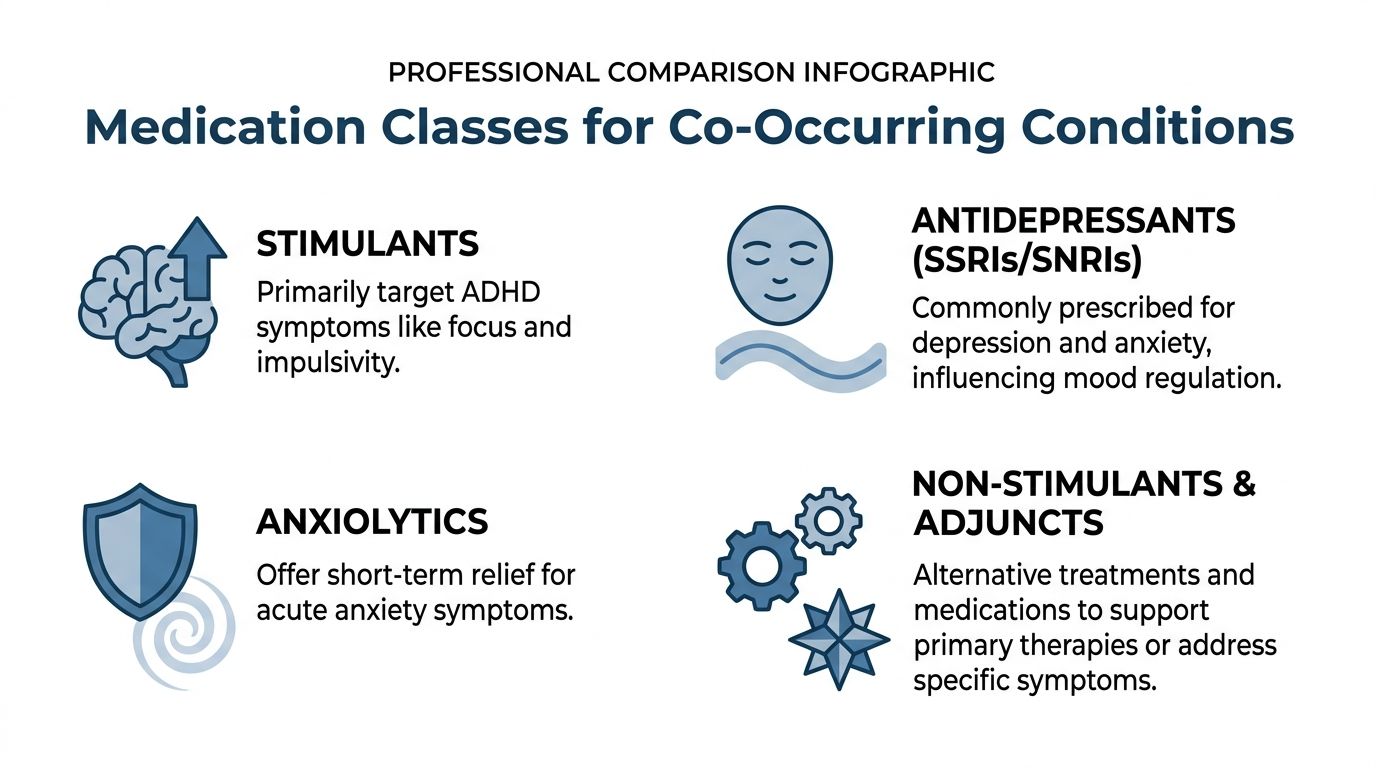
A Guide to Medication Classes for Co-Occurring Conditions
A long medication list can feel like being handed a map with too many roads and no clear starting point. That feeling is common, especially for people in Dallas-Fort Worth who are trying to protect early recovery while also getting relief from anxiety, depression, and ADHD. The goal is not to memorize every medication name. The goal is to understand what each class is designed to do, where it may help, and where it may create problems.
Why medication classes matter
People searching for the best medication for anxiety depression and adhd are often asking one bigger question: "How do clinicians choose a treatment that helps more than one problem without making another worse?"
Medication classes help answer that question because they work on different symptom patterns. Some improve attention and follow-through. Some reduce physical anxiety and intrusive worry. Some lift mood, improve energy, or reduce emotional heaviness. In dual-diagnosis care, that distinction matters even more, because a medication that looks helpful on paper may be a poor fit if it raises relapse risk, worsens sleep, or increases agitation.
Families who are also reviewing depression screening and treatment options often do better when they start with symptom clusters and daily functioning, not brand names.
Stimulants
Stimulants are often used when ADHD symptoms are the main source of impairment. They are meant to improve focus, task initiation, working memory, and impulse control. For the right patient, that can create a ripple effect. Fewer missed steps at work. Less chaos at home. Less shame from falling behind.
In practical terms, stimulants can quiet the mental static that makes everything feel harder.
They are not automatically the first choice in dual-diagnosis treatment. A person with severe panic, recent substance misuse, unstable sleep, or a history of misusing prescribed medication may need a different starting point or much closer monitoring. That is especially relevant in recovery settings, where the treatment plan has to consider both symptom relief and safety.
Common reasons a clinician may consider a stimulant include:
- ADHD symptoms are long-standing and clearly impairing
- Disorganization and inattention are driving work, school, or relationship problems
- Past stimulant treatment helped without causing misuse, severe anxiety, or insomnia
Common concerns include:
- Feeling more physically tense or restless
- Trouble sleeping
- Increased irritability
- Misuse potential in patients with certain substance use histories
Readers who want a clearer side-by-side explanation can review stimulant and non-stimulant ADHD medication differences.
SSRIs and SNRIs
SSRIs and SNRIs are frequently used when anxiety or depression is taking up the most space in daily life. These medications are often chosen for persistent worry, panic symptoms, low mood, loss of interest, obsessive thinking, or a constant sense of dread.
A helpful way to understand them is to picture the treatment plan as a house with several rooms. If anxiety and depression are filling the whole house with noise, SSRIs or SNRIs may lower that background noise enough for the person to sleep, think, and participate in therapy more consistently.
That does not mean they treat ADHD directly.
A person may feel less anxious and less depressed, yet still miss deadlines, forget appointments, lose track of tasks, or struggle to get started. This is one reason medication plans for co-occurring conditions are often layered rather than solved with one prescription.
A calmer nervous system can make recovery possible. It does not always fix executive dysfunction.
Bupropion and other NDRI approaches
Bupropion works differently from SSRIs and SNRIs. It affects norepinephrine and dopamine, which is why clinicians often consider it when depression overlaps with low motivation, mental slowing, and inattentive ADHD symptoms.
For some adults, bupropion sits in the middle of the medication map. It may help mood and energy while also offering some benefit for attention. In substance use recovery, that can make it appealing because it does not carry the same misuse concerns as stimulant medications.
It is not a universal fit. Some people feel more activated on it. If anxiety is already intense, sleep is fragile, or the person becomes agitated easily, clinicians may be more cautious.
Bupropion may be considered when:
- Depression is prominent
- Fatigue and low drive are major complaints
- ADHD symptoms are present, especially inattentive symptoms
- A non-stimulant approach is preferred because of substance use history
Non-stimulants and adjunct options
Non-stimulants often become especially important in recovery-focused care. They may be used when stimulant risks are too high, when anxiety sensitivity is strong, or when a patient has not tolerated stimulant side effects well.
Atomoxetine is one of the best-known options in this group. Clinicians often consider it when ADHD needs treatment but the overall plan also has to protect sobriety, reduce overstimulation, and avoid medications with abuse potential. For some patients, that balance is the main priority.
Other options may also be discussed, depending on the person’s symptom pattern:
- Viloxazine: A non-stimulant ADHD medication that may help attention, with monitoring for activation or mood changes
- Alpha-agonists such as guanfacine: Sometimes used to reduce hyperarousal, emotional reactivity, or impulsive overstimulation
- Limited adjunct medications for anxiety: Used cautiously in selected cases, especially when sedation, dependence risk, or cognitive dulling would create new problems
Many people hope one medication will solve everything. Sometimes one medication covers enough ground. More often, the safest plan is a focused combination that targets the most disruptive symptoms first while protecting recovery, sleep, and day-to-day functioning.
Comparing medication classes for anxiety depression and ADHD
| Medication Class | Primary Targets | Best For | Key Considerations |
|---|---|---|---|
| Stimulants | Attention, impulsivity, task initiation | ADHD symptoms causing major functional impairment | Can improve focus quickly, but may increase tension, insomnia, or misuse risk in some patients |
| SSRIs | Anxiety, depression, intrusive worry | Strong anxiety or depressive symptoms | Often help mood and worry, but usually do not address core ADHD symptoms fully |
| SNRIs | Anxiety, depression, physical tension | Anxiety with depression, especially when broader mood support is needed | May be useful when emotional and physical symptoms overlap |
| NDRI such as bupropion | Depression, energy, attention | ADHD plus depression, especially with low motivation | Can be activating for some patients, so anxiety and sleep need close review |
| Non-stimulants such as atomoxetine | ADHD with anxiety sensitivity | People who cannot tolerate stimulants or need lower misuse risk | Often considered in dual-diagnosis and recovery settings |
| Alpha-agonists and adjuncts | Hyperarousal, emotional reactivity, withdrawal-related discomfort | Selected dual diagnosis cases | Usually support a broader plan rather than serving as the only medication |
How Clinicians Develop Your Personalized Treatment Plan
You sit down for an appointment hoping someone will finally name the problem and hand you the right pill. Instead, the first part of good care often feels slower than expected. In dual-diagnosis treatment, that slower pace is not hesitation. It is how clinicians protect you from a plan that treats the wrong target first.

What happens in a real evaluation
Clinicians usually start by building a timeline. That matters because anxiety, depression, ADHD, trauma, poor sleep, and substance use can overlap in ways that look almost identical on the surface. Trouble concentrating, for example, can come from ADHD, severe depression, constant worry, cannabis use, alcohol withdrawal, or months of inadequate rest. The treatment plan changes depending on which of those came first and which is causing the most disruption now.
Severity matters too. A person who is panicking daily, barely sleeping, or struggling to get out of bed may need mood or anxiety stabilization before anyone can clearly judge what part of the attention problem is true ADHD. In early recovery, this step becomes even more important because withdrawal and post-acute symptoms can temporarily mimic all three conditions.
A careful evaluation often includes several layers:
- Symptom timeline: When inattention, low mood, restlessness, panic, irritability, or loss of motivation began
- Recovery context: Current or recent use of alcohol, cannabis, stimulants, opioids, benzodiazepines, or nonmedical pills
- Past medication history: Which medicines helped, which caused agitation or sedation, and which did nothing
- Daily functioning: Work performance, school demands, parenting, driving, sleep, and relationships
- Risk review: Suicidal thoughts, self-harm, overdose history, relapse triggers, and misuse potential
A useful comparison is a clinician sorting tangled wires before turning the power back on. If the wrong line gets priority, symptoms can worsen instead of improve.
How clinicians decide what to treat first
The first prescription decision is rarely about finding a single medication that does everything. It is about choosing the safest first move.
If depression is severe, treatment may begin with mood support so the person can eat, sleep, think clearly, and participate in therapy. If anxiety is dominating the picture, the early goal may be reducing panic, physical tension, or constant dread. If ADHD symptoms are causing repeated job loss, unsafe driving, or treatment nonadherence, attention may need direct treatment sooner. In a Dallas-Fort Worth recovery setting, clinicians also ask one more question: which option supports sobriety rather than putting it at risk?
That is why treatment planning can feel highly individualized. Two people can share the same three diagnoses and still need very different starting strategies.
Why the plan often changes in stages
Medication planning works more like adjusting a set of dials than flipping a single switch. Clinicians often start with one change, watch closely, and then decide whether the response is meaningful or misleading. A medication may improve focus but worsen insomnia. Another may ease sadness but leave racing thoughts untouched. A third may help anxiety while making fatigue harder to tolerate.
This staged process helps answer practical questions:
- Is the symptom improving because the medication fits, or because the person is sleeping again?
- Is new irritability a side effect, a withdrawal symptom, or part of the original condition?
- Is the person feeling calmer, or just more sedated?
- Has concentration improved enough to function, or only enough to notice everything else still feels wrong?
Those distinctions matter. They help prevent the common mistake of adding more medication before the first change has been understood.
Why combination treatment is sometimes the right call
Some people do well with one medication. Others need a layered plan because each condition responds to a different type of treatment. As noted earlier, clinicians sometimes combine approaches when one medicine improves only part of the picture. That does not mean the case is unusually severe. It often means the treatment is being matched to how the brain symptoms are showing up.
For example, a patient may report that hopelessness lifts, but procrastination and disorganization still derail work. Another may focus better, but anxiety remains so loud that productivity never fully returns. In those cases, a thoughtful combination can make more sense than forcing one medication to do a job it does not do well.
At Tru Dallas Detox & Recovery Center, this process is shaped by more than diagnosis alone. It also has to fit detox status, relapse history, current recovery goals, therapy participation, and any medications already being used in addiction treatment. Good planning is not about speed. It is about building a strategy that is clear enough to adjust, careful enough to protect recovery, and flexible enough to follow real life rather than a textbook.
Safety Interactions and Long-Term Monitoring
People with anxiety, depression, and ADHD often worry about side effects. People in recovery worry about something even more specific: what happens when psychiatric medications interact with alcohol, cannabis, opioids, sedatives, or medications used during treatment for substance use disorders. That concern is valid.
Why substance use changes the medication discussion
Substance use can blur the picture in two ways. First, it can imitate psychiatric symptoms. Alcohol can worsen depression. Cannabis can affect motivation and concentration. Stimulant misuse can intensify anxiety, sleep disruption, and irritability. Second, substances can change how safely certain medications should be prescribed or monitored.
This is why dual diagnosis care matters. A medication that seems reasonable in a standard outpatient setting may need a different plan if the person is detoxing, starting medication-assisted treatment, or trying to stabilize after relapse.
Several safety themes tend to guide good care:
- Addiction potential: Some patients need non-stimulant options because the risk-benefit balance doesn't favor stimulant prescribing.
- Overactivation risk: Certain medications can heighten agitation, insomnia, or physical anxiety.
- Withdrawal overlap: Early recovery symptoms can look like anxiety, depression, or ADHD and can temporarily complicate diagnosis.
- Polypharmacy concerns: The more medications involved, the more carefully clinicians need to watch for interactions and side effects.
What long-term monitoring usually includes
Long-term medication management isn't just about whether symptoms improved. It also tracks whether the plan remains safe, sustainable, and useful in real life.
For patients with co-occurring conditions, treatment options require careful attention to addiction potential and side effects. Newer non-stimulants such as viloxazine may help focus without addiction risk but require monitoring for anxiety spikes, while off-label alpha-agonists like guanfacine are a growing option for anxiety and withdrawal symptoms in dual diagnosis care, according to this overview of ADHD medications in complex co-occurring presentations.
Monitoring often includes:
- Mood tracking: Depression can improve slowly, and anxiety can shift before mood does.
- Sleep review: Insomnia can signal that a dose, timing, or medication choice needs adjustment.
- Appetite and energy: These help clinicians judge whether the treatment is supporting recovery or undermining it.
- Misuse screening: Important when a patient has a history of addiction or is taking medications with abuse potential.
- Coordination with other treatment: MAT, therapy, primary care, and psychiatric follow-up all need to align.
Patients should also know that stopping psychiatric medications abruptly can be risky. Changes should be supervised, especially when someone is also navigating detox, relapse prevention, or significant mood symptoms.
The Role of Non-Medication Support in Lasting Recovery
A common Dallas area recovery story goes like this. Someone starts the right medication and feels calmer, less foggy, or more able to focus. Then real life shows up. An argument at home triggers panic, a busy workweek throws off sleep, or a craving hits at the end of a hard day. The medication may still be helping, but symptom relief alone does not teach the person what to do in those moments.

For people living with anxiety, depression, ADHD, and substance use risk, recovery usually works best when medication is one part of a larger plan. Medication can lower the volume on racing thoughts, improve attention, or ease depressive symptoms. Skills-based treatment helps a person use that relief in daily life. In clinical practice, that is often the difference between early improvement and steady recovery.
Medication works better with skills and structure
Medication works like turning down static on a radio. You can hear the signal more clearly, but you still need to know what station you are trying to tune into. A person may feel less anxious and still avoid conflict. Another may focus better and still miss appointments, stay up too late, or struggle when cravings or stress hit.
That is why therapy and routine matter so much.
CBT can help patients catch thought patterns that feed panic, shame, hopelessness, or all-or-nothing thinking. DBT-informed approaches can teach concrete ways to slow impulsive reactions, tolerate distress, and stay grounded during emotional spikes. Trauma-informed counseling can help when past experiences are still shaping present symptoms. In dual diagnosis care, relapse-prevention therapy adds another layer by helping patients identify triggers, high-risk situations, and the early warning signs that often come before a return to substance use.
Medication may open the door. Repetition, therapy, and daily structure help people walk through it.
Support that helps recovery last
In a dual-diagnosis setting, lasting progress usually comes from several supports working together. Each one addresses a different part of the problem.
- Therapy for patterns and reactions: Patients learn how anxiety, depression, ADHD, and substance use can reinforce each other, then practice ways to interrupt that cycle.
- Sleep and routine support: Consistent wake times, simpler evening habits, and realistic planning often improve mood regulation, focus, and relapse resistance.
- Family and relationship work: Education and counseling can reduce blame, improve communication, and help loved ones respond to symptoms without making them worse.
- Peer and community connection: Group therapy and recovery support reduce isolation, which is a common trigger for both depression and substance use.
- Case-by-case recovery planning: Some patients need help returning to work, rebuilding trust at home, or creating a schedule they can follow outside treatment.
This process matters even more when symptoms overlap. Anxiety can look like distractibility. ADHD can look like poor motivation. Depression can drain the energy needed to use coping skills. Substance use can blur the whole picture. A program that treats these issues together gives clinicians and patients a clearer map of what is driving what. That is one reason many families look for dual diagnosis rehab in Dallas that addresses mental health and substance use together.
For many people in Dallas-Fort Worth, the goal is not just to feel better for a few weeks. The goal is to stay steady through work stress, family strain, boredom, grief, and temptation. Medication can support that goal. Therapy, structure, support, and recovery-focused care are what help it hold.
Finding Expert Dual Diagnosis Care in Dallas Fort Worth
A Dallas parent may watch their adult son seem calmer after stopping alcohol, only to see racing thoughts, low motivation, and poor focus remain. Another person may finally ask for help after months of panic, missed work, and using pills or alcohol to get through the day. In both situations, the question is not merely, "What medication works?" The crucial question is, "Who can sort out which symptoms belong to anxiety, depression, ADHD, substance use, or withdrawal, and then build a plan that is safe in recovery?"
That is why local dual diagnosis care matters. The right team does more than prescribe. It studies timing, patterns, risk, and context. A symptom that looks like ADHD in one setting may be anxiety in another. Low energy may come from depression, poor sleep, early sobriety, or all three at once. Good treatment starts by slowing the picture down so the plan fits the person.
What to look for in local treatment
In Dallas, Fort Worth, Euless, Plano, Irving, and nearby communities, families often need a program that can evaluate mental health and substance use together instead of sending patients in separate directions. That combined view matters because medication choices change when recovery is part of the picture.
A careful program should offer:
- Integrated assessment: One team reviews mood symptoms, attention problems, substance use history, withdrawal risk, sleep, trauma, and medical factors together.
- Prescribing that matches recovery goals: Clinicians consider misuse risk, side effects, drug interactions, and whether a medication can be monitored safely over time.
- A step-by-step treatment plan: The team explains what to treat first, what to watch closely, and when to adjust instead of changing several variables at once.
- Connected levels of care: Detox, residential treatment, outpatient care, and aftercare should share information so the medication plan does not get lost during transitions.
This process works like sorting tangled cords before plugging anything in. If everything is treated as one knot, mistakes are easy. If each strand is identified clearly, treatment becomes safer and more precise.
Why local coordination matters
Medication planning for anxiety, depression, and ADHD can get more complicated during early recovery. A person may need a non-stimulant first. Someone else may need depression treated before attention can be judged accurately. Another patient may need close follow-up because cravings, insomnia, or mood swings can change quickly after detox. These are not one-visit decisions.
Local coordination gives clinicians the chance to observe how symptoms change in real life. Are panic symptoms improving as sobriety stabilizes? Is poor concentration still present after sleep gets better? Does a medication help focus but worsen anxiety? Those details shape good prescribing more than a simple checklist ever could.
For people who need that level of coordinated support, dual diagnosis rehab in the Dallas area can offer a setting where mental health treatment, recovery planning, and medication management work together.
Practical access matters too. Patients and families often have questions about refills, urgent medication gaps, and telehealth rules during transitions in care. For readers who want a plain-language overview, this guide on how to get prescriptions online safely and legally may help clarify the basics.
People in North Texas deserve care that treats the full pattern, not isolated pieces of it. The best program is one that can identify what is driving the symptoms, protect recovery while medication is adjusted, and stay involved long enough to help that progress hold.
Frequently Asked Questions About Medication Management
How long does it take for medication to work
It depends on the medication class and the target symptom. Some ADHD medications can affect focus sooner, while many antidepressant and anxiety medications need more time before benefits are clear. Clinicians usually look for a pattern over time rather than judging a medication after only a few difficult days.
Will someone need medication forever
Not always. Some people use medication for long periods because the benefits remain strong and the side effects are manageable. Others use medication during a specific phase of recovery or stabilization and later reduce or change the plan under medical supervision. The safer question isn't "forever or not?" It's whether the medication is still helping more than it is hurting.
What is the difference between dependence and addiction
They are not the same. Dependence means the body adapts to a medication and may react if it is stopped suddenly. Addiction involves compulsive use despite harm, cravings, loss of control, or continued use outside the treatment plan. This distinction matters because many patients fear all psychiatric medication for the wrong reasons.
For readers who are exploring telehealth logistics, refill questions, or urgent care prescribing rules, this guide on how to get prescriptions online safely and legally offers practical context.
What if a person has tried medication before and it didn't help
One failed medication doesn't mean treatment won't work. The dose may have been wrong, the diagnosis incomplete, side effects may have masked benefits, or another untreated condition may have been driving the problem. In dual diagnosis care, that is especially common because substance use can cloud the picture.
Is there one best medication for anxiety depression and adhd
Usually, no single medication is best for everyone. The better goal is the best strategy for the specific person. That strategy may involve one medication, a combination, or a staged plan that changes as recovery progresses.
When anxiety, depression, ADHD, and substance use are all in the picture, clarity often starts with one conversation. Tru Dallas Detox & Recovery Center helps adults and families across Dallas-Fort Worth through detox, dual diagnosis treatment, medication planning, and long-term recovery support with compassion and structure. If a loved one needs answers, the next step can be simple. Call now, ask questions, and verify insurance with a team that understands how these conditions overlap and how real recovery begins.
