
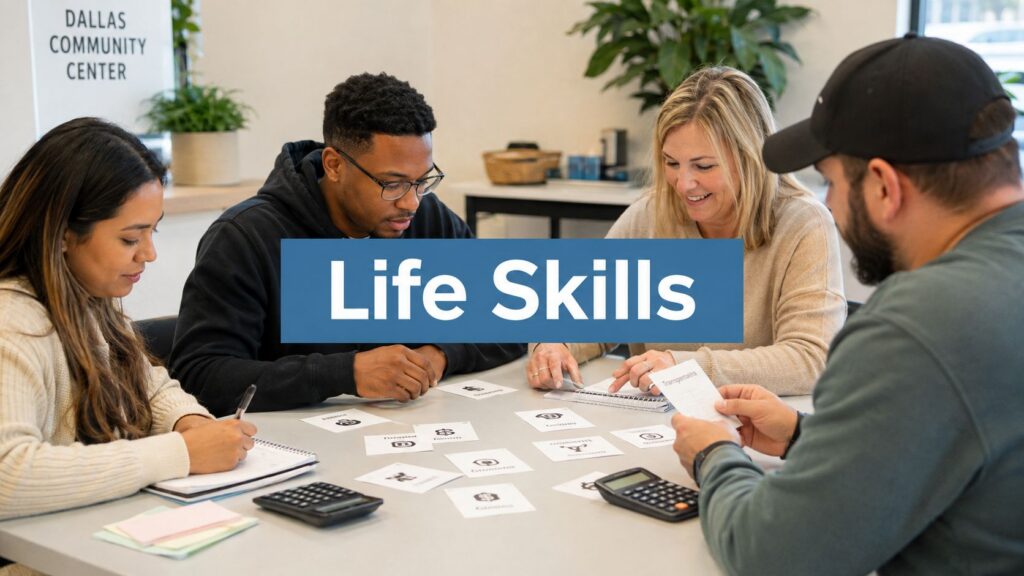
The first morning after detox can feel deceptively manageable. A Dallas resident may wake up without shaking, sweating, or thinking about the next drink or pill, then discover that recovery has also brought an overdue bill, an unanswered call from family, an empty calendar, and a message from someone connected to past use. Physical stabilization helps, but it doesn't automatically teach a person how to handle pressure, repair trust, manage money, or leave a dangerous conversation safely.
Life skills training for recovery fills that practical gap. It gives adults the routines, emotional tools, communication strategies, and problem-solving practice needed to move from a Dallas detox center into real-world independence. For families seeking addiction treatment in Dallas, the most useful question isn't only whether a program can stop withdrawal. It's whether the program helps a loved one function safely after withdrawal ends.
Table of Contents
- Why Detox Alone Is Not Enough for Lasting Recovery
- What Life Skills Training Actually Means in Recovery
- Core Modules That Build Real-World Independence
- Evidence Behind Skills-Based Recovery Programs
- How Tru Dallas Personalizes Life Skills Training
- Designing Programs for People Who Need Them Most
- Taking the Next Step Toward Recovery in Dallas
Why Detox Alone Is Not Enough for Lasting Recovery
A patient completes medical detox in Dallas after years of drinking. The body feels clearer, but the transition home is abrupt. Within days, an overdue electric bill needs attention, a mother wants answers about broken promises, and a former using friend sends a cheerful message inviting a reunion. Each problem is ordinary on paper. In early recovery, each can activate shame, anxiety, anger, or craving.
Detox addresses the immediate medical effects of stopping alcohol or drugs. It can provide monitoring, stabilization, and a safer starting point, but it doesn't rebuild the daily structure addiction disrupted. The distinction between detox and ongoing rehabilitation is explained in this guide to detox and rehab, because the two services solve different problems.
The missing structure after withdrawal
Active addiction often narrows life around obtaining, using, recovering, and hiding substance use. Bills go unpaid. Sleep becomes unpredictable. Employment and family communication deteriorate. A person may know what a responsible decision looks like but still lack the practiced ability to make that decision while distressed.
Relapse in this setting isn't best understood as a simple failure of willpower. It can reflect an unaddressed deficit in emotional regulation, planning, boundary-setting, stress tolerance, or social support. Those deficits become especially dangerous when a person leaves treatment with too much unstructured time and too few rehearsed responses.
Practical rule: A discharge plan should answer what happens during the next difficult phone call, financial crisis, craving surge, and unplanned encounter with someone from the person's using life.
Life skills training creates that bridge. Patients practice how to pause before reacting, ask for help without shame, organize a morning, decline an invitation to use, and recover from a mistake without deciding that the entire treatment episode has failed. Those skills support independence because they turn recovery principles into repeatable behavior.
What Life Skills Training Actually Means in Recovery
The World Health Organization defines life skills as abilities that support adaptive, positive behavior and help people manage everyday demands and challenges. Its framework includes decision-making, problem-solving, creative thinking, critical thinking, effective communication, interpersonal relationships, self-awareness, empathy, coping with emotions, and coping with stress. WHO identifies adolescence and youth as an important period for developing these competencies, and its school-based framework has influenced health and prevention programs globally through its early life-skills education work, including the WHO publication on life-skills education for children and adolescents.
In addiction recovery, those abilities become operational relapse-prevention tools. A person with anxiety may need to recognize escalating physical symptoms before reaching for a substance. Someone with trauma may need grounding skills before discussing a painful memory. A parent may need assertive communication to set limits without returning to either silence or explosive confrontation.
Clinical training, not worksheet filler
Substance use can interrupt emotional and social development. Someone who began heavy drinking during adolescence may reach adulthood with limited practice tolerating disappointment, negotiating conflict, or managing independence. Co-occurring depression, PTSD, or anxiety can make those tasks harder, particularly when shame and avoidance have become familiar coping patterns.
Effective life skills training in a clinical setting is therefore therapeutically integrated, trauma-informed, and paced to readiness. A counselor might introduce a simple pause-and-plan routine before asking a patient to role-play a high-conflict family conversation. A patient who becomes overwhelmed by written material may learn through demonstration, repetition, pictures, and supervised practice rather than a packet of abstract questions.
The difference matters. A worksheet can introduce an idea, but practice builds access to that idea under pressure. Patients seeking practical tools can also review coping skills for addiction as part of a broader relapse-prevention plan.
Core Modules That Build Real-World Independence
A useful curriculum doesn't treat every patient as though the same skill gap caused the addiction. One person may need help with anger and impulsive texting. Another may need a routine, transportation planning, and support finding work. The following modules provide a foundation, but clinicians should sequence them around the person's safety, cognition, trauma history, and discharge environment.
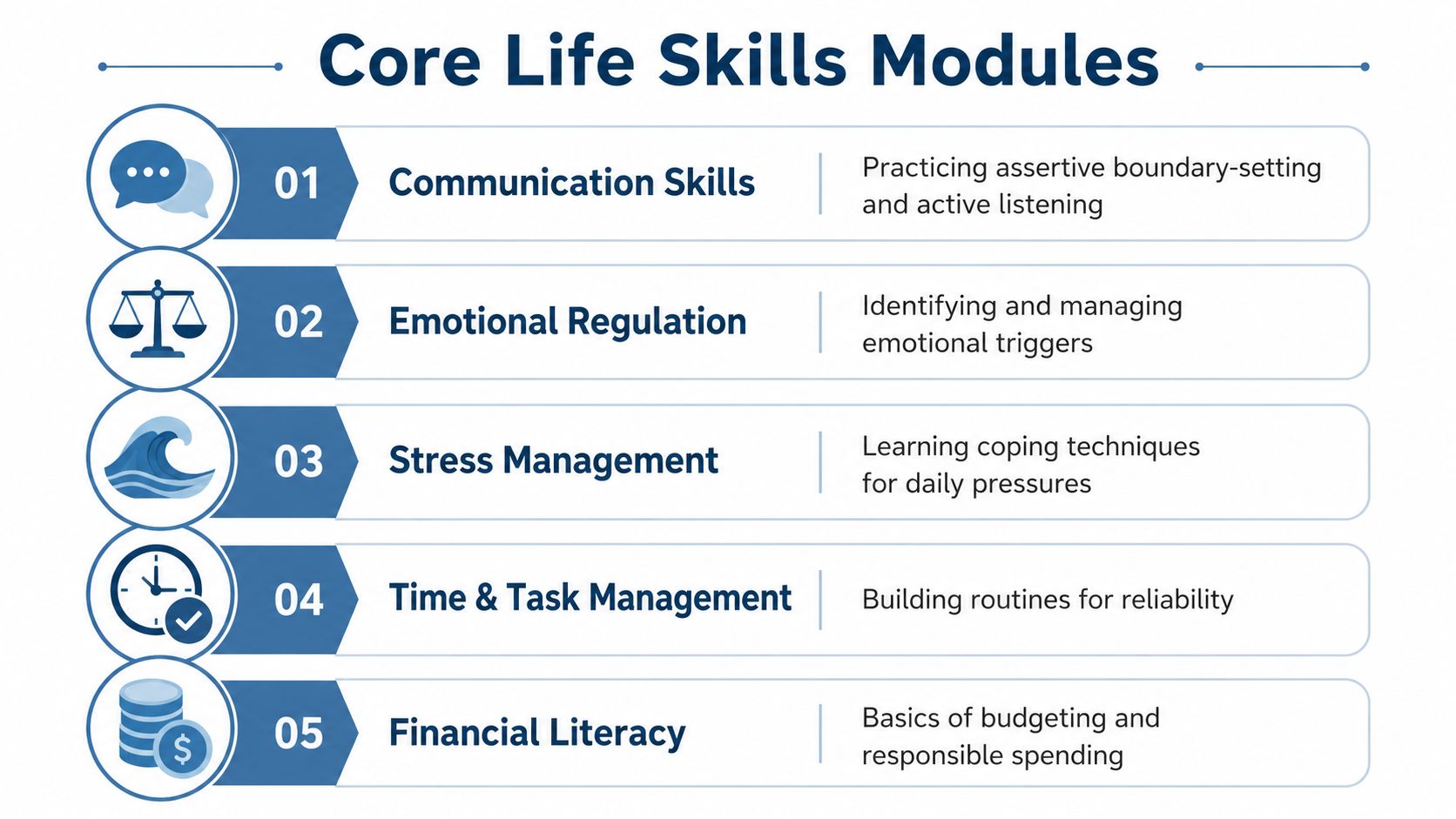
Communication and emotional regulation
Communication practice starts with situations patients face. A patient may rehearse saying, “I'm not discussing this while either of us is shouting,” then practice ending the call and returning to it later. Another may work on telling family members which kinds of check-ins feel supportive and which questions trigger defensiveness.
Emotional regulation involves identifying the point at which discomfort becomes dangerous. Patients can track body cues, name emotions, use grounding exercises during panic or craving surges, and recognize HALT states, meaning hungry, angry, lonely, or tired. The purpose isn't to eliminate difficult feelings. It's to create enough space to choose a safer response.
Stress management and financial literacy
Stress-management practice can include breathing, sensory grounding, movement, contacting a support person, and breaking a large problem into the next manageable action. These techniques work best when patients rehearse them before a crisis, not when a counselor introduces them after a relapse warning has already peaked.
Financial literacy connects directly to stability. Patients may learn to list fixed obligations, separate needs from impulsive spending, plan around irregular income, and address debt without avoiding every letter or call. Someone returning from treatment may also need help reestablishing basic banking access and creating a payment plan that reduces financial panic.
Job readiness and relapse prevention
Job preparation must account for recovery-related anxiety and employment gaps caused by treatment, incarceration, or instability. Practice can include answering interview questions, explaining availability, managing workplace stress, and identifying people or settings that could increase exposure to substances.
Relapse prevention planning should move beyond a generic trigger list. Patients can rehearse specific scenarios, such as receiving a stressful call from a former partner, being offered drugs after a shift, or experiencing a craving while alone at night. Role-play allows the patient to practice refusal, exit, support contact, and follow-up until the sequence feels more accessible under pressure.
A stable next setting matters as well. Patients and families can review how sober living differs from rehab when a structured living environment may support the transition.
Evidence Behind Skills-Based Recovery Programs
Skills-based prevention research supports the idea that structured practice can influence substance-use behavior beyond the treatment period. A major evidence summary of the LifeSkills Training prevention curriculum reported that, at a 12th-grade follow-up, participants were about 19% less likely to smoke weekly, 21% less likely to smoke a pack a day, and 16% less likely to get drunk monthly than controls. The same summary describes broader review findings showing roughly 10% to 30% reductions in smoking, drunkenness, and marijuana use 5 to 6 years after random assignment. These figures are detailed in the LifeSkills Training evidence summary.
Those findings don't mean every adult in recovery will experience identical results. Prevention curricula, clinical treatment, and post-detox services differ in population, intensity, timing, and follow-up. They do show why structured skills deserve more than a brief lecture. Refusal practice, self-management, normative-belief work, and scenario rehearsal can affect behavior pathways that remain relevant after formal treatment ends.
What the research does and doesn't prove
A systematic review of life-skills education in developing countries found improvements across psychosocial and social outcomes, while also reporting that effects were often small and dependent on implementation quality and contextual adaptation. The review emphasizes that structured, experiential, and locally relevant delivery tends to perform better than unstructured or purely didactic instruction, as described in the systematic review of life-skills education.
That evidence supports a cautious comparison rather than a promise of guaranteed outcomes:
| Outcome Metric | With Life Skills Training | Without Life Skills Training |
|---|---|---|
| Response to triggers | Patients rehearse practical responses before high-risk situations arise. | Patients may understand relapse prevention conceptually but lack practiced behavior under stress. |
| Daily structure | Routines, task planning, and communication are connected to the discharge environment. | Physical stabilization may occur without a workable plan for ordinary responsibilities. |
| Transfer to independence | Active practice improves the chance that skills can be used outside treatment. | Lecture-based learning or generic counseling may leave the transfer problem unresolved. |
| Program quality | Progress can be reviewed and adjusted around individual gaps. | A uniform curriculum can miss literacy, trauma, cognitive, and cultural needs. |
The honest conclusion is that skills training is not a guarantee and attendance alone isn't a meaningful outcome. Sequencing, practice, clinician feedback, and real-world relevance determine whether a patient can use a skill when craving, fear, or conflict narrows attention.
How Tru Dallas Personalizes Life Skills Training
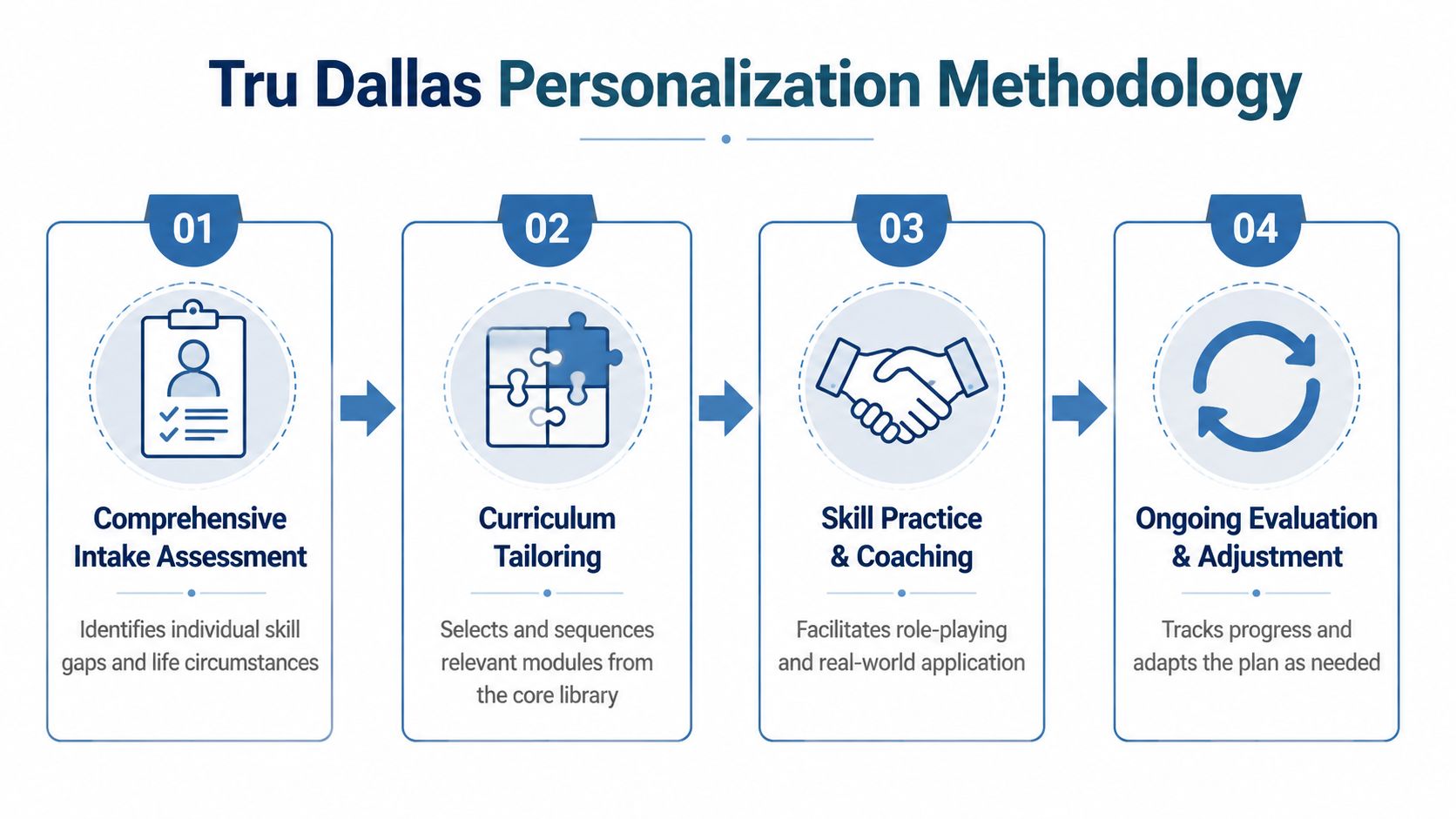
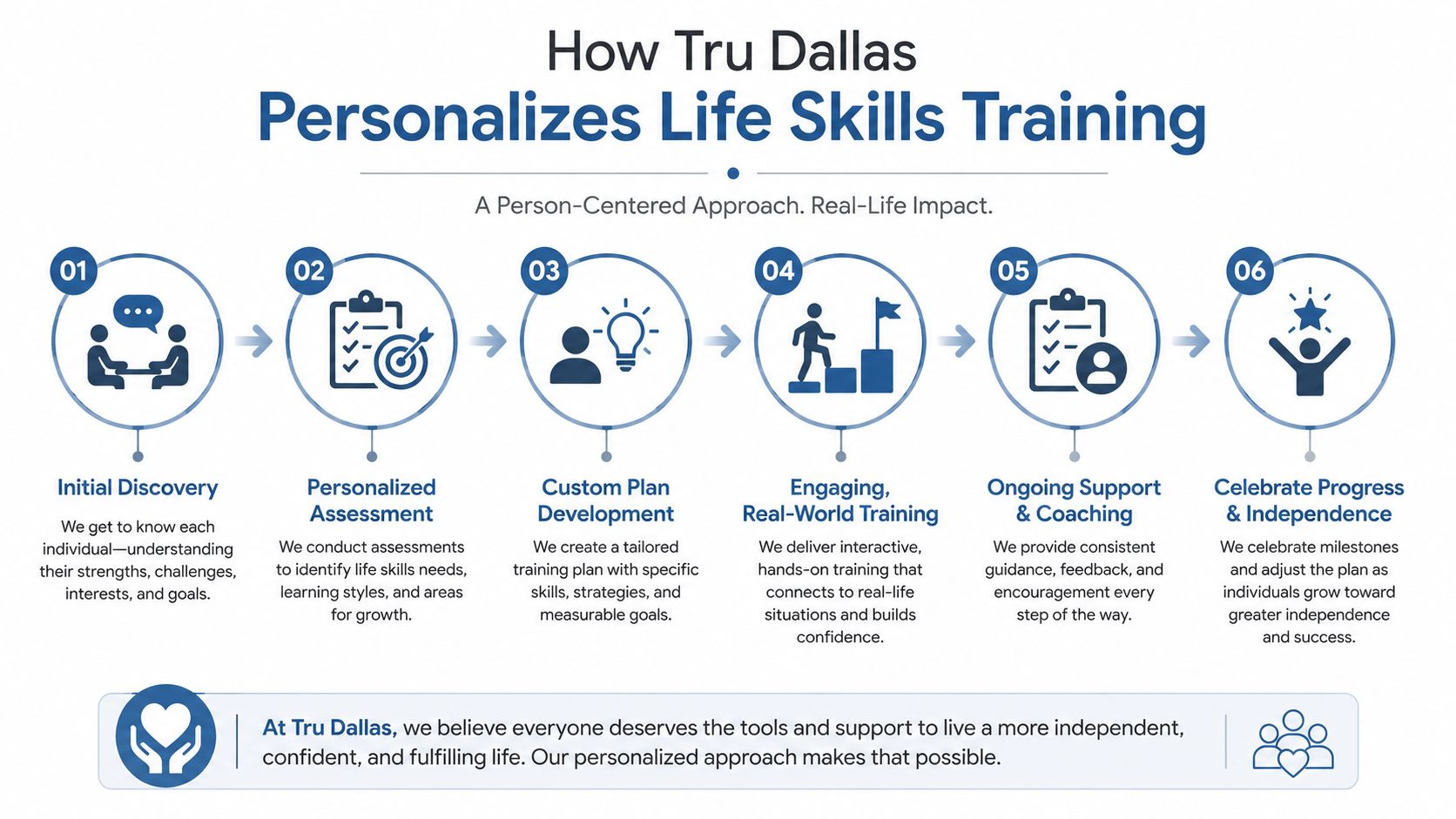
A life skills curriculum becomes useful when it starts with the patient's actual obstacles. During intake, clinicians can identify whether the immediate problem is unstructured time, financial confusion, conflict avoidance, social anxiety, poor sleep routines, difficulty following treatment instructions, or a co-occurring psychiatric condition that interferes with concentration.
The next decision is pacing. A patient with severe anxiety may begin with brief, predictable exercises before attempting a job interview role-play. Someone rebuilding a relationship with a child may start by practicing active listening, taking responsibility without defensiveness, and ending a difficult conversation safely. The work should feel challenging enough to build capacity, but not so difficult that the patient shuts down.
Adapting the method to the person
A multidisciplinary team can adjust language complexity, written demands, repetition, group participation, and individual coaching. Trauma history affects how quickly a patient can tolerate certain discussions. Depression may require smaller tasks and visible progress. Bipolar symptoms, panic, or cognitive effects of prolonged substance use may call for closer coordination between mental health care and life skills instruction.
A patient with social anxiety might first record answers privately, then practice with one staff member, and later participate in a simulated interview. A parent who uses silence to avoid conflict might role-play a boundary conversation several times, receive feedback on tone and wording, and develop a short script for use at home.
Feedback keeps the plan relevant
Clinicians can observe whether a patient can complete a task independently, needs prompts, or becomes overwhelmed. That information should change the next exercise. If a budgeting lesson produces confusion, the team can use a visual calendar, concrete household examples, or a smaller decision. If a communication script works in group but fails with family, the practice needs to become more specific.
Tru Dallas Detox & Recovery Center provides medically supervised detox, residential or outpatient rehabilitation, medication-assisted treatment, therapy, group counseling, dual diagnosis care, and aftercare planning for people in the Dallas-Fort Worth area. Its life skills work can be connected to relapse prevention, stress management, anger management, communication, and discharge planning rather than treated as an isolated workbook activity.
Cultural context also matters in Dallas, where patients come from varied family systems, neighborhoods, work environments, and support networks. A plan should respect the patient's lived experience while still addressing unsafe relationships, discriminatory workplace concerns, transportation limitations, and family expectations that affect recovery.
Designing Programs for People Who Need Them Most
Many life skills programs assume that participants can read complex handouts, attend at consistent times, use digital resources, maintain transportation, and concentrate through a standard classroom session. That assumption excludes people experiencing homelessness, unstable employment, limited formal education, serious psychiatric symptoms, or reentry after incarceration.
The access problem is documented at a global level. Recent evidence reports that only 16% of workers worldwide participated in structured learning during the previous 12 months, with participation around 15% in lower-middle- and upper-middle-income countries and about 17% in low-income and high-income countries. The same OECD-linked skills outlook report notes that adults with lower initial skill levels, insecure employment, and older workers are among those least likely to train, despite facing substantial automation-related displacement risk.
Lowering the practical burden
Recovery programs serving Dallas residents should design for inconsistent schedules and variable literacy from the start. Useful adaptations include:
- Plain-language materials: Replace dense paragraphs with short instructions, familiar examples, pictures, and demonstrations.
- Flexible session blocks: Use shorter learning periods when attention, medication effects, anxiety, or fatigue makes long groups unrealistic.
- Hands-on practice: Teach budgeting with actual bills, routines with a weekly calendar, and communication through role-play instead of relying on lecture alone.
- Multiple formats: Offer technology-assisted exercises when appropriate, while keeping paper-based and verbal options available for people without reliable devices or internet access.
- Peer support: Use carefully supervised peer mentorship to reduce shame and show that asking for help is a recovery behavior, not evidence of failure.
A program also needs to ask who benefits from each module. A digital lesson may be convenient for one patient and unusable for another. A rigid attendance rule may reward people with stable housing while penalizing someone managing shelter changes, court obligations, or unpredictable work.
The strongest design principle is simple: teach at the patient's current developmental, cognitive, and practical starting point. Meeting people where they are isn't lowering expectations. It's creating a realistic route toward mastery.
Taking the Next Step Toward Recovery in Dallas
Families don't need to solve every problem before contacting a treatment provider. A practical starting sequence can reduce uncertainty:
- Request a confidential consultation. Describe the substance involved, recent use, withdrawal concerns, living situation, and immediate safety issues.
- Complete an intake assessment. The assessment should identify life-skill gaps alongside substance use, medical needs, trauma, and co-occurring mental health symptoms.
- Verify insurance coverage. Ask the admissions team to review available PPO or other private-plan benefits, exclusions, deductibles, and authorization requirements. Families should also ask directly about Medicaid eligibility or referral pathways if applicable.
- Prepare useful information. Medical history, medication lists, prior treatment records, emergency contacts, and a short list of daily challenges can help clinicians build a more accurate plan.
- Ask about the first week. Patients should know how detox monitoring, therapy, groups, life skills modules, medication support, and discharge planning fit together.
At Tru Dallas, families can ask about flexible outpatient options, transportation assistance, literacy-adapted materials, sober-living referrals, and continuity from detox through aftercare. The first conversation can happen even when a family isn't sure whether detox, residential treatment, outpatient care, or life skills training is the right fit.
Tru Dallas Detox & Recovery Center connects medically supervised detox with rehabilitation, mental health care, practical life skills training, and individualized aftercare for Dallas-Fort Worth residents. Visit Tru Dallas Detox & Recovery Center to request a confidential consultation, verify coverage, and take the next step toward a recovery plan built for real life.