
The phone is checked again. The last text is reread. Sleep gets shorter, appetite changes, work starts slipping, and the relationship takes over nearly every thought. Even when the connection is chaotic, painful, or clearly unsafe, letting go feels impossible.
That pattern can leave people asking a hard question. What is a love addict? It isn't a dramatic label for caring too much. It describes a pattern of compulsive attachment where romantic pursuit, obsession, and emotional dependence start to function like an addiction.
For many people in Dallas and the wider DFW area, this doesn't show up alone. It often sits next to alcohol misuse, drug use, anxiety, depression, trauma, or codependency. That overlap matters. When someone tries to treat only the substance problem or only the relationship problem, the untreated half can pull them back into the same cycle.
Table of Contents
- What Is Love Addiction and Why Does It Feel So Real
- Understanding the Brain on Love Addiction
- Common Signs and Symptoms of Love Addiction
- The Link Between Love Addiction and Substance Use
- Evidence-Based Treatment for Lasting Recovery in Dallas
- Treatment starts with the full picture
- What effective care usually includes
- Medical detox when substances are part of the picture
- Therapy that targets thought patterns and emotional regulation
- Trauma-informed care
- Structured boundaries and behavioral resets
- Family involvement and support
- What tends not to work
- Building life after the crisis phase
- How to Get Help for Love Addiction at Tru Dallas Today
- Frequently Asked Questions About Love Addiction
What Is Love Addiction and Why Does It Feel So Real
A person can know a relationship is destabilizing and still feel magnetically pulled toward it. That conflict is often the first clue that this is more than ordinary heartbreak.
A love addict is someone whose romantic attachment starts to operate like a compulsive cycle. Thoughts become intrusive. Emotional balance depends on another person's attention. Separation can feel intolerable. Reunion brings temporary relief, then the cycle starts again.
What makes it different from healthy intense love
Healthy attraction can be powerful. It can be exciting, distracting, and emotionally absorbing for a time. But it doesn't usually erase judgment, destroy boundaries, or make someone feel psychologically stranded without contact.
Love addiction is different because the attachment becomes the organizing force of daily life. The person's mood, choices, and sense of safety begin to revolve around the relationship.
A future-dated summary of this debate notes that people often ask whether love addiction is just intense emotion or a legitimate brain-based addiction. It cites a 2025 fMRI study with 450 participants reporting persistent ventral striatum hyperactivity during partner cues, with 35% showing tolerance and withdrawal patterns beyond honeymoon stages, and states that 1 in 5 adults report addictive relational patterns in the U.S. (Wikipedia summary of love addiction). Because that source is a general encyclopedia summary rather than a clinical guideline, those figures should be read cautiously, but the broader point remains important. Many people experience these symptoms as profoundly real, not imagined or exaggerated.
Why shame usually makes it worse
People with this pattern often blame themselves. They call themselves needy, weak, dramatic, or impossible to love. That self-judgment usually drives even more secrecy and desperation.
The more someone treats the bond as proof of personal worth, the harder it becomes to step back and evaluate it clearly.
When love addiction overlaps with anxiety, depression, trauma, or substance use, the cycle gets even tighter. That's one reason co-occurring conditions matter so much in treatment. A fuller look at that overlap appears in this discussion of mental health and substance abuse.
Understanding the Brain on Love Addiction
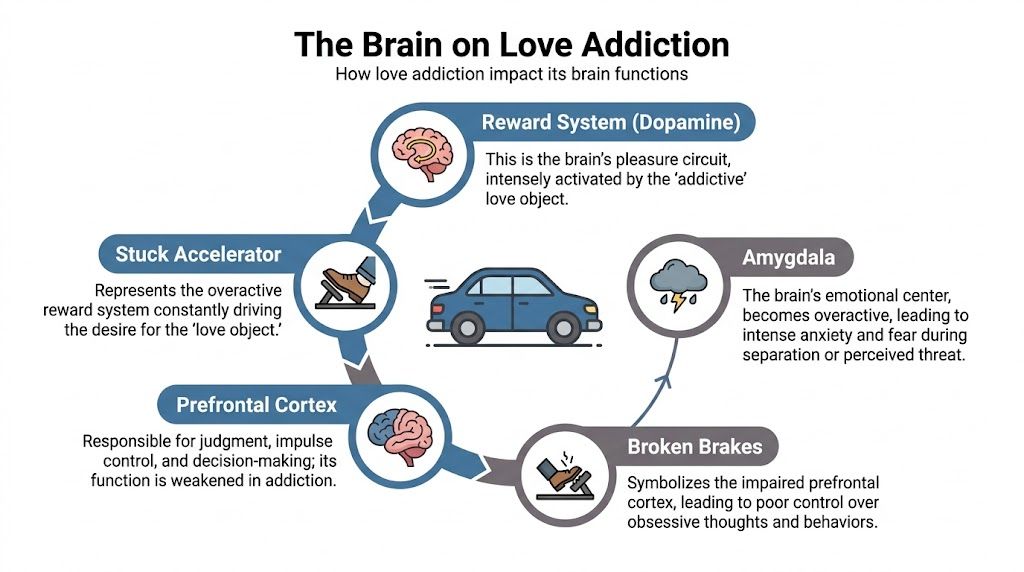
The simplest way to understand love addiction is to think of the brain as a car. The reward system acts like the accelerator. The prefrontal cortex acts like the brakes. In addictive patterns, the accelerator gets pressed hard while the brakes lose control.
That doesn't mean the person has no responsibility. It means willpower alone often isn't enough, because the brain is pushing urgency, craving, and emotional fixation all at once.
The stuck accelerator
Romantic attachment activates the brain's reward system. Foundational fMRI work described by Helen Fisher and colleagues found that intense romantic love engages dopamine pathways associated with craving, tolerance, emotional dependence, and withdrawal, and one study found that the most intense lovers spent 72% of their day thinking about their beloved (Helen Fisher on the neuroscience of love addiction).
In plain language, the brain starts tagging the other person as highly rewarding and highly important. Contact brings a surge of relief, excitement, and focus. Distance can trigger agitation, intrusive thoughts, or panic.
The broken brakes
The prefrontal cortex helps with judgment, planning, impulse control, and reality testing. When someone is flooded by craving and fear, those higher-order functions can weaken.
That helps explain behavior that feels irrational afterward:
- Repeated checking of messages, social media, or location clues
- Boundary collapse after promises to cut contact
- Minimizing harm because brief closeness feels stronger than long-term consequences
- Compulsive return to the same person after painful breakups
The person often isn't choosing calmly. The person is reacting under emotional overload.
The alarm system also gets involved
The amygdala, which helps process threat and emotional salience, can become highly reactive when there is uncertainty, rejection, or fear of abandonment. That makes mixed signals especially powerful.
A delayed reply may not feel like a minor disappointment. It may feel like danger.
Clinical takeaway: When the brain reads separation as threat, the urge to reconnect can feel less like wanting and more like survival.
This is why advice like "just move on" rarely works. It doesn't address the nervous system. Effective treatment has to reduce compulsive reward-seeking while strengthening emotional regulation, reality testing, and tolerance for distress.
Common Signs and Symptoms of Love Addiction
Love addiction doesn't look the same in every person. Some people cycle through intense short relationships. Others stay locked into one painful bond for years. Some appear high functioning from the outside while their inner life is dominated by obsession.
A practical framework comes from Griffiths' six-component model of behavioral addiction. It describes salience, mood modification, tolerance, withdrawal, conflict, and relapse, and a validated screening tool called the Love Addiction Inventory uses these dimensions. That summary also notes that scores above 55 indicate increased clinical concern and higher psychopathology risk (Healthline summary of the Love Addiction Inventory and six-component model).
When attachment becomes compulsion
These signs tend to show up together rather than one at a time.
Obsessive preoccupation
The relationship dominates thinking. Work meetings, parenting, sleep, and daily routines all get interrupted by rumination.Emotional dependency
Mood rises or crashes based on texts, calls, reassurance, or perceived rejection.Using romance to escape
The person turns to the relationship to numb loneliness, shame, anxiety, or emptiness.Escalation
Ordinary connection stops feeling like enough. The person chases intensity, drama, sexual chemistry, rescue fantasies, or constant contact.Withdrawal during separation
Time apart can trigger panic, sadness, insomnia, irritability, or inability to focus.Life conflict
Job performance drops. Parenting suffers. Finances get disrupted. Friendships shrink. The person becomes isolated around the relationship.Relapse after promises to stop
Contact resumes after breakups, blocks, betrayals, or repeated cycles of harm.
Love addiction vs. healthy attachment
| Characteristic | Love Addiction | Healthy Attachment |
|---|---|---|
| Emotional focus | One person dominates attention | Relationship matters, but life stays balanced |
| Boundaries | Limits collapse under fear or craving | Limits are maintained even during conflict |
| Time apart | Separation feels unbearable or destabilizing | Separation can be uncomfortable, but manageable |
| Self-worth | Self-esteem depends heavily on the partner | Self-worth remains more stable |
| Conflict response | Begging, chasing, testing, or returning repeatedly | Direct communication and repair attempts |
| Daily functioning | Work, sleep, family, and routines get disrupted | Responsibilities generally remain intact |
| Partner choice | Often drawn to inconsistency, unavailability, or chaos | Drawn toward safety, reciprocity, and steadiness |
| Breakup pattern | Repeated relapse despite harm | Grief occurs, then recovery progresses |
Why people stay even when it hurts
Many readers recognize themselves in these patterns. The relationship may be humiliating, unstable, or openly harmful. Still, leaving feels worse than staying.
That often reflects a combination of craving, fear of abandonment, and learned attachment patterns. People may confuse unpredictability with passion, or mistake relief after distress for proof of deep love.
For readers seeing overlap with caretaking and self-sacrifice, this related discussion on codependency with an addict can help clarify where love, fear, and overfunctioning start to blur.
Some people don't chase intimacy. They chase relief from the anxiety of losing it.
The Link Between Love Addiction and Substance Use
Love addiction and substance use often reinforce each other. One raises the emotional temperature. The other becomes a way to manage it.
Someone may drink after a breakup to stop the panic. Someone may use drugs to intensify closeness, quiet rejection, or avoid feeling abandoned. Over time, the relationship becomes a trigger for substance use, and substance use makes relationship choices more impulsive.
A treatment gap appears here. A Menninger summary states that a 2023 study found 42% of individuals with love addiction symptoms also met criteria for a substance use disorder, while only 15% of rehab programs explicitly screen for it (Menninger discussion of love addiction and SUD overlap).
Why the two problems feed each other
The overlap isn't random. Several mechanisms keep the cycle alive.
Shared reward pathways
Romantic obsession and substance use can both drive compulsive reward-seeking.Trauma reactivation
Rejection, inconsistency, and emotional distance can activate old wounds. Drugs or alcohol may become the quickest way to dampen that activation.State-dependent decision making
Under the influence, people are more likely to text, return, forgive, pursue, or escalate.Relapse triggers hidden in relationships
Someone may complete detox and still return to the same destabilizing bond that previously fueled drinking or drug use.
Why single issue treatment often falls short
Treating only the alcohol problem or only the romance problem can miss the engine underneath. A person may stop using substances but stay stuck in obsessive attachment, emotional chaos, and repeated reunions. Another person may end the relationship but keep using because the nervous system hasn't learned how to tolerate grief and emptiness.
In Dallas addiction treatment settings, this is where dual diagnosis care matters. It addresses both the substance use disorder and the emotional or psychiatric drivers surrounding it, including trauma, anxiety, depression, and compulsive relationship patterns.
If the person detoxes from a substance but not from the relationship cycle, relapse risk often stays high.
This is also why simplistic advice doesn't work. "Take a break from dating" can be useful, but it isn't enough on its own when the relationship has become part of an addiction pattern. The person usually needs structured treatment, not just insight.
Evidence-Based Treatment for Lasting Recovery in Dallas
Recovery is possible, but it usually requires more than distance from a partner. Effective treatment helps the person understand the pattern, stabilize the nervous system, build new coping skills, and treat any co-occurring substance use or mental health condition at the same time.
That matters because severe forms of love addiction are estimated to affect 5% to 10% of the U.S. population, and the pattern is linked with distress, work problems, and co-occurring mental health concerns. The same summary notes that Susan Peabody described several presentations, including obsessive and codependent love addicts, which supports the need for individualized care rather than one fixed model (PMC summary on severe love addiction patterns).
Treatment starts with the full picture
The first job isn't to force labels. It's to assess what is happening.
That assessment usually looks at:
Current safety
Whether the relationship involves abuse, stalking dynamics, self-harm risk, or severe emotional instability.Substance involvement
Whether alcohol, opioids, stimulants, sedatives, or other drugs are being used to manage the relationship cycle.Mental health symptoms
Anxiety, depression, trauma symptoms, sleep disruption, and compulsive behaviors often sit in the background.Functional impairment
Work problems, social withdrawal, financial harm, parenting strain, and repeated breakup-reunion cycles all matter.
For people with both relationship compulsions and substance use, integrated care is often the right level of support. In the Dallas-Fort Worth area, a dual diagnosis rehab approach is often the clearest fit because it treats both issues together rather than asking one team to ignore half the problem.
What effective care usually includes
The structure depends on severity, but several approaches tend to matter.
Medical detox when substances are part of the picture
If alcohol, opioids, benzodiazepines, or other substances are involved, detox may come first. That's not because love addiction itself requires medical detox. It's because withdrawal, cravings, and unstable mood can make therapy impossible if the body isn't stabilized.
A medically supervised setting can reduce immediate risk and create enough clarity for deeper work.
Therapy that targets thought patterns and emotional regulation
Two therapies are especially useful.
- CBT helps identify distorted beliefs such as "I can't survive without this person" or "chaos means love." It also builds alternative responses to triggers.
- DBT helps people tolerate distress, regulate intense emotions, and stop acting on every urge to contact, chase, or collapse.
Those skills are practical. They help during the exact moments that usually drive relapse into either substance use or the relationship cycle.
Trauma-informed care
For many people, the relationship isn't just a current problem. It hooks into older wounds around abandonment, neglect, inconsistency, or fear. If treatment ignores that history, the same attachment pattern often returns in a new form.
Trauma-informed therapy helps connect present reactions to older survival strategies without excusing harmful behavior.
Structured boundaries and behavioral resets
People often need external structure before internal stability catches up.
That can include:
- No-contact or limited-contact plans when clinically appropriate
- Digital boundaries around messaging, checking, and social media monitoring
- Routine restoration for sleep, meals, work, and movement
- Trigger planning for nights, weekends, anniversaries, and loneliness spikes
Practical rule: Recovery gets stronger when boundaries are made concrete, not left as vague intentions.
Family involvement and support
Loved ones often want to help but accidentally reinforce the cycle. They may over-reassure, cover consequences, or join the emotional panic. Good treatment helps families respond with steadiness, limits, and consistency.
That doesn't mean becoming cold. It means becoming clear.
What tends not to work
People often lose time trying approaches that feel reasonable but don't change the pattern.
Insight without structure
Knowing why the pattern exists doesn't automatically stop it.Willpower alone
Strong intention helps, but craving plus trauma plus loneliness can overpower intention quickly.Couples work too early
If one person is actively using substances or acting out compulsive relationship behavior, couples therapy often becomes chaotic or superficial.Replacing one obsession with another
Jumping into a new relationship, compulsive texting with a different person, or chasing validation online usually keeps the same circuitry active.
Building life after the crisis phase
Long-term recovery depends on building a life that isn't organized around emotional emergencies. That usually includes continued therapy, relapse-prevention planning, peer support, healthier relationship pacing, and daily practices that restore self-trust.
Some people also benefit from broader support around routines, accountability, and sustainable wellness habits. In that context, health and wellness coaching can be a helpful adjunct for people who need more structure around sleep, stress management, consistency, and follow-through after formal treatment.
Healing doesn't require becoming detached or closed off. It requires learning how to experience closeness without compulsion, grief without collapse, and desire without losing judgment.
How to Get Help for Love Addiction at Tru Dallas Today
For many people, the hardest part is the first contact. Shame says to wait, hide it, or handle it alone. That delay usually extends the cycle.
The first step can be simple. Reach out, describe what's happening, and let a clinical team sort through whether the pattern involves love addiction, substance use, trauma, another mental health condition, or several at once.
A simple way to begin
A straightforward admissions process usually looks like this:
Make a confidential call
Share the immediate concerns. That may include a breakup spiral, repeated relapse, alcohol or drug use, panic, depression, or unsafe relationship behavior.Complete a clinical screening
The team can assess severity, co-occurring symptoms, and the right level of care.Review insurance and practical logistics
This helps remove uncertainty around access and timing.Start the recommended program
That may involve detox, inpatient treatment, outpatient care, therapy, or a combination.
What to prepare before the first call
It helps to gather a few basics:
Current symptoms
Obsession, panic, inability to sleep, substance use, self-harm thoughts, or repeated contact after breakupsRelationship pattern
Whether the issue is one person, repeated unstable bonds, infidelity cycles, or fear of being aloneSubstance history
What is being used, how often, and whether stopping feels difficult or unsafeMental health background
Anxiety, depression, trauma history, prior treatment, and medications
People across Dallas, Euless, Fort Worth, Arlington, Irving, and surrounding communities often wait until the crisis becomes unmanageable. Help tends to work better when it starts earlier, before another relapse, another dangerous reunion, or another period of severe emotional collapse.
Frequently Asked Questions About Love Addiction
Is love addiction a real condition if it isn't always listed as a formal diagnosis
Yes. A condition can be clinically significant even when terminology is debated. What matters most is whether the pattern causes distress, impairment, compulsive behavior, and repeated harm. In practice, clinicians often treat the symptoms and underlying drivers rather than arguing over labels.
Does recovery mean giving up relationships
No. Recovery doesn't mean becoming numb or avoiding intimacy forever. It means learning how to build relationships with boundaries, pacing, mutuality, and emotional stability. Healthy attachment feels calmer than addiction, which can seem unfamiliar at first.
Can treatment help if substance use is also involved
Yes. In fact, integrated treatment is often the best option when both issues are present. Treating only the substance use problem while ignoring compulsive attachment can leave a major relapse trigger untouched. Treating only the relationship pattern while ignoring withdrawal, cravings, or active use can have the same result.
Can family members do anything helpful right now
Yes. They can stop arguing with the obsession, stop rescuing the consequences, and start encouraging professional assessment. Calm limits help more than emotional lectures. Families also benefit from support of their own so they don't get pulled into the same cycle.
If obsessive attachment, breakup relapse, alcohol use, drug use, or emotional chaos are taking over daily life, Tru Dallas Detox & Recovery Center can help. The team provides confidential support, insurance verification, medically supervised detox when needed, and integrated care for co-occurring substance use and mental health conditions in the Dallas-Fort Worth area. A single call can clarify the next step and make treatment feel manageable again.