

Temazepam withdrawal symptoms can start within hours of the last dose, often peak on the second day, and commonly include severe anxiety, insomnia, tremors, nausea, and other physical distress. That early, fast-moving pattern is why stopping temazepam without medical supervision can become dangerous very quickly.
Many people in Dallas start searching for help at the exact moment they decide they can’t keep taking the medication but also feel afraid of what will happen if they stop. Families often notice the same tension. Someone wants relief, wants sleep to return naturally, and wants life to feel normal again, but they also know benzodiazepine withdrawal can spiral.
That concern is valid. The withdrawal symptoms of temazepam aren’t just uncomfortable. In some cases, they can become a medical emergency. The safest path is a supervised detox plan that stabilizes the body, monitors for complications, and lowers risk from the start.
Table of Contents
- Your Guide to Safely Stopping Temazepam in Dallas
- Why Temazepam Withdrawal Happens and What It Does to Your Brain
- Common and Severe Withdrawal Symptoms You Must Know
- The Temazepam Withdrawal Timeline What to Expect
- Why Quitting Cold Turkey Is a Risk You Cannot Take
- Professional Detox and Lasting Recovery in Dallas TX
- Frequently Asked Questions About Temazepam Detox
Your Guide to Safely Stopping Temazepam in Dallas
Someone in Dallas may be holding a prescription bottle right now, wondering whether tonight should be the last dose. That decision can feel urgent, especially if temazepam no longer feels like help and instead feels like something the body depends on.
The first rule is simple. Don’t stop temazepam abruptly without medical guidance. Benzodiazepine withdrawal can shift from restlessness and rebound insomnia to far more serious symptoms in a short period of time.

In practical terms, a safe plan usually starts with assessment, not guesswork. A clinician needs to know how long temazepam has been used, the dose pattern, whether alcohol or other sedatives are involved, and whether there’s anxiety, depression, or another mental health condition in the background. Those details shape risk.
What a safer first step looks like
A medically guided stop is usually built around structure:
- Assessment first: medication history, current symptoms, sleep pattern, other substances, and medical risks all matter.
- Monitoring early: the first phase can change fast, so observation is important even when symptoms seem mild at the beginning.
- A taper or detox plan: the approach should fit the patient, not a generic template copied from the internet.
- Next-step treatment: detox alone often isn’t enough if insomnia, anxiety, or prescription dependence has been building for months.
Practical rule: If a person is asking whether they can quit temazepam alone, the safest answer is to get evaluated before trying.
For people in Dallas, Highland Park, Lakewood, North Dallas, Irving, Arlington, and the wider DFW area, local access matters. When symptoms start at night or escalate over a weekend, distance and delay can become part of the danger. A Dallas detox center with round-the-clock clinical support gives families a clear place to turn instead of trying to manage withdrawal in a bedroom, hotel room, or at home with no backup.
What doesn’t work well
A few approaches fail often:
- Skipping doses at random: this creates instability and can make symptoms feel more chaotic.
- Trying to “push through” insomnia: sleep loss can amplify anxiety, agitation, and poor judgment.
- Using alcohol to soften symptoms: that adds risk instead of solving the problem.
- Relying only on willpower: temazepam dependence is a physical process, not a character issue.
Patients in addiction treatment in Dallas often feel relieved once a plan replaces uncertainty. The body may still need time to adjust, but the fear drops when trained staff are watching for what’s normal, what’s worsening, and what needs immediate intervention.
Why Temazepam Withdrawal Happens and What It Does to Your Brain
Temazepam works on the brain’s GABA system, which acts like a braking system for nervous system activity. When the medication is taken repeatedly, the brain adjusts to that outside help. Over time, the system doesn’t respond the same way on its own.
That’s the core of physiological dependence. It doesn’t automatically mean someone has an addiction in the behavioral sense, but it does mean the brain has adapted to the drug being present. When temazepam is removed too fast, the braking system is suddenly weaker while the brain’s excitatory signals keep moving. The result can feel like a car rolling downhill with too little brake pressure.
Dependence is chemical, not moral
Temazepam enhances GABA_A receptor activity, and with chronic exposure the brain responds by downregulating those receptors. A summary of clinical information on temazepam withdrawal and tapering notes that abrupt cessation can trigger severe neurological events, including seizures in up to 20 to 30% of dependent patients undergoing cold turkey detox, especially after high doses or prolonged use.
That matters for one reason above all others. Withdrawal symptoms of temazepam are not proof that a person is weak, dramatic, or failing. They’re signs that the central nervous system is trying to recalibrate.
Why the symptoms can feel so intense
When the calming effect is removed suddenly, the rebound can affect several systems at once:
- Sleep regulation: the person may feel exhausted but unable to sleep.
- Autonomic activity: heart rate, blood pressure, sweating, and body tension can rise.
- Mood and cognition: anxiety can spike, concentration can drop, and ordinary stress can feel magnified.
- Neurological stability: in more severe cases, the overstimulated brain can tip into seizures or other dangerous reactions.
The most useful mindset is this: withdrawal is a medical state that needs management, not a test of toughness.
Why a patient-specific plan matters
Not everyone experiences the same severity. Dose, duration, age, other medications, alcohol use, prior withdrawal history, and co-occurring psychiatric symptoms all change the picture. That’s why one person may report mainly insomnia and agitation, while another develops intense autonomic symptoms or neurological danger.
In a Dallas detox setting, the goal isn’t merely to stop the medication. The goal is to lower risk while the brain regains stability. That takes observation, clinical judgment, and a plan that changes when the patient’s symptoms change.
Common and Severe Withdrawal Symptoms You Must Know
The withdrawal symptoms of temazepam usually affect both body and mind. Some are miserable but manageable in a clinical setting. Others are warning signs that need urgent medical attention.
A review of temazepam withdrawal symptoms and risks describes acute withdrawal as including autonomic hyperactivity such as increased blood pressure and heart rate, gastrointestinal symptoms, insomnia, tremors, anxiety, and in severe cases transient hallucinations or seizures. The same source notes FDA labeling that warns of life-threatening convulsions.
Physical symptoms families often notice first
These are common reasons people in Dallas call a detox center or seek help from addiction treatment in Dallas:
- Sweating and shakiness: hands may tremble, clothing may become damp, and the person may look physically keyed up.
- Racing heart or increased blood pressure: the body can look overstimulated and distressed.
- Nausea, vomiting, or diarrhea: stomach symptoms often make hydration and nutrition harder.
- Headaches and muscle tension: some people describe a constant “wired” physical discomfort.
- Rebound insomnia: the person may feel more awake and restless precisely when they need sleep most.
Psychological and neurological symptoms
Temazepam withdrawal often hits mental and emotional functioning hard:
- Anxiety that feels disproportionate: ordinary worries can become intense fear.
- Agitation or restlessness: sitting still may feel impossible.
- Depressed mood: some people feel flat, hopeless, or emotionally fragile.
- Poor concentration: reading, driving, or following a conversation may become harder.
- Sensory sensitivity: sound, light, and stimulation may feel overwhelming.
For a broader overview of what detox symptoms can look like and when they become concerning, this guide on symptoms of detoxing and when to get help can help families distinguish discomfort from danger.
Emergency warning signs
These symptoms shouldn’t be watched casually at home:
- Seizures: any seizure activity is an emergency.
- Hallucinations: seeing, hearing, or feeling things that aren’t there signals severe withdrawal.
- Extreme agitation or confusion: this can progress rapidly and put the person at risk.
- Delirium-like behavior: disorientation, severe autonomic instability, or marked mental status change needs emergency-level care.
When withdrawal includes confusion, hallucinations, or seizure activity, the question is no longer whether detox is needed. It’s how fast medical care can be reached.
What works best in real life
Families often want a simple threshold for action. A practical standard is this. If symptoms are escalating, sleep has collapsed, panic is severe, or anything neurological appears abnormal, professional detox is the right move.
What helps is calm, structured monitoring, symptom management, and fast response if the picture worsens. What doesn’t help is hoping a severe benzodiazepine withdrawal will burn out on its own overnight.
The Temazepam Withdrawal Timeline What to Expect
People usually cope better when they know the sequence. Temazepam withdrawal often follows a recognizable pattern, although the exact course still varies by person.
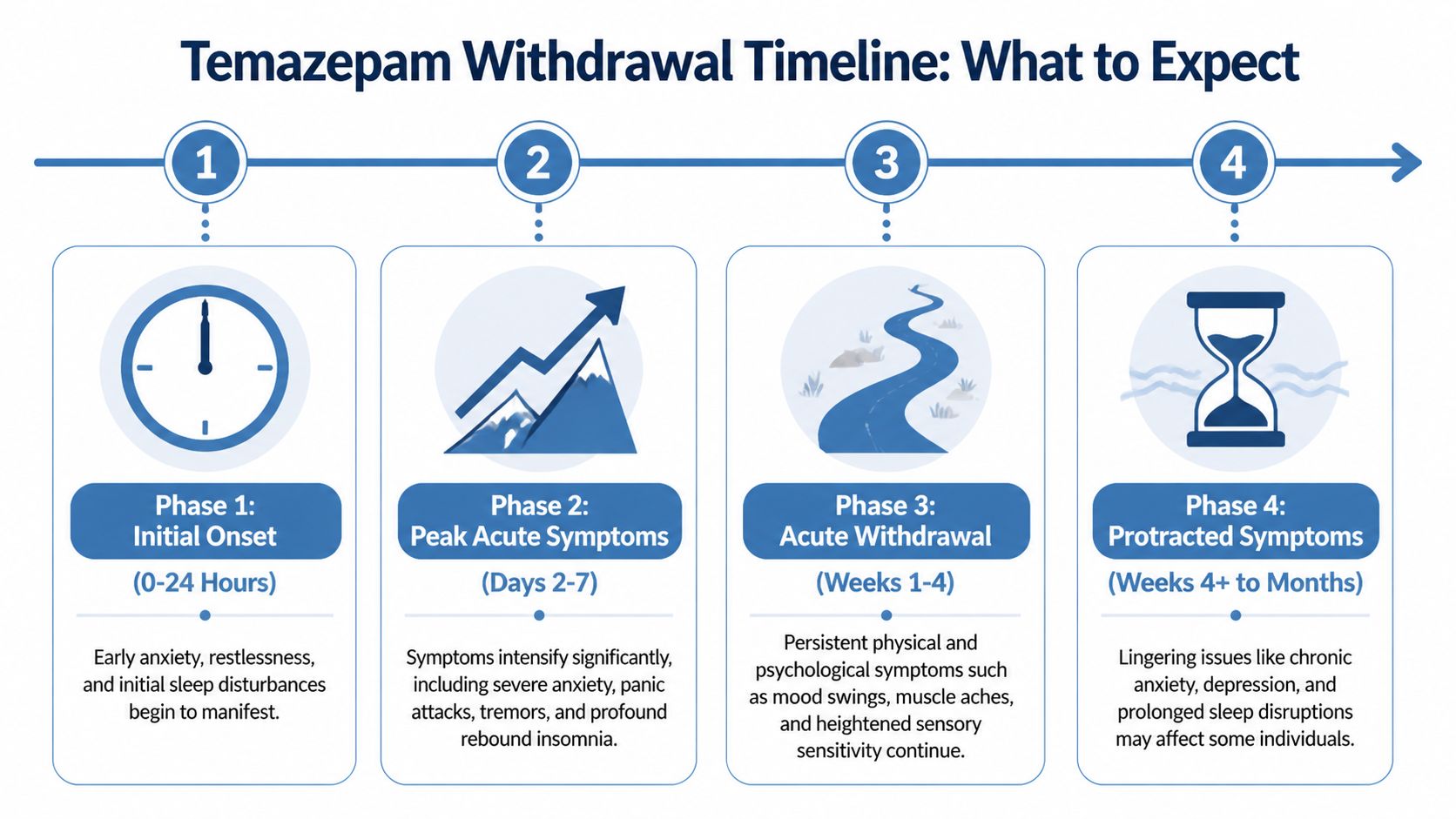
Clinical summaries describe withdrawal from this short-acting benzodiazepine as beginning within hours of the last dose, peaking around the second day, and often improving by the fourth or fifth day, while the overall course may last 2 to 4 weeks or longer in physiological dependence. Some people later develop protracted symptoms beginning 4 to 6 weeks after the initial withdrawal period, with lower-intensity problems such as anxiety, depression, memory impairment, attention deficits, and decreased cognitive function that can last up to six months. Long-term outcomes can also be difficult without ongoing support. A follow-up study summarized in this temazepam detox review found that only 28% remained abstinent at 3 years.
Typical Temazepam Withdrawal Timeline
| Timeframe | Common Symptoms & Intensity |
|---|---|
| Within hours to first day | Early anxiety, restlessness, rising insomnia, sweating, stomach upset, and growing unease. Symptoms may start subtly, then build. |
| Day 2 to around Day 4 | Peak phase for many patients. Anxiety, rebound insomnia, tremors, nausea, vomiting, and autonomic symptoms often intensify. This is the period that can become dangerous without monitoring. |
| Day 4 or 5 through following weeks | Acute symptoms often begin easing, but sleep problems, mood symptoms, low frustration tolerance, and physical discomfort may continue. |
| Weeks later to months for some people | A subset of patients experience protracted symptoms, usually lower in intensity but frustratingly persistent, such as anxiety, low mood, and cognitive fog. |
What the timeline means in practice
The hardest period is often early, which catches people off guard. A person may assume that if the first few hours are manageable, they’re safe. That’s not a reliable assumption with temazepam.
The timeline also explains why family members shouldn’t judge withdrawal by one evening or one morning. A person can look relatively calm, then worsen the next day when the nervous system rebounds more forcefully.
A safe detox plan respects timing. It doesn’t wait for a crisis to prove the withdrawal is serious.
Why aftercare matters even after acute detox
The acute phase may end, but recovery still needs support. The study above is a good reminder that stopping once isn’t the same as staying off long term. Sleep problems, anxiety, and old habits can pull people back toward use if they leave detox with no plan.
That’s especially important in Dallas, where people often return quickly to work stress, family demands, and easy access to prescriptions or other substances. Detox should be the beginning of treatment, not the whole treatment plan.
Why Quitting Cold Turkey Is a Risk You Cannot Take
Cold turkey temazepam withdrawal asks the nervous system to make a hard chemical adjustment all at once. That’s the dangerous part. The body doesn’t smoothly reset just because a person wants to be done.
A medically managed taper lowers risk because it gives the brain time to adapt in smaller steps. It doesn’t eliminate symptoms completely, but it makes the process far safer and more predictable than abrupt cessation.

The real trade-off
People often choose cold turkey for understandable reasons. They want it over with. They’re ashamed. They don’t want anyone to know. They think tapering means “dragging it out.”
But the better question is not which option feels faster emotionally. It’s which option lowers the chance of a medical emergency.
According to the clinical information summarized in this section’s assigned evidence, the risk of seizures can be reduced by 70 to 80% through evidence-based tapering protocols compared with abrupt cessation, and those protocols typically reduce dosage by 10 to 25% weekly under 24/7 monitoring. That same approach is discussed in this guide to safe benzo detox.
What a taper actually does
A taper is not passive waiting. It is an active medical intervention that:
- Reduces the shock to the central nervous system
- Creates time to track blood pressure, pulse, sleep, and mental status
- Allows clinicians to respond if symptoms intensify
- Helps separate expected discomfort from dangerous deterioration
This matters even more for people with prior seizures, polysubstance use, panic symptoms, or unstable mood.
What doesn’t count as a real taper
Patients and families often try informal approaches that sound sensible but aren’t safe enough:
- Cutting the dose whenever symptoms “seem okay”
- Stopping on a weekend to avoid work
- Using leftover pills inconsistently
- Alternating between abstinence and rescue doses
Those patterns can create repeated mini-withdrawals and more volatility.
The safest taper is supervised, measured, and adjusted to the patient’s response. It is not improvised at home.
For anyone searching for a Dallas detox center because temazepam has become physically necessary just to feel normal, the decision point is straightforward. Cold turkey is a gamble with neurological risk. A supervised taper is the responsible medical path.
Professional Detox and Lasting Recovery in Dallas TX
Safe detox is the first job. Lasting recovery is the second. Both matter, and they shouldn’t be separated.
In the Dallas-Fort Worth area, many patients need more than symptom monitoring for a few days. They also need treatment for the reasons temazepam stayed in the picture, whether that was insomnia, anxiety, panic, another substance problem, or a cycle of trying to function while sleep kept getting worse.
What comprehensive care should include
A strong plan usually has several layers:
- Medical detox: round-the-clock observation during the unstable phase, with a taper and symptom management individualized for the patient.
- Inpatient treatment when needed: useful when symptoms are severe, relapse risk is high, or the home environment isn’t stable.
- Outpatient care after stabilization: helpful for patients who can step down safely while maintaining work or family responsibilities.
- Dual diagnosis support: important when anxiety, depression, or other mental health symptoms are wrapped into the temazepam use pattern.
- Relapse-prevention planning: sleep triggers, stress, medication exposure, and emotional setbacks all need a plan before discharge.
Why local care changes outcomes
Practical access matters in DFW. A patient in Dallas, Plano, Grand Prairie, Euless, or Fort Worth does better when care is close enough for family participation, continuity, and smoother transitions from detox into the next level of treatment.
That also makes it easier to plan insurance verification, transportation, step-down care, and sober support without losing momentum. Families who want a clear picture of the detox process can review what medically supervised detox in Dallas looks like.
Recovery is stronger when behavioral health is organized
Some patients and families also benefit from learning how treatment teams organize communication, follow-up, and mental health support. Resources such as Recepta.ai's mental health solutions can help readers understand how structured behavioral health systems support continuity, documentation, and care coordination across treatment settings.
Good detox gets a person through withdrawal. Good treatment helps them stay off the medication when stress, sleeplessness, or fear returns.
What families should look for in Dallas addiction treatment
When evaluating options for addiction treatment in Dallas, the essentials are straightforward:
- Medical oversight during withdrawal
- Experience with benzodiazepine detox
- Capacity to treat co-occurring mental health conditions
- A discharge plan that doesn’t end at detox
- Clear help with insurance and next steps
The most effective care feels calm, organized, and individualized. Patients should leave with more than temporary stabilization. They should leave with a sleep strategy, mental health support, follow-up treatment, and a realistic plan for what happens when cravings, panic, or insomnia try to return.
Frequently Asked Questions About Temazepam Detox
How soon can withdrawal symptoms of temazepam start
They can start within hours of the last dose. That early onset is one reason home detox can become risky before a family realizes how quickly the situation is changing.
Is temazepam withdrawal always dangerous
Not every case becomes life-threatening, but the risk is real enough that abrupt withdrawal should be treated seriously. Severe anxiety, insomnia, autonomic symptoms, hallucinations, and seizures can all occur, and the early phase is not predictable enough to manage casually.
Does everyone need inpatient detox
Not everyone needs the same level of care, but everyone who is physically dependent needs medical guidance. The right setting depends on symptom severity, dose history, co-occurring substance use, mental health symptoms, and whether the home environment is safe and stable.
What does supervised detox actually feel like
Patients usually feel relief from having structure around them. Symptoms may still happen, but they’re being monitored, treated, and interpreted by clinicians instead of becoming a frightening mystery. That often lowers panic even before the body fully settles.
What should a family member do right now
Stay calm, don’t argue, and don’t encourage abrupt stopping without professional input. If symptoms are already escalating, especially confusion, hallucinations, or seizure activity, seek emergency help immediately. If the person is still deciding what to do, the next step is a confidential clinical assessment.
Can treatment continue after detox
Yes, and it should when dependence has been part of a larger pattern. Ongoing care may include residential treatment, outpatient therapy, medication management, dual diagnosis care, and relapse-prevention planning focused on sleep, anxiety, and prescription exposure.
If someone in Dallas or the surrounding DFW area is worried about the withdrawal symptoms of temazepam, Tru Dallas Detox & Recovery Center offers confidential help, medically supervised detox, and a clear next-step plan for recovery. Families can reach out to ask questions, verify insurance, and get immediate guidance on whether detox, inpatient treatment, or outpatient support is the safest fit.