

A family in Dallas often reaches this point after weeks or months of trying to hold everything together. A loved one may have finished detox, started weekly therapy, and still seem shaky. Another person may be living at home, going to work part of the time, but depression, anxiety, cravings, or relapse risk still keep daily life unstable. The choices can feel extreme. Either move into a treatment facility full time or try to manage with an appointment once or twice a week.
That middle space is where many families get confused. They know more help is needed, but they also know the person may not need round-the-clock hospitalization. For adults in Dallas, Euless, Fort Worth, Plano, Irving, and nearby communities, one of the most useful answers is a Partial Hospitalization Program, usually called PHP.
For anyone searching what is php therapy, the short answer is this. It’s a structured day treatment program that gives much more support than standard outpatient care while still allowing the person to return home in the evening. For someone balancing recovery, mental health symptoms, family responsibilities, and the practical realities of life in North Texas, that can be a meaningful fit.
Table of Contents
- Feeling Stuck Between Treatment Options
- What is a Partial Hospitalization Program (PHP)
- A Typical Day in a Dallas PHP
- PHP vs Other Levels of Care
- Who Benefits Most from PHP Therapy
- Navigating Insurance and Costs for PHP in Texas
- How Tru Dallas Delivers Expert PHP-Level Care
Feeling Stuck Between Treatment Options
A man in North Dallas may leave detox feeling physically better but still wake up with panic, low mood, and strong urges to use. His family sees progress, but they also see how fragile that progress feels. Weekly counseling doesn’t seem like enough. Residential treatment may feel like too much, or it may not fit work, parenting, or home responsibilities.
A woman in Fort Worth might be in a different situation but face the same question. She’s medically stable and safe at home, yet alcohol use and depression keep feeding each other. She needs daily accountability, medication support, and real coping skills. She doesn’t necessarily need an overnight hospital bed. She does need more than a single therapy hour each week.
That’s the spot where PHP often makes sense. It gives people a serious treatment structure during the day and lets them practice recovery in real life at night. That matters because recovery isn’t only about what happens in a therapy room. It’s also about getting through evenings, family stress, triggers, and routines without falling back into old patterns.
Practical rule: If a person needs consistent daytime treatment but can remain safe outside of a 24-hour facility, PHP is often worth asking about.
Families often assume “partial hospitalization” means something vague or intimidating. In reality, it usually means a carefully scheduled level of care built for stabilization, skill-building, and relapse prevention.
For Dallas-area families, that can be a relief. It offers a path that feels serious without feeling extreme. It also gives treatment teams room to address both addiction and mental health at the same time, which is often where lasting recovery starts.
What is a Partial Hospitalization Program (PHP)
A Partial Hospitalization Program is a high-support treatment option for people who need more care than standard outpatient therapy but don’t need to stay overnight in a hospital or residential setting. The simplest way to understand what is php therapy is to think of it as a full workday focused on recovery.

Why PHP exists
PHP fills the gap between inpatient care and regular outpatient visits. According to clinical guidance on PHP structure and effectiveness, these programs typically involve about six hours of daily programming and are used to help lower relapse risk, improve quality of life, and prevent unnecessary inpatient admissions.
That’s why many care teams describe PHP as the middle ground. It’s intensive enough to provide real momentum, but flexible enough for someone to sleep at home or in sober living. For a medically stable adult in Dallas who still needs daily support, that balance can be exactly what keeps treatment moving forward.
PHP gives recovery structure without requiring overnight confinement.
What people actually do in PHP
A PHP isn’t just “more therapy.” It’s a coordinated schedule of services designed to help a person stabilize and function better day to day. Depending on clinical needs, treatment may include:
- Group therapy: A core part of the day where people practice communication, coping skills, accountability, and emotional regulation with peers.
- Individual counseling: One-on-one sessions to work through personal triggers, trauma, relapse patterns, and goals.
- Medication management: Psychiatric support for people who need medication review, adjustments, or ongoing monitoring.
- Skills training: Practical work on stress management, boundaries, routines, and relapse prevention.
- Care coordination: Planning for next steps, family support, and transitions to lower levels of care.
For readers trying to understand why group work matters so much in this setting, Sachs Center's group therapy guide offers a useful overview of how structured peer support helps people build insight and reduce isolation.
In plain terms, PHP works like an immersive course in recovery. A person doesn’t just talk about problems once a week. They practice new responses repeatedly, with support close by. That repetition is one reason this level of care can feel more stabilizing than traditional outpatient treatment.
A Typical Day in a Dallas PHP
A day in PHP is usually more predictable than families expect. That’s helpful, because structure reduces the guesswork that often fuels anxiety, cravings, and emotional swings. In a Dallas-area program, the person typically arrives in the morning, checks in, joins treatment activities through the day, and heads home later in the afternoon.
Morning structure and check-in
The day often starts with a clinical check-in. Staff may ask about sleep, mood, cravings, medication concerns, stressors at home, or any relapse risk that showed up the night before. That early check helps the team spot problems quickly instead of waiting for a crisis.
After that, the person may move into a psychoeducational or process group. GoodRx’s overview of PHP services and schedule notes that a typical PHP week includes five days of treatment, often using approaches such as CBT and DBT, with group sizes between six to twelve members and services that include one-on-one counseling, skills training, medication management, and aftercare planning.
That combination matters. CBT helps people identify unhelpful thought patterns and replace them with more realistic responses. DBT helps with emotional regulation, distress tolerance, and interpersonal effectiveness. For someone in addiction treatment in Dallas, those aren’t abstract concepts. They’re tools for getting through a triggering phone call, a lonely evening, or a sudden urge to drink or use.
Afternoon treatment and planning
Later in the day, treatment may shift toward individual counseling, family coordination, relapse prevention work, or medication review. Some people use that time to process a specific relapse pattern. Others focus on co-occurring symptoms such as depression, panic, trauma responses, or mood instability.
A simple example helps. A person who drove past an old using area in East Dallas the night before may talk through what happened, identify the chain of thoughts and feelings, and rehearse a different plan for the next time. Another person may work on how to respond when conflict at home leads to cravings.
Common parts of a PHP day often include:
- Symptom review: Mood, anxiety, cravings, sleep, and safety concerns.
- Therapy groups: Topic-focused sessions on relapse prevention, communication, and coping.
- Psychiatric care: Medication discussions when needed.
- Planning for evenings: Concrete steps for getting through the hours after treatment ends.
The return home each evening isn’t a side detail. It gives people a chance to test new skills in real life while still staying connected to daily treatment.
That’s one reason PHP can be so valuable for recovery in the Dallas-Fort Worth area. It combines strong clinical support with day-to-day practice. The person isn’t separated from life completely, but they also aren’t left to manage alone.
PHP vs Other Levels of Care
One of the biggest reasons families search “what is php therapy” is that treatment levels can blur together. The names sound clinical. The differences don’t always feel obvious. A clear comparison helps.
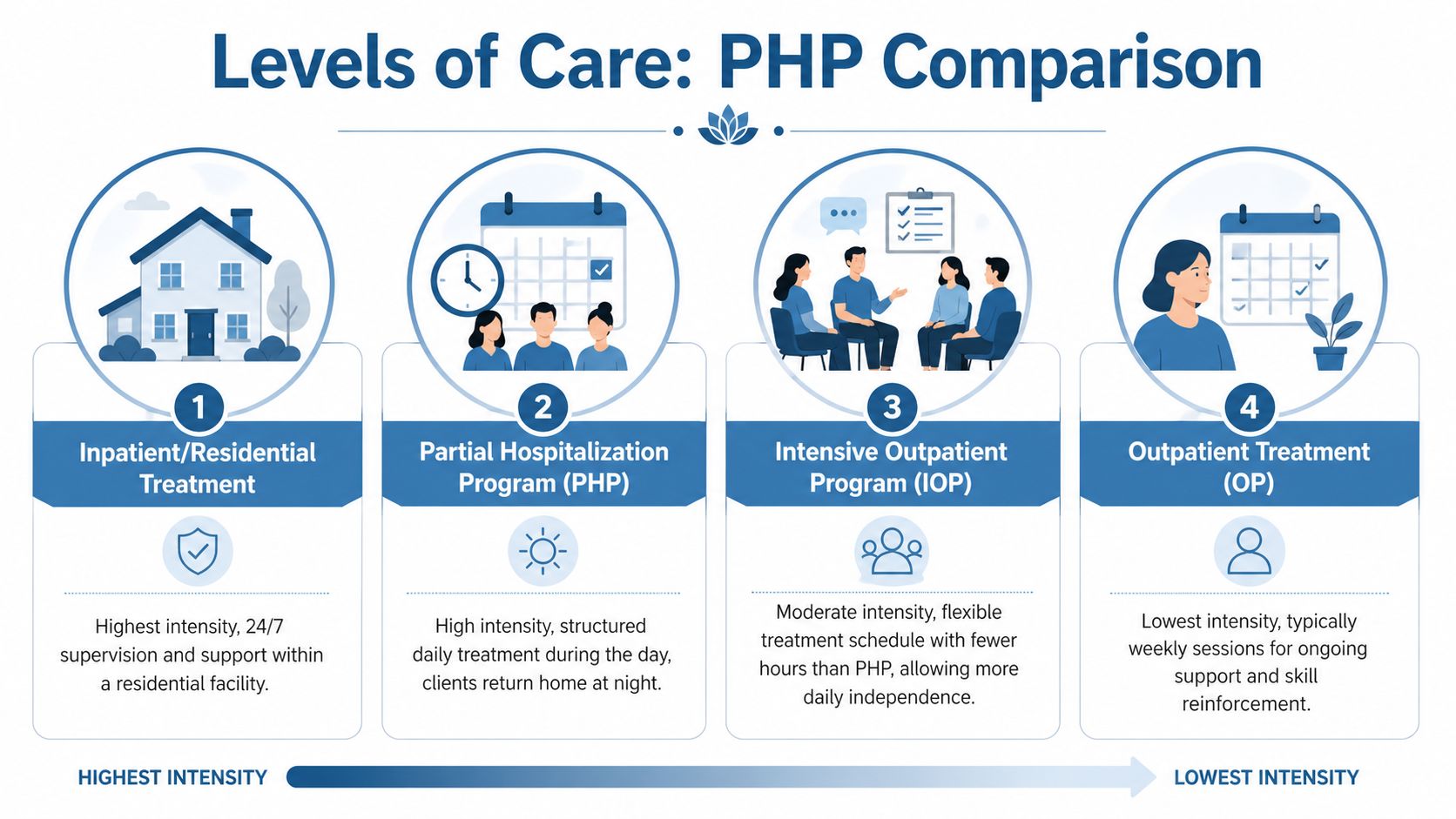
Levels of addiction treatment compared
| Level of Care | Time Commitment | Living Situation | Best For |
|---|---|---|---|
| Inpatient or Residential | Full-time, with treatment and supervision throughout the day and night | Lives at the facility | People who need constant monitoring, a highly controlled setting, or a safe place away from active triggers |
| Partial Hospitalization Program | Most of the day, several days each week | Lives at home or in sober living | People who need intensive treatment and structure without overnight care |
| Intensive Outpatient Program | Fewer hours than PHP, often scheduled around work or family needs | Lives at home | People who need consistent support but have more stability and independence |
| Standard Outpatient | Usually periodic therapy visits | Lives at home | People who need maintenance care, follow-up, or lower-intensity support |
Families often get most stuck between PHP and IOP. Both allow the person to live at home. Both involve therapy. The fundamental difference is intensity. PHP is more immersive and more clinically structured. IOP usually works better when someone has already built some stability and can manage longer stretches between treatment contacts. For a more detailed breakdown, this guide on the difference between PHP and IOP can help families compare those two options more closely.
How families can tell the difference
A few decision points usually make the right level of care clearer.
- Current stability: If symptoms or relapse risk still feel active day to day, PHP may be a better fit than IOP.
- Need for supervision: If a person can’t remain safe outside a monitored setting, inpatient care may be more appropriate.
- Ability to function at home: If home is supportive and stable, PHP can work well. If home is chaotic or unsafe, a higher level of care may be needed.
- Response to prior treatment: If weekly therapy hasn’t been enough, moving up to PHP often makes more sense than repeating the same plan.
A level of care isn’t a reward or a punishment. It’s a clinical match between what the person needs and what the setting can safely provide.
Standard outpatient care can be valuable, but it usually isn’t designed to stabilize someone in the middle of active addiction, major mood symptoms, or an early post-detox period. Inpatient treatment provides the highest structure. PHP sits just below that. IOP offers more flexibility. Outpatient is the least intensive.
That spectrum matters for Dallas families trying to make a practical decision, not just a theoretical one. The right question isn’t “Which program sounds strongest?” It’s “Which setting gives this person enough support to recover safely and consistently right now?”
Who Benefits Most from PHP Therapy
PHP tends to help people who are stable enough to live outside a facility but still need steady clinical support. That includes many adults dealing with both substance use and mental health symptoms at the same time. In Dallas addiction treatment, that combination is common. A person may be trying to recover from alcohol, opioids, cocaine, methamphetamine, or prescription drug misuse while also managing depression, anxiety, bipolar symptoms, trauma, or suicidal thoughts.
Common situations where PHP fits well
Several profiles often match PHP especially well.
- People stepping down from detox or inpatient treatment: They’ve made early progress but still need close structure to avoid sliding backward.
- Adults with dual diagnosis needs: They need addiction treatment and mental health treatment working together, not in separate lanes.
- People who didn’t improve with weekly therapy alone: They need more repetition, more accountability, and more clinical contact.
- Those with a supportive home base: They can return home safely and benefit from practicing skills in daily life.
PHP can also help someone whose symptoms keep interrupting daily function. That may look like repeated relapses, overwhelming anxiety, deep depression, or frequent conflict at home tied to substance use. The person may still be able to participate meaningfully in treatment each day, but they need a stronger framework around them.
When PHP may not be enough
PHP isn’t right for every situation. Some people need 24-hour supervision because of active medical risk, severe withdrawal concerns, or safety issues that can’t be managed outside a residential setting. Others may need less than PHP and can do well in IOP or outpatient care.
A simple way to think about it is this. PHP works best when the person needs a lot of help, but not constant overnight monitoring.
Signs a family may want to ask about PHP include:
- Relapse risk remains high after detox or a recent crisis.
- Mental health symptoms and substance use are linked and keep worsening each other.
- The person wants treatment but struggles to stay consistent without daily structure.
- Home life is stable enough to support evening and weekend recovery.
For many families in Dallas, the appeal is practical as much as clinical. PHP lets a person stay connected to family life and community while still receiving serious treatment. That can make recovery feel more sustainable, especially when the goal is building habits that will hold up outside a facility.
Navigating Insurance and Costs for PHP in Texas
Cost is one of the first questions families ask, and that’s reasonable. People need clear answers before they can commit to treatment. In Texas, many PPO plans may cover PHP when it’s considered medically necessary, but coverage details can vary.
That’s why insurance verification matters so much. The family usually needs more than a general statement that treatment is “covered.” They need to know what the plan requires and what the out-of-pocket responsibility may look like.
What to ask during insurance verification
When speaking with an insurance representative, it helps to ask direct questions such as:
- Does the plan cover partial hospitalization for substance use or dual diagnosis treatment?
- Is pre-authorization required before admission?
- What deductible, copay, or coinsurance applies to PHP?
- Are there limits on the number of treatment days approved at a time?
- Does the plan cover medication management and psychiatric services within PHP?
Families who want a broader overview of rehab coverage can also review this explanation of whether insurance covers drug rehab.
Clear financial information lowers one major barrier to treatment. It helps families make decisions based on facts instead of fear.
Why admissions support matters
Insurance language can be confusing even when a family asks all the right questions. Terms like authorization, medical necessity, deductible, and out-of-pocket maximum don’t always translate into a simple answer about what happens next.
That’s why admissions support is so useful. A strong admissions team can help verify benefits, explain what coverage appears to include, and clarify the practical next steps for entering treatment. For families already under stress, that kind of support can remove a lot of uncertainty.
For someone in Dallas, Arlington, Grapevine, or Euless trying to move quickly from detox or crisis into structured care, speed matters. Delays can create openings for relapse, second-guessing, or missed follow-up.
How Tru Dallas Delivers Expert PHP-Level Care
For adults in the Dallas-Fort Worth area who need a structured step after detox or a higher level of outpatient support, Tru Dallas Detox & Recovery Center’s partial hospitalization program in Dallas is one option within a broader continuum of care. The practical value of that setup is continuity. A person doesn’t have to start over with a completely disconnected treatment plan when moving from one level of care to another.

Where dual diagnosis and MAT matter most
This is especially important for people with dual diagnosis needs. Someone recovering from opioid or alcohol use may also need treatment for depression, anxiety, or bipolar symptoms. If those conditions are treated separately or inconsistently, progress often becomes harder to maintain.
According to UTHealth’s overview of advanced PHP models, programs that integrate stronger aftercare planning and transitions from higher levels of monitoring can reduce readmission risk by 30 to 50%, and only 42% of PHP programs explicitly incorporate Medication-Assisted Treatment (MAT) protocols. That gap matters for people with opioid or alcohol use disorders who need medications such as buprenorphine or naltrexone to be part of treatment rather than treated as a side issue.
In practical terms, MAT integration means the person’s medication plan isn’t disconnected from the rest of the day’s care. It can be coordinated with therapy, psychiatric review, symptom tracking, and relapse prevention planning. For a dual diagnosis patient in Dallas, that’s often the difference between fragmented care and a coherent recovery plan.
What strong aftercare planning looks like
Effective PHP-level care also needs a clear next step. Recovery doesn’t end when the schedule becomes less intensive. It shifts. A thoughtful plan may include continued therapy, medication management, sober living referrals, family support, or a transition to IOP or outpatient care when clinically appropriate.
Strong aftercare planning usually includes:
- A realistic discharge path: Not vague encouragement, but specific appointments and follow-up recommendations.
- Relapse prevention planning: Identifying triggers, warning signs, and concrete responses.
- Support for the home environment: Helping the person return to daily life with more structure.
- Coordination across services: So addiction care, mental health treatment, and medication support stay aligned.
For families searching what is php therapy because they’re worried about what comes after detox, that’s the heart of the answer. PHP isn’t only a treatment schedule. It’s a bridge between crisis care and a more stable life.
For anyone in Dallas, Fort Worth, Euless, Irving, or the surrounding area who needs help understanding treatment options, Tru Dallas Detox & Recovery Center offers confidential guidance, insurance verification support, and help identifying whether detox, inpatient care, PHP, or another level of treatment fits the situation. A call with a care specialist can help a family move from uncertainty to a clear next step.