

A lot of people in Dallas start lorazepam for a completely legitimate reason. Panic attacks get worse. Sleep disappears. A stressful season turns into months of white-knuckling through work, parenting, or both. The prescription helps at first, then something changes. The same dose doesn’t seem to do as much. Memory feels less sharp. Emotions feel flatter. Missing a dose feels bigger than it should.
That shift is frightening because it often doesn’t look dramatic from the outside. Someone may still be going to work in Uptown, getting kids to school in Lakewood, or caring for family in Arlington or Fort Worth. But privately, they’re starting to wonder whether the medication that once brought relief is now creating a second problem.

That concern deserves a clear answer, not shame. Lorazepam long term side effects can affect thinking, mood, coordination, and physical safety. Stopping the medication abruptly can also be dangerous. For people trying to figure out what to say to a prescriber, Joint Ventures' self-advocacy guide offers practical ways to prepare questions and speak up during appointments.
Table of Contents
- Understanding Your Concerns About Long-Term Lorazepam Use
- How Short-Term Relief Becomes Long-Term Dependence
- The Cognitive and Physical Toll of Extended Lorazepam Use
- The Unseen Dangers of Lorazepam Withdrawal
- Finding Safe and Effective Lorazepam Detox in Dallas
- Life After Lorazepam Rebuilding Your Health and Well-Being
- Common Questions About Lorazepam Recovery
Understanding Your Concerns About Long-Term Lorazepam Use
Many people feel conflicted about lorazepam. They know it helped. They also know something feels off now. That tension keeps a lot of people stuck longer than they want to be.
A common pattern goes like this. Someone is prescribed lorazepam during a period of severe anxiety or insomnia. Months later, they’re noticing brain fog, a shorter fuse, reduced motivation, or a strange emotional flatness. They may not be misusing the medication in the stereotypical sense. They may be taking it regularly and realizing they don’t feel like themselves anymore.
What people often notice first
The first warning signs usually aren’t dramatic. They’re practical.
- Mental slowing: Everyday tasks take longer, concentration slips, and conversations don’t feel as easy to track.
- Emotional blunting: Reactions feel muted. Some people describe it as going through the day behind glass.
- Growing reliance: The idea of reducing the dose brings immediate fear, even if the original prescription was short term.
- Functional strain: Work performance, relationships, and sleep routines start feeling less stable instead of more stable.
Clinical reality: Dependence on a prescribed benzodiazepine can happen without any intention to misuse it.
Families often miss this because the person still looks “functional.” The problem is that lorazepam long term side effects tend to interfere with judgment, memory, motivation, and physical coordination in ways that build subtly over time.
In the Dallas area, that can show up in very ordinary but high-risk moments. A commute on Central Expressway feels less focused. A parent feels too sedated in the evening. An older adult becomes more unsteady at home. Someone in a high-pressure job downtown starts making mistakes they never used to make.
Fear about stopping is valid
People often delay asking for help because they’re worried about being judged, or because they’ve heard they should just taper on their own. That fear makes sense. Benzodiazepines affect the central nervous system directly, so getting off them isn’t just a matter of willpower.
The safer path starts with a medical review, a realistic taper plan, and support for the original reason lorazepam was prescribed in the first place. Anxiety, panic, trauma, and insomnia still need treatment. Removing the medication without replacing support rarely works well.
How Short-Term Relief Becomes Long-Term Dependence
Lorazepam works by increasing inhibitory signaling in the brain. In plain language, it turns down overactivity in the nervous system. That’s why it can bring fast relief when someone feels panicked, overstimulated, or unable to sleep.
The problem is that the brain adapts. When a calming signal gets boosted repeatedly, the nervous system starts adjusting around it. Over time, the same dose can feel weaker, and the body becomes less comfortable functioning without the drug on board.
Why the brain starts adapting
A useful way to think about tolerance is volume control. Lorazepam lowers the volume on anxiety and arousal. If that lowered setting stays in place too long, the brain starts compensating. It tries to rebalance itself.
That adaptation can lead to several changes:
- Tolerance develops: The original dose may stop producing the same relief.
- Dependence follows: The nervous system begins to expect the medication.
- Rebound symptoms appear: Anxiety, insomnia, and agitation can feel stronger when the medication wears off.
A real-world pharmacovigilance study found that 91.57% of all adverse events from lorazepam occurred within the first 80 days of treatment in this published analysis of lorazepam safety reports. That matters because it shows how quickly complications can emerge, even when use begins as standard medical treatment.
Needing help with a taper doesn’t mean someone failed treatment. It usually means their brain adapted exactly the way human brains often do with benzodiazepines.
Dependence isn’t the same as addiction, but it can overlap
People often use these terms interchangeably, and that creates confusion. Physical dependence means the body has adapted to the medication. Substance use disorder involves a broader pattern, such as loss of control, compulsive use, or continued use despite clear harm.
Some people develop dependence without compulsive misuse. Others move further along the spectrum and start taking more than prescribed, using lorazepam for emotional escape, or combining it with other substances. Both situations deserve medical attention.
That distinction matters because shame gets in the way of treatment. In a Dallas detox center, the first task isn’t labeling someone. It’s figuring out how long they’ve been taking lorazepam, what dose pattern they’re on, what symptoms they’re experiencing, and what psychiatric or medical issues need to be addressed alongside tapering.
A safe reduction plan usually works better than abrupt stopping because it gives the central nervous system time to readjust. That’s the difference between trying to overpower withdrawal and managing it like the medical issue it is.
The Cognitive and Physical Toll of Extended Lorazepam Use
Long-term lorazepam use doesn’t just create dependence. It can change how a person thinks, feels, and functions in daily life. The effects are often most noticeable when someone tries to work, drive, remember details, or regulate emotions under stress.
Why the brain starts adapting
The clearest evidence points to cognition. Chronic benzodiazepine use is linked to impaired verbal learning and reduced processing speed, and it’s also associated with an increased risk of developing dementia compared with never-users, as reviewed in the American Family Physician discussion of benzodiazepine risks.
That may sound abstract until it shows up in ordinary moments. A person reads the same email twice and still misses key information. They lose track of conversations. They struggle to find words quickly in meetings. They know they’re not functioning at their usual level, but they can’t always pinpoint why.
What long-term use can look like day to day
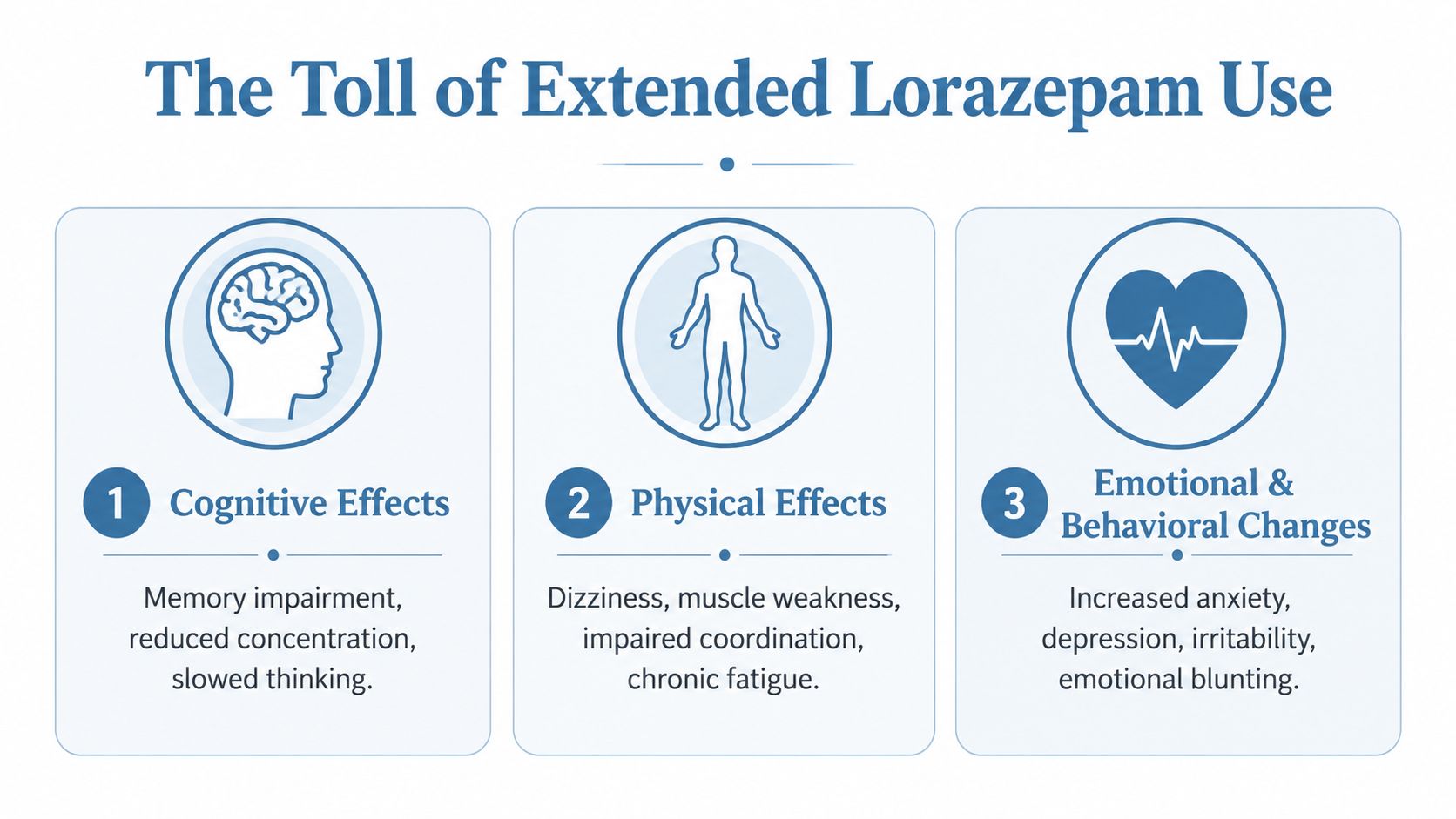
The impact usually falls into three overlapping categories.
| Symptom Category | Common Side Effects |
|---|---|
| Cognitive | Memory problems, brain fog, slowed thinking, reduced concentration, trouble learning new information |
| Physical | Dizziness, sedation, poor coordination, fatigue, unsteadiness |
| Emotional and behavioral | Emotional blunting, irritability, worsening depression, increased anxiety between doses |
These problems rarely stay neatly separated. Memory issues can increase anxiety. Emotional blunting can strain relationships. Fatigue and slowed reaction time can make driving or work less safe.
For people already dealing with depression, trauma, or chronic anxiety, the picture gets more complicated. Long-term benzodiazepine use can mask symptoms for a while, then leave the person with both dependence and untreated mental health needs. That’s one reason dual-diagnosis care matters. This overview of how addiction affects mental health helps explain why substance use and psychiatric symptoms often reinforce each other.
Practical rule: If a medication for anxiety is starting to worsen memory, flatten emotion, or reduce day-to-day functioning, the treatment plan needs a fresh review.
Physical safety is another concern, especially in older adults. Sedation and impaired coordination raise the risk of falls at home, confusion during medication management, and accidents during routine activities. Even younger adults can underestimate how much lorazepam slows reaction time and judgment.
In clinical settings around Dallas-Fort Worth, this often shows up as a quality-of-life problem before it looks like a classic addiction problem. Someone says they don’t feel sharp anymore. Their spouse says they seem absent. A parent notices they’re more forgetful and less steady. Those observations shouldn’t be brushed off. They’re often the early signs that long-term use is costing more than it’s helping.
The Unseen Dangers of Lorazepam Withdrawal
The most dangerous misconception about lorazepam is that stopping should be straightforward because it’s a prescription medication. It isn’t. Benzodiazepine withdrawal can become a serious medical event.

Why quitting suddenly is risky
When the brain has adapted to regular benzodiazepine exposure, abrupt reduction can push the nervous system into overdrive. People may start with rebound anxiety and insomnia, then progress to tremor, panic, sweating, agitation, perceptual changes, or severe confusion. In some cases, symptoms escalate fast.
20% to 30% of untreated patients experiencing benzodiazepine withdrawal syndrome develop seizures, which can be life-threatening. That risk is documented in the same medical review discussed earlier, so the earlier source applies here without repeating the link.
That’s why “cold turkey” is never a casual experiment. It’s also why home tapering without clinical oversight can go wrong, even when someone has good intentions and family support.
What safe withdrawal management actually does
A supervised detox isn’t just about comfort. It’s about reducing preventable danger.
A structured withdrawal plan usually includes:
- Dose review: Clinicians look at the current lorazepam pattern, other medications, alcohol use, and medical history.
- Gradual tapering: The dose is reduced in a controlled way instead of stopped abruptly.
- Symptom monitoring: Staff watch for changes in blood pressure, mental status, sleep disruption, agitation, and seizure risk.
- Psychiatric support: Anxiety, panic, depression, or trauma symptoms need treatment while the taper is underway.
People who are considering stopping at home should read about safe benzo withdrawal and detox before making changes on their own. The process needs planning, not guesswork.
Withdrawal symptoms don’t always arrive in a neat, predictable sequence. A person can look stable, then deteriorate quickly.
Families also often need guidance. Loved ones may interpret withdrawal as overreacting, refusal, or a lack of effort. In reality, the person may be experiencing a nervous system rebound that requires medical support. The right response isn’t pressure. It’s supervised care with enough monitoring to catch complications early.
Finding Safe and Effective Lorazepam Detox in Dallas
Once dependence is established, the question usually isn’t whether help is needed. It’s what kind of help makes withdrawal safer and more manageable. For lorazepam, the answer is a medically supervised detox program with psychiatric capability, not a self-directed taper and not a one-size-fits-all schedule.

What a structured detox process includes
Older adults need especially careful planning. In that group, lorazepam accumulation significantly increases the risk of falls, fractures, and hospitalizations, and geriatric patients on higher doses face a substantially heightened short-term risk of emergency care or death, according to this federal archive entry on lorazepam safety findings.
A strong detox plan in Dallas should account for that kind of medical complexity. It usually includes several moving parts rather than a single intervention.
Assessment at intake
Staff review dose history, age-related risk, kidney and general medical issues, co-occurring mental health symptoms, and any concurrent alcohol or opioid use.A personalized taper
Faster isn’t better. The safest taper is the one that matches the person’s history, current symptoms, and risk factors.Round-the-clock observation
Benzodiazepine withdrawal can shift quickly. Monitoring helps clinicians respond before symptoms become dangerous.Treatment for the original problem
If panic, insomnia, trauma, or depression drove the prescription in the first place, those issues still need active treatment.
A Dallas-area option such as Tru Dallas Detox & Recovery Center can provide medical detox, medication management, dual-diagnosis support, and aftercare planning for people withdrawing from prescription sedatives. For readers comparing levels of care, this overview of a prescription pill detox program gives a practical picture of how medical detox is structured.
Why local access matters in Dallas Fort Worth
Local treatment matters for simple reasons. Families can stay involved. Insurance and admission questions get answered faster. Transition planning is easier when outpatient therapy, sober living, or psychiatric follow-up is coordinated close to home.
For residents in Dallas, Euless, Irving, Plano, Arlington, and Fort Worth, a nearby detox center also reduces the delay that often happens when someone is scared to travel far for care. When lorazepam withdrawal risk is real, convenience becomes a safety factor.
The best next step is usually a confidential assessment, not a promise to quit alone tomorrow. A clinician can sort out whether the person needs detox, a closely managed taper, or a broader treatment plan that addresses both medication dependence and mental health.
Life After Lorazepam Rebuilding Your Health and Well-Being
The hardest question for many people isn’t about detox. It’s whether they’ll ever feel normal again. That question deserves honesty and hope at the same time.
Some people notice steady improvement in concentration, sleep, and emotional range after stopping lorazepam. Others recover more gradually and need support for lingering cognitive or mood symptoms. The exact timeline isn’t the same for everyone, especially if anxiety, depression, trauma, or long-term sleep disruption were present before the medication.
Recovery is more than getting through detox
Detox stabilizes the body. Recovery rebuilds function.
That often means learning how to manage anxiety without relying on a fast-acting sedative. It can involve therapy for panic, trauma work, sleep-focused treatment, medication review, and routines that reduce nervous system overload. Some people also benefit from structured, non-medication strategies and broader education about natural recovery options that support long-term stability.
A successful outcome isn’t just being off lorazepam. It’s being able to think clearly, sleep more reliably, and handle stress without feeling trapped.
What helps people stay well after discharge
Aftercare works best when it’s specific. Generic advice such as “avoid stress” doesn’t help much. People do better when the plan includes actual appointments, named supports, and a strategy for predictable triggers.
Helpful aftercare usually includes:
- Therapy continuity: Ongoing counseling for anxiety, depression, trauma, or relapse prevention.
- Medication review: Careful psychiatric follow-up if another medication is being considered.
- Sleep and routine work: Consistent wake times, reduced overstimulation, and realistic stress management.
- Family involvement: Clear communication about what symptoms to watch, and how to support recovery without policing it.
For many Dallas-Fort Worth families, the turning point is realizing that life after lorazepam can be fuller, not just drug-free. Emotional range can return. Thinking can feel sharper. Confidence often rebuilds when a person no longer has to organize each day around avoiding withdrawal.
Common Questions About Lorazepam Recovery
People usually reach the end of this process with a few practical questions still hanging in the air. Those questions matter because uncertainty often delays treatment.
| Question | Answer |
|---|---|
| How long does a lorazepam taper take? | There isn’t one standard timeline. A safe taper depends on dose history, duration of use, age, medical status, withdrawal sensitivity, and whether other substances are involved. Faster tapers aren’t automatically safer or more effective. |
| Are lorazepam long term side effects permanent? | Some people improve significantly after stopping, while others continue to notice cognitive or emotional symptoms for a longer period. Recovery varies, which is why follow-up care and symptom tracking matter. |
| Can someone detox at home if they were taking lorazepam as prescribed? | Prescribed use doesn’t remove withdrawal risk. Because benzodiazepine withdrawal can become severe, a clinical assessment is the safest way to decide whether home management is appropriate. |
| What if anxiety was the reason for starting lorazepam? | That anxiety still needs treatment. Good recovery plans replace the medication with therapy, psychiatric care, coping skills, and structured support rather than simply removing the drug. |
| Will insurance cover treatment? | Coverage depends on the plan. Many programs can verify PPO benefits and explain likely out-of-pocket responsibility before admission, which helps families make decisions without guessing. |
If someone in Dallas is worried about memory changes, dependence, or the risks of stopping lorazepam, waiting usually makes the decision heavier. A confidential assessment can clarify what level of care is appropriate and what a safe plan would look like.
If lorazepam has shifted from relief to a source of fear, help is available. Tru Dallas Detox & Recovery Center serves the Dallas-Fort Worth area with confidential assessments, medically supervised detox, dual-diagnosis care, and insurance verification for many PPO plans. Calling to ask questions or verify coverage can be the safest first step.
