

A family member often notices the shift before the person taking Klonopin does. A prescription that once seemed helpful for panic, sleep, or seizure control starts to shape the day. Pills are counted. Doses drift. Appointments feel secretive. Someone who used to seem steady now seems sedated, forgetful, or unusually irritable.
That pattern is frightening because it rarely begins with an obvious intent to misuse a medication. The abuse of Klonopin often develops gradually, especially when a person is trying to avoid anxiety, get through work, or prevent the discomfort that shows up when the medication wears off. In Dallas and across the DFW area, families regularly face the same question: is this still treatment, or has it become a dangerous dependency that needs professional help?
Table of Contents
- When a Prescription Becomes a Problem
- Recognizing the Signs of Klonopin Abuse
- The Hidden Dangers and Long-Term Risks
- Navigating Klonopin Withdrawal Symptoms and Timeline
- Your Path to Recovery A Medically Supervised Approach
- Finding Klonopin Addiction Treatment in Dallas Texas
- How to Get Help for Yourself or a Loved One Today
When a Prescription Becomes a Problem
Many people don't set out to abuse Klonopin. They start where doctors often start: with a legitimate need. The medication can calm severe anxiety, reduce panic, or support seizure treatment. Then the line begins to blur. A person takes an extra dose before a stressful meeting. Another pill gets added after a sleepless night. Soon, the medication isn't just treating symptoms. It's managing fear of what happens without it.
That progression is more common than many families realize. In 2022, about 1.3% of people age 12 and older, roughly 3.7 million individuals, misused prescription benzodiazepines, and 23.7 million Klonopin prescriptions were written in 2019, showing how a widely prescribed drug can still become part of a major misuse problem in the United States, according to national Klonopin misuse statistics.
In practical terms, this means concern about the abuse of Klonopin is not overreacting. It's a reasonable response to a medication with real misuse potential and a very wide footprint. Families in Dallas, Plano, Irving, Arlington, and the Mid-Cities often wait too long because the prescription label makes the situation seem safer than it is.
How families usually notice it first
The early warning signs are often subtle:
- Dose drift: The person starts taking Klonopin more often than prescribed, or becomes anxious about running low.
- Functional decline: Work, parenting, driving, or routine decision-making starts to suffer.
- Secrecy: Medication use becomes private, defensive, or hard to discuss openly.
Practical rule: If a prescribed medication is causing fear, secrecy, impaired functioning, or repeated arguments at home, the issue has moved beyond simple symptom management.
Some families also face legal or employment consequences when prescription drug use crosses into unsafe behavior. For military households, controlled substance rules can add another layer of stress, which is why guidance on military drug offense Article 112a may help clarify how misuse can be viewed in a service context.
Recovery starts when the problem is named accurately. Not with blame. With clarity.
Recognizing the Signs of Klonopin Abuse
The hardest part for many families is knowing what they're looking at. A person can be taking Klonopin under medical supervision and still develop physical dependence. That alone doesn't automatically mean addiction. Abuse begins when use shifts outside the doctor's intent, or when the medication keeps being used despite obvious harm.
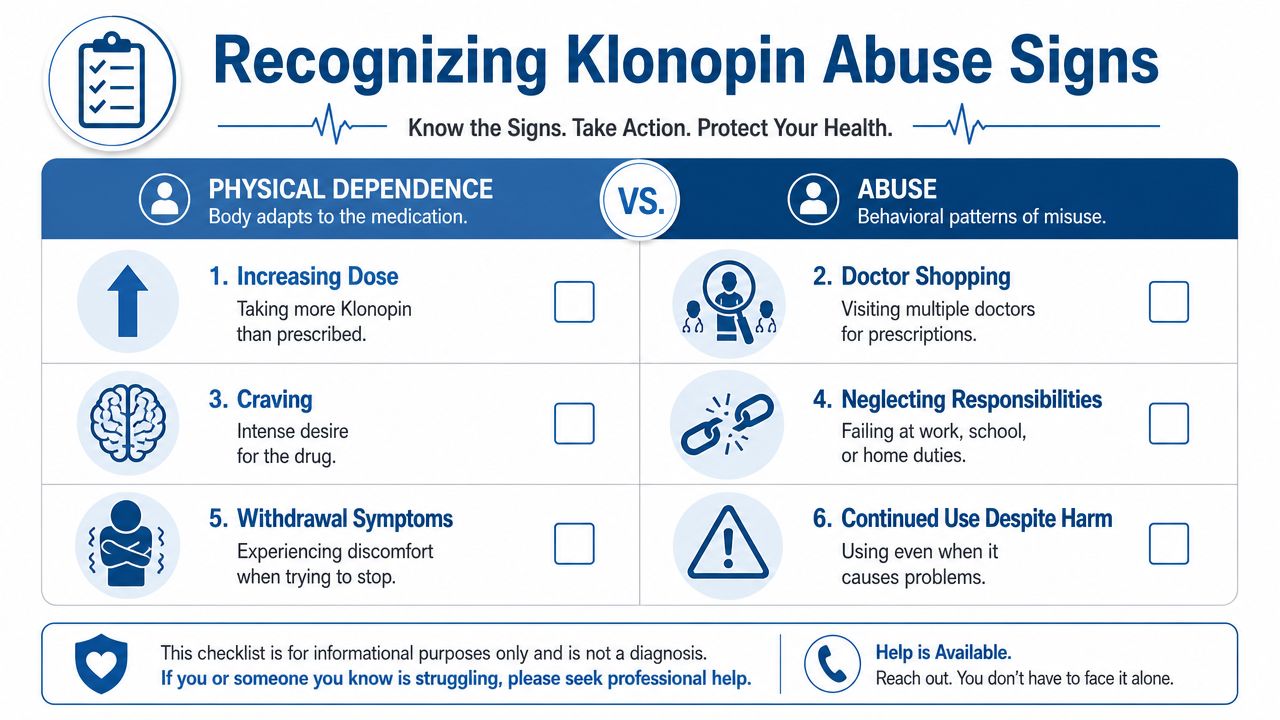
Clinical guidance notes that physical dependence can occur even when taking Klonopin as prescribed, but abuse involves using the drug in a way not intended by the doctor. It also notes that expected side effects such as drowsiness become more concerning when judgment and coordination are impaired enough to interfere with daily life, which should prompt a clinician call rather than abrupt stopping, as explained in guidance on Klonopin side effects and dependence.
Dependence is not the same as abuse
That distinction matters because shame keeps many people from getting help. Someone may be dependent without doctor shopping or intentionally seeking a high. Another person may misuse Klonopin to sleep, calm panic, soften alcohol withdrawal, or come down from another drug. The reason changes. The risk does not.
A useful way to think about it is this:
| Pattern | What it usually means |
|---|---|
| Taking it exactly as prescribed but feeling sick when reducing it | Physical dependence may be present |
| Taking extra doses, hiding use, or using it for reasons outside the prescription | Abuse is likely present |
| Continuing use after falls, blackouts, job problems, or family conflict | A substance use disorder may be developing |
Signs that daily functioning is starting to break down
Families should pay attention to clusters of signs, not one isolated symptom.
- Behavioral changes: running out early, borrowing pills, visiting multiple prescribers, withdrawing from family, or neglecting responsibilities at home or work
- Physical signs: marked drowsiness, slowed reactions, poor coordination, unsteady walking, slurred speech, or unusual sedation
- Psychological indicators: memory problems, mood swings, irritability, rebound anxiety, confusion, or defensiveness when asked about use
A person doesn't have to fit a stereotype to have a serious Klonopin problem. Many people still go to work, care for children, and pay bills while the disorder quietly deepens.
The key question isn't whether the person “looks addicted.” The key question is whether Klonopin use is reducing safety, honesty, and normal functioning. If the answer is yes, a professional assessment is warranted.
The Hidden Dangers and Long-Term Risks
Klonopin misuse is dangerous for two reasons at once. First, the drug itself can suppress the central nervous system. Second, many people who misuse it don't use it alone. They combine it with alcohol, opioids, sleep medications, or pills bought outside a pharmacy setting.
The FDA warning matters here. The official labeling states that Klonopin carries a risk of abuse, misuse, and addiction that can lead to overdose or death, particularly because benzodiazepine misuse can cause central nervous system depression and respiratory compromise, especially with other depressants, as described in the FDA prescribing information for Klonopin.
Why overdose risk changes fast
Many families think overdose means obvious collapse after a huge amount. That's not always how it looks. A person may seem only heavily sedated at first. They may be hard to wake, breathing more slowly, less responsive, and increasingly confused. When opioids or alcohol are involved, the margin for error narrows quickly.
A second data point sharpens that concern. Guidance discussing Klonopin and other benzodiazepines notes that 16% of opioid overdose deaths in 2019 also involved benzodiazepines, underscoring how dangerous these combinations can become in the fentanyl era, as outlined in Klonopin overdose and polysubstance risk information.
Why mixed-substance use is so dangerous in North Texas
In the Dallas-Fort Worth area, one of the biggest practical risks is uncertainty. A family may know about prescribed Klonopin, but not about alcohol use, pain pills, counterfeit pills, or fentanyl exposure. That's why the abuse of Klonopin should never be assessed in isolation when overdose risk is on the table.
Warning signs that require urgent action include:
- Reduced responsiveness: the person can't stay awake, can't answer clearly, or keeps drifting off
- Breathing changes: breathing seems shallow, slowed, irregular, or strained
- Blue or gray appearance: lips or nail beds look dusky
- Mixed sedative use: alcohol, opioids, or unknown pills may also be involved
For families trying to understand how accidental overdose is viewed in forensic and real-world terms, this overview on accidental overdose from Texas Autopsy Services can help frame why apparently “small” combinations can still become fatal.
Sedation is not the same as safety. A person who is sleepy but difficult to rouse may be in medical danger, not simply resting.
Long-term misuse also wears people down. Memory problems, impaired judgment, and worsening mental health often make treatment harder the longer someone waits.
Navigating Klonopin Withdrawal Symptoms and Timeline
Withdrawal is the part people fear most, and with good reason. Klonopin is not a medication to stop suddenly without medical direction. When the nervous system has adapted to regular benzodiazepine exposure, abrupt reduction can trigger severe destabilization.
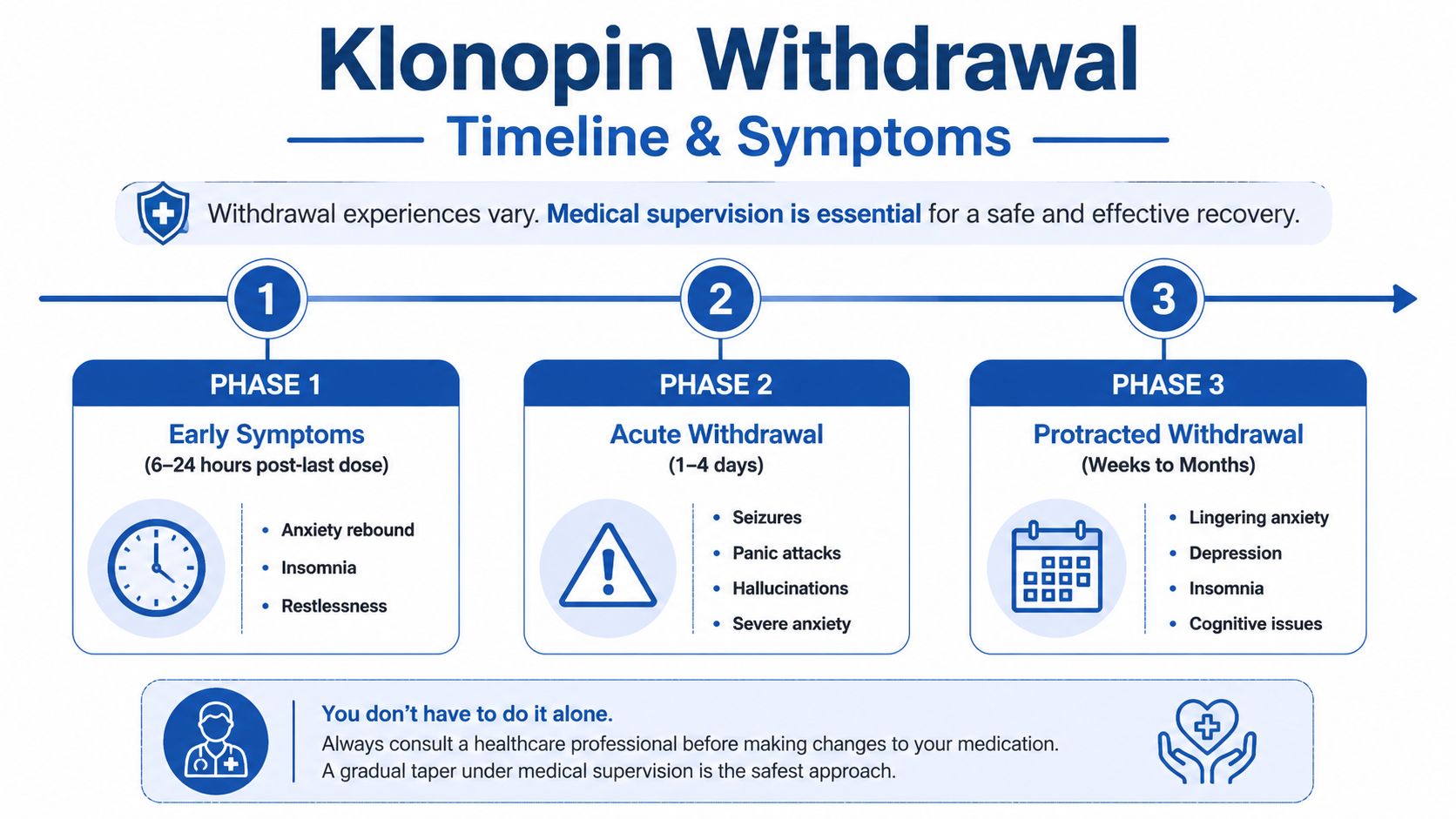
Clinical descriptions of benzodiazepine withdrawal report that abruptly stopping Klonopin can cause increased heart rate and blood pressure, tremors, psychosis, and potentially life-threatening seizures, which is why medically supervised tapering is considered standard care in detox settings, according to clinical guidance on Klonopin withdrawal dangers.
What withdrawal can look like
Early symptoms may be mistaken for “just anxiety.” That's one reason people relapse fast. They may feel intense unease, panic, agitation, or insomnia and assume they need the medication again. In reality, the body may already be moving into withdrawal.
Symptoms can include:
- Autonomic distress: increased pulse, increased blood pressure, sweating, shaking
- Psychological distress: anxiety, panic, irritability, insomnia, perceptual disturbance
- Severe complications: hallucinations, psychosis, and seizures
Stopping suddenly at home is not a test of willpower. It's a medical risk.
Why the timeline matters
A timeline helps families prepare without assuming every person follows the exact same pattern. Factors like dose, duration of use, other substances, and general health all matter. What matters most is this: withdrawal can escalate after the last pill rather than improve.
A safer approach is a monitored taper with medical support and a plan for what comes next. Readers who want a more detailed explanation of safe withdrawal management can review benzo withdrawal and safe detox.
A short comparison makes the trade-off clear:
| Approach | Likely reality |
|---|---|
| Quitting cold turkey at home | Unpredictable symptoms and avoidable medical danger |
| Trying to “cut back” without oversight | Dose swings, relapse, and delayed treatment |
| Structured medical detox with tapering | Better monitoring, safer symptom management, clearer next steps |
Detox is the opening step, not the finish line. Without follow-up treatment, many people return to use because the anxiety, habits, and triggers that drove misuse are still there.
Your Path to Recovery A Medically Supervised Approach
A family in Dallas often reaches this point after a hard week. Pills are running low, anxiety is climbing, sleep is worse, and everyone is arguing about whether to quit at home or get help. With Klonopin, the safer choice is medical care, because the goal is not just to stop use. The goal is to get the person stable, protect them during withdrawal, and start treatment that addresses the reason the misuse took hold.
Good treatment has two parts. First, clinicians stabilize the body and lower the risk of withdrawal complications. Then they address the anxiety, panic, trauma, insomnia, depression, or substance use pattern that kept Klonopin in the picture. In Dallas-Fort Worth, that second part matters even more when alcohol, opioids, or counterfeit pills may also be involved. Fentanyl contamination has changed the risk across North Texas, and any history of mixing substances should shape the treatment plan from day one.
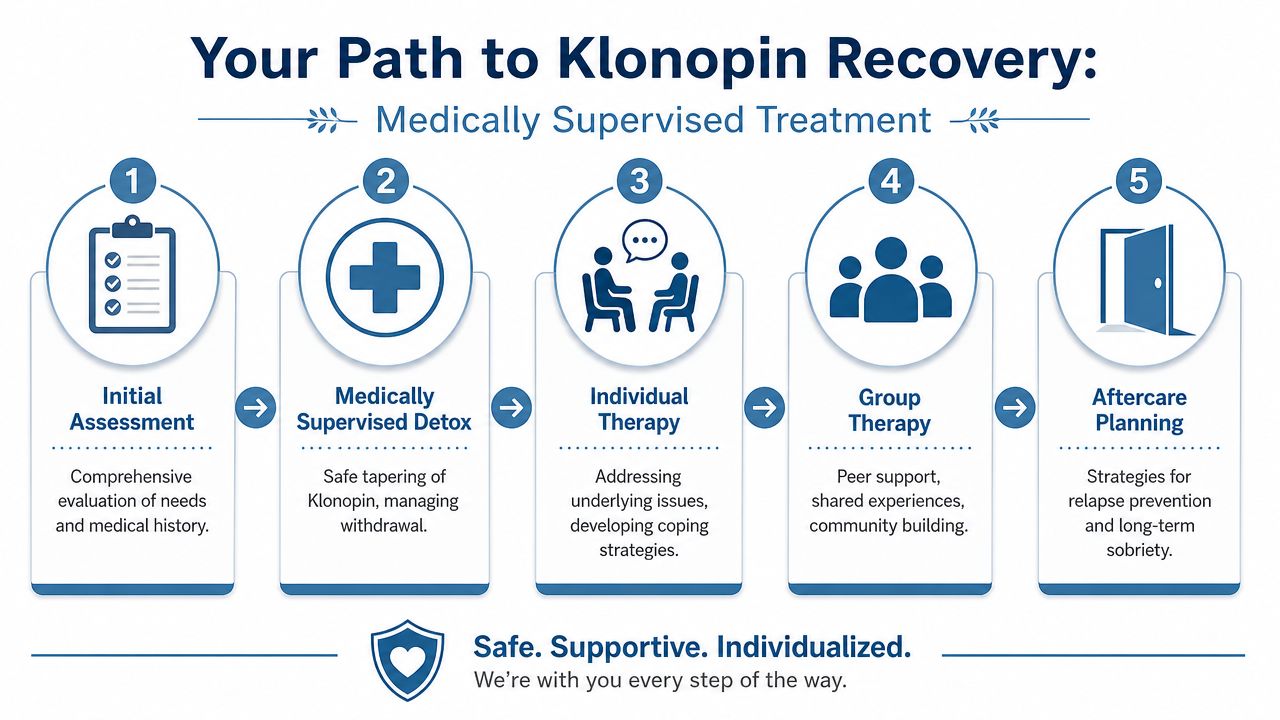
What effective treatment usually includes
Treatment works better when each step is clear and connected.
- Assessment: clinicians review the current dose, length of use, other drugs or alcohol, medical history, and mental health symptoms
- Stabilization and tapering: the early focus is reducing withdrawal risk, monitoring vital signs, and adjusting care based on how the person responds
- Psychiatric and therapeutic care: treatment should address panic, anxiety, trauma, sleep problems, and the habits or triggers tied to misuse
- Discharge planning: the next level of care should be arranged before discharge so the person is not left to figure it out while still vulnerable
For a practical overview of the admission process, monitoring, and daily structure, read what to expect from medically supervised detox in Dallas.
At Tru Dallas Detox & Recovery Center, this level of care may fit people who need close medical supervision, a careful benzodiazepine taper, and coordination with inpatient or outpatient treatment in the Dallas-Fort Worth area.
What tends to go wrong without professional help
Families usually try to solve the problem with good intentions. The problem is that good intentions do not control withdrawal, reduce seizure risk, or treat untreated anxiety.
- Pressure without a treatment plan: ultimatums may get a short-term promise, but they rarely produce safe detox or lasting change
- Home detox watched by family: support helps emotionally, but it does not replace clinical monitoring when symptoms escalate
- Stopping after detox: people often relapse when the underlying anxiety, insomnia, trauma, or polysubstance use pattern is still active
The trade-off is straightforward. Home management may feel faster and less disruptive, but it carries more medical uncertainty. Structured treatment takes planning, yet it gives the person a safer withdrawal process and a better chance of staying engaged in recovery. Hope is realistic here, especially when care starts early and the plan matches the full picture, not just the pills.
Finding Klonopin Addiction Treatment in Dallas Texas
Local treatment matters more than many families expect. The Dallas-Fort Worth metroplex is large, fast-moving, and stressful. Travel across the region can wear people down, especially when they're already anxious, sleep deprived, or physically unstable. Choosing care close to home often makes admission easier and follow-up more realistic.

Why local care matters
For residents of Dallas, Fort Worth, Euless, Grapevine, Irving, Grand Prairie, and surrounding communities, a nearby detox center can make a real difference.
- Family participation: loved ones can attend conversations, provide history, and stay involved in discharge planning
- Continuity: it's easier to transition from detox to ongoing addiction treatment in Dallas without losing momentum
- Practical follow-through: outpatient appointments, therapy, and community support are easier to maintain when they're local
That local continuity is one reason families often begin by comparing detox and rehab options across the area. This guide to drug rehab in Dallas and Dallas County can help clarify what levels of care are available nearby.
Questions worth asking before admission
A treatment call goes better when the family asks direct questions.
- Can the program manage benzodiazepine withdrawal safely?
- Will staff assess other substances, especially alcohol or opioids?
- Is psychiatric care available if anxiety, panic, or depression are part of the picture?
- What happens after detox?
- Can insurance benefits be reviewed before admission?
A good Dallas detox center should answer those questions clearly. If the answers are vague, families should keep asking.
How to Get Help for Yourself or a Loved One Today
People often wait for certainty before reaching out. They want one more conversation, one more promise, one more sign that the situation is serious enough. With Klonopin, that delay can be risky. If use is escalating, functioning is slipping, or withdrawal is already showing up, the safest next move is professional evaluation.
Three simple next steps
Make the call. A confidential conversation can clarify whether the problem looks like dependence, abuse, or dangerous withdrawal risk.
State the facts clearly. It helps to mention dose changes, missed prescriptions, alcohol use, opioid use, panic symptoms, falls, blackouts, or failed attempts to stop. Families don't need perfect language. They need honesty.
Review logistics and act quickly. Ask about insurance verification, intake timing, detox needs, and what to bring. A fast, organized admission process lowers the chance that fear or ambivalence will take over again.
Shame tells people to minimize the problem. Recovery starts when that impulse is ignored. Help is especially important when the person is mixing substances, is hard to wake, or wants to stop but is afraid of withdrawal. In those moments, the goal is not toughness. The goal is safety.
If Klonopin use is creating fear, secrecy, impaired functioning, or withdrawal symptoms, Tru Dallas Detox & Recovery Center can help you take the next step. Reach out for a confidential conversation, ask about PPO insurance verification, and get clear guidance on medical detox and treatment options in the Dallas-Fort Worth area.