

A lot of people in Dallas reach the same painful moment. They know alcohol or drug use is getting worse, they know treatment is needed, and then one thought stops everything: “What if there’s no insurance and no way to pay for rehab?”
That fear is understandable. Money pressure can make a medical decision feel impossible, especially when someone is already dealing with withdrawal, family strain, work problems, or a co-occurring mental health condition. The good news is that paying for treatment without insurance usually isn’t a single yes-or-no decision. It’s a process of matching the right level of care with the right mix of funding options.
For people searching how to pay for drug rehab without insurance in Dallas, the primary challenge usually isn’t whether help exists. It’s knowing which route fits the situation now, which questions to ask before committing, and how to avoid financial surprises halfway through care.
Table of Contents
- Your First Step Is Courage Not Cost
- Assess the Real Cost of Addiction Treatment in Dallas
- Accessing State and Federal Aid for Texas Residents
- Finding Affordable Care Through Non-Profits and Sliding Scales
- Using Payment Plans Loans and Self-Pay Options
- Unlocking Hidden Benefits From Your Employer or the VA
- Get a Confidential Financial Plan at Tru Dallas Detox
Your First Step Is Courage Not Cost
The first job isn’t solving every financial detail today. The first job is deciding that treatment matters enough to act on it.
That matters because hesitation has a cost of its own. The challenge is real for many, in a nation where over 20 million adults battled substance use disorders in recent national surveys, yet insurance gaps persist for many, according to American Addiction Centers on paying for rehab without insurance. In Dallas, Fort Worth, Euless, Arlington, Plano, and nearby communities, families often spend days worrying about payment when they need to spend those days getting someone evaluated.

Why waiting feels safer than acting
People often delay treatment because they assume there are only two options. Pay a huge amount upfront or go without care. That isn’t how admissions works.
In practice, families usually sort through several paths:
- Public funding options that may help qualified Texas residents
- Sliding-scale programs tied to income
- Community or nonprofit support for lower-cost treatment access
- Self-pay and financing when immediate placement matters most
- Employer, VA, or family-supported solutions that reduce the burden
Practical rule: Don’t ask, “Can treatment be afforded?” Ask, “Which payment path fits this clinical need and this timeline?”
For someone who needs detox now, speed may matter more than finding the absolute lowest sticker price. For someone stable enough to wait for intake, state-funded or community-based care may make sense. The important shift is this: cost is a planning problem, not proof that recovery is out of reach.
A Dallas detox center should help families think clearly under pressure. The right next step is getting the level of care assessed first, then matching payment to that need.
Assess the Real Cost of Addiction Treatment in Dallas
The biggest mistake families make is focusing only on the quoted program price. The full financial question is broader: what care is needed, what services are included, and what extra charges might appear after admission?
A critical gap in many rehab searches is the lack of transparency on total out-of-pocket costs. Private rehab centers often quote base treatment costs but don’t itemize ancillary expenses like medication refills or psychiatry consultations, which can create financial surprises during treatment, as noted by Rehabs.com on going to rehab without insurance.
What changes the price
Different levels of addiction treatment in Dallas come with different cost structures. A person entering medical detox may need round-the-clock monitoring, withdrawal medications, labs, and psychiatric review. A person in residential treatment is paying for clinical care plus housing, meals, staffing, and structure. A person in outpatient care usually has a lower overall bill because housing isn’t part of the program.
What matters most is clinical fit. A cheaper level of care isn’t cheaper if it fails to stabilize the person and leads to another crisis.
A family comparing options should ask whether the estimate includes:
- Detox medications used during withdrawal
- Psychiatric services for anxiety, depression, or other co-occurring concerns
- Lab work and medical monitoring
- Medication-assisted treatment when clinically appropriate
- Discharge planning and aftercare coordination
- Extended days if the person needs longer stabilization
Questions that prevent surprise charges
A treatment quote should be specific, not vague. Families in Dallas, Irving, Grapevine, and the wider DFW area should ask for a written breakdown before admission.
| Question | Why it matters |
|---|---|
| What level of care is being recommended? | It shows whether the quote matches the person’s actual needs. |
| What is included in the base rate? | It separates core treatment from add-on charges. |
| What services cost extra? | It identifies labs, psychiatry, medications, or extended stay fees. |
| What happens if detox takes longer than expected? | It clarifies how an extension affects the bill. |
| What aftercare costs should be expected? | It helps families budget beyond discharge. |
Financial stress after admission can be as disruptive as the initial price quote if nobody explained the full picture upfront.
At this point, many families start thinking about the broader risk of financial hardship from medical debt. That concern is valid. Treatment planning should reduce that fear by making every likely cost visible before a commitment is made.
A strong admissions team won’t dodge hard questions. It should explain what the person is paying for, what isn’t included, and what alternatives exist if the preferred option doesn’t fit the budget.
Accessing State and Federal Aid for Texas Residents
For many uninsured Texans, public funding is the first place to look. It won’t fit every timeline or every clinical situation, but it can open a real path to care when private payment isn’t possible.
For Texas residents, eligibility can be checked through the Texas Health and Human Services portal, which often requires proof of residency and income below 200% of the federal poverty level, and SAMHSA data shows approval rates of 65-75% for qualified low-income applicants, according to Renew Health’s guide to paying for rehab without insurance.
What Texas applicants usually need
State-funded programs typically ask for documentation that proves the applicant qualifies. The process is easier when paperwork is gathered before the first call.
Common items include:
- Texas residency proof such as a lease, utility bill, or state-issued ID
- Income documentation showing financial need
- Basic medical or treatment history related to substance use
- Identification records used during intake and placement
The next useful step is reviewing a local guide to state-funded drug rehab in Texas so the family understands what the screening process may involve and where delays usually happen.
How to move faster
State and federal assistance often depends on persistence. Families who call once and stop may miss openings that appear later. The more effective approach is organized follow-through.
Check eligibility first
If income and residency look likely to qualify, that’s worth confirming immediately through the Texas system.Call the SAMHSA National Helpline
It can help identify referrals for free or low-cost treatment resources.Prepare records before the intake call
Delays often happen when documentation is incomplete or scattered.Ask about detox capability
Not every funded placement meets the same medical needs.
When public funding is the right route, speed comes from preparation. Missing paperwork slows down access more than most families expect.
There are trade-offs. State-funded options can be a lifeline, but they may involve waitlists, stricter eligibility screens, and fewer choices about setting or amenities. For someone in severe withdrawal, especially in Dallas detox cases where medical supervision may be necessary, waiting may not be clinically safe.
That’s why families often need a backup plan. If public funding doesn’t line up with the clinical urgency, the next step is looking at lower-cost community resources or structured payment options while continuing the application process.
Finding Affordable Care Through Non-Profits and Sliding Scales
Not every affordable treatment option comes from the state. Across Dallas-Fort Worth, some community organizations, nonprofit programs, and mission-driven providers reduce costs through donations, grants, or income-based pricing.
That matters because a person may not qualify for public aid, may not be able to wait for a funded bed, or may need a simpler starting point such as outpatient support, counseling, or referral assistance.

Where these options fit
Sliding-scale care means the amount owed can change based on income and financial circumstances. That doesn’t always produce free treatment, but it can bring care within reach for someone who’d otherwise delay help.
Community-based options are often most useful for:
- Early intervention when the person is still functioning enough for outpatient support
- Step-down care after detox or residential treatment
- Counseling and recovery support when a full private program isn’t possible
- Bridge care while waiting for a funded placement
Some families in Dallas start with a broad search and miss these programs entirely because they only look for “rehab near me.” A more practical search includes low-cost outpatient care, charity-supported addiction treatment, and free recovery resources in the local area. A useful starting point is this guide to free rehab in Dallas and low-cost addiction treatment.
How to ask the right way
The phrase “Do you offer free rehab?” often leads to a quick no. Better questions usually get better answers.
Try asking:
- Do you offer sliding-scale pricing?
- Are there scholarship funds or grant-supported spots?
- Do you know community partners that can help if this program isn’t affordable?
- What lower level of care would still be clinically safe if residential treatment isn’t possible?
A low-cost option is only useful if it matches the person’s medical risk. Community support can help, but it shouldn’t replace detox when withdrawal could become dangerous.
The trade-off is simple. These resources can lower cost, but availability and clinical intensity vary. Some people need a fuller medical setting than a community-based program can provide. Others can use these programs effectively as part of a broader recovery plan.
Using Payment Plans Loans and Self-Pay Options
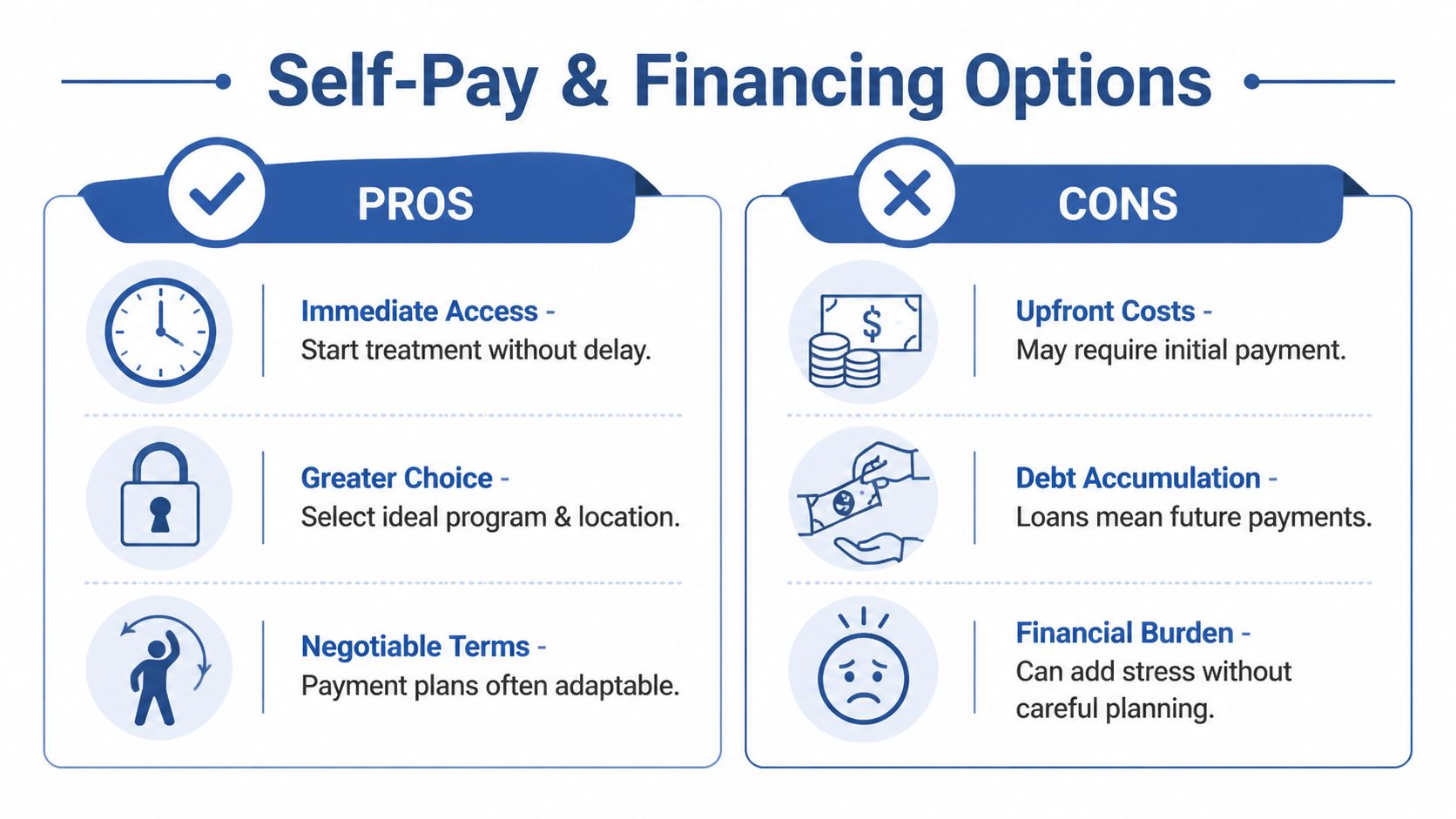
When treatment can’t wait and public resources won’t solve the problem fast enough, private payment becomes the most direct route. This is often the clearest answer for families trying to secure immediate addiction treatment in Dallas.
Approximately 12,000 substance use disorder treatment facilities in the U.S. accept private payment, making self-pay one of the most direct paths to treatment, and costs can range from around $1,703 for outpatient to over $20,000 for a 30-day inpatient stay. That pricing context appears in the earlier source on paying for rehab without insurance.
A practical comparison
Private-pay options aren’t all the same. The best one depends on urgency, available cash, credit profile, and how predictable the total bill will be.
| Option | Best use | Main strength | Main risk |
|---|---|---|---|
| Self-pay upfront | Family has funds available now | Fast admission and simple paperwork | Large immediate outlay |
| In-house payment plan | Family can manage installments | More flexible structure | Terms vary by provider |
| Healthcare financing | Care is urgent and budget needs time | Can spread cost over months | Interest and repayment burden |
| Combined approach | Family can mix savings with financing | Reduces all-at-once pressure | Can become confusing without itemized billing |
A center may also discuss payment plans for continuing care, sober living, or step-down treatment. Families who want to think beyond detox often benefit from reading about whether sober living requires upfront payment or offers payment plans.
What to confirm before signing
The numbers on a financing agreement don’t tell the whole story unless the treatment estimate is clear first.
Ask these questions before accepting any self-pay or loan arrangement:
What exact services does this payment cover?
The answer should include the program level, expected duration, and known add-ons.Is interest involved, and if so, when does it begin?
That affects the true cost over time.What happens if the clinical team recommends a longer stay?
Families need to know whether the financing covers only the initial authorization.How will medications and aftercare be billed?
Those costs are often treated separately.
For some households already dealing with healthcare debt, outside budgeting help can be useful. Resources on reducing medical payments in 2026 may help families think through repayment pressure before adding another monthly obligation.
One practical option in Dallas is Tru Dallas Detox & Recovery Center, which provides medically supervised detox, inpatient or outpatient rehab, medication-assisted treatment, and aftercare planning from its Euless location. For a family comparing private-pay treatment in the DFW area, the important question isn’t just whether financing exists. It’s whether the clinical services, timeline, and payment terms are all transparent enough to support a stable admission.
Unlocking Hidden Benefits From Your Employer or the VA
Some of the most useful funding support never appears in a general online search. It sits inside workplace benefits, veterans’ systems, health spending accounts, or family support plans that haven’t been reviewed carefully yet.
The assumption that “no insurance” means “no benefits” isn’t always true. A person may still have access to confidential workplace assistance, veteran-related services, or designated healthcare funds that reduce the amount needed out of pocket.

Benefits people often miss
An Employee Assistance Program may help with referrals, short-term counseling, or guidance on treatment access. Even when it doesn’t directly pay for a full rehab stay, it can reduce the burden by connecting the employee to approved resources or employer-supported pathways.
Veterans may have routes to addiction treatment through the VA system. The key is confirming eligibility and understanding whether detox, mental health support, or referral coordination is available through that channel.
Other resources can also matter:
- HSA or FSA funds that can be used toward eligible healthcare expenses
- Family pooling of resources to cover admission or transportation
- Structured crowdfunding when the person has a trusted support network
- Faith or community support for practical costs around treatment
How to combine resources without confusion
The strongest financial plan is often layered. One source covers the immediate need, another reduces supportive expenses, and another helps with the next stage of care.
Small benefits add up when they’re organized early. A missed workplace resource or unused healthcare fund can be the difference between delaying treatment and starting this week.
Families should write down every possible source of help in one place. That list can include employer contacts, veteran benefit information, savings available now, relatives willing to help, and any community support already offered. Without that organization, people tend to underestimate what they can assemble.
This approach doesn’t erase hard choices. It does make them clearer.
Get a Confidential Financial Plan at Tru Dallas Detox
People rarely need more generic advice. They need a real plan tied to a real clinical situation.
That’s why admissions guidance matters. The healthcare system is complex, and even insured patients can be denied care as “not medically necessary.” That’s why American Addiction Centers’ state-funded rehab guide highlights the value of admissions specialists who can help build a strong case for care and overcome payment hurdles for both insured and uninsured individuals.
Why expert guidance matters
A useful admissions conversation should do more than quote a number. It should help answer the questions that drive decisions in a crisis.
Those questions usually include:
- Does this person need detox now, or is another level of care safe?
- What payment paths are realistic based on urgency?
- What documents are needed if public funding is still being explored?
- Which charges are included, and which are separate?
- What happens after detox so the person isn’t discharged without a plan?
When those answers are vague, families stay stuck. When they’re clear, action becomes possible.
What a useful admissions call should do
For Dallas-area families, a confidential financial planning call should create order fast. It should sort the clinical need, identify likely funding options, flag the trade-offs, and explain what can happen today versus what may take time.
A good admissions process should also respect the emotional reality. People calling about drug rehab without insurance are often frightened, sleep-deprived, and trying to make decisions under pressure. They shouldn’t have to decode hidden fees, guess whether detox is medically necessary, or bounce between agencies without direction.
The practical next step is simple. Reach out, describe the substance use, describe the financial situation openly, and ask for a clear breakdown of immediate options. Even when the perfect funding source isn’t available, there is often a workable path forward.
If cost has been the reason treatment hasn’t started, the next move is a confidential conversation with Tru Dallas Detox & Recovery Center. The admissions team can help clarify level of care, explain payment pathways, and outline practical next steps for people in Dallas, Fort Worth, and the surrounding DFW area who need addiction treatment without insurance.