

A Dallas professional may know help is needed, but still think, “Treatment would mean walking away from work, family, school, or all three.” That tension is common. A person may be missing deadlines in Uptown, hiding drinking from family in Plano, or trying to get through classes while using pills to stay steady. The need for treatment feels urgent, but daily life doesn’t stop.
That’s where intensive outpatient treatment, often called IOP, starts to make sense. It gives people a real level of structure and clinical support without requiring them to live at a facility. For many adults in Dallas, that balance is the difference between delaying care and starting it.
Table of Contents
- A Path to Recovery That Fits Your Life
- Defining Intensive Outpatient Treatment
- Core Services in a Dallas IOP Program
- How IOP Compares to Other Levels of Care
- Is an IOP in Dallas Right for You
- How to Start IOP at Tru Dallas
- Common Questions About Intensive Outpatient Treatment
A Path to Recovery That Fits Your Life
A parent in Arlington may need treatment but still has school pickup each day. A student near Dallas may know substance use is getting worse, but fears losing a semester. A person commuting across DFW may need serious support and still need to show up for work the next morning.

Those situations don't mean someone should wait. They often mean the person needs a level of care that fits real life. Intensive outpatient treatment does that by combining a structured treatment schedule with the ability to return home each day.
A major reason IOP matters is that it isn't a fringe option. It is well-established in addiction care. In a national survey summarized by the National Institutes of Health, 44% of addiction treatment facilities offered IOPs, serving over 141,000 patients in a single year, which reflects how central IOP has become in recovery care (national IOP prevalence data).
Practical rule: If a person needs more than a weekly counseling appointment but doesn't need to live inside a treatment setting, IOP is often the level of care worth asking about.
Families also get overwhelmed by logistics. They want to know who will call, how scheduling works, and how updates are shared without confusion. Even outside healthcare, organizations that improve client communication usually create better trust by setting clear expectations early. In treatment, that same principle matters. Clear communication lowers fear and helps people stay engaged.
For a person searching in Dallas for addiction treatment that feels serious but still possible, IOP often becomes the first realistic next step.
Defining Intensive Outpatient Treatment
When people ask what is intensive outpatient treatment, the simplest answer is this. It is a structured addiction treatment program that offers several hours of therapy and recovery support each week, while the person continues living at home.
What makes it intensive
The word “intensive” can sound intimidating. It doesn't mean a person is in treatment all day and all night. It means treatment happens often enough each week to create momentum, accountability, and consistency.
The American Society of Addiction Medicine defines Intensive Outpatient Treatment as at least 9 hours of structured, professionally directed treatment per week for adults, for people who need more support than standard outpatient care but do not require 24/7 residential supervision (ASAM-based definition of IOP).
In practical terms, that usually means treatment is spread across multiple days each week. Sessions are often grouped into longer blocks, which gives time for more than a quick check-in. A person may attend group therapy, meet with a counselor, work on relapse prevention, and leave with concrete goals to use that same day.
Why living at home matters
IOP is built around real-world practice. A person might learn how to manage cravings in the afternoon and then use those skills that evening when passing an old liquor store, receiving a stressful text, or feeling pressure after work.
That home-based structure is what makes IOP different from residential treatment. It asks a person to recover in the same environment where stress, triggers, routines, and relationships already exist.
A strong IOP doesn't separate recovery from daily life. It helps a person build recovery inside daily life.
That’s also why IOP isn't right for everyone. If someone is medically unstable, at high risk for dangerous withdrawal, or unable to stay safe outside a supervised setting, a higher level of care may make more sense first. But for people who are stable enough to return home each day, IOP can offer a strong middle ground.
What the schedule is meant to do
The schedule is not there to fill time. It serves a purpose:
- Build routine: Recovery gets anchored to specific days and times.
- Increase accountability: Staff and peers notice when someone is struggling.
- Create repetition: Skills improve when a person practices them often.
- Support transition: People leaving detox, inpatient, or PHP often need a structured next step.
For many adults in Dallas, that combination of structure and flexibility is exactly what makes treatment feel possible.
Core Services in a Dallas IOP Program
An IOP works because it gives people more than a seat in a therapy room. It creates a full treatment rhythm. Each service has a different job, and together they help a person move from crisis management into stable recovery.

What happens during treatment hours
Most Dallas IOP programs include a mix of clinical services rather than a single format.
- Group therapy: This is often the center of the schedule. People practice honesty, hear how others handle similar triggers, and learn that relapse patterns are usually not as unique as they feel.
- Individual counseling: One-on-one sessions help connect treatment to personal history, family stress, work pressure, trauma, and immediate goals.
- Family involvement: When appropriate, treatment may include sessions that help loved ones rebuild trust, set boundaries, and understand recovery in a healthier way.
- Psychoeducation and skills work: People learn practical tools for cravings, emotional regulation, communication, and relapse prevention.
Some programs also use structured clinical models. According to the National Library of Medicine, the Matrix Model includes up to 56 individual counseling sessions and multiple group meetings per week in its intensive phase, showing how detailed and skills-focused IOP can be for substance use treatment (Matrix Model overview and IOP approaches).
A person with stimulant use, for example, may need a highly structured routine. Someone with alcohol use may need help understanding how stress, isolation, and sleep disruption feed the cycle. A person using opioids may need craving management, psychiatric support, and a very clear plan for the hours outside treatment.
Why dual diagnosis and MAT matter
Many adults entering addiction treatment in Dallas are not dealing with substance use alone. Anxiety, depression, bipolar symptoms, trauma, or panic may be part of the picture. If treatment ignores those symptoms, the person may still leave feeling overwhelmed, even if substance use decreases for a time.
That is why dual diagnosis care matters. It treats addiction and mental health together instead of acting as if one can wait until later.
Medication-Assisted Treatment, or MAT, is another area where readers often get confused. MAT doesn't replace therapy. It can support therapy by reducing cravings, stabilizing withdrawal-related symptoms, and giving a person enough steadiness to engage in treatment. For opioid or alcohol use disorders, this can be a critical part of recovery.
The same National Library of Medicine source states that integrating evidence-based therapies with MAT for opioid or alcohol use can boost 6-month retention rates by 30% (evidence on therapy models and MAT integration). That matters because people benefit most when they stay engaged long enough for treatment to take hold.
Some people fear MAT means they aren't “really” in recovery. In clinical care, the more useful question is whether a treatment plan helps the person stay safe, function better, and keep moving forward.
Language access matters here too. When treatment teams discuss diagnoses, medications, side effects, and consent, misunderstanding can create real risk. Families who want a broader picture of this issue may find it helpful to review the consequences of poor medical translation, especially when a loved one feels lost in clinical language.
In practice, an IOP in Dallas should feel organized, personal, and connected to life outside the building. The work done in session should make the evening at home safer and more manageable.
How IOP Compares to Other Levels of Care
People usually don't just want to know what IOP is. They want to know whether it’s enough. That question only makes sense when IOP is compared with the rest of the treatment continuum.
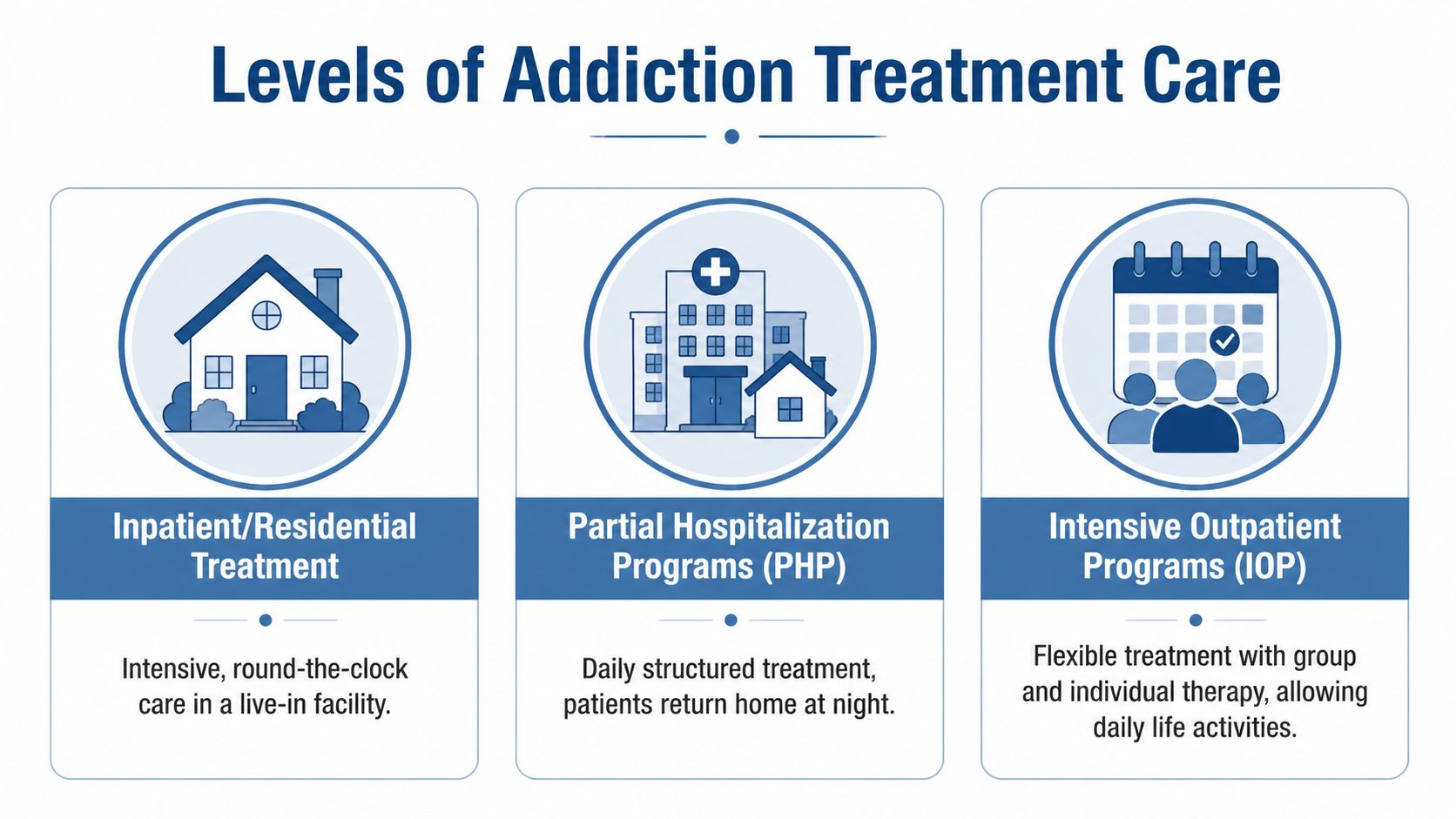
Residential treatment gives the highest level of daily structure because the person lives on-site. Partial hospitalization, often called PHP, offers a full clinical day while the person returns home at night. IOP offers substantial support on a shorter schedule. Standard outpatient is less intensive and usually works best when someone is already more stable.
Addiction Treatment Levels of Care at a Glance
| Level of Care | Time Commitment | Living Arrangement | Best For |
|---|---|---|---|
| Inpatient or Residential | Highest daily commitment | Lives at the facility | People needing 24-hour structure, medical support, or a fully removed environment |
| PHP | More treatment time than IOP | Returns home at night | People needing daily treatment without overnight stay |
| IOP | At least 9 hours per week, based on ASAM guidance | Returns home after sessions | People needing strong support while keeping work, school, or family responsibilities |
| Standard Outpatient | Lower commitment than IOP | Lives at home | People who need ongoing therapy with less structure |
For readers trying to sort out the middle levels, this guide on the difference between PHP and IOP can help clarify how they compare in real life.
When flexibility is a strength, not a compromise
Some people assume inpatient care always works better. That isn't the right way to think about treatment. The better question is whether the level of care matches the person's clinical needs, safety needs, and daily environment.
Research summarized in one reviewed source reports that IOP success rates are 50 to 70 percent and are comparable to inpatient treatment for suitable candidates (IOP success rates and comparison with inpatient). That doesn't mean every person should choose IOP. It means a flexible level of care can still be highly effective when it fits the person.
A few practical distinctions help:
- Residential care fits people who can't safely stabilize while living at home.
- PHP fits people who need more daily monitoring and clinical hours than IOP provides.
- IOP fits people who need serious treatment but can function outside a facility between sessions.
- Standard outpatient fits people who are farther along in stability or stepping down from more structured care.
The right level of care should feel matched, not minimized. Treatment isn't stronger just because it is more restrictive. It is stronger when it fits the person's actual risks and needs.
For many working adults and parents across Dallas-Fort Worth, IOP is the point where treatment becomes both realistic and clinically meaningful.
Is an IOP in Dallas Right for You
A person doesn't need to be “falling apart enough” to qualify for treatment. That fear keeps many people stuck. A better way to think about IOP is whether someone needs structured help and can safely return home after sessions.

Common real life fits for IOP
A professional in Downtown Dallas may still be performing well enough at work to avoid outside concern, but privately knows alcohol or pills are controlling the day. That person may need more than occasional therapy, yet still need a schedule that allows continued employment.
A parent in Irving, Euless, or Fort Worth may need treatment but cannot leave children for a residential stay. If the home environment is stable and the person can attend consistently, IOP may offer the right balance.
A college or graduate student may be dealing with cannabis, stimulants, alcohol, or prescription medication misuse while also managing anxiety or depression. In that case, IOP can support recovery without fully interrupting school responsibilities.
For a closer look at candidacy, this resource on when to choose IOP in Dallas can help families think through timing and fit.
What usually matters most
The strongest candidates for IOP often have a few things in common:
- A safe place to return to: Home doesn't have to be perfect, but it should be stable enough to support treatment.
- Willingness to participate: Progress depends on showing up, speaking openly, and practicing skills outside sessions.
- A need for structure: The person needs more support than standard therapy but doesn't need overnight supervision.
- Readiness for integrated care: If mental health symptoms or medication needs are part of the picture, treatment should address them directly.
Some people start IOP after detox or a higher level of care. Others begin there because they don't need residential treatment in the first place. Both paths are valid.
What matters most is not whether someone fits a stereotype of addiction. What matters is whether life has become hard to manage without structured help, and whether outpatient treatment can be done safely.
How to Start IOP at Tru Dallas
Starting treatment often feels bigger than it is. People imagine paperwork, judgment, or a long delay before anything happens. In reality, admissions usually begin with a simple conversation and move one step at a time.
Step one is a confidential conversation
The first step is usually a phone call. An admissions specialist asks what substances are involved, whether there are mental health concerns, what kind of schedule the person is trying to protect, and whether detox or a higher level of care may be needed first.
That call is also where families can ask practical questions. Can a person keep working. What if there has been a recent relapse. What if the person is unsure whether outpatient care is enough. Those concerns are common, and they are exactly what the intake process is designed to sort out.
Insurance and assessment come next
After the first call, the next steps are usually straightforward:
- Insurance verification: Many people want to know whether PPO coverage may apply before making a commitment.
- Clinical assessment: A treatment team gathers substance use history, mental health concerns, recent risks, and recovery goals.
- Treatment recommendation: The person is matched to the level of care that fits best, which may include IOP if outpatient treatment is appropriate.
One option for people exploring care in the Dallas-Fort Worth area is Tru Dallas Detox & Recovery Center’s intensive outpatient program in Dallas, which is part of a broader continuum that can include detox, outpatient support, MAT, and aftercare planning.
Asking for an assessment doesn't lock anyone into treatment. It gives the person and family a clearer picture of what level of care makes sense.
For many readers, the hardest part is not the paperwork. It is making the first contact. Once that step happens, the path tends to feel much more manageable.
Common Questions About Intensive Outpatient Treatment
Practical questions often matter more than clinical ones at the end of a long search. People want to know whether treatment will fit real life, whether insurance may help, and what happens when the program ends.
Can a person keep working while in IOP
Often, yes. That is one of the main reasons people choose IOP. The schedule is designed to provide structured care while allowing many adults to continue work, school, or family responsibilities.
That doesn't mean it is effortless. A person still needs time, focus, and consistency. But IOP is built for treatment in the middle of ordinary life, not outside of it.
How long does IOP last and what happens after
Program length depends on clinical need, progress, and the person's outside support system. Some people use IOP as a step-down after detox, residential care, or PHP. Others begin there and later transition to less frequent outpatient therapy or aftercare support.
Completion is not the end of recovery. It usually means the person has built enough stability to continue with a lower level of structure, ongoing therapy, relapse prevention planning, support groups, medication management, or some combination of those.
What about cost, insurance, and mental health needs
Cost and coverage vary by plan and provider, so the clearest next step is insurance verification. Many families feel relief from finding out what benefits may apply before making decisions.
Mental health care should also be part of the conversation, not a side issue. When anxiety, depression, trauma, or mood instability are present, treatment should address them directly. For readers who want trustworthy, plain-language support alongside treatment, these evidence-based anxiety resources may be useful.
Other common concerns include:
- Will group therapy feel uncomfortable: At first, it often does. Many people settle in once they realize they are not being singled out or judged.
- What if relapse happens during treatment: A good program responds clinically, not punitively. The treatment plan may need adjustment.
- Can MAT be included in IOP: In many cases, yes. This is especially important for opioid or alcohol use disorders when cravings or instability make recovery harder to sustain.
Recovery does not have to begin with a perfect plan. It usually begins with one clear, informed next step.
A person or family looking for addiction treatment in Dallas can reach out to Tru Dallas Detox & Recovery Center for a confidential conversation, insurance verification, and guidance on whether IOP, detox, or another level of care may fit best.