

When you’re trying to get a handle on addiction but can't just press pause on your entire life, the options can feel overwhelming. You know you need serious help—more than a weekly therapy session—but moving into a full-time residential facility just isn't realistic. That's where an Intensive Outpatient Program, or IOP, comes in.
It’s a powerful middle ground, right here in Dallas.
Key Takeaways
- IOPs offer structured addiction treatment while allowing you to live at home.
- The typical time commitment is 9-12 hours per week, often in the evenings.
- These programs are ideal for those who are medically stable but need more than weekly therapy.
- Dallas offers many specialized IOPs, including tracks for teens, professionals, and dual diagnosis.
- Most major insurance plans cover IOP, and admissions teams can help you verify benefits.
Your Guide to Intensive Outpatient Programs in Dallas
Think of recovery as a spectrum of support. On one end, you have 24/7 inpatient care, and on the other, you have occasional check-ins with a therapist. An IOP sits squarely in between, offering a structured, high-impact treatment program that still allows you to go home every night.
This approach is a game-changer for people in the Dallas-Fort Worth area who need to keep up with jobs, school, or family responsibilities. It’s designed to fit into your world, often with sessions scheduled in the evenings or on weekends, so you can build a new life without completely leaving your old one behind.
Understanding Where IOP Fits in the Big Picture
Addiction treatment isn’t a one-size-fits-all deal. It's a journey, and different stages require different levels of support. We call this the "continuum of care," and it's crucial to find your right place on it.
- Detox & Inpatient Care: This is the most intensive level. You live at the facility and get round-the-clock medical and clinical support, which is essential for safely managing withdrawal and stabilizing.
- Partial Hospitalization Program (PHP): A step down from inpatient. You're still in treatment for most of the day, almost like a full-time job, but you can return home or to a sober living environment at night.
- Intensive Outpatient Program (IOP): Here’s the sweet spot we’re talking about. You'll typically commit to 9-12 hours of therapy each week, spread over a few days. It's a serious commitment but leaves plenty of room for your daily life.
- Standard Outpatient Care: This is the most flexible level, usually involving just one or two therapy sessions a week to maintain progress and manage long-term recovery.
An IOP is where the rubber meets the road. You’re learning new coping skills in therapy and then immediately going out and applying them in the real world—at your job, with your family, and in your community. It turns everyday life into a training ground for lasting recovery.
This guide will walk you through exactly what IOP programs in Dallas TX look like, who they're best for, and how to find a high-quality program that fits your needs.
Dallas IOP At a Glance
To make it even clearer, here’s a quick breakdown of what you can generally expect from an Intensive Outpatient Program in the Dallas area.
| Feature | Description | Typical Commitment |
|---|---|---|
| Schedule | Group and individual therapy sessions held on-site. | 3 to 5 days per week, often in the evenings. |
| Time | Each session day lasts for about 3 hours. | 9 to 12 total hours of treatment per week. |
| Housing | You live at home or in a sober living environment. | No on-site residency required. |
| Focus | Building coping skills, relapse prevention, and peer support. | Practical application in your daily life. |
| Support | Includes group therapy, individual counseling, and family sessions. | Access to a clinical team and peer community. |
This table shows how IOPs deliver a substantial level of care without requiring the 24/7 commitment of an inpatient program, making it a viable and effective option for many.
How an Intensive Outpatient Program Actually Works
When you're looking at addiction treatment, it’s easy to get lost in the different levels of care. Think of it this way: inpatient or residential treatment is like moving into a new, supportive home, with care available 24/7. Standard weekly therapy is like having a personal coach you check in with regularly.
So, where does an Intensive Outpatient Program (IOP) fit in? It’s the perfect middle ground. It's like a rigorous training camp for your recovery that you attend for several hours a week, while still living at home and managing your life.
This structure is so important because it bridges the gap between the total immersion of residential care and the independence of traditional outpatient therapy. You get a solid, consistent framework for healing without having to completely step away from your job, family, or community.
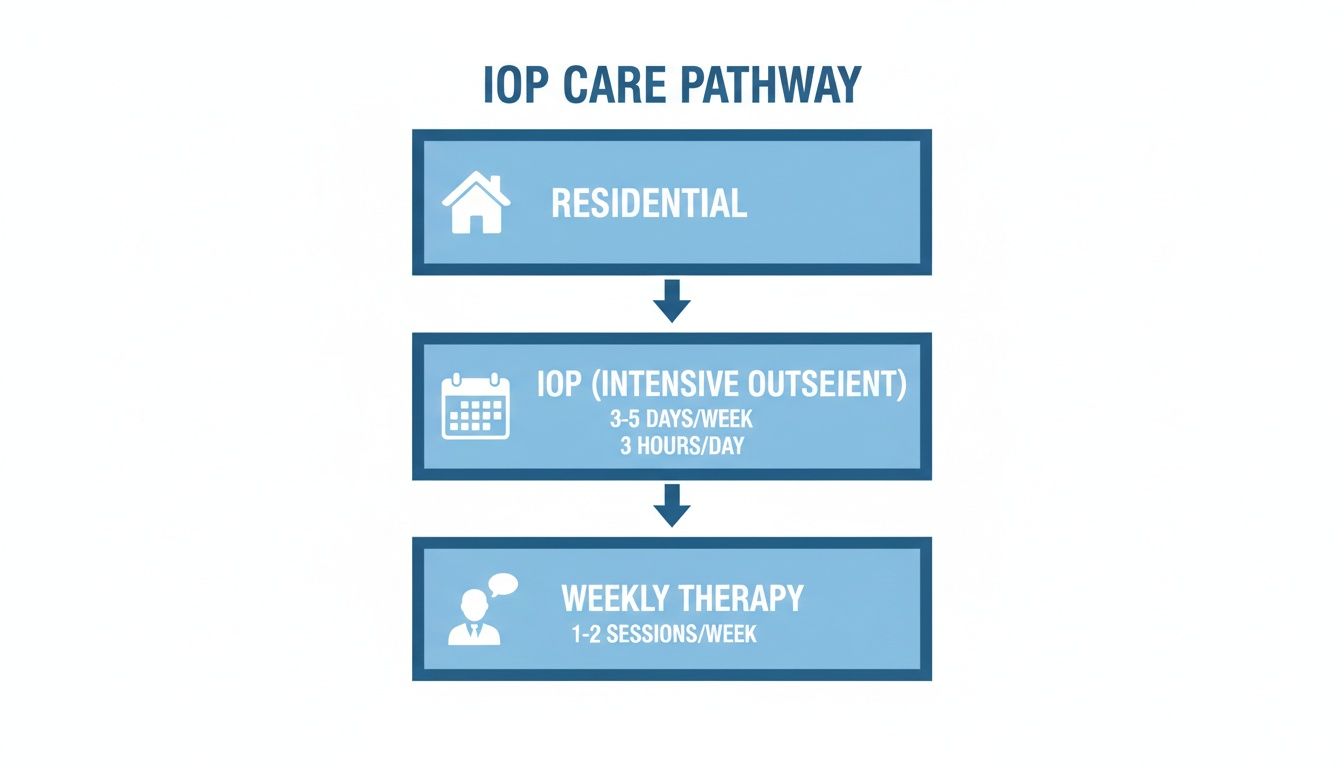
As you can see, IOP is often a crucial "step-down" from a higher level of care, giving you a chance to practice your recovery skills in the real world with a strong safety net still in place.
What Does a Typical Week Look Like?
In Dallas, IOPs are designed to fit into real, busy lives. The entire model is built on providing serious therapeutic support without demanding that you put your entire life on hold. You can get the treatment you need and still show up for work or be home for dinner with your family.
A standard week in an IOP involves about 9 to 12 hours of programming. This is usually broken down into three-hour sessions spread across three to five days. To make it work for people with jobs, many IOP programs in Dallas, TX, offer evening sessions.
This regular schedule is more than just convenient; it creates a predictable rhythm that becomes a stabilizing force in the often-chaotic world of early recovery. You’re constantly reinforcing new skills and have a safe space to talk about what happens when you try to use them.
The Core Components of Treatment
When you join an IOP, you’re not just showing up for meetings. You're diving into a well-rounded clinical program built to tackle addiction from multiple angles. Every part is designed to work together, building a strong foundation for a life in recovery.
The real magic of an IOP is how immediate it is. You might learn a new coping skill for cravings in a group session on a Tuesday afternoon, and then get a chance to use that exact skill when you get home that evening. It’s recovery in real-time.
Here’s a look at the key services you can expect:
- Group Therapy: This is the heart and soul of most IOPs. Led by a professional, you'll connect with others who truly get what you’re going through. It’s a place to process emotions, practice healthy communication, and realize you aren't alone.
- Individual Counseling: You’ll have dedicated one-on-one time with your own therapist. This is where you can safely explore the deeper personal issues, past traumas, or specific challenges that fuel your addiction.
- Skill-Building Workshops: Think of these as the "how-to" classes for recovery. They’re interactive sessions covering topics like the science of addiction, how to spot your triggers, practical relapse prevention strategies, and healthier ways to manage stress.
- Family Therapy: Addiction never happens in a vacuum; it impacts the entire family. Many IOPs offer family sessions to help heal relationships, set healthy boundaries, and get everyone on the same page to create a supportive home environment.
In the Dallas-Fort Worth area, IOPs have become a vital part of the treatment landscape, with 44 dedicated centers offering these services. Most programs require about 9 hours of treatment per week, making it a significant step up from standard therapy without requiring a residential stay. This flexibility is a game-changer in a major metroplex where life doesn't stop for recovery. To learn more, check out our in-depth guide that explores what intensive outpatient treatment entails.
Who Is an Ideal Candidate for a Dallas IOP?
Figuring out the right level of addiction treatment can feel overwhelming. An Intensive Outpatient Program (IOP) isn't for everyone, but for the right person, it strikes the perfect balance between structured support and the flexibility to live your life.
Think of it as a middle ground. An IOP is most effective when you have a safe and supportive place to live but know that a once-a-week therapy session just isn't going to cut it. You need more accountability and guidance to truly get a handle on your recovery.
Here’s an analogy I often use: If residential treatment is like learning to swim in a contained pool with an instructor in the water with you, an IOP is like practicing in the open ocean with your coach guiding you from the shore. You’re navigating real-world waves, but expert help is always right there. This setup is perfect for people who are medically stable and aren't facing severe withdrawal that would require 24/7 medical supervision.

Scenarios Where an IOP Makes Sense
So, who are the people who really thrive in IOP programs in Dallas TX? Let's paint a picture with a few real-world examples of people who need serious help but can't just press pause on their entire lives.
-
The Working Professional: Imagine someone with a high-pressure job in Downtown Dallas. They have a supportive family, but they know their drinking or drug use is getting out of control. Taking 30 days off for inpatient treatment isn't an option. An IOP with evening sessions lets them get intensive therapy after their workday, putting new coping skills to the test in real-time at the office the very next day.
-
The Parent with Young Children: For a parent juggling school runs, meals, and managing a household, residential care can seem impossible. An IOP becomes a lifeline. It provides several hours of focused, transformative treatment during the day while the kids are in school, allowing them to be home for dinner and bedtime.
-
The College Student: A student at a local university might be watching their grades slip and their health decline due to substance use. An IOP gives them the structure to get back on track without having to drop out and completely derail their academic future.
In each of these cases, the person is motivated to get better and has a life they need to keep living. An IOP is a practical solution designed for the messy reality of the real world.
Stepping Down from Higher Levels of Care
One of the most powerful ways an IOP is used is as a bridge. Someone who has just finished medical detox or a residential program is in an incredibly vulnerable spot. Going from a 24/7 supportive bubble straight back into the chaos of daily life can be a massive shock.
An IOP serves as a critical bridge between the protective environment of inpatient care and the independence of long-term recovery. It slowly reintroduces responsibilities while keeping a strong clinical safety net in place, which has been shown to dramatically reduce the risk of relapse.
This "step-down" approach lets you test-drive your new recovery tools in real life—handling a tough day at work or a stressful family event—and then process it all in therapy just a few hours later. It’s an essential piece of building a recovery that actually lasts.
Support for Dual Diagnosis and Co-Occurring Disorders
It’s incredibly common for substance use to be tangled up with mental health challenges like anxiety, depression, or trauma. When they exist together, we call it a dual diagnosis. Trying to treat the addiction without addressing the underlying mental health issue is like patching only half the holes in a leaky boat. It just won’t work.
The best IOP programs in Dallas TX are built to handle this complexity. They weave mental health treatment directly into their substance use curriculum. For someone with a dual diagnosis, this means therapy will explore how their anxiety triggers cravings and how their substance use makes their depression worse. This integrated approach is the key to lasting healing because it gets to the root of the problem, not just the surface-level symptoms.
Finding Specialized IOP Tracks in the DFW Area
Recovery is a deeply personal journey, and there’s no such thing as a one-size-fits-all solution. That's why the best IOP programs in Dallas, TX, don't just offer a single, generic program. Instead, they provide specialized tracks designed around the unique challenges and life experiences people bring with them.
Think of it this way: putting people with shared experiences in the same room creates an instant connection. It builds a powerful sense of community where you can talk to peers who just get it without needing a long explanation. This common ground often helps people open up faster and build a support network that feels truly relevant to their lives.
Answering the Call for Youth Mental Health
One of the most urgent needs for specialized care is for teens and adolescents. The statistics on youth mental health in Texas are a clear wake-up call. In 2020 alone, more than 500,000 children in the state were diagnosed with anxiety or depression.
This isn't just a number; it's a crisis unfolding in our communities. We know that 15.08% of Texans aged 12-17 have had at least one major depressive episode in the last year, and that figure keeps climbing. Zooming in closer to home, a 2019 report from the Fort Worth ISD revealed that nearly 34% of students felt persistently sad or hopeless. This is a problem that spills directly into Dallas and demands a targeted response. You can learn more about these local trends from BasePoint Academy's research on Dallas youth mental health.
Adolescent IOPs aren't just scaled-down adult programs. They're built from the ground up for teens. Therapies like Cognitive Behavioral Therapy (CBT) and Dialectical Behavior Therapy (DBT) are adapted to tackle issues like peer pressure, school stress, and family conflict in a way that resonates with a younger audience.
Specialized Programs for Unique Professions and Needs
Beyond age, many Dallas facilities recognize that what works for a corporate executive won't be the right fit for a firefighter. The triggers, daily pressures, and barriers to recovery look completely different depending on your walk of life.
That's why you'll find specialized groups focused on:
- Executives and Professionals: These tracks understand the immense pressure of a high-stakes career. The focus is on practical skills like managing work stress without substances, finding a healthier work-life balance, and navigating recovery while maintaining professional privacy.
- First Responders: Police, firefighters, and paramedics are exposed to trauma as a routine part of their job. A specialized IOP gives them a confidential space to process that trauma with others who understand the unique culture and unspoken rules of their profession.
- Gender-Specific Groups: Sometimes, healing happens best when you're surrounded by people who share a similar life experience. Men’s and women’s groups create safe, supportive environments to discuss sensitive topics—like societal pressures, past trauma, or relationship dynamics—without the discomfort that can sometimes arise in co-ed settings.
- Dual Diagnosis Tracks: When someone is battling both a substance use disorder and a mental health condition like anxiety, depression, or PTSD, you can't just treat one and ignore the other. Integrated treatment is non-negotiable. To see how this works, read our guide on dual diagnosis treatment centers in Texas, which details why addressing both issues at the same time is crucial for a recovery that lasts.
By creating these focused environments, Dallas IOPs make sure you're treated like a whole person, not just another case file. Your unique story becomes the centerpiece of your healing journey, giving you the targeted support you need.
Navigating Admissions, Insurance, and Program Costs
Figuring out the logistics of getting into treatment—admissions, insurance, costs—can feel overwhelming. Sometimes, it’s the one thing that stops people from picking up the phone. But here’s what I can tell you from years of experience: the process for entering IOP programs in Dallas, TX, is designed to be as straightforward and supportive as possible.
It all starts with a simple, confidential phone call. This isn't a high-pressure sales pitch; it's a conversation. It's your chance to ask questions and share a bit about what’s going on, all in a judgment-free space.
From there, the next step is a clinical assessment. Think of this less like a test and more like a detailed conversation with a compassionate professional. Their job is to listen and truly understand your history, your specific challenges with substance use, and what you hope to achieve. This conversation becomes the blueprint for your personalized treatment plan, ensuring the care you get is exactly what you need.
Making Treatment Affordable With Insurance
Let's talk about the elephant in the room: how to pay for it. This is easily one of the biggest worries people have. The good news is that most reputable IOPs in Dallas accept major PPO insurance plans. The trick is figuring out your specific policy, and that's where an admissions specialist becomes your best advocate. They will handle the insurance verification for you.

To get the ball rolling, you'll generally need to have this info handy:
- Your insurance provider (like Blue Cross Blue Shield, Aetna, Cigna, etc.)
- Your policy or member ID number
- Your date of birth
With just those details, the admissions team can get to work and find out precisely what your plan covers for IOP. They'll walk you through what your deductible is (the amount you pay before your plan starts paying), your co-pay (your set fee for each session), and whether the program is in-network with your provider. If you want a head start, our guide explains in more detail how insurance can cover drug rehab costs.
Trying to understand your insurance benefits can feel like learning a new language. An admissions coordinator is your translator. They break down the financial side of things so you can put all your energy into what truly matters: your recovery.
Understanding Program Costs and Payment Options
The Dallas area is home to a robust network of care. There are 44 centers offering IOP services within a 25-mile radius, which helps keep treatment accessible and competitively priced.
While costs can vary, they often fall near the Texas outpatient average of about $1,698. Most Dallas IOPs, especially those in the DFW metroplex, structure their programs with three-hour sessions a few times per week, making it a manageable and effective option for people who need to keep up with work or family commitments.
But what if insurance doesn't cover everything, or you don't have insurance? Please don't let that be a dead end. Many treatment centers are dedicated to helping people find a way forward. They often offer options like financing plans that let you pay over time or sliding scale fees that adjust the cost based on your income. The most important thing is to just be open with the admissions team about your financial situation. Their goal is to help you find a solution.
Your Path to Recovery in Dallas: What to Remember
The road to recovery looks a little different for everyone, but the first step is always the same—understanding your options and making the choice to move forward. The good news is that the Dallas-Fort Worth area has a strong network of high-quality, flexible treatment programs designed to help you heal while still living your life. As you think about what’s next, let’s boil it all down to the essentials.
The Most Important Things to Keep in Mind
If you take away one thing, let it be this: real, accessible help is available right here in Dallas. Intensive Outpatient Programs (IOPs) offer a powerful middle ground, giving you the structure and support you need without asking you to put your entire world on hold. It’s a model that works especially well for people who have a stable home life but know they need more than a weekly therapy session to build a solid foundation for sobriety.
Recovery isn't about erasing your past; it's about learning from it to build a future you're proud of. Deciding to ask for help is the single most powerful step you can take toward that future.
Keep these five key takeaways with you as you move forward:
- Structure Meets Real Life: IOPs give you a concrete, structured path to recovery while still allowing you to keep up with work, school, and family.
- One Size Never Fits All: The right program for you is one that understands your unique situation, whether that means addressing a dual diagnosis or offering a specialized track for young adults.
- Dallas Has Great Options: The DFW metroplex is home to a deep network of licensed and accredited providers, so you can find a high-quality program that feels like the right fit.
- Don't Let Cost Stop You: Financial hurdles can feel overwhelming, but they can be overcome. Admissions teams are experts at navigating insurance and exploring payment options to make treatment affordable.
- The First Step is a Simple Conversation: The most important thing you can do right now is make a confidential call for an assessment. This is your sign. It's time to start the journey toward a healthier, more fulfilling life.
Frequently Asked Questions
What is the main goal of an IOP?
The core goal is to give you the tools and support to manage addiction or mental health issues while you stay connected to your community. It’s all about preventing relapse, learning healthy coping mechanisms, and building a solid support system you can rely on long-term.
How is an IOP different from regular therapy?
It's all about the intensity. Regular therapy is usually just one hour a week. An IOP is a much bigger time commitment, involving multiple hours of structured treatment over several days. You get a mix of group sessions, one-on-one counseling, and educational workshops that go far deeper.
Can I still work while in an IOP?
Yes, absolutely. This is one of the biggest reasons people choose an IOP. These programs are specifically structured for adults with jobs, family, and other responsibilities. Most IOP programs in Dallas, TX, hold sessions in the evenings, so you can get the help you need without having to put your entire life on pause.
Is family involved in IOP treatment?
Any good IOP in Dallas will tell you that family involvement is key. Most programs offer family therapy sessions and educational nights. The goal is to heal relationships, fix broken communication, and make sure your support system at home is as strong as it can be.
How do I know if I need an IOP or a higher level of care?
The two biggest factors are your medical stability and your home environment. If you need medical help to get through withdrawal or if your home is full of triggers and isn't a safe space, inpatient care is almost always the right place to start. A professional clinical assessment is the best way to get a clear, personalized recommendation.
How long does an IOP usually last?
You can generally expect an IOP to last anywhere from four to eight weeks. The program's length is built around your specific challenges, clinical needs, and how you're progressing through treatment milestones.