
Cognitive Behavioral Therapy, or CBT, isn't about endlessly analyzing your past. It's a hands-on, practical approach to treating substance misuse that gives you the power to change your future. Think of it less as "talk therapy" and more as building a mental toolkit to break the cycle of addiction for good.
A Practical Path to Lasting Recovery
When you're struggling with substance misuse, the path forward can seem foggy and uncertain. CBT clears that fog by providing a structured, goal-oriented map to recovery. It’s built on a straightforward yet powerful idea: the way we think about things directly impacts how we feel, and those feelings drive our actions.
Imagine a stressful situation at work. An automatic thought like, "I can't cope with this pressure without a drink," can pop into your head. That thought sparks feelings of anxiety and hopelessness, which, in turn, can lead directly to the act of using a substance. CBT teaches you how to step into that cycle and break it.
Building Your Mental Toolkit
Instead of just dissecting problems, CBT is all about action and building new skills. You and your therapist become a team, working together to:
- Identify Triggers: Pinpoint the specific people, places, or emotions that spark cravings and the urge to use.
- Challenge Negative Thoughts: Learn how to spot and question the automatic, unhelpful beliefs that keep you stuck.
- Develop Coping Strategies: Create a toolbox of healthy, practical ways to navigate stress, boredom, and other tough emotions without turning to substances.
This forward-looking approach is a major reason why CBT for substance misuse has become a cornerstone of effective addiction treatment. The link between emotional well-being and addiction is incredibly strong, and CBT gives you a clear framework for healing both. To dig deeper into this relationship, you can learn more about the intersection of mental health and substance abuse in our guide.
The core idea is that our thoughts, feelings, and actions are interconnected, creating cycles that can either trap us in addiction or set us free. By learning to manage your thoughts, you regain power over your actions.
At its heart, CBT operates on a few key principles that make it especially effective for addiction. The table below breaks down these core concepts.
Table: Core Principles of CBT in Addiction Treatment
| Principle | How It Applies to Substance Misuse |
|---|---|
| Cognitive Principle | Unhelpful thought patterns (e.g., "I need this to relax") maintain the addiction cycle. CBT teaches you to identify and change them. |
| Behavioral Principle | Actions and habits reinforce addiction. The therapy focuses on developing new, healthy behaviors to replace substance use. |
| The "Here and Now" Focus | While the past is acknowledged, the primary focus is on solving current problems and building skills for the future. |
| Goal-Oriented & Structured | Sessions are structured to help you achieve specific, measurable recovery goals one step at a time. |
By internalizing these principles, you begin to see that recovery isn't a passive process but an active one where you are in the driver's seat.
Why It Works
The success of CBT isn't just based on theory; it's backed by solid scientific evidence. With substance misuse affecting an estimated 284 million people around the world, effective, research-backed therapies are more critical than ever.
A major review of 19 different randomized controlled trials found that CBT was consistently effective in treating drug addiction, leading to significant reductions in substance use across the board. This approach works because it empowers you to become your own therapist, equipping you with the lifelong skills needed to navigate challenges and maintain your recovery long after you leave treatment.
Key Takeaways
- CBT is an active, skill-building therapy, not passive talk therapy.
- It operates on the core principle that thoughts, feelings, and actions are interconnected.
- The primary focus is on solving current problems to build a better future.
- You learn to identify triggers, challenge negative thoughts, and develop healthy coping skills.
- CBT is a goal-oriented partnership between you and your therapist.
How CBT Actually Rewires Your Brain
Cognitive Behavioral Therapy isn't just about talking through your problems; it's a science-backed process that can physically change your brain. For a long time, people mistakenly viewed addiction as a moral weakness. We now know it's a complex condition deeply rooted in the brain's reward system. CBT gets right to the heart of the matter by directly targeting and reshaping these ingrained brain circuits.
This is all possible thanks to something called neuroplasticity. Think of it as your brain's incredible ability to adapt and build new connections. When you're struggling with substance use, your brain has well-worn neural pathways—like deep ruts in a dirt road—that connect a trigger directly to the act of using. Each time you follow that path, the rut gets deeper, making the behavior more automatic.
CBT gives you the tools to start carving new, healthier roads. Every time you use a CBT technique—like challenging a thought that says "I can't handle this without a drink"—you're strengthening a different, more positive neural connection.
Forging New Habits, Weakening Old Ones
Substance use forges powerful links between everyday cues (triggers) and the brain's reward center. CBT works methodically to break those old links while creating new ones that support your recovery. It’s a bit like training a muscle at the gym; the more you practice new ways of thinking and reacting, the stronger those new mental pathways become.
Over time, those old, destructive paths begin to fade from lack of use, and the new, healthier routes become your brain's go-to response. This isn't just a temporary behavioral shift; it's a fundamental change in your brain's architecture, laying a solid foundation for lasting recovery.
"The brain that wires together, fires together." This old saying really gets to the core of how CBT works. By consistently practicing new thoughts and behaviors, you're literally rewiring your brain to fire in ways that support sobriety. Eventually, making the healthy choice starts to feel more natural and automatic.
This isn't just a theory; it’s backed by decades of clinical research. Study after study confirms how effective CBT is for substance use disorders, showing real, measurable reductions in how much and how often people use. One major review found that people who received CBT had 15-26% better outcomes than those with minimal or no treatment. This has earned CBT a 'strong recommendation' as a scientifically validated therapy for alcohol, opioids, and other substance use disorders. You can dig into the full research on these findings to see the data for yourself.
Building Skills for Long-Term Change
The changes CBT makes in your brain are meant to stick around long after you've finished treatment. Because the therapy is all about building practical skills, you leave with a toolkit you can use for the rest of your life. In a way, you learn to become your own therapist, ready to navigate future challenges.
Here’s how CBT helps build that lasting change:
- Heightened Self-Awareness: You learn to pinpoint your personal high-risk situations and the automatic thoughts that pop up right before a craving hits, giving you a chance to step in before the urge takes over.
- Cognitive Reframing: You develop the skill to catch and challenge distorted thoughts. A thought like, "I need this to relax," can be reframed into something more accurate and helpful, like, "I have other, healthier ways to manage my stress."
- Practical Behavioral Skills: You build up a whole new set of go-to coping mechanisms—from simple breathing exercises to structured problem-solving—so you have real, tangible alternatives when faced with a trigger.
Ultimately, this process puts you back in the driver's seat. Instead of feeling helpless against cravings, you build the confidence and the skills to manage them effectively. The science is clear: CBT for substance misuse is more than just talk therapy. It's a proven method for reshaping your brain and building a strong, sustainable recovery.
Key Takeaways
- CBT uses the brain's natural ability (neuroplasticity) to physically form new, healthier neural pathways.
- The therapy works by weakening the old, automatic connections that lead to substance use and building new ones that support sobriety.
- By practicing CBT skills, healthy choices become less of a struggle and more of a default response over time.
- Countless studies have proven that CBT leads to significant, measurable decreases in substance use.
- The skills you learn in CBT are for life, giving you a lasting foundation for managing challenges long after treatment ends.
The 4 Core CBT Techniques for Overcoming Addiction
Cognitive Behavioral Therapy isn't about abstract theories; it's a hands-on approach that gives you a practical toolkit for dismantling the habits that fuel addiction. Think of it less like talk therapy and more like skill-building. You learn specific, powerful methods to manage cravings and respond to triggers in a new way.
At first, these tools might feel a bit clunky, like learning to use a new piece of equipment. But with guidance and practice, they become second nature. The four main techniques you'll master work together, each targeting a different part of the addiction cycle to build a solid foundation for your recovery.
Cognitive Restructuring: Rewiring Your Thought Patterns
Cognitive restructuring is all about learning to catch, challenge, and change the automatic thoughts that lead directly to substance use. These thoughts often fly under the radar, popping into our heads so fast that we just accept them as the absolute truth.
For example, after a tough day at work, your brain might instantly serve up the thought, "I need a drink to deal with this." In that moment, the thought feels 100% real and creates a powerful, almost irresistible urge.
CBT teaches you to hit the pause button. You learn to step back and examine that thought like a detective. Is it really true that a drink is the only way to cope? Have you ever gotten through a stressful day without one? What are the real consequences of following that thought?
By questioning it, you can start to reframe it into something more realistic and helpful, like, "This day was stressful, and I deserve to relax. I know drinking will only make me feel worse tomorrow, so I'll try something else." This small shift is monumental—it severs the direct link between a trigger and the automatic response to use.
This infographic shows how practicing these skills creates real, lasting change in your brain's structure.
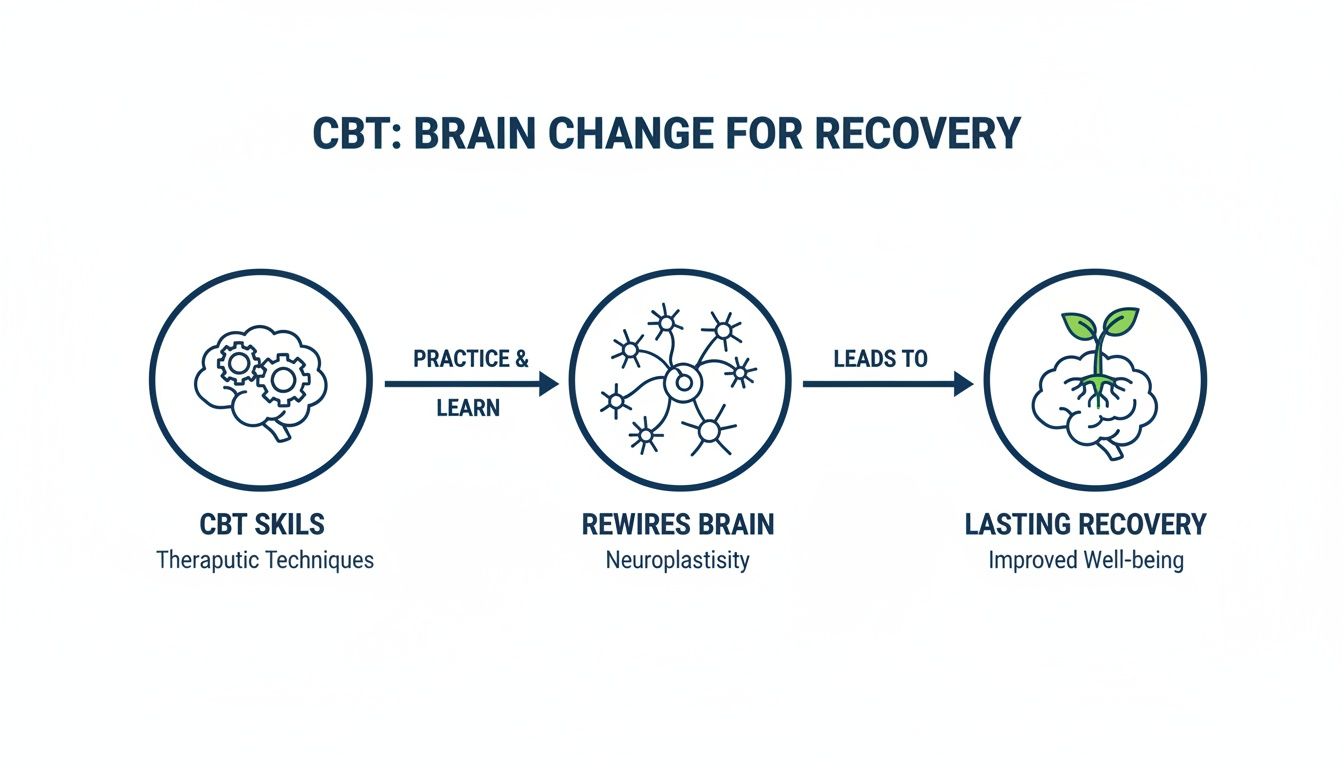
As you can see, consistently applying these new skills isn't just a mental exercise. It actively forges new neural pathways, strengthening the parts of your brain that support long-term recovery.
Functional Analysis: Becoming an Expert on Yourself
You can't change a behavior until you understand it inside and out. Functional analysis is a core CBT technique where you and your therapist act as investigators, mapping out the entire chain of events that leads to substance use.
It's about getting incredibly specific and looking at the whole picture:
- Triggers: What exactly sets things in motion? Is it an internal feeling like boredom, or an external cue like driving past a specific bar?
- Thoughts: What are the first thoughts that pop into your head right after the trigger appears?
- Feelings: What emotions do those thoughts spark? Anxiety? Sadness? A sense of excitement?
- Behaviors: The action of using the substance.
- Consequences: What happens next? This includes both the immediate "reward" (like relief from anxiety) and the longer-term negative fallout.
By breaking it all down, you uncover the function of the substance use. Maybe it’s a tool for escaping difficult emotions or a crutch for feeling confident in social situations. Once you know what job the substance was doing, you can start finding healthier, more effective ways to fill that same need.
Coping Skills Training: Building Your Personal Toolkit
Once you understand your triggers and thinking patterns, the next step is to build a solid set of coping skills. This is where CBT gets really practical. You'll work with your therapist to assemble a personalized toolkit of strategies to manage cravings and navigate high-risk situations without turning to drugs or alcohol.
This isn't about just gritting your teeth and using willpower. It's about having a concrete, go-to plan for when a craving strikes. Instead of trying to fight the urge, you learn to surf it, knowing it's a temporary wave that will pass.
This toolkit will be filled with a variety of techniques that you can practice until they feel natural. For a deeper dive, you can also explore our guide on developing effective coping skills for addiction.
A few examples of core skills include:
- Grounding Exercises: Simple techniques like focusing on your five senses to pull your attention into the present moment and away from the craving.
- Healthy Distractions: Engaging in an activity you enjoy that requires your full attention, like playing an instrument, going for a run, or calling a friend.
- Accessing Support: Knowing exactly who to call or which meeting to attend the moment you feel vulnerable.
Relapse Prevention: Creating a Roadmap for the Future
Finally, relapse prevention is the long-term game plan. It’s a proactive strategy that acknowledges recovery is a journey, and bumps in the road are possible. Instead of just hoping for the best, you create a detailed roadmap for navigating future challenges.
This involves identifying your personal warning signs—the subtle shifts in thinking or behavior that signal you might be heading toward a slip. You then create specific, actionable plans to address those signs before they grow into something bigger.
Ultimately, it’s about building a life where it’s simply easier not to use. This might mean restructuring your daily routine, finding new sober hobbies, or cultivating friendships that support your recovery. By preparing for challenges ahead of time, you build the confidence and resilience needed to protect your sobriety for the long haul.
CBT Techniques in Action
To make these concepts more concrete, let's look at how they apply to real-world recovery challenges. The table below shows how you can swap a common problematic response with a new, CBT-driven action.
| CBT Technique | Problematic Thought or Behavior | CBT-Driven Alternative Action |
|---|---|---|
| Cognitive Restructuring | "I've had a terrible day, I deserve a drink to unwind." | "I did have a terrible day. I'll take a hot shower and listen to music because I deserve to feel better tomorrow, too." |
| Functional Analysis | Feeling lonely on a Friday night and immediately calling an old friend who encourages substance use. | Recognizing that loneliness is the trigger and the "function" is connection. Instead, call a supportive family member or attend a support group meeting. |
| Coping Skills Training | A strong craving hits, and the only thought is to fight it with willpower, which feels overwhelming. | Instead of fighting, use a distraction skill. Immediately put on running shoes and go for a jog or start a complex project to shift focus. |
| Relapse Prevention | Starting to romanticize past substance use and isolating from sober supports. | Recognizing these as personal warning signs. Immediately execute the relapse prevention plan by calling a sponsor and committing to three meetings this week. |
As you can see, CBT provides practical alternatives for the moments that matter most, giving you the power to choose a different path.
Key Takeaways
- Cognitive Restructuring teaches you to challenge and reframe automatic negative thoughts.
- Functional Analysis helps you understand the specific triggers and consequences of your substance use.
- Coping Skills Training provides you with a personalized toolkit of healthy alternatives to substance use.
- Relapse Prevention creates a proactive roadmap to navigate future challenges and warning signs.
- These four techniques work together as a complete system to build a strong foundation for recovery.
How CBT Fits into a Holistic Recovery Plan
Cognitive Behavioral Therapy is a powerful engine for change, but it’s rarely a solo act. Think of it less as a silver bullet and more as the central gear in a well-oiled machine. Lasting recovery from substance misuse isn’t about finding one magic solution; it's about building a comprehensive support system where every part works together. CBT is a cornerstone of that system, giving you the tools to build a life free from substance dependence.
Let's use an analogy: building a house. CBT provides the essential framing and structure—the skills you need to construct a solid, sober life. But you can't build a strong frame on a shaky foundation. That's where medical detox comes in. You also need the electrical wiring (medication-assisted treatment) and the plumbing (dual-diagnosis care) for the house to be truly livable and secure. Each piece is critical, and they all reinforce one another.
Integrating CBT Across Different Levels of Care
One of the best things about CBT is how adaptable it is. It's not a rigid, one-size-fits-all therapy. Instead, it flexes to meet you where you are in your recovery journey, ensuring you always have the right tools for the challenge at hand.
- During Medical Detox: The main goal here is getting you physically stable, but the mental and emotional toll of withdrawal is huge. This is where CBT offers immediate relief, providing simple, practical coping skills to manage the intense anxiety, agitation, and early-stage cravings. It makes the detox process more bearable and sets a positive tone for what comes next.
- In Residential or Inpatient Treatment: Once your body has stabilized, the deeper psychological work can begin. In a safe, supportive environment, CBT sessions become more intensive. You’ll learn to pinpoint your core triggers, challenge the destructive thought patterns you’ve developed over years, and build a solid foundation of healthy coping strategies.
- In Outpatient Programs (PHP & IOP): As you start transitioning back to your daily life, the focus of CBT shifts. It becomes about applying your new skills in the real world. Sessions will help you navigate stressors at work, repair relationships with family, and handle those unexpected triggers that pop up when you're no longer in a 24/7 treatment facility.
The Synergy Between CBT and Medication-Assisted Treatment
For many people, especially those recovering from opioid or alcohol use disorders, Medication-Assisted Treatment (MAT) is a game-changer. MAT involves using FDA-approved medications to curb cravings and help normalize brain chemistry. In essence, it turns down the volume on the constant, overwhelming noise of withdrawal and early recovery.
This creates the perfect mental space for CBT to do its best work. When you aren't in a constant battle with overpowering physical cravings, you have the focus and energy to truly engage in therapy. You can concentrate on learning and practicing new skills instead of just trying to survive from one moment to the next.
Think of MAT as the anchor that holds a ship steady during a storm. CBT is the map and compass that allow you to navigate toward a safe harbor. One provides stability, while the other provides direction.
This combination is a powerful one-two punch against addiction. The medication gives your brain the biological support it needs to heal, while CBT gives you the psychological skills you need to build a new, sober life. You can learn more about Medication-Assisted Treatment and its role in recovery in our detailed guide.
Addressing Co-Occurring Conditions with Dual Diagnosis
It’s incredibly common for substance use disorders and mental health conditions like anxiety, depression, or PTSD to go hand-in-hand. When they occur together, it's called a dual diagnosis. Trying to treat the addiction while ignoring the underlying mental health issue is like trying to fix only one leak in a pipe that has two holes—you’re never going to solve the real problem.
CBT is exceptionally well-suited for dual-diagnosis treatment because its core principles apply to both addiction and many mental health challenges. The very same techniques you use to challenge thoughts about using substances can be used to reframe anxious or depressive thinking. This integrated approach gets to the root causes of your struggles, not just the surface-level symptoms. By tackling both conditions at the same time, you build a much stronger, more resilient foundation for recovery.
The proof is in the results. For example, a major JAMA Network study on Alcohol Use Disorder found that people who completed a digital CBT program increased their days of abstinence from 47.6% to 82.6% after just six months. With 96% of treatment facilities in the US using CBT, its adaptability and success have become cornerstones of modern recovery.
Key Takeaways
- CBT works best when it's woven into a complete recovery plan that includes medical detox, MAT, and dual-diagnosis care.
- The therapy is highly flexible, playing a specific and vital role at every stage, from inpatient detox to outpatient aftercare.
- Medication-Assisted Treatment (MAT) can provide the biological stability needed to make CBT sessions more effective and engaging.
- CBT is a top-tier therapy for dual diagnosis because it powerfully addresses the thought patterns driving both addiction and co-occurring mental health issues.
- A holistic plan treats the whole person, using CBT as the primary skill-building tool alongside other crucial medical and psychological supports.
What to Expect in Your CBT Journey
Starting any new kind of therapy can feel a little intimidating. Let’s be honest, the unknown is often scary. But knowing what’s ahead can make taking that first step a whole lot easier. A journey using CBT for substance misuse isn’t about endlessly digging through the past; it’s a practical, forward-looking process where you actively build skills for the life you want.
Right from your very first session, you'll see that CBT is a team effort. You and your therapist work together, setting clear and achievable goals. Think of your therapist as a coach—they give you the playbook and guide you through the drills, but you're the one on the field making the plays that lead to real change.
A Structured and Goal-Oriented Approach
Unlike some therapies that can feel a bit aimless, CBT sessions are very structured. Each meeting has a plan. We'll usually start by checking in on how your week went—what were the wins? What were the challenges? From there, we'll zero in on a specific problem, learn a new skill to tackle it, and set a practical goal for the week ahead.
This goal-oriented approach is incredibly empowering. You won't just be talking about your problems; you’ll be building a toolkit of real-world solutions for them. The focus is always on the here-and-now challenges that keep the cycle of substance use going.
In CBT, the therapy room is a training ground, but the real work happens in your daily life. The skills you learn in sessions are designed to be applied immediately, turning insights into real, lasting behavioral change.
You’ll spend time exploring the powerful link between what you think, how you feel, and what you do. This happens in both one-on-one sessions and in group settings, where you have the chance to connect with and learn from others walking a similar path.
The Role of Practice Between Sessions
One of the things that really sets CBT apart is the idea of "homework," though we prefer to call it real-world practice. These aren't graded assignments; they're opportunities to take the strategies we discuss in therapy and put them to the test in your actual life.
This practice is what turns a good idea into a new habit. It might look like:
- Tracking your triggers: Using a simple journal to note when cravings hit and what was going on right before they did.
- Challenging negative thoughts: Catching a self-defeating thought in the moment and actively questioning if it’s really true.
- Practicing a new coping skill: When you feel stressed, intentionally using a breathing exercise instead of automatically reaching for a substance.
This active participation is what makes CBT for substance misuse so effective. By consistently practicing these skills, you are quite literally rewiring your brain’s old responses to stress and triggers. You're building a solid foundation for a recovery that lasts.
Key Takeaways
- CBT is a collaborative partnership between you and your therapist, focused on shared recovery goals.
- Sessions are structured and goal-oriented, concentrating on solving present-day challenges.
- The therapy happens in both individual and group settings, allowing for personalized work and peer support.
- A crucial part of the process is practicing new skills in your daily life between therapy sessions.
- The goal is to empower you with a practical toolkit to manage thoughts, feelings, and behaviors long-term.
Putting It All Together for Your Recovery
Getting a handle on how CBT works for substance misuse is one thing, but actually putting it to work is where the magic happens. Think of it as building a mental toolkit you can reach for anytime to handle triggers, ride out cravings, and lay a solid foundation for a sober life.
As you move forward, keep these core ideas close. They're the real-world principles that will back up all your hard work and point you toward a future where you're in control, not the substance.
Key Takeaways
- CBT Gives You Real-World Tools: It’s about learning concrete skills to manage thoughts and cravings, not just talking about problems.
- Your Thoughts Fuel Your Actions: By changing destructive thought patterns, you can change the behaviors that lead to substance use.
- Recovery Is a Learned Skill: Sobriety is built through practice, and CBT provides the instruction manual to improve every day.
- A Setback Is a Lesson, Not a Failure: CBT reframes relapse as a learning opportunity to strengthen your coping strategies and resolve.
- This Approach Is Backed by Science: Decades of research prove CBT is one of the most effective methods for achieving long-term recovery.
Frequently Asked Questions about CBT for Substance Misuse
It’s completely normal to have a lot of questions as you start exploring the path to recovery. Getting clear on how CBT for substance misuse actually works can give you the confidence you need to take that next step. Here are some straightforward answers to the questions we hear most often.
How Long Does CBT Treatment Take?
There's no one-size-fits-all timeline, but a typical round of CBT usually lasts somewhere between 12 and 24 weeks. The real goal isn't just to hit a certain number of sessions; it's to make sure you feel confident and capable with the new skills you’re learning. Even after finishing a program, some people find it helpful to schedule occasional "booster" sessions to keep their recovery skills sharp.
Is CBT Effective for All Types of Substances?
Yes, and this is one of its biggest strengths. The core principles of CBT are incredibly versatile, which is why research has consistently shown it works for a whole range of substance use disorders, including addiction to alcohol, opioids, stimulants, and cannabis. The skills you learn are a powerful foundation for recovery, regardless of the specific substance.
Does CBT Deal With Past Trauma?
While your past is part of your story, traditional CBT focuses on the "here and now"—the current thoughts and behaviors keeping you stuck. However, if trauma is a major driver of substance use, a therapist will often integrate a specialized approach, like Trauma-Focused CBT, to address both issues safely and effectively.
What if I Relapse During Treatment?
In CBT, a relapse is not seen as a moral failure or a sign that you're back to square one. It is treated as valuable information—a chance to learn something crucial. Your therapist will work with you to analyze what happened, identify the triggers, and strengthen your coping skills to build an even more resilient relapse prevention plan.
Can CBT Work Without Medication?
Absolutely. CBT can be highly effective on its own, especially for substances that don't have FDA-approved medications for treatment (like stimulants). However, for opioids and alcohol, the combination of CBT and Medication-Assisted Treatment (MAT) often leads to the best long-term outcomes because it addresses both the psychological and biological drivers of addiction.