

A spouse in Dallas may lie awake waiting for the garage door to open, checking the clock, rehearsing what to say, and wondering whether tonight will bring an apology, an argument, or another crisis. A parent in Fort Worth may keep a phone nearby at all times, ready to send money, make excuses, or drive across town because a son or daughter says this time is different. A partner in Euless may promise to stop rescuing, then reverse course the moment fear, guilt, or panic takes over.
That kind of life feels chaotic, but it often follows a pattern.
When a loved one struggles with alcohol or drugs, family members sometimes adapt in ways that help them survive the day but slowly harm everyone involved. That pattern is often called codependency with an addict. It is not a sign of weakness or a lack of intelligence. It is usually a learned way of coping with instability, fear, and repeated emotional pain.
Many families feel ashamed when they first hear that word. They assume it means they caused the addiction. It does not. Addiction is complex. Codependency is a relationship response that can grow around addiction, especially when someone becomes responsible for managing the fallout, preventing disasters, and trying to keep the household together.
This dynamic is common, not rare. A 2008 study on codependence among women seeking primary health care in Mexico City found a 25% prevalence of codependence, and women with a submissive cultural script were nearly eight times more likely to develop it. The same body of evidence highlights how often codependency and addiction become intertwined inside families.
For families across Dallas, Plano, Irving, Arlington, and the wider DFW area, the problem is bigger than the substance alone. Recovery becomes more stable when the whole relationship system changes.
Table of Contents
- Introduction The Hidden Toll of Loving an Addict
- What Is Codependency with an Addict
- Recognizing the Signs of Codependency
- The Dangerous Cycle of Enabling an Addict
- How to Set Boundaries and Stop Enabling
- A Path to Healing for Dallas Families
- Take the First Step Toward a Healthier Future
- Frequently Asked Questions About Codependency and Addiction
Introduction The Hidden Toll of Loving an Addict
A family member living with addiction rarely suffers alone. The stress spreads through the house, the bank account, the sleep schedule, the holidays, and the emotional life of everyone nearby.
One day may feel almost normal. The next may include missed work, broken promises, hidden bottles, missing medication, or a call from a hospital, employer, or friend. Families often respond by becoming more watchful, more controlling, and more exhausted. They start anticipating problems before they happen.
That vigilance can look responsible from the outside. Inside, it feels like never being able to breathe.
The everyday strain families carry
A partner may monitor spending because rent has become uncertain. A parent may search a bedroom for pills, then feel guilty for doing it. A sibling may cover for someone at a family gathering because telling the truth feels too painful or too public.
These are not signs that a person is cold or manipulative. They are signs of a household trying to function under pressure.
Still, when fear takes over, love can become tangled with overprotection. The family member starts organizing life around preventing the addict from unraveling. Meals, conversations, plans, and finances begin revolving around one person’s substance use.
Key takeaway: Codependency often starts as an attempt to keep the peace, protect a loved one, or hold the family together.
Why this pattern feels so confusing
Many people in Dallas dealing with a spouse, adult child, or partner with addiction ask the same question. If the actions come from love, why do they keep making things worse?
The answer is painful but important. Actions that reduce immediate chaos do not always support long-term recovery. Paying a debt may stop one argument tonight. Calling an employer with an excuse may prevent embarrassment today. Handing over cash may avoid a confrontation in the parking lot. But those same actions can also shield the addiction from consequences.
That creates a challenge for identifying codependency with an addict. It often looks caring. It may even feel necessary. But over time, it can trap both people in fixed roles. One keeps using. The other keeps rescuing.
For families in Dallas County and nearby communities, change usually begins when someone realizes that surviving the crisis is not the same as solving it. Healing becomes possible when the family stops measuring love by how much pain it can absorb.
What Is Codependency with an Addict
Codependency with an addict is a relationship pattern in which one person becomes overly focused on managing, rescuing, protecting, or fixing someone whose addiction is creating repeated harm. The codependent person may ignore personal needs, suppress emotions, and tie self-worth to being needed.
A simple way to understand it is this. Healthy support offers help while respecting reality. Codependency tries to outrun reality.

When helping turns into self-loss
Consider the difference between these two responses:
- Healthy care: Driving a loved one to an assessment for addiction treatment in Dallas and asking what support would help them follow through.
- Codependent rescue: Calling their job, paying their debts, lying to relatives, and cleaning up every crisis so they never fully face what the addiction is doing.
The second pattern usually grows slowly. It may begin with compassion. Then it expands into monitoring moods, preventing consequences, absorbing verbal abuse, and believing that if the right words are used, enough money is provided, or enough patience is shown, the addiction will finally stop.
At that point, identity gets pulled into the crisis. The codependent person may think:
- If this loved one relapses, it means support was not good enough.
- If boundaries are set, it means abandonment.
- If the addict gets better, there may no longer be a role to play.
That does not mean the person wants addiction to continue. It means the relationship has become organized around emergency management rather than health.
Why it often runs through families
Codependency often has deep roots. Many adults who fall into this pattern grew up in homes where love, safety, or approval felt unpredictable. They learned to read the room quickly, calm conflict, stay useful, and put other people’s needs first.
That family connection has been documented. A study on women with codependent behavior disorders and family alcoholism found that first-degree relatives of codependent women had a 34.1% frequency of alcoholism, compared with 4% in a control group. The research supports the idea that codependency can function like a familial disease, shaped by both environment and family history.
Many people blame themselves for “choosing badly” in adulthood, but the deeper issue is that old survival patterns are still operating.
Healthy support versus codependent control
The clearest distinction is not how much someone loves. It is whether the action supports responsibility.
Healthy support might include:
- Encouraging treatment
- Refusing to fund substance use
- Attending family counseling
- Speaking frankly about consequences
- Protecting children and household stability
Codependent control usually includes:
- Covering up
- Chasing
- Threatening without follow-through
- Repeatedly rescuing
- Measuring personal worth by the addict’s behavior
A family can care a great deal and still choose a different role. That shift is where recovery begins.
Recognizing the Signs of Codependency
Many people recognize codependency only after years of strain. They notice exhaustion, resentment, or anxiety, but they do not yet see the pattern behind it.
One useful clue is how the relationship handles stress. Research summarized around the Spann-Fischer Codependency Scale found that people with higher codependency levels reported significantly more negative coping behaviors in relationships and lower life satisfaction. In plain language, codependency does not just create emotional pain. It changes how a couple or family responds to every difficult moment.
Common signs that show up at home
| Category | Signs & Symptoms |
|---|---|
| Behavioral | Making excuses for the addict, calling in sick for them, giving money after promising not to, checking their phone or location constantly, canceling personal plans to manage their crisis |
| Emotional | Chronic anxiety, guilt when saying no, fear of abandonment, shame about the family situation, feeling responsible for another adult’s choices |
| Relational | Weak boundaries, difficulty trusting personal judgment, tolerating broken promises repeatedly, trying to control outcomes through pleading, rescuing, or monitoring |
| Self-image | Self-worth tied to being needed, ignoring personal health, losing contact with friends, feeling empty when there is no crisis to solve |
| Communication | Walking on eggshells, avoiding honest conversations, minimizing the severity of addiction, saying one thing but doing another under pressure |
Some families also notice that they no longer know what is reasonable. They ask permission to feel upset. They second-guess basic limits. They start treating chaos as normal.
For related patterns inside intimate relationships, this discussion of alcoholism and relationships can help put those dynamics into words.
Why these signs matter
Codependency is not defined by one behavior. It is the repeated pattern.
A single loan during a true emergency does not prove codependency. One argument after a relapse does not prove it either. The pattern becomes clearer when a person keeps sacrificing emotional safety, finances, time, or health in order to control another person’s addiction.
A few examples often make this easier to spot:
- A wife says she will not lie to her husband’s employer again, but panics the next morning and does it anyway.
- A father pays for “food and gas,” knowing part of the money will likely go toward drugs.
- A girlfriend checks her partner’s breathing at night, hides her fear during the day, and tells friends everything is under control.
These actions usually come from fear, not selfishness. But fear-driven care can still become destructive.
Practical note: When someone’s mood, schedule, money, and sense of safety all depend on whether the addict is stable, codependency may be shaping the relationship.
A short self-check
A family member may be dealing with codependency if several of these feel familiar:
- Relief only when monitoring: Calm appears only after checking where the loved one is, what they took, or who they are with.
- Promises collapse under guilt: Boundaries sound firm in private, then disappear during a crisis.
- Personal needs stay last: Sleep, meals, work, friendships, and medical care keep getting pushed aside.
- Truth feels dangerous: Honesty seems likely to trigger anger, withdrawal, or abandonment.
- Responsibility feels misplaced: The family member feels responsible for preventing relapse, keeping the peace, and managing outcomes no one can fully control.
Recognizing the signs is not about labeling someone as broken. It is about naming a pattern clearly enough to change it.
The Dangerous Cycle of Enabling an Addict
Enabling is one of the most painful parts of codependency because it usually looks like kindness in the moment. The family member steps in to stop immediate damage. Then the same problem returns, often stronger.
That is why many Dallas families feel trapped. They are not doing nothing. They are doing too much of the wrong kind of help.

Helping versus enabling
Helping supports recovery and accountability.
Enabling protects the addiction from consequences.
That distinction can be hard to see when emotions run high, so a side-by-side comparison helps:
| Action | More likely helping | More likely enabling |
|---|---|---|
| Money | Paying directly for treatment or transportation to a clinical appointment | Giving cash after repeated drug or alcohol use |
| Housing | Offering a place to stay with clear rules tied to sobriety and safety | Allowing ongoing substance use in the home |
| Work consequences | Encouraging the person to contact the employer personally | Calling the employer to cover up intoxication or absence |
| Legal trouble | Supporting treatment after an arrest | Paying to “make it disappear” without any treatment follow-through |
| Emotional support | Listening without taking over responsibility | Absorbing blame, threats, or manipulation to keep the peace |
How the cycle keeps repeating
This explanation of codependency and addiction describes enabling as a reinforcing cycle in which caretaking shields an addict from consequences, deepens the addiction, and also feeds the codependent person’s need to be needed. The same dynamic can raise relapse risk after treatment if family therapy does not address it directly.
That cycle often looks like this:
- The addict uses, lies, disappears, or creates a crisis.
- The family member feels terror, guilt, or urgency.
- The family member rescues, pays, explains, or covers.
- The immediate pressure goes down.
- The addiction continues because the full consequence never lands.
- The family member feels resentful, then prepares to rescue again.
Over time, everyone’s role hardens. The addict expects rescue. The codependent expects chaos. Trust gets replaced by surveillance and control.
Key takeaway: Enabling reduces short-term pain while increasing long-term damage.
This is why many families feel confused when treatment starts. They assume the hardest part is getting the person into detox or rehab. In reality, the harder task may be changing the relationship habits that formed around the addiction.
A spouse may still want to monitor every call. A parent may still rush in at the first sign of discomfort. If those habits stay untouched, the old system keeps pulling everyone backward.
The goal is not cold detachment. The goal is support without protection from consequences.
How to Set Boundaries and Stop Enabling
Boundaries are often misunderstood. They are not punishments. They are not speeches meant to force change. They are clear statements of what a person will and will not do in order to protect safety, sanity, and recovery.
For families dealing with codependency with an addict, boundaries matter because the relationship cannot heal if one person keeps absorbing the consequences of another person’s substance use. That is one reason this issue deserves direct attention. Family addiction research discussed here indicates that 60-70% of addiction relapses involve enabling dynamics within the family system, yet many resources still fail to give families practical scripts for detox and early recovery.
Boundaries during detox
Detox is a high-stress phase. Fear often spikes because the family finally sees change happening, but they also fear losing contact or control.
Useful detox boundaries may include:
- No emergency cash transfers: If a loved one enters treatment, money does not get sent directly to them for unverified reasons.
- No secret side deals: Family members do not promise early pickup, hidden rides, or private rule exceptions.
- One consistent contact plan: The household chooses who speaks with the treatment team and who communicates updates to others.
- No arguing with intoxication: If the person is still using before admission, conversations stay short and safety-focused.
A detox boundary is often strongest when it is simple. “Treatment staff will handle medical care. The family will not interfere with that process.”
Tip: A boundary should be short enough to repeat under stress. Long explanations often invite negotiation.
Boundaries in early recovery
Early recovery often confuses families because the crisis looks different. The person may be sober but emotionally raw, defensive, or demanding. Here, old patterns often return.
Helpful boundaries during this phase can include:
- Transportation with purpose: Rides are offered to treatment, therapy, support groups, work, or medical appointments. They are not open-ended rescue services.
- Housing tied to behavior: The home remains substance-free. Verbal aggression, threats, or bringing drugs or alcohol into the house leads to a pre-decided consequence.
- Financial limits in writing: Bills may be paid directly when appropriate, but cash does not get handed over casually.
- Recovery participation matters: If the person refuses agreed treatment steps, the family does not pretend everything is fine.
Simple scripts for hard moments
Many family members know what boundary they want, but freeze when they need words. Scripts help because they reduce panic and keep the message clear.
When they ask for money
- “Cash is not something the family can give. A meal, a ride to treatment, or help making a treatment call is available.”
- “The answer is no to money. If help with treatment is wanted, support is available today.”
When they are intoxicated
- “This conversation will not continue while intoxication is involved.”
- “Safety comes first. The room will be left now, and this can be revisited when things are calm.”
When they ask to come home after repeated chaos
- “Coming home is only possible under specific conditions tied to safety and recovery.”
- “Love is still present. The house cannot be used in a way that supports addiction.”
When guilt starts to take over
- “Protecting the addiction is not the same as loving the person.”
- “A boundary is being kept because the situation is serious, not because love is gone.”
A strong boundary has three parts:
- State the limit clearly
- Say what support remains available
- Follow through without arguing
Many families in Dallas find that the emotional aftermath is the hardest part. Guilt, second-guessing, and pressure from other relatives can be intense. That does not mean the boundary is wrong. It usually means the family system is adjusting.
A Path to Healing for Dallas Families
Families heal best when addiction and codependency are addressed together, not as separate problems living in separate rooms. A person with substance use disorder may need detox, rehab, therapy, and relapse-prevention planning. The partner, parent, or spouse may need counseling, family sessions, education, and a place to rebuild emotional stability.
That dual path is often what turns a crisis into lasting change.
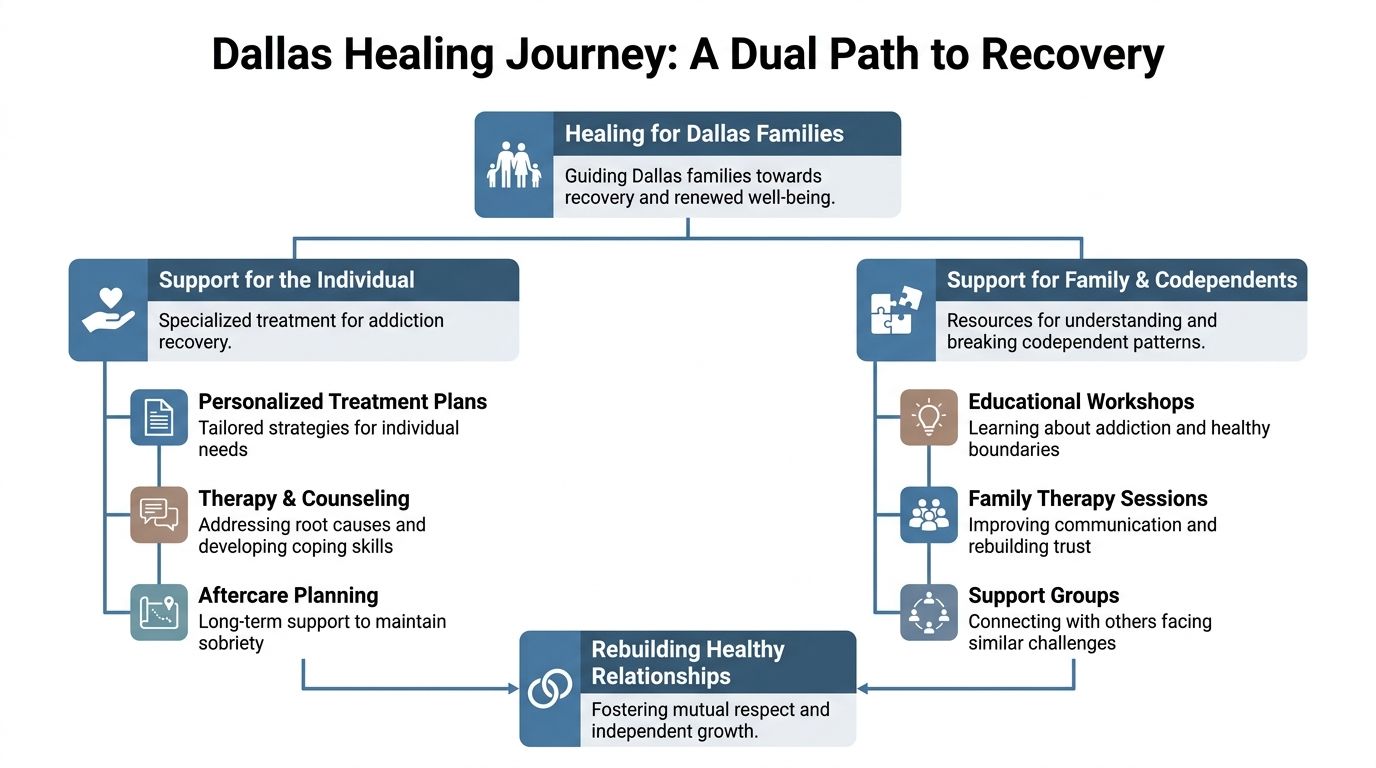
Support for the person with addiction
A person actively using alcohol, opioids, fentanyl, methamphetamine, cocaine, heroin, or misused prescription drugs may first need a medically supervised detox. This is especially important when withdrawal could be intense, unpredictable, or dangerous.
From there, care may include:
- Inpatient rehab: Helpful when the home environment is unstable or relapse risk is high.
- Outpatient treatment: Useful when someone has a stable living situation and can participate consistently.
- Medication-assisted treatment: Appropriate for some opioid, alcohol, or prescription pill cases.
- Dual diagnosis care: Important when substance use is intertwined with depression, anxiety, bipolar disorder, or other mental health concerns.
- Aftercare planning: Continued therapy, relapse-prevention work, and sober living referrals when needed.
Family involvement often matters here. This overview of family therapy for substance abuse shows why treatment outcomes improve when the household learns new ways to communicate and respond.
Support for the family and codependent partner
The family’s recovery path looks different, but it is just as important.
A spouse or parent dealing with codependency with an addict may benefit from:
- Individual therapy: To work on guilt, trauma responses, self-esteem, and boundary follow-through.
- Family counseling: To replace blame, rescuing, and secrecy with honest communication.
- Support groups: To reduce isolation and learn from others facing similar patterns.
- Psychoeducation: To understand addiction as a clinical issue without excusing harmful behavior.
- Practical planning: Budget protection, child safety planning, transportation limits, and crisis response decisions made ahead of time.
Some families also need help with logistics. That may include insurance verification, choosing between inpatient and outpatient care, or deciding what role the household should play during detox and discharge.
Practical note: The healthiest plan is usually the one that treats addiction clinically and treats codependency relationally.
For Dallas, Fort Worth, Euless, Grapevine, Irving, and surrounding areas, local access matters. Families are more likely to stay involved when treatment, counseling, and aftercare are realistic to attend. Recovery becomes stronger when the plan fits real life rather than sounding good only on paper.
Take the First Step Toward a Healthier Future
Codependency with an addict can make a capable, caring person feel powerless. Days start revolving around monitoring, rescuing, explaining, and recovering from the latest crisis. Over time, that pattern can feel permanent.
It is not permanent.
Codependency is learned. That means it can also be unlearned. A family can stop protecting addiction, start setting limits, and begin building a different kind of relationship. The person with addiction may still need to choose treatment, but the family does not have to keep living by the same exhausting rules.
For many Dallas families, the first healthy change is small. One honest conversation. One firm refusal to send money. One call to ask what detox involves. One decision to get support instead of waiting for the next emergency.
Hope becomes more real when it turns into action.
Families that are still trying to persuade a loved one to accept care may also benefit from this guidance on how to convince someone to go to rehab. A thoughtful approach often works better than pleading, lecturing, or reacting in panic.
The goal is not to become harder. The goal is to become clearer, steadier, and safer. That change can protect the whole household and create better conditions for real recovery.
Frequently Asked Questions About Codependency and Addiction
Can codependency be cured
Codependency is better understood as a pattern of thinking, feeling, and relating that can be changed. Many people continue improving over time through therapy, support groups, family counseling, and repeated practice with boundaries.
The most important shift is this. The person stops measuring love by rescue and starts measuring it by honesty, responsibility, and safety.
What if the addict refuses help
A refusal does not mean the family has to keep living in chaos.
If treatment is refused, the family can still act. That may mean ending financial support, changing living arrangements, protecting children, refusing to argue with intoxication, or seeking counseling for personal recovery. A loved one may reject treatment, but they cannot control whether others keep participating in the cycle.
Is setting boundaries selfish
No. In families affected by addiction, boundaries are often one of the most responsible forms of care.
A boundary says, “The addiction will not be made easier here.” It also says, “The family’s safety and stability matter too.” That is not cruelty. It is reality-based love.
Can a family support recovery without enabling
Yes. Supportive actions usually increase accountability instead of reducing it.
Examples include offering rides to treatment, attending family sessions, encouraging sober living arrangements when appropriate, helping verify insurance, or participating in discharge planning. Those actions support recovery without shielding substance use from consequences.
When is detox medically necessary
Detox becomes especially important when a person has been using heavily, has repeated relapses, experiences withdrawal symptoms, mixes substances, or has co-occurring mental health symptoms that complicate early sobriety. Alcohol, opioids, and sedatives can create serious withdrawal concerns, and a medically supervised setting can help manage those risks.
Families should take urgent symptoms seriously. If a person is confused, medically unstable, threatening self-harm, or in immediate danger, emergency evaluation may be necessary.
What should a partner do during early recovery
A partner should focus on consistency, not intensity.
That usually means keeping boundaries simple, avoiding detective work, attending family therapy when offered, not taking over treatment tasks the recovering person can do, and getting personal support. Early recovery is a time for structure. It is not a time to go back to old rescue patterns because everyone feels fragile.
If a family in Dallas is dealing with codependency, relapse, or uncertainty about detox, Tru Dallas Detox & Recovery Center offers confidential support for both the individual struggling with addiction and the loved ones affected by it. The team can help families understand treatment options, verify PPO insurance, and take the next step toward medically supervised detox, rehab, and a healthier path forward.
