

The first step in staging an intervention is often the hardest: admitting to yourself that your loved one's substance use has become a crisis. It's the moment you move past hope and denial and decide to create a clear, compassionate plan because you can no longer watch their life, health, and relationships fall apart.
Key Takeaways
- Recognize the Signs: An intervention is needed when you see a consistent pattern of destructive behavior, such as isolation, neglect of responsibilities, and deteriorating health.
- A Structured Approach Works: Unlike spontaneous arguments, a planned intervention presents a calm, unified message of concern that is proven to be more effective at breaking through denial.
- Assemble a Calm, Unified Team: Choose 4-8 close family members and friends who can speak from a place of love and remain calm under pressure.
- Consider a Professional: Hiring a trained interventionist significantly increases the chances of a successful outcome by providing expert guidance and de-escalation.
- Have a Plan B: If the person refuses help, the intervention isn't a failure. The next step is to consistently enforce the loving boundaries you've all agreed upon.
Knowing When an Intervention Is the Right Path
Deciding to hold an intervention is one of the most difficult, and most loving, choices a family can make. You get to this point when the informal pleas, the late-night arguments, and the heartfelt talks have all failed to make a difference. The situation has simply become unsustainable.
This isn't about starting a fight. It's about creating a structured opportunity for change when your loved one is lost in the fog of addiction and can no longer see how serious things have become. The entire goal is to build a bridge to recovery, not a platform for blame.

The need for a formal intervention usually becomes undeniable when you see a consistent pattern of destructive behavior and a long line of broken promises. It’s less about one single incident and more about the accumulation of red flags that you can no longer ignore.
- Growing Isolation: Have they started pulling away from family gatherings? Do they avoid friends they used to be close with or drop hobbies they once loved? This kind of withdrawal is often a way to hide the true extent of their substance use.
- Neglecting Responsibilities: Maybe you've noticed their performance at work has tanked, bills are piling up, or they've started blowing off commitments that used to be important to them.
- Deteriorating Health: The physical toll can be obvious. Things like drastic weight changes, a decline in personal hygiene, or seeming to be sick all the time can be direct results of substance misuse. You can learn more about the top signs you or a loved one may need medical detox in our detailed guide.
Why a Structured Approach Works
Think about the spontaneous confrontations you've likely already had—they probably ended in anger, tears, and even deeper denial. A planned intervention is different. It’s a structured, unified message of love and concern from the people who matter most.
Its power comes from showing the person that everyone they trust and respect shares the same worries and the same hope for their future. Seeing that united front can be the one thing that finally breaks through the wall of denial that addiction builds.
An intervention is a carefully orchestrated event designed to break through denial and present a clear choice: accept help or face predefined consequences. It shifts the dynamic from chaotic arguments to a calm, focused conversation about reality.
The data backs this up. When done correctly, interventions for substance use disorders have a remarkable track record. Some studies show that family-led interventions can increase the chances of someone entering treatment by up to 70-80% compared to doing nothing at all.
In the United States, 48.5 million people aged 12 or older had a substance use disorder in the past year, yet only a small fraction ever got the treatment they needed. That gap is precisely where a well-executed intervention can make all the difference. Discover more insights on substance misuse treatment statistics.
Building Your Support Team and Planning for Success
A successful intervention is never a spur-of-the-moment confrontation. It's a carefully orchestrated event, one that’s built on a foundation of love, unified purpose, and a crystal-clear plan. The very first move is to assemble the right group of people—a team that can deliver a powerful message of concern and hope. This team is the heart of the intervention, and who you choose can genuinely shape the outcome.

Think of this group as a circle of trust. From experience, the ideal size is somewhere between four and eight people. That’s enough to present a strong, united front but not so large that your loved one feels ambushed or completely overwhelmed.
Choosing Who to Involve
Selecting the participants requires some serious thought. Every single person in that room needs to have a strong, positive relationship with your loved one and be able to speak calmly, from a place of genuine care.
Your team should be made up of people who:
- Have a close relationship: This means immediate family, trusted friends, or respected mentors—people whose opinions your loved one actually values.
- Can remain calm under pressure: Let’s be realistic, emotions will be running high. Your team members have to be able to stick to the script without getting drawn into arguments or becoming overly emotional themselves.
- Have witnessed the addiction's impact: People who have direct, firsthand experience can provide the specific, undeniable examples needed to help break through denial.
Knowing who not to invite is just as critical. To protect the integrity and focus of the intervention, it's best to leave out anyone who has unresolved conflicts with your loved one, is struggling with their own unmanaged substance use, or tends to fly off the handle. Their presence can easily derail the entire conversation. The family dynamic itself is a huge factor, which is why understanding the role of family therapy for substance abuse can offer powerful context for healing together.
The Crucial Role of a Professional Interventionist
While you can certainly stage an intervention with only family and friends, bringing in a professional interventionist dramatically increases the chances of a positive outcome. These specialists aren't just moderators; they are trained guides who bring deep expertise in addiction, psychology, and conflict de-escalation.
An interventionist's job is to:
- Help your family prepare both emotionally and logistically for the day.
- Educate the entire team on the nature of addiction and what to expect.
- Keep the meeting on track and expertly manage the difficult emotional reactions that will likely come up.
- Facilitate a smooth, immediate transition into a pre-arranged treatment program.
Hiring an interventionist isn't a sign of weakness—it's a strategic decision. It’s about ensuring the process is as safe, calm, and effective as it can possibly be. Their neutrality and experience are priceless when emotions are high and the stakes are even higher.
Setting the Stage for a Productive Conversation
The nuts and bolts—the logistics—are a critical piece of the puzzle. The environment and timing you choose can either encourage a calm discussion or create immediate tension and resistance.
Select a Neutral and Private Location. The meeting needs to happen in a space where your loved one feels safe but not trapped. A family home might work, but a neutral setting like a therapist’s office is often a better choice. Whatever you do, avoid public places.
Choose the Right Time. Plan the intervention for a time when your loved one is most likely to be sober and clear-headed. Early morning is often the best bet. Surprise is also a key element; they shouldn't know about the meeting beforehand. This prevents them from building up their defenses or simply refusing to show up. With a solid team and a thoughtful plan, you create the best possible opportunity for them to finally accept the help they so desperately need.
Getting Your Message Across: What to Say and How to Say It
The real strength of an intervention isn't about confrontation. It’s about creating a unified front of unwavering love and genuine concern. You’re not there to read off a list of everything they’ve done wrong; you’re there to share a message so full of love and truth that it can finally break through the denial.
The best way to do this is through carefully written letters, which each person on the team will read aloud. These letters are the heart of the intervention. They provide structure and turn what could be a chaotic, emotional argument into a calm, compassionate conversation. The whole point is to help your loved one see their reality through the eyes of the people who matter most.
The Power of “I” Statements
This is probably the single most important rule when you sit down to write: avoid blame at all costs. Language filled with judgment and accusations will backfire immediately.
Starting sentences with "You…"—like "You always make me worry" or "You are destroying your family"—is a surefire way to make someone defensive and completely shut down. They'll stop listening before you even get to the point.
Instead, you need to use "I" statements. This simple change flips the script. It moves the focus from their behavior to your experience. You're not attacking them; you're sharing how their substance use has personally impacted you. This is the foundation of staging an intervention that feels supportive, not like an ambush.
An "I" statement is powerful because it's your truth. When you say, "I feel scared when I can't reach you," you're stating a fact about your own feelings. No one can argue with how you feel. This keeps the conversation grounded and focused on connection, not accusation.
It's helpful to see the difference side-by-side. Notice how the "ineffective" examples feel like an attack, while the "effective" ones open the door for a real conversation.
Effective vs Ineffective Intervention Language
| Ineffective Language (Blaming) | Effective Language (Using 'I' Statements) |
|---|---|
| "You are so selfish for missing the family dinner." | "I felt really hurt and disappointed when you didn't show up for dinner last night." |
| "You can't keep a job because of your drinking." | "I am worried about your future when I see you struggling with work." |
| "You're ruining your health." | "I am scared for your health, and it's painful for me to watch." |
| "Why do you always lie to me?" | "When I find out you haven't been honest with me, I feel betrayed and it's hard for me to trust you." |
Using "I" statements isn't a trick; it's a way to communicate honestly and lovingly, making it much more likely your loved one will actually hear you.
How to Structure Your Intervention Letter
Your letter should be short, heartfelt, and straight to the point. Stick to a simple framework to make sure your message is clear and powerful.
-
Start with Love. Don't jump straight into the problem. Begin by reminding them how much you love them. Share a happy memory or talk about a quality you’ve always admired. This sets a caring tone right from the start.
-
Share Your Concern with a Specific Example. This is crucial. Don't just say, "You drink too much." That’s too general and easy to deny. Instead, use a concrete, fact-based example. "Last Tuesday, when you were supposed to pick the kids up, I couldn't reach you for hours. I felt terrified and so alone."
-
Express Your Hope for Their Future. Talk about what you want for them. Share your dream of seeing them healthy, happy, and fully present in your life again. Paint a picture of the future you believe is possible.
-
State Your Boundary. This is the tough part. You have to lovingly but firmly state the consequence you've all agreed on if they refuse help. For example, "Because I love you so much, I can't keep enabling this. If you choose not to go to treatment today, I will no longer be able to give you money."
Don’t Skip the Rehearsal
Writing the letters is only the first step. One of the most critical, and most often overlooked, parts of the process is rehearsing them together as a team. This isn't about memorizing lines; it's about getting prepared emotionally.
Reading your letter out loud, in front of the others, does a few things. It helps you work through your own emotions, catch any phrases that might sound harsher than you intended, and practice staying calm. Even more importantly, it makes sure everyone is on the same page, delivering a consistent message of love and support. It builds the team’s confidence and prevents mixed signals on the actual day.
Conducting the Intervention: The Day of the Event
You've done all the hard work. The planning, the late-night phone calls, the gut-wrenching process of writing your letters—it all comes down to this day. This is the moment your carefully laid plans meet the raw, unpredictable reality of the situation. Your one and only goal now is to see that plan through with as much calm and compassion as you can muster.
Getting your loved one to the intervention spot without tipping them off is often the first hurdle. The key is to keep it simple and believable. Maybe it’s a family meeting about an upcoming birthday, or a friend who needs to talk about something important. Whatever the story, make sure everyone on the team knows it and sticks to it.

The second they walk in and see everyone, the air in the room will change. Expect shock, maybe confusion, and almost certainly fear. This is where you have to hold your ground. Stay calm and remember why you're all there. If you've hired a professional interventionist, they will step in now, creating a safe, respectful space to begin the conversation you’ve all rehearsed.
Managing the Inevitable Pushback
No matter how much love is in the room, you have to be ready for resistance. Addiction is a disease that protects itself with powerful defense mechanisms, and you are confronting it head-on. The most common reactions you'll face are denial, anger, and bargaining.
- Denial: You'll hear things like, "It's not that bad," or the classic, "I can stop anytime I want." This isn't the time for an argument. Your job is to calmly read the letters you wrote—the ones filled with specific, factual examples that gently but firmly dismantle those denials.
- Anger: Lashing out is a classic deflection tactic. Your loved one might try to blame everyone else, dredge up old family fights, or get personal. Do not take the bait. The entire team's job is to stay focused and refuse to get sidetracked. Stick to your letters and the purpose of the meeting.
- Bargaining: This sounds like, "Okay, I'll cut back, I promise," or "Just give me one more chance to do this on my own." Your response has to be unified: you've all been down that road before. The only path forward today is the professional help you have already arranged.
The real secret to handling these reactions is expecting them. When you've already talked through how you'll respond to anger or denial, you're far less likely to get rattled in the moment. Your calm, united front is your greatest strength.
Staging an intervention is all about timing and having the right expertise on your side. In fact, a major meta-analysis found that professionally guided interventions increase the odds of someone entering treatment by 60% compared to families trying to go it alone. Other research is even more compelling, showing an 85% higher success rate when a professional is involved, especially when a facility with 24/7 admissions is lined up and ready. You can learn more about the impact of professional intervention support and see why it makes such a difference.
The Art of Setting Firm Boundaries
This is it. This is the hardest—and most important—part of the day. After everyone has shared their letter, it's time to state the consequences. You have to clearly explain the boundaries you will enforce if they refuse the offer of treatment.
These are not threats. They are not punishments. They are acts of self-preservation and profound love, designed to stop the cycle of enabling and protect your own well-being. Every boundary must be something you are fully prepared to follow through on.
Here are some real-world examples of firm, loving boundaries:
- "If you choose not to go to treatment today, I can no longer give you money or help you with your bills."
- "I love you, but for my own health, I can't let you live in my home if you aren't actively in a recovery program."
- "It's too painful for me to talk to you when you're using, so I won't be able to answer your calls if you're not sober."
When you state these boundaries, your tone should be one of sorrow, not anger. The underlying message has to be, "I am doing this because I love you too much to keep watching this happen, not because I want to hurt you."
This is how you close every other door, leaving the bridge to recovery as the only clear and supported path forward. Your collective commitment to upholding these boundaries is what gives the intervention its power.
Life After the Intervention: Healing for the Whole Family
When you hear a "yes," the relief is overwhelming. But that moment isn't the finish line. It's the starting gun for the real journey—for your loved one and for everyone who loves them. The next few hours are absolutely critical.
This is why you have everything ready to go beforehand. The bags are packed, the car is waiting, and the treatment center knows you're on your way. You have to get them there immediately. There can't be any "one last time" or second thoughts. That immediate action closes the door on the addiction and opens the first one to recovery.
The Family's Recovery Begins Now
Once your loved one is safely checked into treatment, it's time to turn the focus inward. Addiction is a family disease, not because of blame, but because of its impact. It rewires relationships, creates unhealthy dynamics, and leaves a trail of hurt. Everyone has been affected, and everyone needs their own path to healing.
This is where you lean into the support systems you've hopefully already identified. Treatment centers often provide family therapy, which is an incredible resource. It gives you a safe, mediated space to start unpacking the hurt, mistrust, and codependent habits that have likely built up over years.
Addiction forces families into unhealthy roles and communication patterns. True recovery means everyone learns new ways to interact, set boundaries, and offer support that doesn't slide back into enabling. This is a team effort.
You also need support from people who just get it. Groups like Al-Anon or Nar-Anon are filled with people who have walked in your shoes. Sharing your story with them and hearing theirs is a powerful reminder that you aren't alone and can give you practical tools for navigating your own recovery.
Holding Firm on Your New Healthy Boundaries
Remember the boundaries you set during the intervention? They weren't just a tactic for that one conversation. They are the new foundation for your relationship, and holding onto them is everything—both while your loved one is away and when they return.
Sticking to these boundaries shows you're serious about this new chapter. It's a powerful, loving message that you will no longer participate in the old, destructive patterns. It’s not about punishment; it’s about protecting your own well-being and modeling what a healthy, recovery-focused life looks like. For more specific advice, our guide on how to support someone in recovery is a great resource for this next phase.
The data backs this up. Family involvement is a game-changer. Landmark studies have found that interventions incorporating family support can cut relapse rates by a staggering 40%. When families truly engage in the recovery process alongside their loved one, the odds of long-term success more than double.
What to Do If They Say "No"
Of course, you might not get the "yes" you were hoping for. If your loved one refuses help, it's heartbreaking. But it is not a failure. It simply means the next—and hardest—part of your plan begins now: enforcing your consequences.
This is where your resolve will be tested. You have to follow through, calmly and with love. This isn’t about punishing them; it’s about letting them feel the natural consequences of their addiction. For many, this is the only thing that will create the motivation to finally accept help. You always leave the door open, reminding them that treatment is on the table the second they are ready, but you cannot waiver on the boundaries you've set.
Your Action Plan for a Successful Intervention
Staging an intervention is an overwhelming and emotional process, there's no doubt about it. But success often comes down to just a few core principles. Think of this as your quick reference guide—a way to stay focused and grounded as you navigate this difficult but incredibly important journey.
Remember, getting your loved one to agree to help is just the first step. The real work starts immediately after.
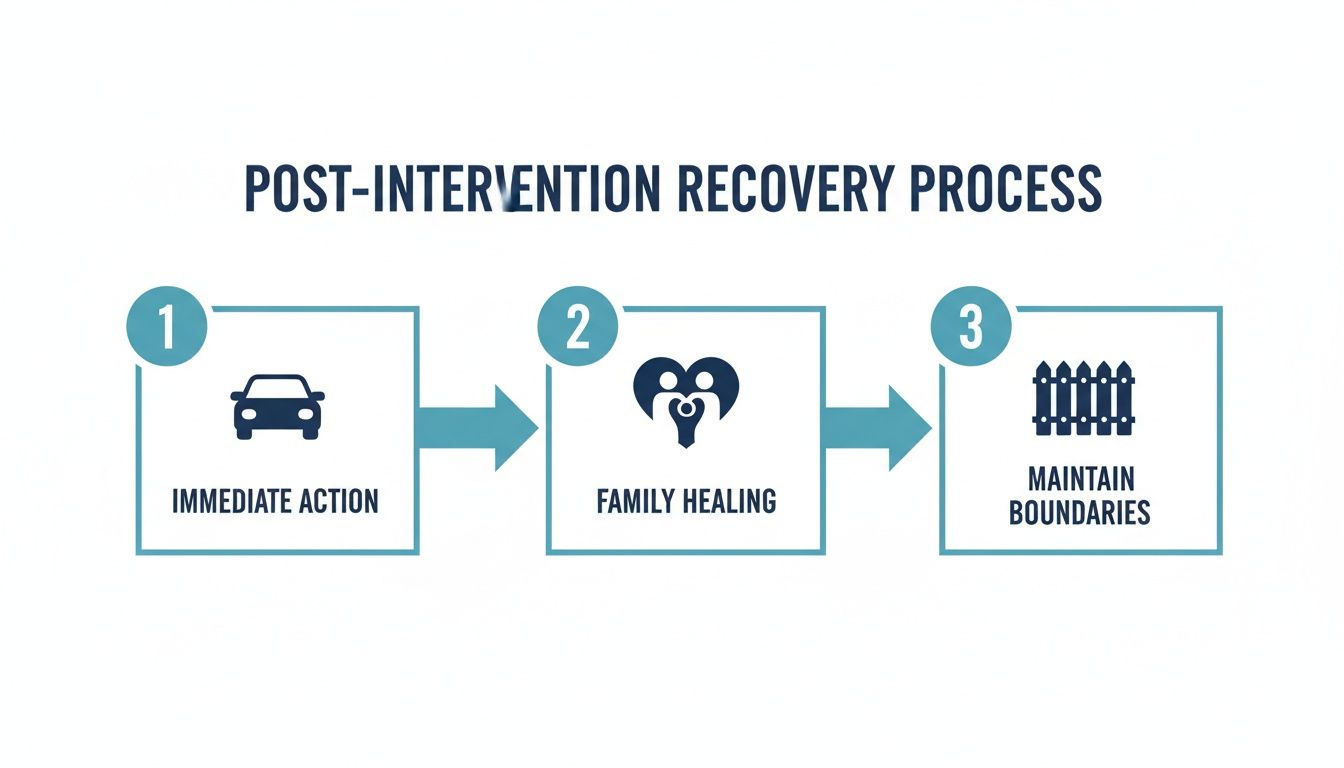
As you can see, the path forward involves immediate action, healing for the entire family, and a firm commitment to maintaining the new, healthy boundaries you’ve all agreed upon.
Core Principles for Success
-
Plan Meticulously: A successful intervention is never spontaneous. It’s the result of careful, detailed preparation—from choosing the right team and practicing what you’ll say to having a treatment plan lined up and ready to go.
-
Seek Professional Guidance: Bringing in an experienced interventionist is the single most important thing you can do. They provide structure, know how to manage high-stakes emotions, and can dramatically increase the likelihood that your loved one will accept help.
-
Lead with Love, Not Anger: This is crucial. Your message must be a unified voice of concern, not a chorus of accusations. Use "I" statements to express how you feel and share specific, fact-based examples of how the addiction has impacted you. This isn't about placing blame; it's about gently illuminating the reality of the situation.
The goal isn’t to win an argument; it’s to open a door. Every word you choose and every boundary you set should be a loving invitation for your loved one to walk through it.
-
Set Firm and Loving Boundaries: You have to be crystal clear about what will happen if they refuse treatment. These aren’t threats or punishments. They are protective actions you must be ready to enforce to stop the cycle of enabling.
-
Focus on Family Recovery: Addiction impacts everyone. This intervention is the beginning of a healing journey for the whole family, not just the person struggling. Commit to your own support through therapy or groups like Al-Anon. You can't pour from an empty cup.
Common Questions About Staging an Intervention
Even with the best-laid plans, you’re bound to have questions. Stepping into an intervention is a big deal, and it's completely normal to feel a mix of hope and anxiety. Let's tackle some of the most common and pressing concerns that come up for families.
What Happens if My Loved One Gets Angry and Walks Out?
This is probably the number one fear everyone has, and for good reason—it’s a real possibility. When a person feels cornered, their first instinct is often fight or flight. If they get angry and leave, the single most important thing your team can do is remain calm and stay put.
Do not chase them. Do not start arguing. That will only pour fuel on the fire.
A professional interventionist is trained for this exact moment. They know how to de-escalate tension and can often steer the conversation back before it reaches a breaking point. But if your loved one does walk out, the intervention isn't over. It just moves into its next phase: you must immediately begin enforcing the boundaries and consequences you all agreed upon. The spot at the pre-arranged treatment center is still waiting for them, and often, it's the reality of those consequences that finally makes them ready to accept help.
How Much Does a Professional Interventionist Cost?
The cost of bringing in a professional can vary quite a bit. You’ll see prices that range from a few thousand to over $10,000. Several factors come into play, like the interventionist's experience, where you're located, whether they need to travel, and just how complex your family situation is.
It’s a significant investment, no question. But you have to weigh that cost against the reality that professionally-led interventions have a much higher success rate. Their expertise in navigating such an emotional and volatile process is often what gets you a "yes" instead of a "no." For many families, that makes it a crucial and worthwhile expense.
Can We Stage an Intervention for Mental Health Issues?
Absolutely. The intervention model isn't just for substance abuse. It’s built on a foundation of love, clear communication, and firm boundaries, which can be adapted for a variety of crises. It's often used for severe depression, eating disorders, gambling addiction, and other serious mental health conditions.
The core principles are the same, but it's critical to work with an interventionist who specializes in the specific mental health challenge your loved one is facing. They'll have the right training to guide the conversation and will know how to connect you with the appropriate type of treatment facility.
How Do We Choose the Right Treatment Center?
Picking a treatment facility is one of the most important decisions you'll make. It can't be a last-minute choice; it needs to be guided by what your loved one actually needs to heal. At Tru Dallas, for example, we know that a personalized path to recovery is essential.
Here’s what to look for when you're researching options:
- Specialization: Does the center have a proven track record with your loved one's specific addiction (like alcohol or opioids)? Can they handle co-occurring mental health conditions like anxiety or depression?
- Accreditation: Make sure the facility is licensed and accredited by reputable organizations. This is your assurance of quality care and safety standards.
- Treatment Philosophy: Do they rely on evidence-based therapies? Crucially, do they offer programs like family therapy that will involve you in the healing process?
Your interventionist is an incredible resource here. They can provide trusted recommendations and help you coordinate a smooth, immediate admission.
Frequently Asked Questions (FAQ)
What if I'm not sure the problem is serious enough for an intervention?
If you find yourself constantly worried, have seen them engage in dangerous behavior, or can point to a clear pattern of negative consequences in their life (and yours), it's serious enough. Trust your gut. Waiting for some dramatic "rock-bottom" moment can be incredibly dangerous.
How long should my intervention letter be?
Keep it brief. You should be able to read it in just a few minutes, so aim for one page at most. The goal is a clear, powerful message that doesn't overwhelm them with too much information.
What happens when they come home from treatment?
The transition home is a high-risk time. A solid aftercare plan is essential. This should be arranged before they are discharged and might include things like ongoing therapy, mandatory 12-step meetings (AA/NA), or even a stay in a sober living home to ease the transition. Your healthy boundaries will be more important than ever.
How can we rebuild trust after an intervention?
Trust isn't rebuilt overnight. It's earned back, one consistent, honest action at a time. It requires tremendous patience from the family and a real commitment to change from your loved one. Family therapy is the perfect setting to start navigating this complex process.
Is it ever too late to stage an intervention?
No. As long as someone is alive, there is hope. It is never too late to offer a structured, loving path to help, no matter their age or how long addiction has been a part of their life.